
Rhodes Travel Guide — Knights, Beaches & the Old Town That Never Fell Quiet
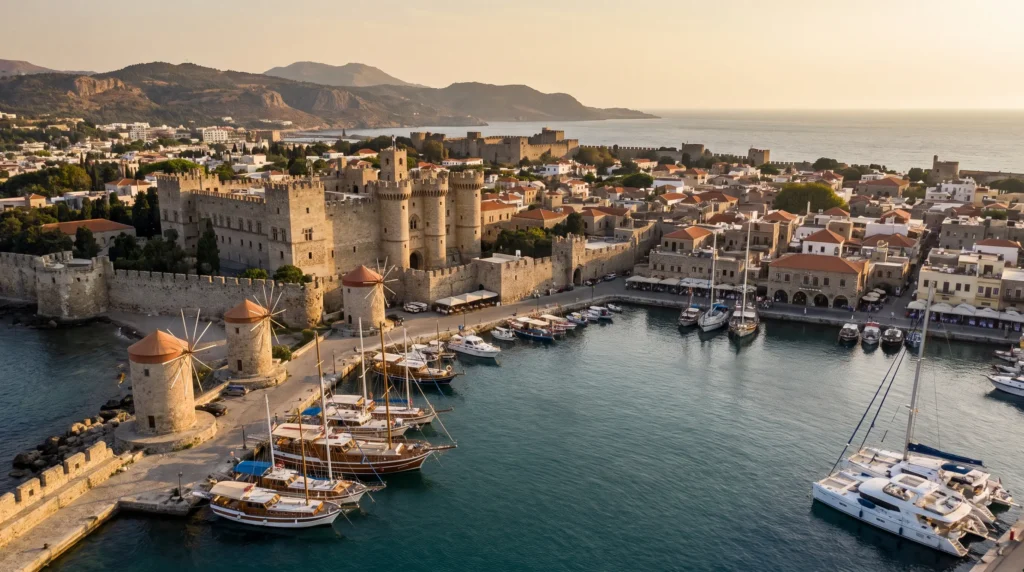
I still remember the first time I walked through the Sea Gate into Rhodes Old Town at nine at night — cobblestones underfoot, cannonballs stacked against the ramparts, and a moat that once kept the Ottomans out now growing citrus trees. Rhodes plays a strange trick on visitors: it looks like a beach island from the brochure, then hands you a walled medieval city so complete that UNESCO calls it one of the best-preserved Gothic towns in Europe. This is the largest of the Dodecanese islands, sitting closer to the Turkish coast than to Athens, and it has been fought over by Greeks, Romans, Byzantines, the Knights of St John, Ottomans and Italians — every one of them left something behind. The catch: July and August turn the Old Town into a cruise-ship crush by midday, and the island’s fame means prices climb fast in peak season. Time it right, though, and you get ancient ruins, a working medieval fortress city, and some of the Aegean’s best beaches inside one manageable island.
In This Guide
- Overview — Why Rhodes Is the Aegean’s Fortress Island
- The Medieval Rose Festival — Knights Return to the Old Town
- Best Time to Visit Rhodes (Season by Season)
- Getting There — RHO Airport & Ferries
- Getting Around Rhodes Town & the Island
- Neighborhoods — Old Town, New Town & Beyond
- Culture & People — Knights, Ottomans & Italians
- A Food Lover’s Guide to Rhodes
- Off the Beaten Path
- Day Trips From Rhodes
- Practical Information
- Budget Breakdown — What Rhodes Actually Costs in 2026
- Frequently Asked Questions
Overview — Why Rhodes Is the Aegean’s Fortress Island
Rhodes is the largest island in the Dodecanese chain, closer to the Turkish coast — about 18 kilometres away at the narrowest point — than to mainland Greece, which sits roughly 363 kilometres to the northwest. That position made it a prize for millennia: ancient Rhodes was wealthy enough to build the Colossus of Rhodes, a 33-metre bronze statue of the sun god Helios and one of the Seven Wonders of the Ancient World, completed around 280 BC and toppled by an earthquake just over half a century later.
The island’s defining chapter came later. The Knights Hospitaller of St John ruled Rhodes from roughly 1310 to 1522, fortifying the city into the walled stronghold that still stands today, before the Ottomans took over for nearly four centuries and Italy occupied the island from 1912 until Rhodes joined Greece in 1947. Layer all of that into one small city and you get the Medieval City of Rhodes, inscribed as a UNESCO World Heritage Site in 1988 for its Gothic Upper Town and Ottoman-era Lower Town standing side by side.
Outside the walls, Rhodes stretches into pine-forested hills, working vineyards, and a coastline that flips from package-tourism strips in the north to quiet fishing villages in the south. It is not an undiscovered secret — Rhodes ranks among Europe’s most visited islands — but the crowds mostly pool in a handful of hotspots, leaving plenty of room to find your own version of it.
The Medieval Rose Festival — Knights Return to the Old Town
Time a late-May or early-June trip around the Medieval Rose Festival, an annual re-enactment first organized in 2006 that turns the Old Town into a working 15th-century city for several days. Knights in armor stage jousting tournaments and sword displays, archers compete in the moat, jugglers and stilt-walkers work the lanes, and wooden stalls sell traditional food and handicrafts against the backdrop of the actual fortress the festival is imagining.
It is free to wander and watch, family-friendly, and one of the few times the Old Town’s theatrical history stops being a plaque you read and becomes something happening in front of you. Book Old Town accommodation early if your dates overlap — this is also the start of the island’s shoulder-season sweet spot, so rooms move fast.
Best Time to Visit Rhodes (Season by Season)
Late April – June · Spring shoulder (best value)
Wildflowers, mild seas warming up, the Medieval Rose Festival, and noticeably thinner crowds than summer. Some beach bars and rural tavernas are still opening for the season in April, so call ahead outside Rhodes Town.
July – August · Peak summer (hottest & busiest)
Reliable sun, warm sea, and the fullest Old Town you will ever see — cruise-ship day-trippers stack up around Palace of the Grand Master and the Street of the Knights by late morning. Lindos in particular holds the record for the highest mean monthly temperature ever recorded in Europe, set in August 2021, so plan around midday heat.
September – October · Autumn shoulder (second-best value)
Sea temperatures peak in early autumn even as air temperatures ease, harvest festivals fill inland villages, and hotel rates soften. This is many repeat visitors’ favorite window.
November – March · Off-season
Many beach hotels and island restaurants close entirely; Rhodes Town itself stays open year-round with a quieter, more local rhythm, mild but rainier weather, and the lowest prices of the year.
Getting There — RHO Airport & Ferries
Diagoras International Airport (RHO) sits about 14 kilometres southwest of Rhodes Town, roughly 20–25 minutes by taxi or bus. Domestic flights connect year-round to Athens (about an hour) and Thessaloniki, while direct seasonal charters and scheduled flights link Rhodes to dozens of European cities April through October — this seasonal charter network is often the cheapest and most direct way in from the UK, Germany, and Scandinavia.
By sea, overnight and day ferries run from Piraeus (Athens’ port) to Rhodes, typically 12–18 hours depending on the route and stops through other Dodecanese islands such as Kos and Symi. Faster catamarans cut the Athens run to roughly 8–9 hours in summer. Rhodes also has ferry and hydrofoil links to nearby Turkish ports — Marmaris and Fethiye — a genuinely quick way to combine a Greek-island trip with a Turkey side trip.
Getting Around Rhodes Town & the Island
Rhodes Old Town is entirely walkable and largely car-free inside the walls — cobblestones and pedestrian lanes are the point, so leave the suitcase-with-wheels at home and pack something with soles that grip. The New Town, just outside the walls, is an easy walk or short taxi ride from the Old Town’s main gates.
For the rest of the island, KTEL public buses run from Rhodes Town to Lindos, Faliraki, and most coastal towns on reasonably frequent, cheap schedules, though service thins out in the off-season and doesn’t reach every village. Rental cars (roughly €35–55/day in peak season) and scooters give the most freedom for exploring inland villages, Prophet Elias forest, and Monolithos Castle at your own pace — just budget for narrow mountain roads and remember Greece has one of Europe’s higher traffic fatality rates, so drive cautiously. Taxis and organized day-tour buses cover Lindos and the south comfortably if you’d rather not drive.
Neighborhoods — Old Town, New Town & Beyond
The Old Town (Medieval City)
The walled UNESCO core and the reason most people come. The Upper Town holds the Palace of the Grand Master and the Street of the Knights, a cobbled Gothic corridor lined with the former lodgings (“inns”) of the Knights Hospitaller’s national divisions; the Lower Town mixes Ottoman-era mosques, hammams, and minarets with tavernas and shops. Stay inside the walls for atmosphere at night after the day-trippers clear out — it is a different, much quieter place after 8pm.
Mandraki Harbour & New Town
Rhodes Town’s modern waterfront, where the Colossus of Rhodes is traditionally said to have straddled the harbor entrance (historians now doubt the exact spot, but the twin deer statues marking it are a popular photo stop regardless). The New Town has the marina, ferry terminal, shopping streets, and most of the city’s nightlife.
Lindos
A whitewashed village about 40 kilometres south of Rhodes Town, built around a dramatic acropolis with a Doric Temple of Athena Lindia dating to roughly 300 BC. It is Rhodes’ most-photographed spot and, by midday in summer, its most crowded — arrive at opening time or come for a sunset stroll instead.
Faliraki
The island’s package-tourism and nightlife hub on the east coast: long sandy beach, water parks, and a strip built for beach clubs and late nights. Good if that’s what you want, worth skipping if it isn’t.
Prasonisi
The island’s southern tip, where two beaches meet at a sandy spit and the wind funnels through hard enough to have made it one of the Mediterranean’s best-known windsurfing and kitesurfing spots.
The West Coast (Kremasti to Monolithos)
Windier, less developed beaches, the ruined Knights’ castle at Monolithos perched on a cliff, and villages that see a fraction of the east coast’s tourist traffic.
The Interior — Archangelos, Embonas & Profitis Ilias
Rhodes’ inland side: hill villages, vineyards around Embonas producing the island’s wine, and pine forest hiking around Profitis Ilias and Mount Attavyros, the island’s highest peak.
Culture & People — Knights, Ottomans & Italians
Rhodes’ culture is layered rather than singular. Greek Orthodox Christianity and the Greek language anchor daily life, but the built environment carries Crusader Gothic churches turned into mosques under the Ottomans, then restored and rebuilt again under Italian rule between 1912 and 1947 — the Italians left grand administrative buildings around Mandraki that still define the New Town’s skyline.
Rhodes’ historic Jewish community, centered on the Old Town’s Jewish Quarter around the Kahal Shalom Synagogue, was nearly destroyed in the Holocaust; the synagogue and its small museum remain open and are a sobering, worthwhile stop alongside the fortress sightseeing. Village life inland still runs on older rhythms — name-day feasts, church panigyria (festivals) with live music and dancing, and, in wine country around Embonas, harvest celebrations each autumn.
A Food Lover’s Guide to Rhodes
Rhodian tables lean into what the island and surrounding sea produce: grilled octopus and fresh-caught fish, pitaroudia (chickpea fritters, the island’s answer to falafel), and melekouni, a sesame-honey sweet traditionally served at weddings and christenings. Standard Greek staples — moussaka, souvlaki, horiatiki (Greek salad), tzatziki, and fresh dolmades — are everywhere and everywhere decent, but the better meals tend to be a short walk from the main tourist strips.
Embonas and the surrounding hill villages produce Rhodes’ own wine, including local varieties like Athiri; look for it by the carafe in village tavernas rather than by the bottle in Old Town restaurants. For something to bring home, honey from the island’s pine forests and small-batch olive oil travel well, and a jar of melekouni makes a better souvenir than another magnet.
Off the Beaten Path
Petaloudes (Butterfly Valley)
A shaded gorge in the island’s interior that fills with Jersey tiger moths every summer, drawn by the resin of the valley’s storax trees — walk the wooden boardwalks in the cool of morning, before tour buses arrive.
Monolithos Castle
A ruined Knights’ castle balanced on a sheer rock outcrop on the wilder west coast, with a chapel inside and a view down to the sea that most visitors to Rhodes never see.
The Acropolis of Rhodes
A hillside site above the modern town with a restored ancient stadium and the remains of a Temple of Apollo — genuinely ancient ruins a ten-minute walk from the medieval walls, and usually close to empty.
Prasonisi at Shoulder Season
Skip the July windsurfing crowds and visit the sandbar spit in May or October, when the wind is gentler and you can walk the exposed strip between the calm and rough sides of the sea alone.
Day Trips From Rhodes
Symi. A short ferry hop north to a candy-colored neoclassical harbor town, popular as a day-boat excursion from Rhodes Town and one of the most photogenic islands in the Dodecanese.
Marmaris or Fethiye, Turkey. Given Rhodes sits only about 18 kilometres from the Turkish coast, hydrofoils and ferries run regularly to these Turkish resort towns — bring your passport and check current visa requirements before booking, since this is a border crossing even though the boat ride is short.
Halki. A tiny, near-traffic-free island reachable by ferry from Rhodes’ western port of Skala Kamirou, popular for its stillness rather than any single sight.
Kamiros. The ancient Doric city on Rhodes’ own west coast — less visited than Lindos’ acropolis but a genuinely substantial archaeological site, easily combined with a west-coast beach day.
Practical Information
Money. Greece uses the euro. Cards are widely accepted in Rhodes Town, Lindos, and hotels; carry small euro amounts for village tavernas, buses, and beach bars that prefer cash.
Safety. The US State Department rates Greece at Level 1, “Exercise Normal Precautions” — the most relaxed tier — with petty crime like pickpocketing at tourist sites the main practical concern, plus occasional wildfire risk in the drier months and a notably high road-traffic fatality rate. Rhodes itself is a low-crime, tourist-friendly island; drive defensively and watch belongings in the busiest Old Town lanes.
Health. No special vaccinations are required for Greece beyond staying current on routine shots; the CDC notes hepatitis A as worth considering if you’ll eat a lot of street food or visit rural areas, and recommends standard mosquito/tick precautions. Tap water in Rhodes Town is generally fine; bottled water is cheap and widely available if you’d rather not risk it in rural areas.
Visa & entry. Greece is a full Schengen Area and EU member; US, UK, Canadian, and Australian passport holders currently enter visa-free for up to 90 days in any 180-day period. The EU’s new ETIAS travel-authorization system is expected to roll out later in 2026 for visa-exempt travelers — check the current requirement before you book, since timelines have shifted before.
Connectivity. An EU-roaming or regional eSIM covers the island well in towns; coverage thins in remote west-coast and mountain areas. Plugs: Type C/F, 230V. Time zone: EEST/EET (UTC+3 in summer, UTC+2 in winter).
Budget Breakdown — What Rhodes Actually Costs in 2026
Rhodes sits in the middle of the Greek-island price range — pricier than lesser-known Dodecanese neighbors, cheaper than Santorini or Mykonos in peak season.
Budget (US$60–100/day): Hostel or budget guesthouse outside the Old Town walls, gyros and taverna lunches, KTEL buses, free beaches and self-guided Old Town walking.
Mid-range (US$130–230/day): Boutique Old Town hotel or New Town mid-range stay, restaurant dinners with local wine, a rental car or scooter for a few days, entry tickets to the Palace of the Grand Master and Acropolis of Lindos.
Luxury (US$350+/day): Beachfront resort on the east coast, private boat day trip to Symi, a driver-guide for Lindos and the south, fine-dining tasting menus in Rhodes Town.
Fixed costs to expect: small entry fees at most archaeological sites and museums, and a modest overnight-stay tax added at check-in by many hotels. Tipping 5–10% is appreciated but not obligatory.
Planning Your First Trip to Rhodes
The classic first-timer split is fortress + beach: fly into RHO, spend two or three nights inside the Old Town walls (Palace of the Grand Master, Street of the Knights, Acropolis of Rhodes, a night at the Medieval Rose Festival if your dates line up), then base south in Lindos or on the east coast for three or four nights of beach time and a Symi day trip. Five nights covers the highlights without rushing; eight to ten lets you add the west coast and Prasonisi. Pair it with our Athens guide for the mainland leg most flights connect through, or continue island-hopping to Santorini for a very different, cliff-top Aegean look. Our full Greece guide covers how the islands fit together if this is your first trip to the country.
Frequently Asked Questions
Is Rhodes safe for tourists in 2026?
Yes — the US State Department rates Greece at its lowest advisory tier, “Exercise Normal Precautions.” The main real risks are petty theft in crowded Old Town lanes and Greece’s high road-traffic fatality rate if you’re driving — watch your bag, drive carefully, and check current advisories before you go.
Do I need a visa for Rhodes?
US, UK, Canadian, and Australian passport holders currently enter Greece and the wider Schengen Area visa-free for up to 90 days within any 180-day period. The EU’s ETIAS pre-travel authorization is expected to begin later in 2026 for visa-exempt visitors — verify the current requirement close to your travel dates.
How many days do you need in Rhodes?
Three days covers Rhodes Town and Lindos comfortably; five to seven lets you add west-coast villages, Prasonisi, and a Symi day trip without feeling rushed.
Rhodes or Santorini?
Choose Rhodes for a walkable medieval fortress city, layered history, and calmer beaches; choose Santorini for the caldera-cliff sunset views and volcanic-island scenery. Rhodes is generally the better-value, less crowded option outside of peak Old Town hours.
Is the Old Town walkable, or do I need a car?
The Old Town itself is entirely walkable and largely car-free. You’ll want a rental car, scooter, bus, or organized tour only to reach Lindos, the west coast, or the island’s interior.
What’s the cheapest way to see Lindos?
Take the KTEL public bus from Rhodes Town rather than an organized tour, arrive near opening time to beat the cruise-excursion crowds up to the acropolis, and eat lunch a street or two back from the main tourist strip.
Ready to Explore Rhodes?
A walled medieval city you can still sleep inside, an ancient wonder’s harbor to stand in, and beaches ranging from windsurfer-loud to village-quiet — all on one island small enough to circle in a day. Rhodes rewards showing up early to its famous sights and wandering everywhere else without a plan.
Explore More
- Greece Travel Guide — how Rhodes fits into a wider Greek island trip
- Athens City Guide — the mainland gateway most flights connect through
- Santorini City Guide — a very different, cliff-top Aegean island
- Turkey Travel Guide — the coast Rhodes almost touches, 18km away
How this guide was built
Published as part of Facts From Upstairs’ city guide series. Built from authoritative sources — UNESCO’s Medieval City of Rhodes World Heritage inscription, the European Commission’s Schengen visa policy page, the US State Department’s Greece travel advisory, the US CDC’s Greece traveler page, VisitGreece (the Greek national tourism organization), Greeka’s Dodecanese festival coverage, the European Festivals Association, and Wikipedia entity pages for Rhodes, the Medieval City of Rhodes, Lindos, and the Colossus of Rhodes. Numeric claims carry inline citations.
Sources cited on this page
- Wikipedia — Rhodes
- Wikipedia — Medieval City of Rhodes
- UNESCO — Medieval City of Rhodes
- Wikipedia — Colossus of Rhodes
- Wikipedia — Lindos
- European Commission — Schengen Visa Policy
- US State Department — Greece
- US CDC — Greece traveler page
- VisitGreece — Rhodes
- Greeka — Medieval Rose Festival
- European Festivals Association — Medieval Rose Festival
More city guides you might like
Plan your trip to Rhodes
The booking tools we use ourselves. FFU may earn a commission at no extra cost to you.
Plan & book your trip to Rhodes
Booking through these searches supports our guides at no extra cost to you.