
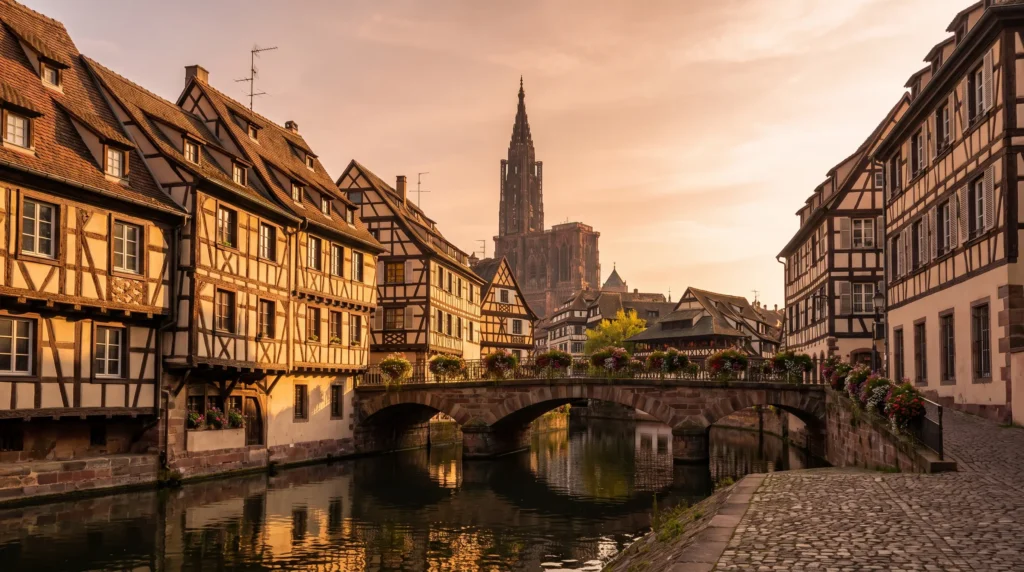
Strasbourg Travel Guide — Half-Timbered Alsace, a Medieval Cathedral & Europe’s Christmas Capital
Strasbourg is the city France and Germany fought over for four centuries, and honestly, I understand why. Cross a footbridge in Petite France and you’re surrounded by leaning half-timbered houses stacked over canals like something out of a fairy tale; walk twenty minutes and you’re in a stern, symmetrical German imperial quarter built when the Kaiser ran the place. The cathedral in between held the title of world’s tallest building for 227 years. Today the city hosts the European Parliament, which means it spends most of the year as a fairly sleepy regional capital and a few weeks each month as the center of continental politics. I love it for the architecture and the food — choucroute and Riesling one night, tarte flambée and pinot blanc the next — but I’ll say the honest part up front: come in December and you will share the Grande Île with two million other people. Come in May instead and you’ll have the same cobblestones nearly to yourself.
In This Guide
- Overview — Why Strasbourg Sits Between Two Countries
- Europe’s Oldest Christmas Market
- Best Time to Visit Strasbourg
- Getting There — Airport, TGV & Cross-Border Rail
- Getting Around — Trams, Bikes & Your Own Two Feet
- Neighborhoods — Grande Île, Petite France & Neustadt
- Culture & People — Alsace’s Split Identity
- A Food Lover’s Guide to Strasbourg
- Off the Beaten Path
- Day Trips — The Alsace Wine Route & Beyond
- Practical Information
- Budget Breakdown — What Strasbourg Actually Costs in 2026
- Frequently Asked Questions
Overview — Why Strasbourg Sits Between Two Countries
Strasbourg is the capital of the Grand Est region and the historic capital of Alsace, sitting directly on the Rhine at France’s eastern border with Germany. That location is the whole story: the city and the surrounding Alsace region changed hands between France and Germany four times between 1871 and 1945, and the architecture, the food and even the local dialect still carry both flags. It shows up in small ways — street names in French with an older German-derived version underneath, half-timbered houses that would look at home in the Black Forest, a cathedral built in Gothic style but by architects trained in the Holy Roman Empire.
The historic center, the Grande Île (“Big Island,” formed by two arms of the River Ill), was inscribed as a UNESCO World Heritage Site in 1988 — the first time UNESCO had listed an entire city center rather than a single monument — and the listing was extended in 2017 to cover the Neustadt, the grid of grand Wilhelmine-era buildings the German administration built after 1871. Strasbourg Cathedral anchors it all: its single spire reached 142 metres and held the record for the world’s tallest building from 1647 until 1874.
Since the 1950s the city has taken on a very different role as one of the European Union’s three de facto capitals, hosting the European Parliament, the Council of Europe and the European Court of Human Rights. Politicians fly in for a few days a month; the rest of the time Strasbourg is a compact, walkable, slightly sleepy university and canal city of around 294,000 people. The catch, if there is one: it’s popular enough in December that hotel prices roughly double and the Grande Île gets genuinely shoulder-to-shoulder. Outside that month, it’s one of the most relaxed city breaks in France.
Europe’s Oldest Christmas Market
Strasbourg calls itself the “Capital of Christmas,” and the claim has history behind it: the Christkindelsmärik has run since 1570, when the city’s Protestant council replaced the Catholic Saint Nicholas market with a “Market of the Christ Child” held outside the cathedral — making it one of the oldest Christmas markets in Europe. The market has shifted locations over the centuries (Place Kléber from 1830, Place Broglie from 1870) and now sprawls across a dozen squares on the Grande Île, drawing an estimated two million visitors over roughly five weeks.
The giant fir tree on Place Kléber — decorated, occasionally topping 30 metres — is the market’s postcard shot, and mulled wine (vin chaud) is the fuel that keeps everyone moving between chalets selling ornaments, bredele Christmas cookies and roasted chestnuts. The honest catch: this is peak tourist season by a wide margin. Book hotels two to three months out, expect the Grande Île’s narrow streets to be genuinely packed on weekends, and watch your bag — pickpocketing spikes in crowded market lanes exactly like it does at any major European holiday market.
Best Time to Visit Strasbourg
Late April – June · Spring into early summer
Mild temperatures, blooming window boxes on the half-timbered houses, and the Alsace Wine Route villages at their prettiest before the summer coach-tour crush. This is genuinely the best value-to-crowd ratio of the year.
July – August · Summer
Warm, occasionally hot with the increasingly subtropical-leaning summers the region has seen in recent years, long daylight for riverside terraces and outdoor concerts, but also the busiest season for the Wine Route towns and higher hotel rates in the city itself.
September – October · Wine harvest
My personal favorite window: harvest season across the Alsace vineyards, comfortable walking weather, and noticeably thinner crowds than summer or December.
Late November – December 27 · Christmas market
Magical, but the trade-off is real — book far ahead, expect the highest room rates of the year, and brace for crowds on the Grande Île. The 2026 market runs from late November through 27 December.
January – March · Deep winter
Grey, cold, quiet — the cheapest hotel rates of the year if you don’t mind the market chalets being packed away and shorter museum hours.
Getting There — Airport, TGV & Cross-Border Rail
Strasbourg Airport (SXB) sits in Entzheim, about 10 kilometres southwest of the city, and mostly handles European routes — Barcelona, London, Madrid, Milan, Nice and seasonal Mediterranean links rather than long-haul flights. A short train ride on the TER regional line connects the airport terminal to Strasbourg-Ville station in around 7–12 minutes. Most visitors from outside Europe fly into Paris or Frankfurt and take the train onward instead.
That train connection is genuinely excellent: direct TGV INOUI high-speed services link Paris Gare de l’Est to Strasbourg in around 1 hour 46 minutes on the LGV Est high-speed line, with close to a dozen direct departures a day. Strasbourg also sits within easy rail reach of Frankfurt, Basel and Karlsruhe, making it a genuinely convenient stop on a multi-country Central European rail trip rather than a detour.
The most charming way to arrive from Germany, though, is Strasbourg’s own cross-border tram — Line D crosses a dedicated bridge over the Rhine into Kehl, Germany, the first cross-border tram line in France, running since 2017. If you’re coming from Baden-Baden or the Black Forest by regional train to Kehl, you can finish the trip into central Strasbourg by tram for a couple of euros.
Getting Around — Trams, Bikes & Your Own Two Feet
The Grande Île is small enough to cross on foot in under half an hour, and honestly walking is the best way to see Petite France’s canals and footbridges anyway — trams don’t reach the narrowest lanes. For everything else, CTS (Compagnie des Transports Strasbourgeois) runs six tram lines and dozens of bus routes across the metro area, and the network is dense enough that most hotels and sights sit within a short walk of a stop.
Strasbourg was one of France’s earliest bike-friendly cities and it shows — dedicated cycle lanes lace the center, and the Vélhop bike-share system makes a two-wheeled loop of the Grande Île and Neustadt an easy afternoon. Renting a car is unnecessary in the city itself and mostly worth it only if you’re doing a self-paced Wine Route road trip; otherwise regional trains and organized day tours cover the same ground without the parking headaches of Colmar or Riquewihr in high season.
Neighborhoods — Grande Île, Petite France & Neustadt
Grande Île
The UNESCO-listed historic core, wrapped by the River Ill, centered on Strasbourg Cathedral and its 16th-century astronomical clock — the current mechanism dates to 1843 and still runs its procession of apostle figures past a life-size mechanical rooster every day at solar noon. Place Kléber, Place Gutenberg and the cathedral square form the backbone of both everyday life and the Christmas market.
Petite France
The most photographed corner of the city: a former tanners’, millers’ and fishermen’s district built on four channels of the Ill, its half-timbered houses dating mostly from the 16th and 17th centuries with open lofts once used to dry hides. The name has nothing to do with patriotism — it comes from a 16th-century hospice here that treated soldiers with a disease then nicknamed the “French disease.” Come at golden hour for the canal reflections and go early to beat the tour groups.
Neustadt
The “New Town” built during the German imperial period after 1871: wide boulevards, grand sandstone buildings and the Palais du Rhin, all laid out on a scale closer to Berlin than to old French Strasbourg. It’s the part of the UNESCO listing most visitors skip, which is exactly why it’s worth the walk.
European Quarter
North of the center, a modern district of glass-and-steel institutional architecture housing the European Parliament, the Council of Europe and the European Court of Human Rights — worth a look even if you can’t get inside, for the sheer contrast with the half-timbered old town a twenty-minute walk away.
Krutenau
The student and nightlife quarter just south of the Grande Île, dense with bars, cheap ethnic eats and a younger crowd — a good base if you want evenings livelier than the postcard streets offer.
Robertsau & the Parks
A leafy, residential edge of the city bordering the Rhine, home to the Parc de l’Orangerie (Strasbourg’s oldest public park, with storks — the region’s emblematic bird — kept in a small reserve) and quieter walking and cycling routes along the river.
Culture & People — Alsace’s Split Identity
Alsace’s back-and-forth history between France and Germany left a genuinely blended culture rather than a simply French one. The Alsatian dialect — a Germanic language closer to Swiss German than to standard French — is still spoken, mostly by older generations, and its influence is everywhere: village names, dish names, half-timbered building styles that look transplanted from Bavaria or the Rhineland. French is the official and dominant language in daily life and on all signage, and English gets you by easily in tourist areas.
That dual heritage shows up in the calendar too: Strasbourg keeps both French and Alsatian traditions alive, from the Christkindelsmärik’s Protestant Reformation roots to Catholic village processions in the surrounding countryside. As one of the EU’s institutional capitals, the city also carries a cosmopolitan, multilingual undercurrent most French regional capitals don’t have — diplomats, interpreters and EU staff cycle through constantly, even if you’d never guess it strolling Petite France on a quiet Tuesday.
A Food Lover’s Guide to Strasbourg
Alsatian cuisine sits at the crossroads of French technique and German heartiness, and Strasbourg is the best place to eat all of it in one trip. Start with flammekueche (tarte flambée) — a paper-thin, wood-fired dough base topped with crème fraîche, raw onion and smoked lardons, originally a peasant test-bake for the oven’s temperature. Then there’s choucroute garnie, Alsace’s answer to sauerkraut: fermented cabbage braised in wine or beer and piled with sausages, pork and potatoes.
Baeckeoffe — “baker’s oven” — is the slow-cooked classic: three meats, potatoes and onions marinated in white wine and traditionally dropped at the neighborhood bakery to cook in the residual heat of Monday’s bread oven. Eat it, and everything else, in a winstub — literally a “wine room,” the Alsatian answer to a bistro, born as a place for winemakers to sell surplus stock and now the backbone of Strasbourg’s dining scene. Pair everything with a local Riesling, Gewürztraminer or Pinot Blanc from the Wine Route vineyards half an hour away, finish with a kougelhopf (the braided, almond-studded brioche), and budget one indulgent foie gras meal — Alsace has produced it for centuries and menus lean into it hard around the holidays.
Off the Beaten Path
Barrage Vauban
A 17th-century dam and covered bridge just past Petite France with a rooftop terrace giving the single best panoramic view of the canal district and cathedral spire together — and most day-trippers walk straight past it.
Walk (or Tram) Into Germany
Cross the Rhine on foot via the Passerelle des Deux Rives footbridge, or hop cross-border tram Line D, and you’re in Kehl, Germany, within minutes — a quick, novel way to say you’ve “done” two countries in an afternoon.
The Neustadt on Foot
Skip the tour groups clustering around the cathedral and spend an hour walking the Neustadt’s wide German-built avenues instead — you’ll likely have entire blocks of UNESCO-listed architecture to yourself.
Parc de l’Orangerie
Strasbourg’s oldest park, with a small stork reserve, boating lake and — depending on the season — genuinely quiet green space a fifteen-minute walk from the tourist core.
Day Trips — The Alsace Wine Route & Beyond
Strasbourg sits at the northern end of the Alsace Wine Route, a roughly 180-kilometre circuit through more than 70 villages that stretches south toward Colmar. Colmar itself is about 74 kilometres away — under an hour by car or a similar window by regional train — and makes the best single base for exploring the prettiest cluster of villages, with Eguisheim, Riquewihr and Kaysersberg all within 15–30 minutes of it. Doing Colmar and one or two villages as a single long day from Strasbourg is realistic; doing the full Wine Route properly wants two or three days of its own.
Closer to home, the Rhine puts Germany’s Black Forest and the spa town of Baden-Baden within a short train hop, and the university city of Freiburg im Breisgau isn’t much further. Southward, Basel, Switzerland sits at the convenient meeting point of France, Germany and Switzerland for travelers stitching together a longer regional trip.
Practical Information
Money. France uses the euro, shared across 20 of the EU’s 27 member states plus several microstates. Cards are accepted almost everywhere, including small cafés; carry some cash for the smallest winstubs and market stalls.
Safety. France sits at Travel Advisory Level 2 (“Exercise Increased Caution”) from the US State Department, reflecting general terrorism and demonstration risk rather than anything specific to Strasbourg — the city has had one serious incident, a 2018 attack near the Christmas market, but day-to-day risk for visitors is dominated by ordinary pickpocketing in crowded tourist areas and on trains. Keep bags zipped and in front of you in market crowds and on trams.
Health. No vaccinations are required for entry, and routine vaccines (MMR, tetanus, seasonal flu) plus general food and water precautions are all the CDC recommends for typical travel to France. Tap water is safe to drink and pharmacies (marked with a green cross) are plentiful for minor ailments.
Connectivity. EU roaming rules mean UK, EU and many international plans work seamlessly, or grab a local/eSIM on arrival. Plugs: European two-round-pin (Type C/E), 230V. Time zone: Central European Time (UTC+1), CEST (UTC+2) in summer.
Budget Breakdown — What Strasbourg Actually Costs in 2026
Strasbourg runs a notch cheaper than Paris but firmly mid-range for a Western European city — expect December Christmas-market rates to push every tier upward.
Budget (US$90–140/day): hostel dorm or budget hotel outside the Grande Île, flammekueche and market-stall lunches, tram day pass, walking tours over guided ones.
Mid-range (US$180–320/day): boutique hotel in Petite France or Neustadt, a winstub dinner with wine, cathedral tower climb, a half-day Wine Route excursion or Vélhop bike rental.
Luxury (US$450+/day): canal-view suite, a Michelin-starred Alsatian tasting menu, a private Wine Route driver-guide through Riquewihr and Eguisheim, front-row Christmas market season hotel rates.
Expect the Christmas market season (late November–December) to add 30–70% to typical hotel rates; book that window as early as possible. Tipping isn’t obligatory in France — a service charge is built into the bill — but rounding up is appreciated.
Planning Your Trip to Strasbourg
Three nights covers the essentials: a day for the Grande Île, cathedral and Petite France, a day for the Neustadt and European Quarter, and a day trip to Colmar and a Wine Route village or two. Five nights lets you add Kehl and the Black Forest, or a slower two-village wine-tasting day. Strasbourg pairs naturally with a wider trip — it’s on the direct TGV line from Paris, within easy rail reach of Munich and the rest of southern Germany, and a short hop from Brussels, the EU’s other institutional capital, if you want to make the Parliament connection a theme. For the wider country context, see our France travel guide.
Frequently Asked Questions
Is Strasbourg worth visiting outside of Christmas market season?
Genuinely, yes — arguably more so. Spring and early autumn give you the same half-timbered streets and cathedral without the crowds or the doubled hotel rates, plus better weather for the Wine Route day trips.
Do I need a visa?
US, UK, Canadian and EU citizens get visa-free entry to France for up to 90 days within any 180-day period across the Schengen Area; passports need at least three months’ validity beyond your planned departure.
Is Strasbourg safe for tourists?
Yes, for the vast majority of visitors — the main practical risk is pickpocketing in crowded tourist areas and on trains, which spikes during the Christmas market. France overall sits at a general “exercise increased caution” advisory level tied to terrorism and demonstration risk rather than anything Strasbourg-specific.
Can I do Strasbourg and Colmar’s Wine Route villages in one day?
Yes, as a long day — Colmar is about 74 kilometres away and villages like Eguisheim sit just 10–15 minutes further, so a car or organized tour can realistically cover Colmar plus one or two villages. To properly savor the Wine Route, though, plan a night or two based in Colmar instead.
Do people speak English, or do I need French?
French is the everyday language and the one on all signage; English is widely spoken in hotels, restaurants and shops in the tourist core. A few polite French phrases go a long way, and you’ll hear the Alsatian dialect in the older generation and on some village signage.
How walkable is Strasbourg, and do I need a car?
Very walkable — the Grande Île is crossable on foot in under 30 minutes, and the tram network handles everything beyond it. Skip the rental car unless you’re planning a self-driven Wine Route loop.
Ready to Explore Strasbourg?
A medieval cathedral that once out-built every structure on Earth, a canal district that looks hand-painted, a cross-border tram that drops you in another country for the price of a ticket, and — for five weeks a year — Europe’s oldest Christmas market lighting up the whole Grande Île. Strasbourg rewards a slow visit more than a rushed one, so give it at least three nights and let the two cultures it’s built from show themselves.
Explore More
- France Travel Guide — the country Strasbourg calls home
- Germany Travel Guide — the Black Forest and Rhine cities just across the border
- Paris City Guide — under two hours away by direct TGV
- Brussels City Guide — the EU’s other institutional capital
How this guide was built
Published as part of Facts From Upstairs’ city guide series. Built from authoritative sources — Wikipedia entity pages for Strasbourg, Strasbourg Cathedral, the Strasbourg astronomical clock, Strasbourg Airport, the Strasbourg tramway, the Compagnie des Transports Strasbourgeois, Petite France, Alsatian cuisine and the Christkindelsmärik; UNESCO’s World Heritage listing for Strasbourg’s Grande Île and Neustadt; the European Central Bank’s euro overview; the US State Department’s France travel advisory; and the US CDC’s France traveler health page. Numeric and checkable claims carry inline citations.
Sources cited on this page
- Wikipedia — Strasbourg
- UNESCO — Strasbourg, Grande-Île and Neustadt
- Wikipedia — Strasbourg Cathedral
- Wikipedia — Strasbourg astronomical clock
- Wikipedia — Christkindelsmärik, Strasbourg
- Wikipedia — Strasbourg Airport
- Trainline — Paris to Strasbourg by train
- Wikipedia — Compagnie des Transports Strasbourgeois
- Wikipedia — Strasbourg tramway
- Wikipedia — Petite France, Strasbourg
- Wikipedia — Alsatian cuisine
- European Central Bank — The euro
- US State Department — France travel advisory
- US CDC — France traveler health page
More city guides you might like
Plan your trip to Strasbourg
The booking tools we use ourselves. FFU may earn a commission at no extra cost to you.
Plan & book your trip to Strasbourg
Booking through these searches supports our guides at no extra cost to you.