
City Guide · Piedmont
Turin, Italy: Baroque Boulevards, the First Italian Capital, and the Home of Chocolate, Cinema, and the Shroud
I came to Turin the first time almost by accident, changing trains on the way to the Alps, and ended up staying four days — and I have gone back every chance I get since. We tell first-time travellers that Turin is the most underrated major city in Italy: it was the country’s first capital, the cradle of the Italian state and of FIAT, and a city of roughly 845,000 people laid out in long, dead-straight Baroque boulevards under arcades that let you walk for kilometres in the rain or the sun without ever getting wet . My favourite Turin ritual is a mid-afternoon bicerin — the city’s own layered drink of espresso, drinking chocolate, and cream — in a 200-year-old café, followed by a slow climb up the Mole Antonelliana for the Alpine panorama. Treat this guide as the brief I would hand my own family the night before they landed: the spiralling Mole and its cinema museum, the Egyptian Museum that is the second-largest on earth, the Royal Palace and the Savoy residences, the chocolate and the café culture, the aperitivo invented here, and the easy day trips out to the royal hunting lodge of Venaria and the wine hills of the Langhe .

Table of Contents
Why Turin?
Turin is the city that surprises everyone who arrives expecting an industrial afterthought and instead finds the most regal, orderly, and quietly sophisticated of Italy’s big cities — the first capital of a unified Italy, the historic seat of the House of Savoy, and the birthplace of FIAT, home to roughly 845,000 people inside the city and some 2.2 million across the surrounding metropolitan area . Where Rome sprawls and Venice floats, Turin marches in straight lines: a Baroque grid of long boulevards, vast geometric piazzas, and 18 kilometres of arcaded porticoes that let you cross the centre under cover. It does not shout for attention the way the famous cities do, and that is precisely the point — it rewards the traveller who looks.
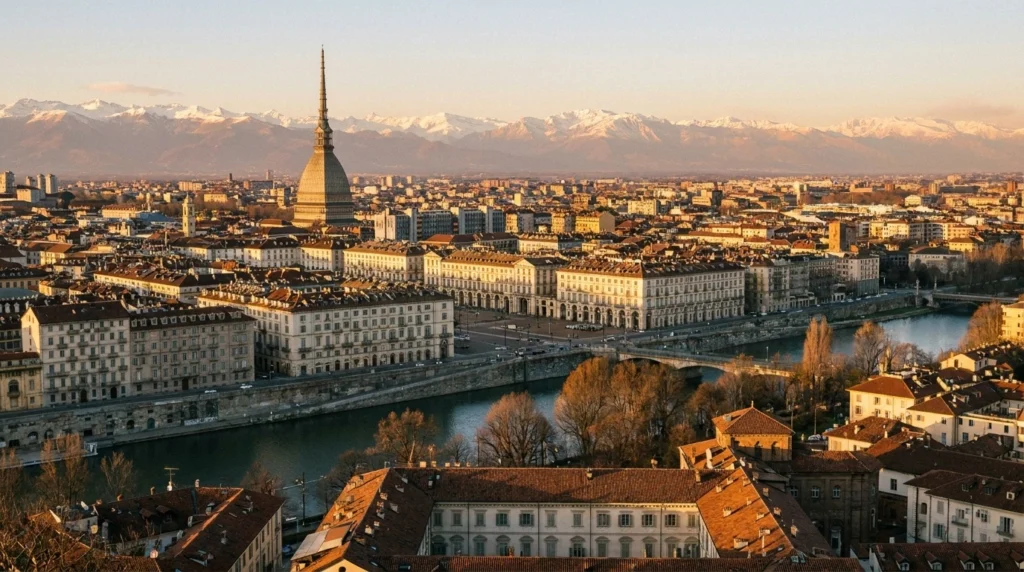
The city’s defining monument tells the story of its ambition. The Mole Antonelliana, begun in 1863 as a synagogue and finished as a civic symbol, rises 167.5 metres on its slender masonry dome and spire — for a time the tallest brick-and-stone building in Europe — and now houses the spectacular National Museum of Cinema, with a panoramic glass lift that shoots up through its hollow centre to a viewing platform over the rooftops and the Alps . A short walk away, the Museo Egizio holds the most important collection of Egyptian antiquities outside Cairo — the second-largest in the world — a legacy of the Savoy kings’ nineteenth-century passion for archaeology .
What makes Turin worth far more than the day-trip it is too often reduced to is the breadth beyond those two icons. This is the cradle of Italian chocolate — the gianduiotto and the layered bicerin were both invented here — and the home of the aperitivo, with the world’s first vermouth bars; it is a UNESCO-listed constellation of royal Savoy palaces and a serious museum city; and it sits at the foot of the Alps with the wine hills of the Langhe and the great ski resorts both within easy reach . This guide covers the neighbourhoods, the distinctive Piedmontese food, the headline sights, the café and cultural scene, the day trips, and the practical realities of the metro, the trams, and the airport.

Neighborhoods: Finding Your Turin
📍 Turin Map: Every Place in This Guide


Turin is compact at its core and ringed by working neighbourhoods, but almost everything a visitor wants sits inside the historic centre, laid out on the dead-straight Roman-and-Baroque grid and threaded by arcades, trams, and a single clean automated metro line. The broad shape runs out from the great central square of Piazza Castello: the Royal Palace and the Savoy quarter to the north; the medieval Quadrilatero Romano to the north-west; the grand café-lined Via Roma and Piazza San Carlo running south to the central station of Porta Nuova; the Mole, the university, and the lively Vanchiglia quarter to the east; and the River Po and the green hills rising on the far bank. Staying anywhere inside this ring puts you within a short walk or a couple of tram stops of every major sight . The single most useful orientation fact is that Piazza Castello is the dead centre, and Via Roma — the spine of the arcaded shopping district — links it directly to the main station.
The character shift across the districts is real and worth planning around. The centre around Piazza Castello and Via Roma is grand, regal, and busiest with visitors and shoppers; the Quadrilatero Romano is the oldest, most atmospheric quarter, packed with aperitivo bars and trattorias; San Salvario, behind the station, is the buzzing multicultural nightlife district; Vanchiglia and the area around the university are studenty and bohemian; and the Crocetta, west of the centre, is the elegant residential quarter. Returning visitors almost always trade a first-trip station-side hotel for a Quadrilatero or centro base on later trips — the atmosphere is better and the medieval streets are where the city’s evening life actually happens. This section walks the districts you will actually use, with the access notes that matter.
One practical note on choosing where to stay: because the centre is so walkable and the tram network so dense, the difference between neighbourhoods here is far more about atmosphere and price than about convenience. Almost nowhere central is genuinely “far” from the sights. So decide first what you want your evenings to feel like — the regal calm of the centre, the medieval buzz of the Quadrilatero, the multicultural energy of San Salvario, or the student bohemia of Vanchiglia — and let that drive the choice, rather than worrying about being a few hundred metres further out. The one real trade-off is price against character: the Via Roma and Piazza Castello rooms cost the most, while San Salvario and the streets behind the station offer better value with more local life.
A useful mental map for first-timers: think of the city as a grid hung on the central axis of Via Roma, running south from Piazza Castello to Porta Nuova station. The regal sights and the grand cafés line that axis; the medieval Quadrilatero sits just to its north-west; the nightlife of San Salvario lies just south of the station; the Mole, the university, and Vanchiglia are to the east toward the river; and the hills rise green across the Po. A single metro line and a web of trams do most of the heavy lifting, and a rechargeable GTT ticket plus a pair of comfortable shoes are genuinely most of the transport planning a visitor needs . Below are the districts you will actually choose between, with the trade-offs that matter for each.
Centro & Piazza Castello
The regal heart of the city is where most first-time visitors want to be, and for good reason — Piazza Castello, the Royal Palace, the Mole, the Egyptian Museum, and the arcaded shopping of Via Roma all sit within a few minutes’ walk. It is the grandest and most polished part of Turin, busy with visitors and elegant shoppers by day and lined with historic cafés. The trade-off is price and a slightly formal feel: this is a district to stroll and admire, and rooms here command a premium. But for a short first trip it is unbeatable for convenience, with the metro and the main tram lines all close at hand.
- Piazza Castello with the Palazzo Madama and the Royal Palace complex
- Via Roma and Piazza San Carlo — the arcaded “drawing room of Turin” lined with grand cafés
- The Mole Antonelliana and the National Museum of Cinema, a short walk east
- The Egyptian Museum (Museo Egizio) on Via Accademia delle Scienze
Best for: first-time visitors, short trips, museums, shopping on foot. Access: Metro Porta Nuova then a short walk, or tram 4/13/15.
Quadrilatero Romano
The grid of narrow streets north-west of Piazza Castello is Turin’s oldest quarter, built on the Roman street plan and now the most atmospheric corner of the centre — cobbled lanes, the surviving Roman gate of the Porta Palatina, and a dense concentration of aperitivo bars, wine bars, and trattorias. It feels like the social heart of the city after dark, with the kind of buzzing evening life the formal centre lacks, and it puts you within easy walking distance of every major sight. It is more characterful than expensive, and it suits travellers who want atmosphere and good food over polish.
- The Porta Palatina, the best-preserved Roman gate in northern Italy
- The Mercato di Porta Palazzo, Europe’s largest open-air market, on the quarter’s edge
- The dense aperitivo and trattoria scene around Via Bonelli and Piazza Emanuele Filiberto
- The Cathedral of San Giovanni Battista, home of the Shroud of Turin
Best for: food lovers, aperitivo, atmosphere, an authentic central base. Access: a short walk from Piazza Castello; tram 4 to Porta Palazzo.
San Salvario
The grid of streets directly behind Porta Nuova station is Turin’s most diverse and energetic nightlife district — a formerly working-class, now thoroughly hip quarter packed with bars, ethnic restaurants, and a young, international crowd. It can be lively and loud late at night, so light sleepers should ask for a quiet room, but it offers better value than the centre and far more buzz, with the great green expanse of the Parco del Valentino and its mock-medieval village right alongside the river. It is the obvious base for younger travellers and night owls, and it is barely five minutes’ walk from the station and the metro.
- The Parco del Valentino, the riverside park with the Borgo Medievale mock-medieval village
- The dense bar, club, and international-restaurant scene around Via Baretti and Largo Saluzzo
- The grand synagogue of Turin, one of the largest in Europe
- Easy access to the river promenades and the rowing clubs of the Po
Best for: nightlife, value stays, younger travellers, multicultural food. Access: Metro Porta Nuova or Marconi; a short walk from the station.
Vanchiglia & the University quarter
East of the centre, toward the river and the Mole, the Vanchiglia district and the streets around the university have become the city’s bohemian, creative heart — independent bars, record shops, vegetarian cafés, and a young student crowd give it a relaxed, alternative feel quite distinct from the regal centre. It is walkable to the Mole, the cinema museum, and the riverside, and it offers good value and genuine local life. It suits travellers who want a younger, less touristy base within easy reach of the headline sights, and it has some of the best casual eating in the city.
- The Mole Antonelliana and the National Museum of Cinema on the quarter’s western edge
- The lively student bars and cafés around Largo Montebello and Via Vanchiglia
- The Lungo Po riverside promenades and the Murazzi nightlife stretch below
- The Campus Luigi Einaudi and the buzz of the university district
Best for: students, a younger creative base, casual food, value. Access: a short walk or tram 16 from the centre.
Crocetta & the elegant west
West of Via Roma and the station, the Crocetta is Turin’s most refined residential quarter — leafy avenues, handsome Liberty-style (Art Nouveau) and rationalist apartment buildings, smart boutiques, and one of the city’s best daily markets. It is quieter and more upmarket than the centre, with a genuine residential rhythm and excellent everyday restaurants, and it puts you within a short tram ride of the sights. It suits travellers who want a calm, elegant base with local life and good value over postcard surroundings, and it is home to the GAM modern-art gallery and the Politecnico university.
- The GAM — Galleria Civica d’Arte Moderna e Contemporanea
- The daily Mercato della Crocetta, a favourite for produce, cheese, and fashion stalls
- The Liberty-style mansions and tree-lined avenues around Corso Galileo Ferraris
- A calm, residential base a short tram ride from the centre
Best for: elegant calm, value stays, local life, longer trips. Access: Metro Vinzaglio or Re Umberto; tram 5/16.
The Hills & the Po (Borgo Po, Gran Madre)
Across the river from the centre, the slopes of the Turin hills hold the city’s greenest, most exclusive corners — the grand domed church of the Gran Madre di Dio, the riverside Borgo Po quarter, and the winding roads up to the panoramic viewpoint of Monte dei Cappuccini and, higher still, the Basilica di Superga. It is far quieter and more residential than the centre, with villas, gardens, and sweeping views back over the city to the Alps, and it suits travellers who want calm and scenery within a short walk or bus ride of the sights. The riverbank below is lined with rowing clubs and Sunday strollers.
- The Gran Madre di Dio, the neoclassical domed church facing Piazza Vittorio Veneto across the river
- The Monte dei Cappuccini viewpoint and its mountain museum, for the classic city-and-Alps panorama
- The Borgo Po riverside quarter, with its villas and gardens
- The rack railway and the Basilica di Superga on the hill above
Best for: scenery, quiet, walkers, a green base near the centre. Access: a short walk across the Vittorio Emanuele I bridge; bus to Superga or the Sassi–Superga rack railway.
In short, pick by mood and budget rather than by distance. First-timers on a short trip should default to the centro or the Quadrilatero for unbeatable walking access to the headline sights; food lovers and aperitivo-seekers will be happiest in the Quadrilatero; younger travellers and night owls belong in San Salvario or Vanchiglia; anyone after elegant calm and value should weigh the Crocetta; and those chasing scenery should look across the river to the hills. Whichever you choose, the dense tram network keeps every other district within comfortable reach.
The Food

Piedmontese cuisine is genuinely distinct from the Italian food most visitors picture, and Turin is its showcase. This is northern, butter-and-truffle country rather than the olive-oil-and-tomato south — the signature dishes are built on egg pasta, hazelnuts, white truffles, slow-braised beef, and the rich dairy of the Alpine pastures. The flavours are refined and aristocratic, a legacy of the royal Savoy court and a long French influence: delicate agnolotti pasta, vitello tonnato, bagna càuda, and an extraordinary chocolate and café tradition. The city also invented the modern aperitivo and the bicerin, and has one of the most serious slow-food and wine cultures in Italy, with the Langhe vineyards on its doorstep. Coming hungry and curious is the right approach; this is a food city that rewards both the standing espresso and the long, ceremonial dinner.
What makes eating in Turin so rewarding is the range of price points and the quality at every tier. You can eat very well and cheaply at lunchtime — a plate of agnolotti at a workers’ trattoria, a panino, a slice of farinata — and the famous Turinese aperitivo culture means that in the early evening the price of a single drink (around €8–12) often includes a generous buffet that can stand in for dinner. At the top end, Piedmont is one of the great gastronomic regions of Italy, with Michelin-starred kitchens, century-old cafés, and the white-truffle and Barolo culture of the nearby hills. The trick is knowing which neighbourhood does what: the Quadrilatero for aperitivo and trattorias, the centre for the grand historic cafés, San Salvario and Vanchiglia for the casual and international scene.
It helps to understand the rhythm of eating here. Lunch runs roughly 12:30–14:30 and is often the working Turinese’s quick, good-value meal; the sacred ritual is aperitivo from about 18:00–21:00, when bars put out food alongside the drinks; and dinner proper starts from around 20:00. The aperitivo is not just a drink — Turin claims to have invented it, along with vermouth, in the eighteenth century, and the city effectively perfected the “apericena” buffet model. Knowing this lets you eat cheaply and sociably: a couple of well-chosen aperitivo stops can replace a restaurant dinner entirely, which is exactly how many young Turinese eat on weeknights.
It also pays to think regionally rather than reach for the pan-Italian clichés. Turin sits at the heart of Piedmont, a wealthy region of rice paddies, hazelnut groves, truffle woods, and the great red-wine hills of the Langhe and Roero, and its cooking reflects that: egg pasta and risotto in place of the dried pasta of the south, butter in place of olive oil, and a fondness for veal, game, and slow, patient cooking. The result is food that feels closer to neighbouring France than to the sun-drenched plates most visitors associate with Italy. Lean into that difference — order the agnolotti, the vitello tonnato, and a glass of Barolo rather than another margherita pizza — and you eat the city as the Turinese actually do, which is the whole point of coming.
Classic Piedmontese
The city’s signature dishes are worth seeking out at a proper old-school trattoria rather than a tourist trap. Agnolotti del plin — tiny hand-pinched egg-pasta parcels stuffed with roast meat — are the defining first course, often served simply with butter and sage or in their own roasting juices. Vitello tonnato (cold sliced veal under a creamy tuna-caper sauce) and bagna càuda (a warm garlic-and-anchovy dip for raw vegetables, eaten communally in winter) round out the canon. These are refined, satisfying dishes, and the best versions come from the kind of family-run place that has been doing them for generations.
- Tre Galline — a historic Quadrilatero trattoria for classic Piedmontese cooking, agnolotti and braised meats (mains around €18–28)
- Consorzio — a beloved modern trattoria celebrated for nose-to-tail Piedmontese dishes and natural wines, booking essential (mains around €16–26)
- Porto di Savona — a long-running institution on Piazza Vittorio Veneto for agnolotti, vitello tonnato, and bollito (mains around €14–24)
Aperitivo & the Historic Cafés
The early-evening aperitivo is the single most Turinese way to eat and drink — the city claims to have invented both it and vermouth — and the grand nineteenth-century cafés are its spiritual home. For the price of a vermouth, a spritz, or a glass of Barbera — usually €8–12 — many bars lay out a buffet of small bites that can comfortably replace dinner, while the historic cafés serve the ritual with marble, mirrors, and two centuries of history. The aperitivo runs from roughly 18:00 to 21:00, and the social point is as much the setting as the drink. Choose your spot for the spread and the atmosphere, and arrive early before the best food is picked over.
- Caffè Al Bicerin — the 1763 café by the Santuario della Consolata where the bicerin was reputedly born (bicerin around €7–9)
- Caffè Mulassano — the tiny, gilded Belle Époque café on Piazza Castello, birthplace of the tramezzino sandwich (coffee and bite around €6–10)
- Caffè San Carlo & Caffè Torino — the grand historic cafés on Piazza San Carlo for an aperitivo under chandeliers (drinks around €10–15)
Beyond Agnolotti and Vitello Tonnato
The everyday Piedmontese repertoire runs much deeper than the famous dishes, and rewards exploration across markets, bakeries, and trattorias. Many of these are slow-cooked comfort dishes built for the region’s cold winters, and several — like the gianduiotto chocolate — have become global exports that taste entirely different fresh from a Turin confetteria. Look out for the city’s pastry and chocolate tradition too: Turin takes its cafés and patisseries seriously, and a mid-morning coffee with a slice of something sweet is part of the daily fabric.
- Brasato al Barolo — beef slow-braised in the region’s great red wine until meltingly tender, a winter classic (€18–26)
- Bagna càuda — a warm garlic-and-anchovy dip for raw and cooked vegetables, eaten communally in the cold months (€14–20)
- Tajarin — fine ribbons of rich egg pasta, served with butter and sage or, in season, shaved white truffle (€14–30 with truffle)
- Gianduiotto — the boat-shaped hazelnut-chocolate that Turin invented, sold by the box at the historic chocolatiers (€10–20 a box)
- Bonet — the classic Piedmontese chocolate-and-amaretto pudding, the region’s defining dessert (€6–9)
Markets & Where to Shop for Food
Turin’s markets are the cheapest and most rewarding way to eat and shop for food. The Mercato di Porta Palazzo, on the edge of the Quadrilatero, is the largest open-air market in Europe — a sprawling daily blaze of produce, cheese, cured meats, fish, and street food from across the world. The covered Mercato Centrale inside the old market hall lets you eat artisan versions of Piedmontese and Italian classics from a cluster of stalls, while neighbourhood markets like the Crocetta rotate through the week across the city. For a sit-down market meal, the food halls and the bars ringing Porta Palazzo make an easy, cheap lunch.
If you are self-catering or just want a cheap, excellent lunch, the markets and the city’s many panetterie, salumerie, and confetterie are the move. A few euros buys a wedge of focaccia, some local toma cheese, a handful of olives, and the stallholders will happily point you to what is in season. Eataly, the now-global food emporium, was actually born in Turin in 2007, and its flagship in the Lingotto district is worth a visit even just to browse — its prepared foods, cheeses, and chocolate are a showcase of Piedmontese gastronomy, ideal for assembling a high-end picnic.
Coffee, Chocolate & What to Drink
Turin takes its coffee and chocolate more seriously than perhaps any other Italian city, and a stand-up espresso at the counter is the local rhythm — order and drink it standing for a fraction of the seated price. But the city’s true signature is the bicerin, the layered glass of espresso, drinking chocolate, and cream served in the historic cafés, and the gianduiotto and gianduja chocolate-hazelnut paste that Turin gave the world. To drink, the region is one of Italy’s greatest wine areas: Barolo and Barbaresco from the nearby Langhe, everyday Barbera and Dolcetto, and the local vermouth that the Turinese invented and still drink as an aperitivo. A glass of vermouth or Barbera with the aperitivo buffet is the most Turinese drink you can order.
Two small rituals are worth honouring. First, the morning cappuccino-and-brioche standing at the bar — a euro or two, gone in five minutes, and the single most efficient breakfast in the city. Second, the mid-afternoon bicerin in a historic café, a sweet, warming pause that no visitor should skip. Get both right and you bookend the day exactly as a local would, for almost nothing.
One more habit worth adopting is the Porta Palazzo browse. Several mornings a week the great market fills with stalls of seasonal fruit and vegetables, cheese, cured meats, and street food, and it is where ordinary Turinese — and the city’s many immigrant communities — actually shop. Even if you are not self-catering, an hour wandering the largest open-air market in Europe with a coffee in hand is one of the cheapest and most authentic food experiences in the city, and it tells you more about how Turin really eats than any restaurant could. Many stalls will let you taste before you buy, and the prices are a fraction of those at the smart central food halls.
Food Experiences You Can’t Miss
- A bicerin in the 1763 Caffè Al Bicerin, exactly where the drink was born
- A plate of agnolotti del plin and a glass of Barbera at an old-school Quadrilatero trattoria
- A stand-up espresso and a tramezzino at the gilded Caffè Mulassano on Piazza Castello
- A box of fresh gianduiotti from a historic Turin chocolatier — utterly unlike the supermarket version
- A morning browse and a picnic assembled from the Mercato di Porta Palazzo
Cultural Sights

Mole Antonelliana & the National Museum of Cinema
Turin’s defining sight rises 167.5 metres on its slender masonry dome and spire — once the tallest brick-and-stone building in Europe — and now houses the spectacular National Museum of Cinema, one of the most beautiful museums in Italy, arranged up the soaring hollow interior. A panoramic glass lift shoots through the centre to a viewing platform with sweeping views over the city to the Alps. Begun 1863. Museum admission around €15, the panoramic lift around €9, or a combined ticket around €20; book online and go up the lift on a clear day.
Museo Egizio (Egyptian Museum)
Turin’s Egyptian Museum holds the most important collection of Egyptian antiquities outside Cairo — the second-largest in the world — built on the Savoy kings’ nineteenth-century passion for archaeology, with statues, mummies, papyri, and an entire rock-cut temple. It is one of the great museums of Europe and the single must-see of any Turin trip. Founded 1824. Admission around €18, with discounts for the young and free entry under six; allow at least two hours and book a timed slot to skip the queue.
Royal Palace & the Savoy Residences (Musei Reali)
The Palazzo Reale, seat of the House of Savoy, anchors a vast complex of state apartments, the Royal Armoury, the Galleria Sabauda picture gallery, and the chapel that once held the Shroud — together the Musei Reali, a UNESCO World Heritage Site. The opulent rooms trace the dynasty that unified Italy, and the gardens are free to wander. Admission around €15 for the combined Musei Reali ticket; closed Mondays; allow a half-day for the full complex.
Turin Cathedral & the Shroud
The Renaissance Cathedral of San Giovanni Battista, beside the Royal Palace, is the home of the Shroud of Turin — the linen cloth, bearing the faint image of a man, that many believe wrapped the body of Christ. The Shroud itself is rarely displayed (the next public ostension is exceptional), but a full-size replica and an exhibition explain its history year-round. The cathedral is free to enter; the nearby Museo della Sindone tells the full story for a small admission. Free entry; best visited alongside the Royal Palace next door.
Museo Nazionale dell’Automobile (MAUTO)
Fitting for the home of FIAT, Turin’s car museum is one of the finest in the world, tracing the history of the automobile through a dazzling collection of historic and racing cars in a striking modern building by the river. It is a must for any enthusiast and surprisingly engaging even for those who are not, with strong design and social-history storytelling. Admission around €15; a short tram or metro ride south of the centre toward Lingotto; allow a couple of hours.
GAM & the Contemporary Art Scene
The Galleria Civica d’Arte Moderna e Contemporanea (GAM) in the Crocetta holds Italy’s first municipal modern-art collection, strong on nineteenth- and twentieth-century Italian painting, while the Castello di Rivoli on the city’s edge is one of Europe’s leading contemporary-art museums. Turin has long been a centre of the Arte Povera movement, and its gallery scene is among the most serious in Italy. Admission around €10–12 for the GAM; closed Mondays; pair it with a Crocetta market visit and lunch.
Basilica di Superga
High on the hill above the city, the Baroque masterpiece of the Basilica di Superga — designed by Filippo Juvarra and completed in 1731 — offers the most famous panorama of Turin, the plain, and the Alps, and holds the royal tombs of the House of Savoy. It is reached by a charming early-twentieth-century rack railway from the Sassi station. Basilica free; the dome climb and royal tombs a small charge; the rack railway around €4–7 return; go on a clear day for the Alpine view.
A sensible way to string these together is by geography and ticketing. Cluster the central sights — the Egyptian Museum, the Royal Palace, the cathedral and the Mole — into the first day or two, since they sit within a few minutes’ walk of Piazza Castello, and pick up a Torino+Piemonte Card if you plan three or more, as it bundles entry and the Mole lift. Save the car museum, the GAM, and the hilltop Superga for a clear-weather half-day each, and almost everything central sits within a 20-minute walk or a short tram ride, so a well-planned two or three days covers the lot without feeling rushed. Check the closing days before you build your itinerary, too: most of the big museums shut on Mondays, so make that your day for the cathedral, the arcades, and a long café morning rather than a wasted trip to a locked door.
Entertainment

Aperitivo & Vermouth Bars
Turin’s after-work drinking culture is among the best in Italy — the city claims to have invented both the aperitivo and vermouth — and the historic cafés, the Quadrilatero bars, and the riverside spots all keep the ritual alive. Drinks run roughly €8–15, and many bars throw in a generous buffet at aperitivo hour. Typical cost €8–15 a drink. The grand Belle Époque cafés on Piazza San Carlo and Piazza Castello trade on history and chandeliers; the Quadrilatero and San Salvario do the lively, crowded version; and the rooftop and riverside bars trade on the view. Try a classic vermouth on the rocks where it was invented — book ahead at weekends, when the best tables go fast.
Theatre, Opera & Classical Music
The Teatro Regio, Turin’s grand opera house rebuilt behind its historic façade after a 1936 fire, is the cultural anchor, with a season of opera, ballet, and concerts running roughly October to June. Tickets start around €25 for the upper tiers and climb for premieres. Typical cost €25–150+. The city also has a strong classical scene around the RAI National Symphony Orchestra and the MITO music festival each September, shared with Milan. For a special night, the Regio delivers world-class opera at a fraction of La Scala’s prices; dress smartly and book ahead for the big productions.
Football: Juventus & Torino
Turin is one of Italy’s great football cities, home to the record-winning Juventus and the historic Torino FC. A match at the Allianz Stadium — Juventus’s modern, English-style ground — is an electric experience, and the club museum and stadium tour run on non-match days. Typical cost from around €30 for a match ticket, around €25 for the museum-and-tour. Book the big games and the Derby della Mole well ahead; the stadium is reached by tram and a short shuttle from the centre.
Live Music & Nightclubs
Beyond the bars, Turin has a serious live-music and club scene, from intimate jazz venues to the riverside Murazzi nightlife stretch and the clubs of San Salvario and the Docks Dora warehouses. Cover charges run roughly €10–25 depending on the venue and night. The Murazzi del Po — the arches along the riverbank — are the historic clubbing heart, while San Salvario holds the densest concentration of bars. Turin stays out late; clubs rarely fill before midnight. The big international tours stop at the Inalpi Arena and the OGR cultural centre, a converted railway workshop that is now one of the city’s best venues, so check the listings before you travel.
Cinema & Festivals
As the home of Italian cinema — the industry was born here before it moved to Rome — Turin takes film seriously, with the National Museum of Cinema in the Mole and the prestigious Torino Film Festival each November. The city’s calendar is rich with festivals: the Salone Internazionale del Libro (Italy’s biggest book fair) in May, the Salone del Gusto / Terra Madre slow-food fair, and the Luci d’Artista light-art installations that illuminate the squares each winter. Most festival events are affordable or free, and they are among the best reasons to time a visit; the Luci d’Artista in particular turns the whole centre into an open-air gallery from late October to January.
Shopping & the Arcades
Shopping in Turin is a pleasure precisely because of the 18 kilometres of arcaded porticoes that let you browse in any weather. Via Roma is the elegant flagship spine, lined with luxury houses under grand colonnades; Via Garibaldi is one of Europe’s longest pedestrian streets for the high street; and the antique and book stalls of the Balon flea market by Porta Palazzo, biggest on Saturdays and the second Sunday of each month, reward a patient hunt. Even browsing the historic chocolatiers and the gilded café windows is a free pleasure, and the twice-yearly winter and summer sales (the saldi) draw shoppers from across the region. Do not leave without a box of gianduiotti, the foil-wrapped hazelnut-chocolate triangles invented here, which make the best and most portable souvenir the city has to offer.
Day Trips

Venaria Reale (about 30 min by bus or train)
The vast royal palace of Venaria Reale, just north of the city, is one of the grandest of the Savoy residences — a Baroque “Versailles of the Alps” with a magnificent Galleria Grande, restored after decades of neglect, and sweeping formal gardens. Reachable in around half an hour by the dedicated shuttle bus or a short train, it makes a full and rewarding half- or full-day. Go for the gilded gallery, the gardens, and the seasonal exhibitions; combine it with the adjacent hunting park, and check the closing days before you set out.
The Langhe & Alba (about 1 hr 15 min by train or car)
South of Turin, the UNESCO-listed vineyard hills of the Langhe — the home of Barolo, Barbaresco, and the white truffle — make one of the great wine day trips in Italy, centred on the handsome town of Alba. Reachable in around 75 minutes, it rewards a slow day of cellar visits, hilltop villages, and a long Piedmontese lunch. Go for the Barolo tastings, the autumn truffle fair, and the rolling vineyard scenery; a car or a guided tour makes the scattered villages far easier than the train alone.
Sacra di San Michele (about 1 hr by train and bus)
The dramatic abbey of the Sacra di San Michele, clinging to a rocky peak guarding the Susa Valley west of Turin, is one of the most spectacular monasteries in Europe and the symbolic monument of Piedmont — said to have inspired Umberto Eco’s The Name of the Rose. Reachable in around an hour by train to Avigliana and a bus or a steep walk, it offers soaring Romanesque architecture and vast valley views. Go for the cliff-top setting, the Stairway of the Dead, and the Alpine panorama; wear sturdy shoes for the final climb and check the seasonal hours.
Stupinigi Hunting Lodge (about 40 min by bus)
The Palazzina di Caccia di Stupinigi, on the southern edge of the city, is the Savoy kings’ lavish Baroque hunting lodge — a star-shaped masterpiece by Filippo Juvarra, crowned by a bronze stag and set in vast grounds. Reachable in around 40 minutes by bus, it makes a quieter, art-focused half-day for those who have done the central palaces. Go for the frescoed central salon, the playful Rococo interiors, and the parkland; it is less visited than Venaria, so the crowds are thinner and the calm is part of the appeal.
The Alpine Valleys & Sestriere (about 1 hr 30 min by train or car)
Turin sits at the foot of the Alps, and the great ski resorts of the Via Lattea — Sestriere, Sauze d’Oulx, and the slopes that hosted the 2006 Winter Olympics — are reachable in around 90 minutes, making the city a rare big-city base for a winter ski day or a summer mountain hike. Go for the snow in season and the high meadows and hiking in summer; check the train-and-bus connections or hire a car, and remember that Turin itself, with its museums and cafés, makes a perfect bad-weather alternative to the slopes.
Lake Maggiore & the Borromean Islands (about 1 hr 45 min by train)
For a contrast to the mountains and the vineyards, the southern shore of Lake Maggiore and the palatial Borromean Islands sit within easy reach to the northeast, a serene world of lakeside gardens, baroque palaces, and ferry-hopping between islets. Reachable in under two hours by train to Stresa and a short boat, it makes a gentle, scenic full day. Go for the Isola Bella palace and terraced gardens, the lake views, and a long waterside lunch; check the ferry timetable before you set out, as the inter-island boats run less often outside the summer season.
Seasonal Guide
Spring (March – May)
One of the best windows to visit, with daytime highs climbing from the low teens in March to the mid-20s°C by late May, the parks in bloom, and the café terraces fully open . May brings the Salone Internazionale del Libro, Italy’s biggest book fair, which fills the city with energy and some hotels, so book ahead if you visit then. Outside that, spring offers warm, pleasant weather, manageable crowds, and the city at its most relaxed, with the Alps still snow-capped behind it. Pack layers for the cool mornings and the odd spring shower, and consider basing a trip around the late-May window once the weather has warmed but the summer heat has not yet arrived — arguably one of the best times of the year to be in Turin.
Summer (June – August)
Hot and quiet — Turin sits on the Po plain and warms up in summer, with daytime highs often in the low 30s°C, though the nearby Alps temper the evenings . Many Turinese leave for the mountains or the coast in August, when some shops and restaurants close for the holidays and the city can feel half-empty. Hotel rates drop, and the Alpine valleys are an easy escape from the heat. If you visit in summer, sightsee early, retreat into the cool museums and arcades at midday, and take advantage of the thinner crowds at the major sights, and plan at least one mountain day to escape the heat of the plain.
Autumn (September – November)
Arguably the best season of all. September keeps warm, pleasant weather while the crowds thin and the city comes back to life after the August lull, and it is the start of the great food season . October brings the white-truffle season in the nearby Langhe and, in even years, the Salone del Gusto slow-food fair; November brings the CioccolaTÒ chocolate festival, the Torino Film Festival, and the first of the Luci d’Artista light installations. The catch is the increasingly grey, foggy, and wet weather from late October, when the Po-valley mist settles in, but the food and festival calendar more than compensates.
Winter (December – February)
Cold, often grey and foggy, with daytime highs around 5–8°C, occasional snow, and the famous Po-valley mist — but winter is also when Turin is most magical . The Luci d’Artista light-art installations glow over the squares and arcades from late October into January, the Christmas markets and the chocolate season are in full swing, the opera season at the Teatro Regio is underway, and the winter sales (saldi) draw shoppers in January. The cold keeps tourist crowds light at the major sights, and the Olympic ski resorts are a short train ride away. Pack a warm waterproof coat and embrace the cosy, indoor rhythm of café, museum, and opera.
Getting Around
Turin is one of the easiest big Italian cities to get around: the historic centre is flat, compact, and almost entirely walkable, threaded by 18 kilometres of arcaded porticoes, and what your feet cannot manage the dense tram-and-bus network and a single clean metro line will. The public transport is run by GTT, and a rechargeable ticket plus a good pair of shoes is genuinely most of the transport planning a visitor needs . The one thing worth knowing in advance is that the airport sits to the north of the city and is linked by both a train and a bus, so arrivals are simple and cheap.
Metro Line 1
Turin’s single, fully automated, driverless metro line runs from the Fermi terminus in the western suburbs through the central stations of Porta Susa and Porta Nuova down to the Lingotto and Bengasi in the south, and it is fast, frequent, and spotless. A single urban ticket costs around €1.70 and is valid for 100 minutes across metro, tram, and bus . The two central stations connect directly to the mainline trains, making it the simplest way to cross the city and to reach the station for onward travel.
Trams & Buses
The real workhorse of Turin transit is its extensive tram and bus network, including some charming historic tram cars still rattling along the central lines — tram 4 is the most useful single line for visitors, running north–south through the centre past Porta Palazzo. The same €1.70 100-minute ticket covers all of it, and a day pass costs around €4 . Validate paper tickets on board, and note that services thin out late at night, when a few night buses take over.
Tickets & Passes
Buy the rechargeable contactless ticket or single paper tickets at metro machines, tobacconists (tabaccai), and newsstands, and validate every ride. For sightseers, the Torino+Piemonte Card bundles museum entry, the Mole panoramic lift, and unlimited public transport into a single pass from around €33 for one day, and it pays for itself fast if you visit three or more museums . A standard 100-minute single is around €1.70 and a daily ticket around €4.
Airport Access
- GTT regional train (Torino–Ceres line) from Dora station to Caselle Airport — about 20 minutes, around €3.50
- Sadem / Arriva airport bus to/from Porta Nuova and Porta Susa — about 40–45 minutes, around €7.50
Taxis & Ride-Hailing
Flag-fall on a Turin taxi is around €3.50–6 depending on the time of day, with metered fares thereafter; a typical ride across the centre runs €10–15. Taxis are best hailed at ranks or booked by phone or app rather than flagged on the street, and the standard ride-hailing apps operate in a limited form. For most central journeys the metro, trams, and walking are faster and far cheaper than a cab.
Navigation Tips
Apps: Google Maps, Moovit. Both have reliable real-time GTT data for the metro, trams, and buses, and Moovit in particular is excellent for planning multi-leg trips across the network. Download an offline map of the centre before you arrive, and remember that the arcaded grid makes orientation easy — almost everything radiates from Piazza Castello, with Via Roma running south to Porta Nuova station. The porticoes themselves are a navigation aid in bad weather: you can cross much of the historic core from the station to the river barely stepping into the rain, which is worth knowing on a grey Po-valley winter day when the open squares feel exposed.
Budget Breakdown: Making Your Euros Count
| Tier | Daily | Sleep | Eat | Transport | Activities | Extras |
|---|---|---|---|---|---|---|
| Budget | €75–110 | €25–45 hostel/dorm | €15–25 markets & aperitivo | €4 day pass | €10–18 one museum | €10 coffee & snacks |
| Mid-Range | €150–250 | €90–150 3-star hotel | €40–60 trattoria dinner | €4 day pass / taxis | €33 Torino+Piemonte Card | €20–30 cafés & drinks |
| Luxury | €380+ | €220+ 4/5-star hotel | €90+ fine dining | €20+ taxis | €50+ tours & tastings | €40+ shopping & extras |
Prices reflect 2025–26 on-the-ground rates cross-checked against cost-of-living indices for Turin . Turin is noticeably cheaper than Milan, Venice, or Rome for hotels and dining, which is one of its quiet pleasures.
Where Your Money Goes
Accommodation is the single biggest line item, and it is where Turin rewards you most: a comfortable 3-star room that would cost €200 in central Venice runs €90–150 here. Food can be as cheap or as grand as you like — markets and aperitivo buffets keep eating costs low, while the Michelin kitchens and white-truffle dishes climb fast. Transport is almost negligible thanks to the €1.70 single and the €4 day pass, and museums are the other meaningful cost, which the Torino+Piemonte Card neatly caps. Budget travellers can have a rich few days here for well under €110 a day.
What a Typical Day Costs
To make the tiers concrete, picture a mid-range day. You wake in a comfortable 3-star room near the centre, breakfast on a standing espresso and a brioche for a couple of euros, and spend the morning in the Egyptian Museum on a Torino+Piemonte Card that has already covered your transport. Lunch is a market plate or a panino for under €10, the afternoon goes to the Royal Palace and a slow walk under the arcades, and the evening is the city’s great trick: a single €10 aperitivo with a buffet generous enough to count as dinner. Add a coffee or two and a gelato and you have spent perhaps €50–70 on top of the room — a genuinely rich day in a major European capital of culture for the price of a quiet one in Venice or Rome.
Seasonal & Booking Notes
Timing moves the numbers more than anything else. Hotel rates are lowest in the deep summer, when the Turinese decamp to the mountains and the coast, and in the depths of winter outside the Christmas and Luci d’Artista weeks; they spike around the big trade fairs, above all the Salone del Libro in May and the autumn food festivals, when even ordinary 3-star rooms can double. Book those weeks well ahead or sidestep them entirely. Restaurant prices are remarkably stable across the year, but the white-truffle dishes that appear in autumn carry a steep surcharge that is worth knowing about before the bill lands. For the best value overall, target late spring or September: warm weather, full opening hours, and shoulder-season room rates all at once.
Money-Saving Tips
- Treat aperitivo as dinner — one €8–12 drink with a generous buffet replaces a restaurant meal
- Buy the Torino+Piemonte Card if you plan three or more museums; it bundles transport and the Mole lift
- Drink coffee standing at the bar, not seated — the seated table price can be double or triple
- Refill your water bottle free from the cast-iron toret fountains all over the centre instead of buying bottles
- Eat the set-price menu del giorno at lunch rather than dinner — the same kitchens charge noticeably less midday
- Use the €1.70 100-minute single and the €4 day pass instead of taxis; the metro and trams reach almost everywhere a visitor needs
Practical Tips
Language
Italian is the official language, and a heritage Piedmontese dialect survives among older locals, but you will hear standard Italian everywhere. English is widely understood in hotels, the major museums, and the universities, less so in neighbourhood trattorias and markets, so a handful of polite Italian phrases — buongiorno, grazie, un caffè per favore — goes a long way and is warmly received.
Cash vs. Cards
Contactless cards are accepted almost everywhere — restaurants, shops, museums, and the metro machines — and Italy has steadily moved toward card payments. Still, carry some cash for the markets, the smallest cafés and trattorias, the toilets, and the occasional cash-only bar. ATMs (bancomat) are plentiful in the centre; withdraw from bank-branded machines and decline the dynamic-currency-conversion offer for a better rate.
Safety
Turin is a safe city by big-city standards, with the usual urban caution rather than any special concern; violent crime against visitors is rare. The main risk is petty pickpocketing in crowded spots — Porta Nuova station, the Porta Palazzo market, and busy trams — so keep bags zipped and front-facing. San Salvario and the Murazzi riverside get lively and a little edgier late at night; stay aware but not anxious.
What to Wear
Turin is an elegant, fashion-conscious city, and dressing a notch smarter than you might elsewhere fits the local style, especially for the historic cafés, the opera, and dinner. Pack layers year-round: the Po-valley winters are cold, grey, and damp, demanding a warm waterproof coat, while summers are hot, so light breathable clothing plus something for cool Alpine evenings works best. Comfortable walking shoes are essential given the cobbles and the distances.
Cultural Etiquette
The Turinese are reserved and courteous, more formal than southern Italians, and they appreciate good manners: greet shopkeepers with buongiorno, dress neatly, and observe the rhythm of the day — coffee standing at the bar, the sacred early-evening aperitivo, late dinners. Cappuccino is a morning-only drink in local eyes, and lingering politely over an aperitivo rather than rushing is very much the local way. Tipping is modest and not obligatory: rounding up the bill or leaving a euro or two for good service is plenty, and a coperto (cover charge) on the restaurant bill is normal rather than a scam. Dinner rarely starts before eight, lunch runs long, and many smaller shops still close for a midday break, so plan errands around the local clock rather than against it.
Connectivity
Mobile coverage and 4G/5G are excellent across the city, and free Wi-Fi is common in cafés, hotels, and many public spaces. EU and EEA visitors roam at home rates; travellers from outside the EU will find a local or eSIM (TIM, Vodafone, WindTre, Iliad) cheap and easy to buy, with tourist data bundles widely available at the airport and in phone shops.
Health & Medications
Tap water is safe to drink across the city, and the free cast-iron toret bull-head fountains run drinkable water all over the centre . Pharmacies (farmacia, green cross) are plentiful and the pharmacists knowledgeable; a rota system keeps one open at night in each district. EU visitors should carry the EHIC/GHIC card; everyone else should travel with insurance, as Italy’s standard of care is high but private treatment is billed.
Luggage & Storage
Left-luggage lockers and staffed deposits are available at Porta Nuova and Porta Susa stations, and private bag-storage services operate near the centre for a few euros a day — handy for the gap between an early checkout and a late train. Both main stations have the facilities, so a day of sightseeing without your bags is easy to arrange, which makes Turin an easy stop to slot between Milan and the Riviera or the Langhe without wasting an afternoon babysitting suitcases.
Frequently Asked Questions
How many days do I need in Turin?
Three full days is the sweet spot for a first visit: one for the Mole and the cinema museum plus the Egyptian Museum, one for the Royal Palace and the Savoy quarter, and one for the Quadrilatero, the riverside, and a museum like the GAM or the car museum. Add a fourth day if you want a day trip to Venaria Reale or the Langhe wine hills. Two days covers the absolute headlines if you are tight, but Turin rewards the slower pace its café culture invites. The mistake most first-timers make is trying to match a Rome-style sightseeing sprint; here the right rhythm is two or three sights a day with long, unhurried stops for a coffee under the arcades and an aperitivo at dusk, which is as much a part of the city as any museum.
Is Turin good for solo travellers?
Excellent. Turin is safe, compact, walkable, and full of museums, historic cafés, and aperitivo bars where a solo traveller is entirely at ease. The aperitivo ritual in particular is sociable and easy to do alone, and the city’s grid layout and clear transit make it stress-free to navigate. The university quarters and San Salvario give it a young, friendly energy, and a solo visitor will never feel out of place lingering over a bicerin or a glass of Barbera. Because so much of the city’s social life happens in public — the cafés, the aperitivo bars, the festivals and the arcades — it is one of the easier Italian cities to enjoy alone without ever feeling isolated, and walking food tours or museum-card sightseeing fill the days effortlessly.
Do I need the Torino+Piemonte Card?
If you plan to visit three or more museums it almost always pays for itself, since it bundles entry to dozens of sites — including the Egyptian Museum, the Royal Palace, and the Mole panoramic lift — together with unlimited public transport, from around €33 for one day . If you only want one or two sights, buy individual timed tickets online instead. Do the maths against your shortlist before you commit.
What about the language barrier?
Minimal for the visitor. English is widely understood in hotels, the major museums, and the universities, and menus in the centre are usually translated. In neighbourhood trattorias and the markets you will rely more on Italian, but a few polite phrases and a translation app cover everything. The Turinese are courteous and patient with visitors who make an effort, and the language barrier is rarely a practical problem.
When is the best time to visit Turin?
Spring (April–June) and early autumn (September–October) offer the best balance of warm, pleasant weather and manageable crowds. Autumn also brings the white-truffle season and the food festivals; late autumn into winter brings the magical Luci d’Artista light installations and the chocolate season, at the cost of grey, foggy, sometimes wet weather. Summer is hot and quieter as locals leave; deep winter is cold but atmospheric and cheap. Avoid August if you want the city fully open, when many family-run shops and restaurants shut for the holidays. If your trip can flex, the single best week is usually late May or mid-September — warm enough for terrace dinners, dry enough for the hilltop views to the Alps, and busy enough that everything is open without the crowds or the trade-fair room rates.
Can I use credit cards everywhere?
Almost. Contactless cards work in restaurants, shops, museums, hotels, and the metro ticket machines, and Italy has shifted firmly toward card payments. The exceptions are the markets, the smallest cafés and trattorias, public toilets, and the odd cash-only bar, so carry some euros for those. Decline dynamic currency conversion at the card terminal for a better exchange rate.
Is Turin worth visiting over Milan or Venice?
For travellers who want elegance, world-class museums, food, and the Alps without the crush of the famous cities, emphatically yes. Turin offers the Egyptian Museum, the Savoy palaces, the chocolate and café culture, and the aperitivo it invented, all at noticeably lower prices and with far thinner crowds than Milan, Venice, or Rome. It is best seen not as a substitute but as the underrated counterpart — and it pairs beautifully with Milan, an hour away by train, on a wider Italian trip. Think of it this way: Milan is for fashion and business, Venice for its singular waterborne spectacle, but Turin is the place to actually slow down and live like a Northern Italian for a few days, which is exactly why so many visitors who arrive with low expectations leave plotting a return.
Ready to Experience Turin?
Italy’s first capital is its most elegant surprise — Baroque arcades, the Egyptian Museum, chocolate and café culture, and the Alps on the doorstep. Come for three days, treat aperitivo as dinner, ride the lift up the Mole on a clear afternoon, and let the city’s quiet sophistication win you over. For the full country context, read the Italy Travel Guide.
Explore More City Guides
Where to Stay
Base yourself in the centro or the Quadrilatero for first trips, San Salvario for nightlife and value, or the Crocetta for elegant calm — then read on for more of Italy.
Alex the Travel Guru
Alex has spent two decades writing first-person travel guides built on the ground — riding the trams, climbing the towers, and treating aperitivo as dinner so you do not have to guess. Every Facts From Upstairs city guide pairs that lived experience with sourced, up-to-date practicalities, so you arrive knowing exactly how to spend your time and money. Turin is a personal favourite: the most underrated major city in Italy, and the one Alex returns to every chance there is.
More city guides you might like
Plan your trip to Turin
The booking tools we use ourselves. FFU may earn a commission at no extra cost to you.
Plan & book your trip to Turin
Booking through these searches supports our guides at no extra cost to you.