
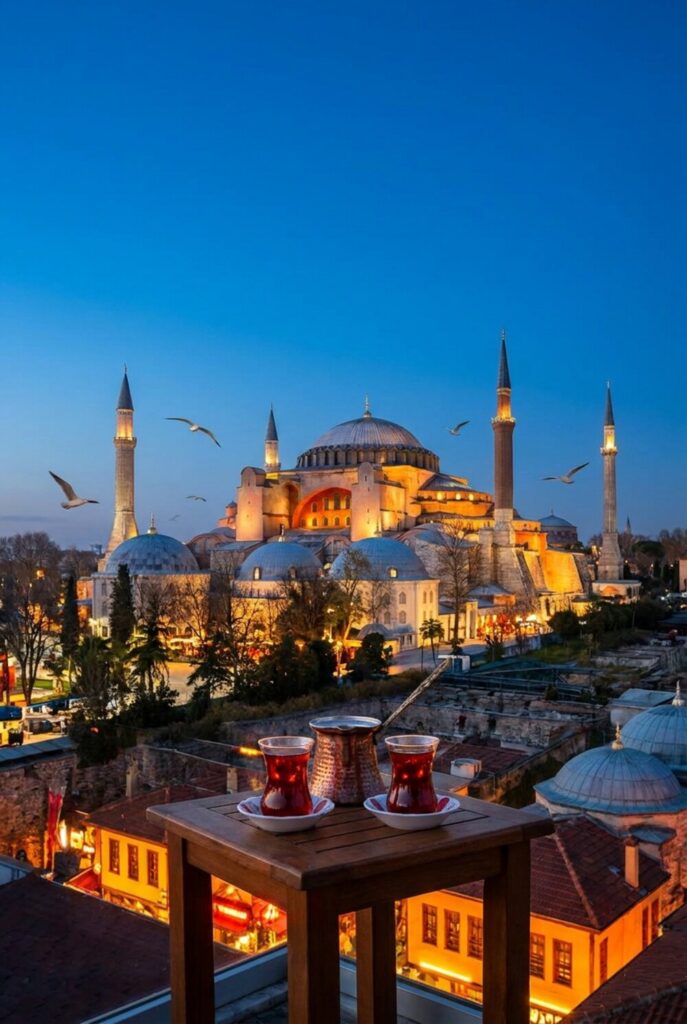
City Guide · Turkey · Marmara · Eurasia
Istanbul, Turkey: Two-Continent Capital, Bosphorus Crossroads, 1,693-Year Imperial Stage
Part of our Turkey travel guide.
I have lost more afternoons in Istanbul than in any other city on the FFU desk, and I keep going back. We tell first-timers that Istanbul is not really one city — it is three: the historic peninsula of Sultanahmet on the European side , the 19th-century Beyoğlu hill above Galata , and the quieter Asian shore from Kadıköy down to Üsküdar . My favourite ritual is a 7am simit and çay on a Bosphorus ferry from Karaköy to Kadıköy , watching the Asian skyline come up out of the haze. The city ships 15.9 million people across 39 districts straddling two continents and a Marmaray rail tunnel that crosses the Bosphorus in 4 minutes flat . Treat this guide as the brief I would hand my own family the night before they cleared IST passport control.

Table of Contents
Why Istanbul?
Istanbul is the only city on Earth straddling two continents and the largest city in Europe by population at 15.9 million across 39 districts in the 2024 TÜİK address-based census . Continuously inhabited since the seventh century BCE, the city has been the capital of Rome (refounded as Constantinople in 330 CE), of the Byzantine Empire for 1,123 years, and of the Ottoman Empire for 469 years; the modern Republic of Turkey moved the capital to Ankara in 1923 but Istanbul remained the cultural, financial and demographic centre of the country.
What makes Istanbul different from any other historic capital is that the imperial-monumental layer is still in daily use. Hagia Sophia is an active mosque again as of July 2020 , the Grand Bazaar’s roughly 4,000 shops still trade six days a week , the 17th-century Spice Bazaar still sells saffron, sumac and Turkish delight , and Bosphorus ferries still connect the European and Asian shores on the same routes Byzantine fishermen used . UNESCO listed the Historic Areas of Istanbul as a World Heritage site in 1985, covering the Hippodrome, Süleymaniye, Zeyrek and the Theodosian land walls in a single inscription that remains the densest UNESCO concentration in any European capital .
Istanbul Airport (IST) opened in 2018 as the world’s largest single-terminal airport and the Marmaray underwater rail tunnel (2013) connects the European and Asian sides under the Bosphorus in a 4-minute ride between Sirkeci and Üsküdar . Sabiha Gökçen (SAW) on the Asian side handles the low-cost-carrier traffic, including Pegasus and SunExpress. Plan five full days minimum: three for the historic peninsula and Beyoğlu, one for the Asian side, one for the Princes’ Islands or a long Bosphorus tour. The all-mode İstanbulkart unifies metro, tram, ferry, funicular, Marmaray and city bus on a single contactless card .
Best Time to Visit Istanbul
Istanbul is a four-season Marmara city with a mild damp winter, a hot humid summer, and two excellent shoulder windows. The Turkish State Meteorological Service (MGM) publishes monthly climate normals for the city: January averages 6°C with frequent rain, July averages 25°C with peaks above 33°C and high humidity off the Marmara, and the two windows worth re-arranging your year around are mid-April through May (tulip season) and mid-September through October (clear and mild) .
Spring (March – May)
The best window for first-time visitors. April runs the city-wide tulip festival across Emirgan, Gülhane and Sultanahmet — around 30 million bulbs in bloom for the month, the Ministry of Culture & Tourism’s flagship spring event since 2005 . Average temperatures climb 10°C to 20°C through April; cherry and Judas-tree blossom along the Bosphorus mid-April. Hotel rates 25–35% above winter but well below July. The 2026 festival runs 1–30 April with Emirgan Park as the main concentration .
Summer (June – August)
Hot and humid. July averages 25°C with peaks above 33°C and high Marmara humidity. Sultanahmet queues are at their longest; ferries are at full capacity through Saturday weekends. The compensation is 14-hour daylight, the Bosphorus swimming season at the Princes’ Islands, and a packed open-air festival calendar — the Istanbul Music Festival in June and the Istanbul Jazz Festival in July, both run by IKSV . Pack linen, a sun hat and a refillable bottle.
Autumn (September – November)
The other excellent window. Average temperatures fall 25°C to 12°C across the season . September is essentially a second summer with thinner crowds; October and November bring photogenic Bosphorus mist and the autumn-leaf turn at Belgrad Forest and Yıldız Park. The Istanbul Biennial returns mid-September 2026 (verify dates on the IKSV page) and is the city’s signature contemporary-art moment.
Winter (December – February)
Wet and chilly. January averages 6°C with frequent rain and the occasional snow event. The compensation: hammam season is at its peak, mosques are blissfully empty, hotel rates are 30–40% below summer, and the Çemberlitaş Hamamı (1584) has zero queue. Pack a real waterproof; the Bosphorus wind cuts. The Istanbul New Year fireworks light the Galata Tower hill and the entire Beyoğlu skyline on 31 December.
Getting There — IST, SAW, Marmaray and the e-Visa
Istanbul has two international airports. Istanbul Airport (IST), on the European side near Arnavutköy, opened in 2018 as the world’s largest single-terminal airport and is Turkish Airlines’ global hub . The M11 metro line connects IST to Halkalı / Göktepe in 41 minutes for TL 70 with İstanbulkart, with onward Marmaray rail to Sirkeci (Sultanahmet) . The HAVAİST shuttle bus reaches Taksim in roughly 90 minutes for TL 280 and is the simplest option with three or more checked bags . Sabiha Gökçen (SAW) on the Asian side handles Pegasus, SunExpress and most low-cost European and Gulf carriers; the M4 metro extension and HAVABÜS coach reach Kadıköy in 60–75 minutes.
The 13.6 km Marmaray rail tunnel under the Bosphorus connects the European and Asian sides between Sirkeci and Üsküdar in 4 minutes, with through-services to Halkalı and Gebze; trains run every 4–10 minutes throughout the day and accept İstanbulkart at TL 22 per ride . The Marmaray completed in 2013 and is the fastest cross-Bosphorus mode at peak.
The Republic of Turkey e-Visa portal handles single-entry tourist visas for ~70 nationalities including the United States, the United Kingdom, Australia and Canada at $50 (apply 24–72 hours before flying) . Schengen passport-holders, including most EU nationals, are visa-free for stays up to 90 days within any 180-day period; the Ministry of Foreign Affairs page is the canonical reference for the visa-required, e-Visa-eligible and visa-free lists . Entry stamp validity is checked at the gate; over-stays are fined at exit.
Getting Around — Metro, Tram, Marmaray, Ferries
Walking
Sultanahmet itself is genuinely walkable — Topkapı to the Blue Mosque to the Grand Bazaar fits inside 1.2 km . The hill from Karaköy up to Galata (and on to İstiklal) is the steepest you will face; take the F2 funicular (Karaköy to Tünel) if knees object — the 600-metre line opened in 1875 and is the second-oldest underground urban transit in the world after London.
Metro & Tram
Istanbul Metro runs 11 main lines (M1A/B through M11) plus two funiculars (F1 Taksim–Kabataş, F2 Karaköy–Tünel) and three nostalgic trams — the İstiklal red tram, the Kadıköy–Moda tram, and the heritage tram on the historic peninsula . The T1 tram (Kabataş–Bağcılar) is the visitor’s lifeline — Sultanahmet, Eminönü, Karaköy and Kabataş are all on it. Single fare TL 22 with İstanbulkart in 2026 (verify on site). The M2 line connects Taksim–Şişhane (Beyoğlu)–Vezneciler (Süleymaniye-side)–Yenikapı (Marmaray interchange) and is the metro line travellers use most.
İstanbulkart (Prepaid Transit)
The all-in-one transit card — works on metro, tram, ferry, funicular, Marmaray, public bus, and the Princes’ Islands ferries. Buy at IST or SAW kiosks, any metro station or every corner kiosk for TL 70 deposit + load . One card pays for up to five passengers (each tap is one fare), so a couple shares one card. Top up at vending machines at every metro entrance, at corner kiosks, or via the İstanbulkart mobile app.
Marmaray
The 13.6 km Bosphorus rail tunnel runs every 4–10 minutes between Halkalı and Gebze, crossing the strait in 4 minutes between Sirkeci (Sultanahmet) and Üsküdar — the fastest cross-Bosphorus mode at peak hours . Trains accept İstanbulkart at the standard TL 22 fare; bicycles permitted off-peak. The tunnel completed in 2013 and is the world’s first standard-gauge intercontinental rail tunnel.
Airport Access
- IST → Halkalı: M11 metro, 41 minutes, TL 70 with İstanbulkart. Onward to Sirkeci/Sultanahmet via Marmaray.
- IST → Taksim: HAVAİST shuttle bus, 90 minutes, TL 280.
- SAW → Kadıköy: HAVABÜS or M4 metro extension, 70 minutes, TL 200 / TL 70.
Ferries (Şehir Hatları)
Six core public ferry lines link the European and Asian shores — Eminönü–Kadıköy, Karaköy–Kadıköy, Beşiktaş–Üsküdar, Eminönü–Üsküdar, Kabataş–Üsküdar, plus Bostancı–Princes’ Islands . Fares TL 22–50 with İstanbulkart. The Eminönü–Kadıköy crossing at sunset is the city’s best evening transit and arguably the cheapest 25-minute Bosphorus tour money can buy.
Taxis
Yellow city taxis are metered (drop fare TL 21, then TL 17 per km). Insist on the meter (‘taksimetre’). BiTaksi (the local app) and Uber both operate but in 2024–2025 routinely match riders to the same yellow taxi fleet at the same metered fares. Sultanahmet to Taksim runs around TL 280–360.
Navigation Tips
Apps: Mobiett (live IETT bus + metro tracker), Şehir Hatları (ferry timetable), İBB CepTrafik (live traffic). Google Maps works fine but routinely under-estimates ferry options. Friday afternoon traffic is brutal; switch to Marmaray or ferry between 16:00 and 19:00.
Neighborhoods: Finding Your Istanbul
📍 Istanbul Map: Every Place in This Guide
Sultanahmet (Historic Peninsula / Fatih)
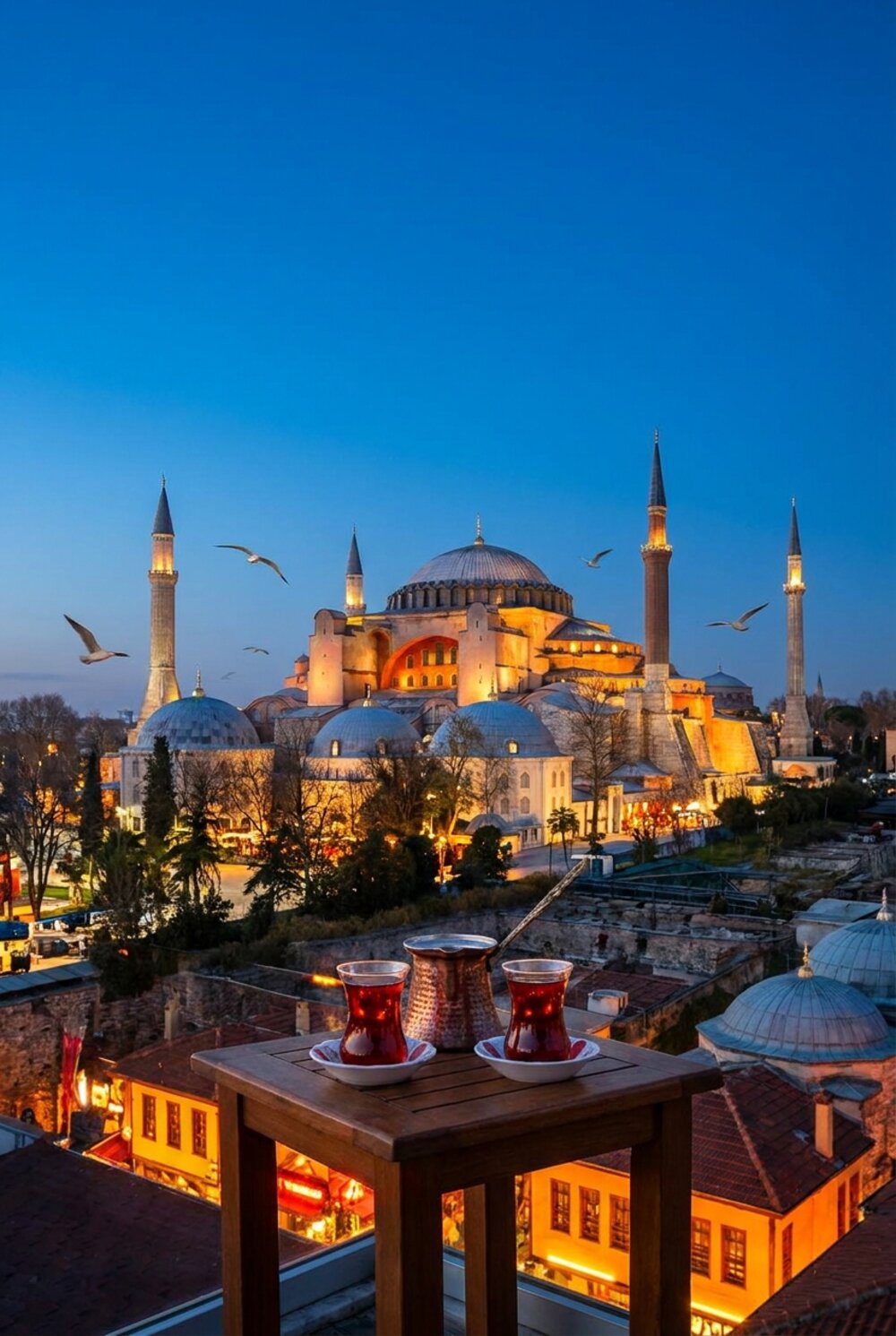
The 1,500-year imperial stage — Hagia Sophia, Topkapı Palace, the Blue Mosque, the Basilica Cistern and the Hippodrome are all within a 600-metre walking radius. Most first-time visitors base here for the morning openings. The downside is dinner: Sultanahmet’s evening restaurant scene is heavily tourist-priced; the locals eat in Beyoğlu or Kadıköy.
- Hagia Sophia Grand Mosque (Ayasofya) — 537 CE Justinian basilica, since 2020 a working mosque again
- Topkapı Palace Museum — Ottoman residence 1465–1856, Treasury, Harem, sacred relics
- Sultanahmet (Blue) Mosque — 1616 Ahmed I imperial mosque with İznik tiles
Best for: first-time arrivals, monument density. Access: T1 tram to Sultanahmet stop.
Beyoğlu & Galata
The 19th-century European-quarter hill north of the Golden Horn — İstiklal Caddesi (the pedestrianised main artery), Galata Tower, the Pera Museum, and Cihangir’s café streets. The city’s bar, bookshop, gallery and live-music density is here. Stay in Galata or Cihangir for evenings; ten-minute funicular and tram to Sultanahmet for mornings.
- Galata Tower (Galata Kulesi) — 14th-century Genoese watchtower with panoramic deck
- Pera Museum — Suna and İnan Kıraç Foundation collection, Orientalist paintings
- İstiklal Caddesi — 1.4 km pedestrian boulevard with the historic red Nostalgic Tram
Best for: nightlife, dinner, contemporary culture. Access: M2 metro to Şişhane, F2 funicular up from Karaköy.
Karaköy & Galataport
The reborn waterfront below Galata. The 2021 Galataport redevelopment turned the old port quarter into a 1.2 km cruise-and-promenade strip with the relocated Istanbul Modern museum, restaurants and the Galata Bridge fish-sandwich (balık ekmek) boats moored upstream. Walk from here to Sultanahmet across the bridge in 15 minutes.
- Istanbul Modern (Galataport) — Türkiye’s flagship contemporary-art museum, reopened 2023 in a Renzo Piano building
- Galata Bridge — two-level Eminönü–Karaköy crossing, fish sandwiches on the lower deck
- Karaköy Lokantası and Karaköy Güllüoğlu (since 1949) — anchor lunch addresses
Best for: contemporary art, walking the Bosphorus edge. Access: T1 tram to Karaköy stop.
Kadıköy & Moda (Asian Side)
The Asian shore neighbourhood that feels closest to a real local Istanbul — the Kadıköy fish market, Yeldeğirmeni’s painted streets, Moda’s seafront promenade, and a café-bar density that beats Beyoğlu for prices. Take the 25-minute Şehir Hatları ferry from Eminönü or Karaköy. Most visitors come for an afternoon and end up wishing they had stayed.
- Kadıköy Fish Market (Kadıköy Çarşı) — open seven days, anchored by Çiya Sofrası
- Moda seafront — sunset promenade with Bosphorus and Princes’ Islands views
- Yeldeğirmeni — gentrified pre-Republican quarter, painted houses, indie cafés
Best for: local Istanbul, dinner, market lunches. Access: Şehir Hatları ferry from Eminönü/Karaköy or Marmaray rail.
Eminönü & the Spice Bazaar
The historic-peninsula waterfront where the Galata Bridge lands — anchor of the Egyptian (Spice) Bazaar (1664), the Yeni Cami (New Mosque, 1665), and the Eminönü ferry terminal. The bazaar is smaller than the Grand Bazaar but more food-focused: saffron, sumac, Turkish delight, dried fruit, lokum and Iranian saffron.
- Egyptian Spice Bazaar (Mısır Çarşısı) — 1664 covered food market, 88 shops
- Yeni Cami (New Mosque) — 1665 Ottoman imperial mosque on the Eminönü waterfront
- Galata Bridge balık ekmek boats — TL 100 grilled-fish sandwich
Best for: spice shopping, lunchtime balık ekmek, ferry transfers. Access: T1 tram to Eminönü.
Beşiktaş & Ortaköy
The European Bosphorus quarter north of Beyoğlu — Dolmabahçe Palace (the late-Ottoman Westernised palace, 1856), Beşiktaş football club, the Ortaköy waterside and its photogenic mosque framing the Bosphorus Bridge. A favourite for evening waterfront walks and weekend kumpir (loaded baked potato) at Ortaköy. Beşiktaş is the home of the BJK football club — a Saturday match-day at Vodafone Park is one of the loudest sport experiences in Europe .
- Dolmabahçe Palace — 1856 Sultan’s Westernised palace, four-tonne crystal chandelier
- Ortaköy Mosque (Büyük Mecidiye) — 1856 neo-Baroque waterfront mosque
- Beşiktaş Square — ferry to Üsküdar, Saturday market, the BJK stadium
Best for: palaces, waterfront sunset, kumpir, football. Access: Bus or M2 metro to Vezneciler then Kabataş tram.
Üsküdar (Asian Side, Historic)
The other Asian-side neighbourhood — older, quieter, more religious in feel than Kadıköy. The Maiden’s Tower (Kız Kulesi, just offshore), Mihrimah Sultan Mosque (Mimar Sinan, 1548), and the Şemsi Pasha Mosque on the waterfront. Üsküdar’s tea gardens at sunset look directly at Topkapı Palace across the Bosphorus.
- Maiden’s Tower (Kız Kulesi) — restored 2023, ferry-only access from Salacak
- Mihrimah Sultan Mosque — Mimar Sinan’s 1548 imperial mosque on Üsküdar’s hill
- Çamlıca Hill (TV tower viewpoint) — the highest point on the Asian side
Best for: sunset photography, quieter Asian-side mornings. Access: Şehir Hatları ferry from Eminönü or Marmaray to Üsküdar.
Balat & Fener
The painted-houses, Greek-Orthodox-Patriarchate quarter on the Golden Horn’s northern shore — Istanbul’s most-Instagrammed neighbourhood since 2018, but still one of the city’s poorest. The Ecumenical Patriarchate of Constantinople, the Bulgarian Iron Church (Sveti Stefan, 1898), Chora (Kariye) Mosque with its Byzantine mosaics. Lunch at Forno or Cooklife.
- Chora (Kariye) Mosque — 11th-century Byzantine church with restored 14th-century mosaics
- Ecumenical Patriarchate of Constantinople (Fener) — seat of Eastern Orthodoxy
- Sveti Stefan Bulgarian Iron Church — 1898 prefabricated cast-iron church on the Golden Horn
Best for: photography, Byzantine art, weekend lunches. Access: bus 99 from Eminönü or 30-minute walk from Sultanahmet.
Princes’ Islands (Adalar)
The nine-island archipelago in the Sea of Marmara is technically a district of Istanbul rather than a day-trip; Büyükada, Heybeliada, Burgazada and Kınalıada are the four with public-ferry stops . Cars banned since 1923 (electric vehicles only since 2020); the islands run on bicycles, e-scooters and walking. 90 minutes from Kabataş or Eminönü, TL 50 with İstanbulkart, and a clean break from the city’s noise.
- Büyükada — the largest, walkable end-to-end in three hours; the 19th-century Çankaya hilltop is the canonical viewpoint
- Heybeliada — the second-largest, the disused Greek Theological School of Halki on the highest hill
- Burgazada — the quietest of the four, painted timber houses, Sait Faik Abasıyanık Museum
Best for: half-day Bosphorus escape, bicycle riding, ferry photography. Access: Şehir Hatları from Kabataş or Bostancı.
The Food
Istanbul is the easiest city in the world to taste the genuine Turkish pantry — a long Ottoman-imperial repertoire that rewards eating slowly and across multiple meals. The classics anchor every itinerary; the regional variations follow. The 2020s broadened the city’s food map well beyond the canon — modern Anatolian tasting menus, third-wave coffee, contemporary fish bars and a Michelin-starred crop since the guide’s 2022 Istanbul launch .
Turkish Breakfast (Kahvaltı)
The two-hour Turkish breakfast is the meal that ate the morning. The full serpme kahvaltı spread runs to 12–20 small plates — menemen (eggs scrambled with tomato and pepper), beyaz peynir (white sheep cheese), kaymak (clotted cream) with honey, sucuk (spiced sausage), olives, tomatoes, cucumbers, simit (sesame ring bread), börek pastry layers, and unlimited çay . Best at Van Kahvaltı Evi (Cihangir) or Privato (Galata) for around TL 380–520 per person; the meal genuinely takes two hours.
Turkish Classics, Done Properly
- Çiya Sofrası (Kadıköy) — chef Musa Dağdeviren’s Anatolian-regional kitchen, the most influential Istanbul restaurant of the 21st century. Mains TL 220–360 (~$7–11).
- Karaköy Lokantası (Karaköy) — pastel-tiled Ottoman tradesmen’s lunch hall, esnaf classics. Set lunch around TL 380.
- Hacı Abdullah (Beyoğlu, since 1888) — the oldest restaurant in Istanbul, Ottoman palace cuisine. Mains TL 280–500.
Kebab, Köfte & Lahmacun
Istanbul absorbs every regional kebab tradition Anatolia produces — Adana, Urfa, Iskender, çağ, beyti — and runs them at price points the rest of Europe cannot match. Köfte is the everyday Tuesday-night meal; lahmacun (a thin minced-meat flatbread) is the equivalent of pizza .
- Hamdi Restaurant (Eminönü) — five-floor terrace overlooking the Galata Bridge, signature pistachio kebab. Mains TL 260–420.
- Sultanahmet Köftecisi Selim Usta (Sultanahmet, since 1920) — köfte set with piyaz and ayran, ~TL 280.
- Halil Lahmacun (Beyoğlu) — TL 90 lahmacun, open until 3 a.m.
Balık Ekmek & Pide & Simit
Istanbul’s three street-food anchors. Balık ekmek (grilled-fish-in-bread) sandwiches are sold from the painted boats moored at Galata Bridge’s Eminönü side — hot mackerel, sliced onion, lemon, salt, TL 100, eaten standing on the quay. Pide is the canoe-shaped Turkish flatbread (think Turkish pizza without tomato); the kayseri version with kaymak-and-honey is breakfast-adjacent. Simit is the sesame-encrusted ring bread sold from red push-carts on every Sultanahmet corner for TL 20 — the morning ritual.
Künefe, Baklava and the Sweet Course
Turkish desserts are their own continent. Künefe (shredded pastry layered with unsalted Hatay cheese and orange-blossom syrup, served hot) is the headline dessert; the best version in Istanbul is at Hatay Has Konya Mut Mevlana on Fındıkzade. Baklava at Karaköy Güllüoğlu (since 1949) is Istanbul’s defining counter at TL 90 per slice . Lokum (Turkish delight) is best from Hacı Bekir on İstiklal — the original 1777 recipe, dozens of fillings, TL 250–380 per box.
Turkish Coffee & Tea Culture (UNESCO ICH)
Turkish coffee culture and tradition was inscribed on UNESCO’s Representative List of the Intangible Cultural Heritage of Humanity in 2013 . The coffee is made in a copper cezve, brewed unfiltered with very fine grounds; the foam is the test of a properly-made cup. Çay (black tea) is the everyday drink — served in small tulip-shaped glasses with two sugars, refilled constantly in shops and offices. The Grand Bazaar’s tea-runners sprint between stalls with stacked trays; refusing politely is fine but accepting opens a bargaining conversation rather than committing you to buy.
Modern Anatolian & Michelin (since 2022)
- Mikla (Beyoğlu, Marmara Pera rooftop) — Mehmet Gürs’s New Anatolian tasting menu, Michelin-starred. Around TL 4,800 / ~$140.
- Neolokal (Karaköy, SALT Galata) — contemporary Anatolian, Michelin-starred. Around TL 3,800.
- Balıkçı Sabahattin (Sultanahmet) — old-school meyhane fish-bar, raki and meze. Around TL 1,400/head.
- Karaköy Güllüoğlu (since 1949) — Turkey’s defining baklava counter, TL 90/slice.
Food Experiences You Cannot Miss
- A two-hour Turkish kahvaltı (breakfast) at Van Kahvaltı Evi or Privato — TL 380–520 per person, the meal that ate the morning
- A balık ekmek (grilled-fish sandwich) on the Galata Bridge boats, TL 100 — eat standing
- The Saturday morning Beşiktaş market for fresh produce and sucuk
- A Turkish coffee at any Galata kahve in front of the tower — the unfiltered cup is the calibration
Cultural Sights
Hagia Sophia Grand Mosque (Ayasofya)
The Justinian basilica completed 537 CE, converted to a mosque after 1453, secularised as a museum in 1934, and reconverted to an active mosque in July 2020 . Entry to the prayer hall is free outside the five daily prayer windows; a paid upper-gallery ticket (since January 2024 around €25 / TL 950 for foreigners, verify on site) covers the gallery and the Byzantine mosaics. Modest dress; women given headscarves at the entrance.
Topkapı Palace Museum
The Ottoman Sultans’ principal residence 1465–1856 — four courtyards, the Imperial Treasury (Topkapı Dagger and the Spoonmaker’s 86-carat diamond), the Sacred Relics Pavilion (Prophet Muhammad’s mantle and standard), and the Harem (separate ticket) . Adult ticket TL 1,500 in 2026 (verify on site); plan four hours.
Sultanahmet (Blue) Mosque
Sultan Ahmed I’s 1616 imperial mosque facing Hagia Sophia across Sultanahmet Square. Six minarets (a deliberate provocation of Mecca that required adding a seventh to the Holy Mosque), 20,000 hand-painted İznik tiles, and one of the most photographed interiors in Istanbul. Free entry outside prayer windows .
Basilica Cistern (Yerebatan Sarnıcı)
The 6th-century Justinian-era underground reservoir under Sultanahmet — 336 marble columns including two upended Medusa-head capitals. Reopened in 2022 after extensive restoration . Adult TL 800 in 2026 (verify on site); 30 minutes is enough.
Grand Bazaar (Kapalıçarşı)
Mehmed II founded the bazaar in 1455; today’s covered market has roughly 4,000 shops on 64 streets, around 26,000 daily workers and 250,000–400,000 daily visitors . Open Monday through Saturday 09:00–19:00; closed Sunday and during religious holidays. Bargain in the rug, lamp and silver streets; jewellers and antique sellers post fixed prices.
Süleymaniye Mosque
Mimar Sinan’s 1557 masterpiece — the largest Ottoman imperial mosque in Istanbul, on the Third Hill . Sinan considered it his apprenticeship work; he later said the Selimiye in Edirne was his masterpiece. The mosque complex (külliye) includes a hospital, a soup kitchen and the tombs of Süleyman the Magnificent and his wife Hürrem Sultan. Free, dawn–dusk outside prayer.
Dolmabahçe Palace
The late-Ottoman Westernised palace built 1843–1856 to replace Topkapı, on the European Bosphorus shore in Beşiktaş. Atatürk died here on 10 November 1938; clocks across the palace are still set to 09:05, the time of his death . Selamlık + Harem combined ticket TL 1,650 in 2026 (verify on site); guided-only entry.
Chora (Kariye) Mosque
The 11th-century Byzantine Church of the Holy Saviour in Chora, in Edirnekapı (north-west Fatih), holds the most complete cycle of 14th-century Byzantine mosaics and frescoes anywhere — restored 1948–1958, reconverted to a mosque in 2020 . Free; modest dress. The mosaics rival Ravenna and are the single best Byzantine-art destination in the city.
Istanbul Archaeological Museums
Three buildings inside the Topkapı outer wall — the main Archaeology Museum, the Museum of the Ancient Orient, and the Tiled Pavilion (Çinili Köşk) . The Alexander Sarcophagus, the Treaty of Kadesh tablet, and 800,000 artefacts from across the former Ottoman territories. Adult TL 850 in 2026 (verify on site).
Istanbul Modern (Galataport)
Türkiye’s flagship contemporary-art museum, originally opened 2004 in a converted Karaköy warehouse, reopened in May 2023 in a purpose-built Renzo Piano building on the Galataport waterfront . The permanent collection covers Turkish modernism from the 1900s to the present; rotating exhibitions and a rooftop reflecting pool with Bosphorus views. Adult TL 600 in 2026 (verify on site).
Entertainment
Meyhane & Raki Culture
The meyhane is Istanbul’s defining institution — a long-table eating-and-drinking house centred on raki and a parade of cold meze plates. Nevizade, off İstiklal, holds the highest concentration; Asmalı Mescit and Kadıköy’s Kadife Sokak are quieter alternatives. Around TL 900–1,400 per person for a full evening with two raki and 12 meze.
Live Music
Salon İKSV (the Istanbul Foundation for Culture and Arts venue) is the city’s flagship indoor stage ; Babylon (Bomontiada) handles indie and electronic; Nardis Jazz Club in Galata is the long-running jazz address; Zorlu PSM in Levent is the 5,000-seat for international tours .
Bosphorus Sunset Cruise
The non-negotiable Istanbul evening — a 90-minute Bosphorus cruise from Eminönü or Kabataş up to the Second Bridge and back. Şehir Hatları runs the official 3-hour Bosphorus Tour (TL 100 with İstanbulkart, TL 250 cash) twice daily; private operators charge TL 700–1,500 .
Hammam (Turkish Bath)
Çemberlitaş Hamamı (1584, Mimar Sinan) and Kılıç Ali Paşa Hamamı (1583, restored 2012) are the two best historic working hammams . Around TL 1,800–3,200 for the full self-service-plus-attendant ritual (kese scrub, soap massage, towel-wrap rest); 90 minutes.
Istanbul Tulip Festival (April 2026)
Every April since 2005, the city plants around 30 million tulips across Emirgan, Gülhane Park and Sultanahmet for a one-month bloom — the festival commemorates the 16th–18th-century Ottoman tulip mania . 2026 dates: 1–30 April; Emirgan Park is the main concentration. Free.
Football (Beşiktaş, Fenerbahçe, Galatasaray)
Istanbul’s three Süper Lig giants share the Bosphorus — Beşiktaş (Vodafone Park, European side), Fenerbahçe (Şükrü Saracoğlu, Asian side), Galatasaray (RAMS Park, Seyrantepe). Derbies are an experience and a logistical headache; check Süper Lig fixtures and book through the official club sites only .
Day Trips from Istanbul
Princes’ Islands (Adalar) — Half day, by ferry
The nine-island archipelago in the Sea of Marmara — Büyükada (the largest), Heybeliada, Burgazada and Kınalıada are the four with public-ferry stops. Cars banned since 1923 (electric vehicles only since 2020); the islands run on bicycles, e-scooters and walking. Şehir Hatları ferry from Kabataş or Eminönü, TL 50 with İstanbulkart, 90 minutes to Büyükada .
Bosphorus Full Tour (Anadolu Kavağı) — Full day, by ferry
The Şehir Hatları Long Bosphorus Tour goes Eminönü → Beşiktaş → Üsküdar → Kanlıca → Anadolu Kavağı (the last fishing village before the Black Sea), with a three-hour layover for fish lunch and the 14th-century Yoros Castle hike. TL 100 round-trip with İstanbulkart; departs 10:35 daily .
Bursa & Mount Uluğdag — Full day, by car/bus
The first Ottoman capital (1326–1365) — Green Mosque, Green Tomb, the silk Koza Han caravanserai, and the Uluğdag cable car (Türkiye’s longest, 4,752 m) up to 1,810 m for skiing in winter or hiking in summer . 2.5 hours from Istanbul via the Osmangazi Bridge across the Gulf of İzmit; high-speed ferry-and-bus combo via Yenikapı in 2.5 hours.
Edirne — Full day, by car/bus
The Ottoman second capital (1365–1453), 235 km from Istanbul on the Bulgarian border. Mimar Sinan’s masterpiece — the Selimiye Mosque (1568–1574, UNESCO 2011 inscription) — sits here . 3 hours by car or 4 hours by bus from Esenler otogar. The biennial Kırkpınar oil-wrestling tournament every June is the country’s signature traditional sport event.
İznik (Nicaea) — Half day, by car/ferry
The Roman/Byzantine city of Nicaea on the eastern shore of Lake İznik — site of the First Council of Nicaea in 325 CE (which produced the Nicene Creed) and the Second Council of Nicaea in 787 CE . The 14th–17th-century İznik tile kilns supplied the tiles for every Ottoman imperial mosque from Süleymaniye onward. 2 hours from Istanbul via the Osmangazi Bridge.
Practical Tips
Language
Turkish is a Turkic language unrelated to its Indo-European neighbours; Atatürk’s 1928 Latin-alphabet reform makes signs readable at sight. English fluency is high in Sultanahmet, Beyoğlu and tourist hotels, low in residential Asian-side and Anatolian-shore neighbourhoods. Learn ‘merhaba’ (hello), ‘teşekkür ederim’ (thank you), ‘lütfen’ (please), ‘yok’ (no, doesn’t exist).
Visa & e-Visa
Turkey runs an online e-Visa system for ~70 nationalities including the United States, the United Kingdom, Australia and Canada at $50 for a 90-day single-entry tourist visa — apply 24–72 hours before flying via the official portal . Most EU/Schengen passport-holders are visa-free up to 90 days within any 180-day period; the Ministry of Foreign Affairs maintains the canonical list of visa-required, e-Visa-eligible and visa-free nationalities .
Cash vs. Cards
Cards work everywhere — restaurants, taxis, museums, ferries (via İstanbulkart), street vendors. Always pay in lira (TL), not euros or dollars; most card terminals offer dynamic currency conversion at terrible rates. Keep TL 200–500 cash for the Grand Bazaar, simit-and-çay vendors and tipping. ATMs everywhere; the foreign-exchange shops near Tahtakale and the Grand Bazaar offer better rates than airport kiosks.
Safety
Istanbul is broadly safe by world-capital standards — petty theft (mostly distraction-and-pickpocket teams) is the genuine risk in Sultanahmet and on the T1 tram between Sultanahmet and Eminönü . The classic Istanbul scam is the friendly local who steers you to a ‘recommended’ rooftop bar where the bill comes in at TL 6,000+ — politely decline. Emergency 112; tourist police 153. The UK FCDO travel-advice page is the canonical English-language reference for current risk windows .
What to Wear
Modest dress to enter mosques — long trousers (men) or skirt-below-knees (women), shoulders covered, headscarf for women (loaned at the entrance of Hagia Sophia and Sultanahmet). Outside mosques, dress is fully Western and casual; Beyoğlu and Kadıköy are indistinguishable from Berlin or Athens. Pack a real waterproof for Mar–May and Oct–Feb; sturdy walking shoes for Sultanahmet’s cobbles.
Cultural Etiquette
Shoes off in mosques and many homes. Don’t photograph people praying. Tipping is expected — 5–10% in restaurants if service is not added; round up taxis. Tea (çay) is offered constantly in shops, especially the Grand Bazaar; refusing politely is fine but accepting opens a bargaining conversation rather than committing you to buy. Don’t show the soles of your feet in mosques.
Connectivity
4G/5G blanket coverage from Turkcell, Vodafone TR and Türk Telekom. Foreign phones registered for more than 120 days face IMEI lock — if you’ll be in Türkiye longer than four months, register your phone or pay the fee . eSIMs work everywhere; Turkcell Welcome bundle TL 590 for 30 GB / 30 days. WhatsApp is the default messaging app.
Health & Medications
Pharmacies (eczane) carry European medications; Eczane Acıbadem and Watsons are the chains . 24-hour rota pharmacies (nöbetçi eczane) post on every closed pharmacy door. Public hospital emergency care via 112 is free; private hospitals (Acıbadem, Memorial, American Hospital) bill in lira at international rates. Travel insurance recommended.
Luggage & Storage
IST has 24-hour luggage storage in International Arrivals (TL 250/day for medium) . Sirkeci railway station, the Marmaray hub closest to Sultanahmet, has Bagaj Plus lockers at TL 180/day. Most Sultanahmet hotels store bags free for guests on the day of departure.
Budget Breakdown: What Istanbul Costs in 2026
| Tier | Daily | Sleep | Eat | Transport | Activities | Extras |
|---|---|---|---|---|---|---|
| Budget | USD $45–75 | Hostel dorm TL 600–900 | Lokanta + simit TL 280–420 | İstanbulkart TL 22/ride, walking | Free mosques, Hagia Sophia upper gallery TL 950 | Çay TL 15, simit TL 20 |
| Mid-Range | USD $110–180 | 3-star hotel TL 2,500–4,200 | Sit-down dinner TL 700–1,200 | Metro + occasional taxi | Topkapı TL 1,500, Bosphorus tour TL 100, hammam TL 1,800 | Meyhane evening TL 900 |
| Luxury | USD $300+ | 5-star hotel TL 7,500–25,000+ | Mikla / Neolokal TL 4,800 | Private driver TL 4,500/day | Private Bosphorus yacht TL 14,000 | Çırağan Palace spa session TL 6,500 |
Where Your Money Goes
Istanbul is one of the cheapest world capitals for a high-quality visit, but the ranges have widened sharply with inflation: 2026 prices are roughly 5× 2019 lira prices, while USD-converted prices are roughly flat . The biggest line item for most mid-range travellers is monument tickets — Hagia Sophia upper gallery (TL 950), Topkapı (TL 1,500), Dolmabahçe (TL 1,650) and Basilica Cistern (TL 800) each price-list above EU equivalents because foreigners pay a fixed-rate ticket while Turkish citizens pay a fraction. The MüzeKart for foreigners (€135 / 5-day pass to over 300 sites) breaks even at four major monuments .
Money-Saving Tips
- Buy the MüzeKart Foreign Pass (€135 / 5 days, ~TL 5,200) — covers Hagia Sophia, Topkapı, Chora, Archaeological, Basilica Cistern.
- Eat lunch in lokantas (esnaf cafeterias) for TL 250–380, dinner only at meyhanes or Beyoğlu spots.
- Use ferries instead of the dedicated Bosphorus tour boats — TL 22 vs TL 700.
- Mosques are free; the Hagia Sophia upper gallery is the only paid mosque-like ticket.
- The annual TUIK CPI series is the best public-data anchor for tracking lira inflation between trip-planning and arrival .
Frequently Asked Questions
How many days do I need in Istanbul?
Five full days minimum. Allocate three to the historic peninsula (Sultanahmet sights + Grand and Spice Bazaars + Süleymaniye) and Beyoğlu, one to the Asian side (Kadıköy + Üsküdar), and one to a Bosphorus or Princes’ Islands day. Seven days lets you add Chora, Dolmabahçe and a meyhane evening without rushing.
Is Istanbul good for solo travellers?
Yes — petty crime is the only real risk and it is concentrated on the T1 tram and in Sultanahmet’s tourist strip. Female solo travellers report Istanbul as safe but heavier on unwanted attention than other European capitals; modest dress and a confident pace solve most of it. The Beyoğlu–Karaköy–Kadıköy circuit is fully solo-friendly day and night.
Is the İstanbulkart worth it?
Always. Single-ride tourist fares cost roughly 3× İstanbulkart fares; the card pays for itself within four trips. One card pays for up to five passengers (one tap = one fare), so a couple shares one card .
What about the language barrier?
Manageable in Sultanahmet, Beyoğlu and tourist hotels; thinner outside them. Restaurant menus in tourist zones are bilingual; in residential Kadıköy and Üsküdar, expect Turkish-only menus and pointing-and-pictures ordering. Google Translate’s camera mode handles printed Turkish well.
When are the busiest weeks?
Mid-June through August (peak European school holidays + Gulf-region escape from heat) and the entire month of April (tulip festival + spring shoulder demand). Ramadan (17 Feb – 18 Mar 2026) and the Eid weeks are softer for tourists but busier for domestic travel between cities. Avoid Republic Day (29 October) hotel weeks if you don’t want a parade-route hotel.
Can I use credit cards everywhere?
Yes. Visa, Mastercard and (less often) Amex work at restaurants, museums, taxis, hotels and most Grand Bazaar shops. Decline dynamic currency conversion at the till. Carry TL 200–500 cash for street vendors, mosque shoe-care tips and small Grand Bazaar purchases.
Is Hagia Sophia free or paid?
The prayer hall is free to all visitors outside the five daily prayer windows; the upper gallery (with the Byzantine mosaics) requires a ticket — €25 / TL 950 in 2026 for foreign visitors (verify on the official site) . Modest dress is required; women are loaned headscarves at the entrance.
Do I need an e-Visa or is Turkey visa-free?
It depends on your passport. Schengen passport-holders, including most EU nationals, are visa-free up to 90 days within any 180-day period. United States, United Kingdom, Australia and Canada travellers use the e-Visa portal at $50 for a 90-day single-entry visa . The Ministry of Foreign Affairs page is the canonical visa-status reference for every nationality. Check before flying.
Ready to Experience Istanbul?
Five days in the only two-continent capital, two Bosphorus crossings, one Princes’ Islands afternoon — that is the Istanbul rhythm. For the full country context, read the Turkey Travel Guide; for the next Mediterranean leg, pair Istanbul with Athens on a 1h 35min direct flight.
Explore More City Guides
- Athens City Guide — Mediterranean cross-empire peer, 1h 35min by direct flight
- Cairo City Guide — the other Sunni-Ottoman imperial capital, 2h 20min by direct flight
- Dubai City Guide — modern Gulf hub and Turkish Airlines partner-route capital
- Marrakech City Guide — Mediterranean Islamic sibling on the North African Ottoman edge
- Turkey Country Guide
- All City Guides
Alex the Travel Guru
Alex has been writing destination guides for FFU since 2019, with eleven Istanbul trips on the docket and one annual late-spring meyhane evening at Asmalı Mescit. Istanbul is the city Alex most often recommends to first-time intercontinental travellers — close to Europe in flight time, far from it in atmosphere. For the full country context, read the Turkey Travel Guide.
More city guides you might like
Plan your trip to Istanbul
The booking tools we use ourselves. FFU may earn a commission at no extra cost to you.
Plan & book your trip to Istanbul
Booking through these searches supports our guides at no extra cost to you.