
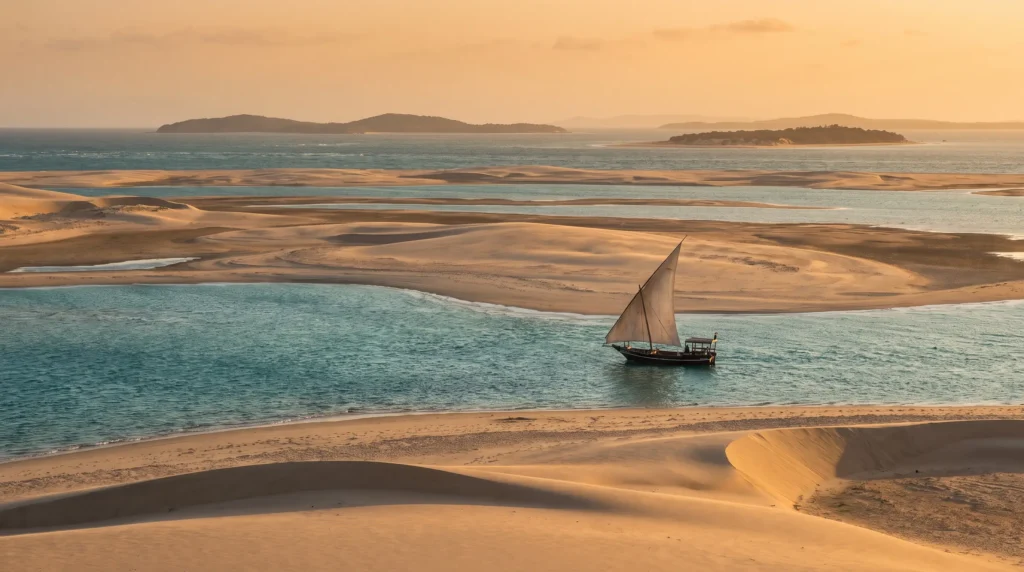
Mozambique Travel Guide — Indian Ocean Islands, Whale Sharks & a Coastline Almost Nobody Talks About
I get asked about Mozambique less than almost anywhere else I cover, and I genuinely do not understand why. This is a country with roughly 2,700 kilometres of Indian Ocean coastline, six-island archipelagos with dugongs grazing seagrass beds, a UNESCO Stone Town you can walk end to end in twenty minutes, and a national park that has clawed its way back from near-total wildlife collapse into one of the great conservation comeback stories in Africa. It is also, I will say plainly up front, a country with real logistical friction — a patchy road network, a new digital entry system still finding its feet, and a hard no-go zone in the far north that you need to know about before you book anything. None of that cancels out the rest of it. It just means Mozambique rewards a bit of homework in a way Zanzibar or the Seychelles don’t ask of you, and that homework is exactly what this guide is for.
In This Guide
- Overview — Africa’s Quiet Indian Ocean Coast
- Whale Season on the Southern Coast
- Best Time to Visit Mozambique (Season by Season)
- Getting There — MPM, Overland Borders & Domestic Flights
- Getting Around — Chapas, Charter Flights & Dhows
- Top Regions — Islands, Coast & Bush
- Culture & People — Bantu, Swahili-Arab & Portuguese Threads
- A Food Lover’s Guide to Mozambique
- Off the Beaten Path
- Practical Information
- Budget Breakdown — What Mozambique Actually Costs in 2026
- Frequently Asked Questions
Overview — Africa’s Quiet Indian Ocean Coast
Mozambique is a big country that most travelers only see a sliver of — 801,590 square kilometres running north to south along the Indian Ocean, bordered by Tanzania, Malawi, Zambia, Zimbabwe, Eswatini and South Africa. It won independence from Portugal in 1975 after over four centuries as a colony, and that Portuguese thread runs through everything: the official language, the architecture, the food, the coffee culture in Maputo’s cafés.
The headline draws sit almost entirely on or near the water. Ilha de Moçambique — a coral island barely a kilometre long, connected to the mainland by a 1960s bridge — was the capital of Portuguese East Africa until 1898 and carries a UNESCO World Heritage listing since 1991 for its extraordinary blend of Swahili-Arab, Indian and Portuguese architecture, all built from the same local limestone over five centuries. Further south, the Bazaruto Archipelago’s six islands shelter one of the last significant dugong populations on the East African coast, alongside whale sharks, manta rays and nesting sea turtles. Inland, Gorongosa National Park tells the opposite story — a wildlife population reduced by roughly 95% during the 1977–1992 civil war, now rebuilt through one of Africa’s most-watched conservation partnerships.
What Mozambique doesn’t have, outside Maputo and a handful of beach resort clusters, is developed tourist infrastructure. Roads between regions can be long and rough, information online is thinner than for neighboring Tanzania or South Africa, and a chunk of the far north is genuinely unsafe. That combination keeps prices lower than the Seychelles or Zanzibar for a comparable stretch of white sand, and keeps the good spots refreshingly empty — but it also means this is not a wing-it destination. Plan the logistics and Mozambique delivers some of the best-value, least-crowded Indian Ocean coastline left on the continent.
Whale Season on the Southern Coast
If you’re building a trip around wildlife, anchor it to Tofo Beach in Inhambane Province, one of the most reliable whale-shark and manta-ray sites in the world. Humpback whales migrate along this stretch of coast roughly June through November, with the biggest numbers and most surface activity in August and September as they head south to Antarctic feeding grounds after calving in warmer water.
Whale sharks are trickier — a resident population means sightings happen year-round off Tofo, but the plankton blooms that concentrate them peak from roughly October through March, giving you a short overlap window in October and November when both whale sharks and the tail end of humpback season are possible on the same trip. Book dives or snorkel trips through PADI-affiliated operators in Tofo or Barra; this is one of the few places on Earth where megafauna encounters this reliable don’t require a liveaboard or a long boat transfer.
Best Time to Visit Mozambique (Season by Season)
May – October · Dry, cooler season (peak)
The most comfortable months for travel countrywide — lower humidity, minimal rain, best game viewing at Gorongosa, and peak humpback whale activity on the southern coast. This is when accommodation on Bazaruto and around Vilanculos and Tofo books up furthest in advance.
November – March · Hot, wet season & cyclone risk
Heat and humidity climb, afternoon storms roll in, and this is also the core of the southwest Indian Ocean cyclone season — Mozambique’s coast has taken direct hits in recent years, so trip insurance with cyclone/weather coverage is not optional if you’re traveling December through March. On the upside, this is whale-shark peak season at Tofo and the cheapest lodge rates of the year.
April · Shoulder month
Rains taper off, landscapes are green, crowds and prices are both still low. A genuinely underrated month for the southern beach circuit if you don’t mind the occasional lingering shower.
Getting There — MPM, Overland Borders & Domestic Flights
Maputo International Airport (MPM), about 3 kilometres northwest of the capital, is Mozambique’s main gateway, with connections concentrated within Africa — Johannesburg, Cape Town, Addis Ababa, Nairobi, Dar es Salaam and Luanda — plus a handful of longer-haul links via Lisbon (TAP), Doha (Qatar Airways) and connections through Johannesburg. Most travelers from outside Africa route through Johannesburg, which has the widest global connectivity in the region — see our South Africa guide if you’re combining the two.
Overland, Mozambique shares long borders with South Africa, Eswatini, Zimbabwe, Zambia, Malawi and Tanzania, and the Maputo–Kruger/Johannesburg crossing and the Ressano Garcia border post are the most-used land routes for combining a Mozambique beach add-on with a southern Africa safari trip. Domestically, LAM (Linhas Aéreas de Moçambique) and smaller charter operators connect Maputo to Vilanculos, Beira, Pemba, Nampula and Inhambane — often faster and more reliable than the long coastal road.
Getting Around — Chapas, Charter Flights & Dhows
Mozambique is roughly 2,700 kilometres tip to tip along the coast, and the road network, while improving, still makes long overland transfers slow. Domestic flights are the practical way to link the main hubs — Maputo to Vilanculos or Pemba runs a couple of hours versus a very long, occasionally rough drive.
Within a region, shared minibuses called chapas are the backbone of local transport — cheap, frequent, and an experience in themselves, though not built for tight schedules or heavy luggage. Rental cars and self-drive are workable in the south (Maputo–Inhambane is a decent paved road) but a 4×4 is genuinely necessary once you head toward Gorongosa or the more remote coast. To reach island destinations like Ilha de Moçambique or the Bazaruto and Quirimbas archipelagos, expect a mix of causeway/bridge crossings, motorized boats, and traditional dhows for shorter hops.
Top Regions — Islands, Coast & Bush
Maputo
The capital: wide Portuguese-era avenues, jacaranda-lined streets, a lively café and live-music scene, and the country’s best restaurants. Most visitors use it as an entry point and a night or two of urban culture rather than a long stay.
Ilha de Moçambique (Mozambique Island)
A UNESCO World Heritage Site since 1991, this coral island packs Swahili-Arab, Indian and Portuguese architecture — including what’s considered the oldest European building in the Southern Hemisphere — into a walkable historic core connected to the mainland by a 1960s bridge. Quiet, atmospheric, and still far off the mass-tourism radar.
Bazaruto Archipelago & Vilanculos
Six islands forming a marine national park since 1971, home to one of East Africa’s last significant dugong populations plus whale sharks, manta rays and turtles. Vilanculos on the mainland is the main jump-off point, with dhow transfers and light-aircraft charters out to the island lodges.
Tofo & Barra (Inhambane Province)
The country’s diving and marine-life capital — whale sharks, manta cleaning stations, and humpback whales in season, plus a laid-back backpacker-to-boutique beach scene that’s the most developed on the coast after Maputo.
Gorongosa National Park
Central Mozambique’s flagship park, a near-4,000-square-kilometre ecosystem at the southern end of the Great Rift Valley that lost roughly 95% of its large mammals during the civil war and has been rebuilt since 2004 through a partnership between the government and the Carr Foundation — lions, elephants, reintroduced wild dogs and leopards, and over 500 bird species.
Quirimbas Archipelago & Pemba
A remote, coral-reef-fringed archipelago in the far north with some of the most exclusive private-island lodges on the coast — genuinely worth it, but this region sits adjacent to areas under active government travel advisories (see Practical Information), so confirm current conditions before booking.
Beira & the Central Coast
A working port city and gateway to Gorongosa, with less polish than Maputo but useful as a logistics hub for the central region.
Culture & People — Bantu, Swahili-Arab & Portuguese Threads
Mozambique’s population is overwhelmingly Bantu in origin, spread across dozens of ethnic and linguistic groups — Makhuwa in the north, Sena and Ndau in the centre, Tsonga in the south, among many others — with Portuguese as the official and unifying language of government, education and most signage. Christianity is the largest religious grouping at roughly 62%, with Islam around 19%, concentrated especially along the northern coast where a millennium of Swahili-Arab trade contact left a deep imprint on architecture, food and language.
That trade history is most visible on Ilha de Moçambique, where the same Indian Ocean routes that carried Arab merchants, Vasco da Gama’s fleet in 1498, and later Portuguese colonial administration all left overlapping layers still standing side by side. Music and dance vary sharply by region — marrabenta guitar music from the south has genuine national-pop status, while northern coastal towns carry more taarab and Swahili-influenced rhythms. As with anywhere still rebuilding tourism infrastructure, ask before photographing people or religious sites, and expect Portuguese (not English) to be the most useful second language to know a few phrases of.
A Food Lover’s Guide to Mozambique
Mozambican food is Portuguese technique meeting Indian Ocean and Bantu ingredients, and the national dish makes that plain: piri-piri chicken (frango à zambeziana or frango piri-piri), grilled and basted in a fiery chili-and-garlic sauce that Mozambique claims as its own export to the world via Portugal. Seafood is the other constant — prawns (camarão) the size of your palm, grilled or in a garlic-butter sauce, are the coastal signature, alongside grilled fish, crab and squid sold fresh off the boats in places like Tofo and Vilanculos.
Matapa — cassava leaves stewed with ground peanuts, garlic and often crab or shrimp, served over rice — is the comfort-food staple worth seeking out inland as much as on the coast. Coconut milk turns up constantly, especially in the north where the Swahili-Arab influence runs strongest. Portuguese-style bread rolls, strong coffee and pastel de nata-style pastries reflect the colonial-era café culture still thriving in Maputo, and the local beer, 2M (Dois Ems), is everywhere and cheap.
Off the Beaten Path
Niassa Special Reserve
One of Africa’s largest protected wilderness areas, in the remote far north — exceptional for wildlife density and total lack of crowds in the parts that are open, but confirm current safety guidance before planning a trip here, as some northern districts carry active government travel advisories.
Chimanimani National Reserve
Mountainous border terrain with Zimbabwe, cooler highland scenery, waterfalls and hiking that feels nothing like the coastal image most people have of Mozambique.
Ibo Island (Quirimbas Archipelago)
A crumbling, atmospheric former colonial trading post known for silversmiths working in a centuries-old style, reachable by boat and light aircraft — a genuine “nobody I know has been here” destination for travelers who make it work logistically.
Inhaca Island
A short boat ride from Maputo, popular as a day or weekend trip for marine biology research stations, snorkeling and a much quieter beach scene than the mainland capital.
Practical Information
Visas. Mozambique moved to a new eVisa/electronic travel authorisation system in early 2026, replacing the older visa-on-arrival assumptions many guides still repeat online — apply through the official evisa.gov.mz portal well before departure rather than counting on arrival processing.
Money. The Mozambican metical (MZN, symbol MT) trades at roughly 64 to the US dollar as of mid-2026; carry cash for chapas, markets and rural areas, as card acceptance is limited outside Maputo, Vilanculos and resort properties.
Safety. As of mid-2026, the US State Department rates Mozambique Level 2 (exercise increased caution), citing crime, civil unrest and terrorism risk, and specifically advises against all travel to Cabo Delgado Province, the Niassa Special Reserve area of Niassa Province, and the Memba and Erati districts of Nampula Province due to active terrorism threats. The UK FCDO advises against all travel to most of Cabo Delgado (with exceptions for Palma town, Pemba and the Afungi area, rated “all but essential travel only”) plus parts of Nampula and Niassa. The southern coast — Maputo, Inhambane, Tofo, Vilanculos, Bazaruto — sits well outside these zones, but check current advisories before finalizing any itinerary that goes north of Pemba, and avoid non-emergency travel after dark generally.
Health. Malaria risk exists countrywide; talk to a travel clinic about prophylaxis well before you go, and pack strong repellent. Hepatitis A and typhoid vaccines are commonly recommended, yellow fever vaccination is required only if arriving from an endemic country, and avoid swimming in untreated freshwater due to schistosomiasis risk.
Connectivity & practicalities. A local SIM or regional eSIM is worth arranging in Maputo; connectivity thins out fast on islands and in reserves. Plugs: mostly South African/European-style round-pin (Type M/C/F varies by building age). Time zone: UTC+2, no daylight saving.
Budget Breakdown — What Mozambique Actually Costs in 2026
Mozambique undercuts the Seychelles and most of Zanzibar’s upscale resort belt, while still charging a premium for the remote island lodges that are its biggest draw.
Budget (US$40–80/day): Backpacker lodges in Tofo or Maputo, chapa transport, market and street-food meals, snorkeling over dive trips.
Mid-range (US$120–250/day): Boutique guesthouses in Vilanculos or Ilha de Moçambique, restaurant dinners with fresh seafood, a guided whale-shark or manta dive trip, one domestic flight to skip a long road transfer.
Luxury (US$400+/day): Private-island lodges on Bazaruto or in the Quirimbas, Gorongosa fly-in safari packages, chartered dhow and light-aircraft transfers.
Fixed costs to plan for: eVisa/eTA application fees, park entry fees at Gorongosa and Bazaruto, and domestic flight or charter costs, which add up fast given the distances involved. Tipping 10% is appreciated but not always automatically added.
Planning Your First Trip to Mozambique
The classic first-timer route is capital + coast: land in Maputo for a night or two of city and food culture, fly to Vilanculos for the Bazaruto Archipelago (three to four nights of island time, dugongs and diving), then add Tofo for whale sharks or humpbacks depending on season. Ten to twelve days covers that comfortably; two weeks lets you add Ilha de Moçambique or a Gorongosa safari extension in the centre of the country. Because Mozambique borders so much of southern Africa, it pairs naturally with a safari-and-beach combination — our South Africa guide covers Kruger connections, our Zimbabwe guide covers Victoria Falls add-ons, and for more Indian Ocean island time afterward, see our Zanzibar guide.
Frequently Asked Questions
Is Mozambique safe for tourists in 2026?
The southern coast and Maputo — where the vast majority of tourism happens — are rated at the general “exercise increased caution” level by the US State Department, similar to many popular destinations, with concerns focused on street crime and after-dark travel. The far north (Cabo Delgado, parts of Niassa and Nampula) is under a “do not travel” advisory due to active terrorism activity, so keep any itinerary well south of Pemba unless you’ve checked current government guidance specifically for that region.
Do I need a visa?
Mozambique overhauled its entry system in early 2026 with a new eVisa/eTA portal — assume you need to apply online before you travel rather than relying on visa-on-arrival, and build in at least a week or two of processing time.
When can I see whale sharks or humpback whales?
Humpback whales peak roughly June through September off Tofo and the southern coast, while whale sharks are best October through March, though a resident population means some sightings happen year-round.
Mozambique or Zanzibar/Seychelles?
Choose Mozambique for lower prices, emptier beaches and serious marine megafauna (dugongs, whale sharks, manta rays); choose Zanzibar or the Seychelles for more built-out tourism infrastructure and easier logistics. Mozambique asks more of you in planning — and gives back more solitude in return.
Is malaria a real risk?
Yes, countrywide — talk to a travel clinic well before departure about antimalarial medication, and take repellent and mosquito-net precautions seriously, especially around Gorongosa and other bush destinations.
What’s the cheapest way to see the islands?
Base yourself in Vilanculos or Tofo rather than booking a private-island lodge outright, and take a day-trip dhow or speedboat out to Bazaruto or Inhaca — you get the water and the wildlife without the four-figure nightly rate.
Ready to Explore Mozambique?
Dugongs grazing seagrass off a six-island archipelago, a UNESCO Stone Town you can still walk without a crowd, and whale sharks cruising past divers who didn’t have to fly to a remote atoll to find them. Mozambique makes you work a little harder for it than its Indian Ocean neighbors — that work is exactly why it’s still this good.
Explore More
- South Africa Travel Guide — Kruger safaris and Maputo’s nearest big neighbor
- Zimbabwe Travel Guide — pair the coast with Victoria Falls
- Tanzania Travel Guide — more Swahili coast and safari country to the north
- Zanzibar Guide — another Indian Ocean Stone Town, more developed for tourism
How this guide was built
Published as part of Facts From Upstairs’ country guide series. Built from authoritative sources — Wikipedia entity pages for Mozambique, the Island of Mozambique, the Bazaruto Archipelago, Gorongosa National Park, Maputo International Airport and the Mozambican metical; the official Mozambique eVisa/eTA portal (evisa.gov.mz); the US State Department and UK FCDO Mozambique advisory pages; the US CDC traveler page for Mozambique; and marine-research reporting on the Mozambique humpback whale migration. Numeric and checkable claims carry inline citations.
Sources cited on this page
- Wikipedia — Mozambique
- Wikipedia — Island of Mozambique
- Wikipedia — Bazaruto Archipelago
- Wikipedia — Gorongosa National Park
- Wikipedia — Maputo International Airport
- Wikipedia — Mozambican metical
- Mozambique eVisa/eTA — official portal
- US State Department — Mozambique
- UK FCDO — Mozambique
- US CDC — Mozambique traveler page
- Marine Research Projects — Mozambique humpback whale migration
More country guides you might like
Plan your trip to Mozambique
The booking tools we use ourselves. FFU may earn a commission at no extra cost to you.
Plan & book your trip to Mozambique
Booking through these searches supports our guides at no extra cost to you.