
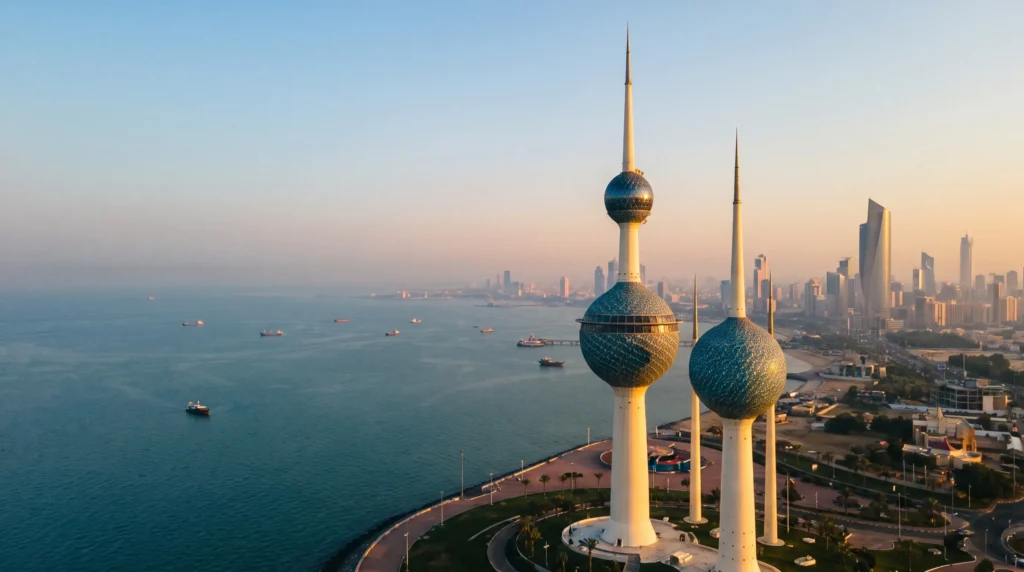
Kuwait City Travel Guide — The Gulf’s Quietest Capital, Between Ancient Souks and the World’s Priciest Currency
Kuwait City is the Gulf capital most travelers can’t quite place on a map, and that’s part of what makes it interesting. It sits between Iraq and Saudi Arabia on a natural harbor that made it a pearling and trading port a century before oil turned it into one of the wealthiest small nations on Earth. You can wander a 200-year-old covered souk buying dates and cardamom coffee in the morning, stand under the world’s largest single-dome mosque by midday, and watch the sun set behind three space-age towers that have symbolized the country since 1979. I need to be straight with you up front, though, because this is a guide I’d want someone to be honest with me about: Kuwait is currently under a heightened regional security advisory tied to tensions with Iran, and that has to shape how and whether you plan a trip right now. I’ll cover exactly what that means, and everything else — the souk, the food, the world’s strongest currency, the day trip to a Greek-occupied island — further down.
In This Guide
- Overview — Why Kuwait City Is the Gulf’s Overlooked Capital
- National Day & Liberation Day — Late February’s Two-Day Celebration
- Best Time to Visit Kuwait City
- Getting There — KWI & the Only Way In
- Getting Around — Taxis, Ride-Hail & a Car-First City
- Neighborhoods — Sharq, Salmiya, Kuwait City’s Downtown Core
- Culture & People
- A Food Lover’s Guide to Kuwait City
- Off the Beaten Path
- Day Trips — Failaka Island & Beyond
- Practical Information
- Budget Breakdown — What Kuwait City Actually Costs in 2026
- Frequently Asked Questions
Overview — Why Kuwait City Is the Gulf’s Overlooked Capital
Kuwait City sits at the head of Kuwait Bay, a natural deep-water harbor that made it a pearling, shipbuilding and trading center as far back as 1752, long before anyone drilled for oil here. The metro area now holds roughly 5 million residents — more than 70% of Kuwait’s entire population — packed into a compact coastal footprint, with the city proper accounting for around 3.4 million of that. Only a small fraction of that population are Kuwaiti citizens; the country runs on one of the highest foreign-resident ratios in the world, which is exactly why English gets you through nearly any transaction even though Arabic is the only official language.
Compared to Dubai or Doha, Kuwait City has done almost no marketing of itself as a tourism destination — there’s no equivalent of the Burj Khalifa press machine, no beach resort strip, no theme park. What it has instead is one of the Gulf’s oldest continuously used souks, a skyline of oil-boom modernist landmarks from the 1960s–80s “golden era,” and a genuinely walkable historic core along the Gulf corniche that most visitors to the region never see because they fly straight past to Dubai.
I have to be direct about the current moment, though. As of mid-2026, Kuwait sits under an elevated regional security advisory connected to the wider Iran-related conflict in the Gulf, and that is not background noise — it changes trip planning, insurance, and which parts of this guide you should treat as aspirational versus immediate. I’ve built the safety specifics into the Practical section and FAQ rather than burying them, because a guide that pretends otherwise isn’t doing its job.
National Day & Liberation Day — Late February’s Two-Day Celebration
If your dates are flexible, aim for February 25–26: Kuwait National Day, marking the 1961 end of the British protectorate, runs directly into Liberation Day on the 26th, which commemorates the 1991 end of the Iraqi occupation. The two days are treated as a single extended public holiday, and Kuwait City turns genuinely festive for it — the corniche and Gulf Road fill with families, foam-spray and water-gun street parties (a local tradition unique to Kuwait’s celebrations), fireworks over the bay, and government buildings and towers lit up in the Kuwaiti flag’s red, white, green and black.
It’s also one of the few weeks where you’ll see Kuwait’s public spaces at full capacity — Al Shaheed Park and the Scientific Center get crowded with locals rather than mostly expatriate joggers, which is arguably the best possible time to feel the city rather than just tour it. Hotel rates in the mid-range and business-traveler segment can dip slightly around this window since it’s a domestic rather than international holiday, though luxury properties sometimes do the opposite and add event packages.
Best Time to Visit Kuwait City
Late November – March · The only comfortable window
Daytime highs sit in the pleasant 18–26°C (64–79°F) range, evenings can be genuinely cool, and this is when the corniche, souk and outdoor cafés are actually enjoyable to linger in. This is also peak season for a reason — book central hotels a few weeks ahead around National Day.
April & October · Shoulder months
Warming up or cooling down fast; still walkable in the mornings and evenings, with midday heat that pushes you indoors. Good value, fewer crowds, occasional dust (shamal) winds.
May – September · Genuinely brutal heat
Average summer highs exceed 45°C (113°F) for three straight months, and Kuwait has recorded some of the hottest temperatures ever measured on Earth, over 52°C (125.8°F). Life moves indoors into malls and air-conditioned buildings; outdoor sightseeing before 9am or after 7pm only. If you must travel in summer for business, plan the corniche walk, the souk, and Failaka Island around the edges of the day and accept that most of your daytime will be spent inside.
Ramadan
Dates shift yearly on the Islamic calendar. Restaurants are closed or curtained during fasting hours for non-Muslims to eat discreetly, the pace of the city slows dramatically by day and picks up after sunset (iftar tents, night markets), and it’s a genuinely interesting but different kind of visit — check the year’s dates before booking if you want a “normal” trip versus a cultural one.
Getting There — KWI & the Only Way In
Kuwait International Airport (KWI) sits about 15.5 kilometres south of the city center and is the country’s only real gateway for international arrivals. Kuwait Airways and Jazeera Airways are the home carriers, alongside Gulf and international names like Emirates, Qatar Airways and Turkish Airlines connecting through their own hubs; there are no direct long-haul flights from North America, so most travelers route through London, Frankfurt, Istanbul, Doha or Dubai.
The airport has been mid-expansion for several years — a large new Terminal 2 has been under construction with a planned 2026 opening, while flights are currently split across the existing terminals by airline. Given the current regional security situation, terminal assignments and schedules have been unusually fluid this year, with UK and US advisories both flagging reduced schedules and terminal closures at points in 2026. Confirm your terminal directly with your airline within 48 hours of flying rather than trusting an old booking confirmation. If you only have a connection here, our Kuwait City layover guide breaks down exactly what a 6, 8 or 12-hour layover gets you. A taxi or ride-hail into downtown takes roughly 20–30 minutes depending on traffic; there is no rail or metro link to the airport.
Getting Around — Taxis, Ride-Hail & a Car-First City
Kuwait City has no metro or tram system, and it is built for cars — wide highways, big blocks, and summer heat that makes walking between districts unrealistic for most of the year. Careem and Uber both operate reliably and are the easiest way to get around without a rental, typically far cheaper than equivalent taxi meters in Western capitals given the currency’s strength working the other direction on tipping and short hops.
Renting a car is straightforward with an international license and opens up day trips, but driving culture is fast and assertive by Western standards — stick to ride-hail if you’re not confident merging on an eight-lane highway. Within downtown, the corniche and the souk district around Al-Mubarakiya are genuinely walkable, especially November–March, and it’s the one part of the city where you’ll want to be on foot rather than in a car.
Neighborhoods — Sharq, Salmiya & Kuwait City’s Downtown Core
Sharq & the Downtown Core
The historic and administrative heart of the city, home to Souq Sharq’s marina-side malls, the Kuwait Towers along the corniche, and the government and financial district around Liberation Tower. This is where most first-time visitors base themselves.
Mirqab & Al-Mubarakiya
The old commercial quarter, anchored by Souk Al-Mubarakiya, one of the oldest working souks in the city and the pre-oil trading center of Kuwait — narrow lanes of spice stalls, gold shops, textiles, dates and traditional coffeehouses that still function as a real neighborhood market rather than a tourist reconstruction.
Jibla & Dasman
Quieter residential districts close to downtown; Dasman holds the Amiri Diwan (ruling family’s seat) and several of the city’s museums, including the Tareq Rajab Museum’s Islamic art and manuscript collections.
Salmiya
The city’s liveliest secondary hub, with a population well over 300,000 on its own, a long seafront corniche, the Scientific Center (the Gulf’s largest aquarium) and the bulk of Kuwait’s mid-range dining and shopping strip. This is a good second base if you want beach-adjacent evenings and more restaurant variety than downtown offers.
Hawally & Farwaniya
Dense residential and commercial districts, each home to over 200,000 residents, known for budget shopping, South Asian and Levantine restaurants, and a far more local, less polished feel than the corniche-facing districts. Worth a few hours for food rather than sightseeing.
Al Shaheed Park & Kuwait City’s Green Spine
A large landscaped park built along the old city wall’s route, with museums, walking paths and one of the only genuinely green, shaded public spaces in the city — popular at dusk once the temperature drops.
Culture & People
Kuwaiti citizens make up only a minority of the country’s roughly 5 million residents, with the rest a mix of South Asian, Filipino, Egyptian, other Arab and Western expatriate communities — a demographic reality that shapes everything from restaurant variety to the languages you’ll hear on the street. Islam is the state religion, practiced by the large majority of residents, with a significant Christian minority and other faiths represented mostly within the expatriate population.
Kuwait had a notably liberal, cosmopolitan reputation regionally during its 1946–1982 “golden era” of oil-fueled growth, and remnants of that era — mid-century modernist architecture, a lively press and literary scene, a parliament that’s one of the oldest elected legislatures in the Gulf — still color the city’s self-image today. Alcohol is entirely illegal, dress is conservative in public (shoulders and knees covered for both genders is the safe default, more so inside the Grand Mosque), and Friday is the primary day of prayer and rest, with the weekend running Friday–Saturday and the work week Sunday–Thursday.
A Food Lover’s Guide to Kuwait City
The national dish is machboos — spiced rice (usually with dried lime, cardamom and cinnamon) layered with chicken, lamb or fish, the Gulf’s answer to biryani and found on nearly every home-style menu in the city. Pair it with gers ogaily pickled turnip and you’ve got the standard Kuwaiti lunch. Grilled fish — hammour and zubaidi are the local favorites — comes fresh given Kuwait’s Gulf coastline, and the seafood counters at Souk Al-Mubarakiya are worth a wander even if you’re not buying.
Street and market food runs on dates, karak (spiced milk tea), and fresh juice stalls; the souk’s central produce and spice halls are the best place to see the ingredients before they hit a menu. Because of Kuwait’s expatriate mix, the city also has genuinely excellent South Asian, Levantine, Iranian and Filipino food scattered through Salmiya, Hawally and Farwaniya at prices well below what a similar meal costs in Dubai or Doha. No alcohol anywhere — dinner culture here runs on tea, juice and dessert instead, and Kuwaitis take the dessert course seriously, particularly luqaimat (fried dough balls in date syrup) and knafeh from the city’s many Levantine bakeries.
Off the Beaten Path
The Old City Gates
Five surviving gates from Kuwait’s original 1920 mudbrick city wall are scattered around the modern downtown perimeter, easy to miss and rarely visited by outsiders, but a striking contrast against the glass towers around them.
Tareq Rajab Museum
A private collection of Islamic art, manuscripts, jewelry and musical instruments in a converted house in Jabriya — small, quiet, and consistently rated as one of the best specialist museums in the Gulf despite almost no international profile.
Grand Mosque’s Public Tours
Completed as the country’s largest mosque, with room for roughly 10,000 worshippers in the main hall, the Grand Mosque offers guided tours for non-Muslim visitors at set hours — a rare chance in the Gulf to see a working mosque’s interior with an English-speaking guide rather than only the exterior.
Al-Mubarakiya’s Back Lanes
Skip the main spice hall and walk the narrower lanes behind it — antique dealers, bird markets, and coffeehouses where the conversation is entirely in Arabic and the tourist traffic drops to zero.
Day Trips — Failaka Island & Beyond
Failaka Island
About 20 kilometres offshore by ferry, Failaka has one of the more unusual layered histories in the Gulf: Mesopotamian traders from Ur settled it around 2000 BC, Alexander the Great’s forces later renamed it Ikaros and built a Hellenistic fort with temples to Artemis and Apollo, and in 1990 Iraqi forces depopulated it entirely, mined the beaches and left it a ghost island for years. Today it’s slowly reopening as a low-key day-trip and beach destination around the Wanasa Beach development, with the Bronze Age and Hellenistic ruins, an open-air war-relic display, and empty, slowly decaying village houses from before the occupation all visible in a single visit. Given the mined areas noted in current safety advisories, stick to the established tour routes and beach zones rather than exploring the interior independently. Our full Failaka Island day-trip guide covers ferry operators, prices and the route on the island in detail.
The Scientific Center & Marina Waterfront
Not a full day trip, but worth building an afternoon around: the Scientific Center in Salmiya houses the Gulf’s largest aquarium and an IMAX, with the adjoining waterfront one of the better sunset spots in the city.
Practical Information
Safety — read this first. As of mid-2026, the US State Department rates Kuwait at Level 3, “Reconsider Travel,” citing the risk of armed conflict, drone and missile activity tied to the broader Iran conflict, and landmines in some desert and coastal areas north of Mutla’a Ridge. The UK FCDO advisory similarly warns that Iran has struck Gulf targets before and “could do so again at short notice,” and gives specific shelter-in-place guidance in case of missile or drone activity. This is a genuinely different situation from the routine “watch your pockets” safety notes in most of our guides — check your own government’s current advisory the week before you fly, buy travel insurance that explicitly covers the region, and have a plan for what you’d do if a shelter-in-place alert came through. Away from that overarching risk, day-to-day street crime in Kuwait City is low, with the areas near Jleeb Al-Shuyoukh flagged for petty crime caution.
Money. The Kuwaiti dinar is the world’s highest-valued currency unit, trading at roughly 1 KWD ≈ US$3.25 as of early 2026, and is pegged to an undisclosed weighted basket of major currencies rather than the US dollar alone. Prices that look small in dinars are not small in dollars — do the math before you order. Cards are accepted almost everywhere in the city; carry some cash for the souk and small vendors.
Visa. Most US, UK, EU and Canadian passport holders can get an e-visa in advance or a visa on arrival, generally valid for tourism stays of up to 30–90 days depending on nationality and visa type; a US citizen’s visa-on-arrival currently costs 10 Kuwaiti dinars. Passports must be valid at least six months from arrival, and any Israeli stamps or evidence of travel to Israel can complicate your application — apply well before you fly if that applies to you.
Health. No special vaccines are required to enter, but routine and hepatitis A/B coverage plus typhoid (especially if visiting local homes or smaller towns) are recommended by the CDC; yellow fever is not required. Summer heat itself is the biggest practical health risk — hydration and avoiding midday sun exposure matter more here than almost anywhere else on our site.
Connectivity, plugs & time. An eSIM or local prepaid SIM gives fast, reliable coverage across the city. Plugs are UK-style Type G, 230V/50Hz, so North American devices need an adapter (and a converter if not dual-voltage). Kuwait runs on Arabia Standard Time, UTC+3 year-round with no daylight saving, and the weekend falls on Friday–Saturday with Sunday as the first workday.
Budget Breakdown — What Kuwait City Actually Costs in 2026
Kuwait’s dinar being the world’s strongest currency is a psychological trap for visitors — everything is priced in a unit smaller than what you’re used to, but the actual cost of living skews mid-to-high Gulf, closer to Doha than to Cairo.
Budget (US$70–120/day): A simple hotel or serviced apartment in Salmiya or Hawally, machboos and karak from local diners, ride-hail rather than taxis, souk browsing and free corniche time.
Mid-range (US$180–320/day): A well-located downtown or Salmiya hotel, restaurant meals mixing Kuwaiti and international cuisine, a Failaka Island day trip, museum entries, occasional rental car day.
Luxury (US$500+/day): Five-star corniche-view hotels, fine dining in Sharq or the marina district, private guided tours of the Grand Mosque and old city gates, chauffeured transport throughout.
Because alcohol is illegal, bar and nightlife spend simply doesn’t exist here the way it would in a comparable Gulf itinerary — money goes toward food, hotels and shopping instead. Tipping 10% is appreciated but not mandatory in most restaurants.
Planning Your First Trip to Kuwait City
Given the current security situation, treat any Kuwait City trip as something to plan close to departure rather than months out — check your government’s advisory the week you’re due to fly, not the week you booked. If conditions are calm, a compact two- to three-night stay covers the souk, corniche, Grand Mosque and a Failaka Island day trip comfortably; add a night for the Scientific Center and Salmiya’s food scene. Kuwait City pairs naturally with other Gulf stops on the same regional swing — our Doha guide and Dubai guide are both under two hours away by air, and Muscat or Riyadh extend the trip further around the peninsula. Passing through rather than staying? Our Kuwait City layover guide covers 6, 8 and 12-hour plans from KWI.
Frequently Asked Questions
Is Kuwait City safe to visit right now?
As of mid-2026, both the US State Department (Level 3, “Reconsider Travel”) and the UK FCDO flag an elevated risk of regional armed conflict, including drone and missile activity tied to Iran, alongside standing landmine warnings in specific desert and coastal areas. Day-to-day street crime is low, but this is not a “normal” Gulf safety picture right now — check your government’s current advisory in the days before you fly and travel with insurance that covers conflict-adjacent disruption.
Do I need a visa?
Most Western passport holders can get an e-visa in advance or a visa on arrival for tourism, typically valid up to 30–90 days depending on nationality. Your passport needs at least six months’ validity, and any record of travel to Israel can complicate approval.
Can I drink alcohol in Kuwait City?
No — Kuwait is dry, and alcohol possession carries serious legal penalties, up to and including for trafficking. Plan your evenings around tea, juice and dessert culture instead; it’s a different rhythm, not a lesser one.
How hot does it actually get?
Summer (June–September) averages above 45°C (113°F), with recorded highs above 52°C (125.8°F) — among the hottest reliably measured temperatures on Earth. Visit November–March if you want to spend meaningful time outdoors.
Kuwait City or Doha for a first Gulf trip?
Doha has more built-out tourism infrastructure, museums and a World Cup-era international profile; Kuwait City has an older, more working souk, a lower-key pace, and far fewer tourists competing for the same photo. Right now, also factor the security picture into that choice — Doha’s advisory levels are currently milder. Our Is Kuwait Worth Visiting? verdict weighs this decision in full, including the current advisory picture for both.
What’s the one thing I shouldn’t skip?
Souk Al-Mubarakiya at a slow morning pace, followed by the corniche walk to the Kuwait Towers at golden hour — it’s the single best two-hour block the city offers, and it costs nothing beyond whatever you buy from a spice stall.
Ready to Explore Kuwait City?
Kuwait City rewards travelers willing to slow down for a two-century-old souk, a mosque that welcomes visitors, and a Greek-occupied island most people have never heard of — all wrapped in the world’s strongest currency. Just make sure you’re checking the current safety picture the week you fly, not the week you booked, and you’ll find one of the Gulf’s least crowded, most genuinely historic capitals waiting on the other side.
Explore More
- Doha City Guide — the Gulf’s other understated capital, under two hours away
- Dubai City Guide — the region’s tourism heavyweight, a short flight south
- Muscat City Guide — Oman’s mountain-backed, more tourism-ready alternative
- Riyadh City Guide — Saudi Arabia’s fast-changing capital, further around the peninsula
How this guide was built
Published as part of Facts From Upstairs’ city guide series. Built from authoritative sources — Wikipedia entity pages for Kuwait City, Kuwait, Kuwait Towers, Grand Mosque of Kuwait, Kuwait International Airport, Failaka Island and the Kuwaiti dinar; the Central Bank of Kuwait’s exchange-rate policy page; the US State Department and UK FCDO Kuwait travel advisory pages; the US CDC traveler page for Kuwait; and worldstandards.eu for electrical specifications. Given the fast-moving regional security situation, safety and advisory details were current as of the sources cited on the publish date above and should be independently re-checked before travel. Numeric and safety claims carry inline citations.
Sources cited on this page
- Wikipedia — Kuwait City
- Wikipedia — Kuwait
- Wikipedia — Visa policy of Kuwait
- Wikipedia — Kuwait Towers
- Wikipedia — Grand Mosque of Kuwait
- Wikipedia — Kuwait International Airport
- Wikipedia — Failaka Island
- Wikipedia — Kuwaiti dinar
- Central Bank of Kuwait — Exchange Rate Policy
- US State Department — Kuwait
- UK FCDO — Kuwait
- US CDC — Kuwait traveler page
- World Standards — Kuwait electrical plugs & voltage
More city guides you might like

Plan your trip to Kuwait City
The booking tools we use ourselves. FFU may earn a commission at no extra cost to you.
Plan & book your trip to Kuwait City
Booking through these searches supports our guides at no extra cost to you.