
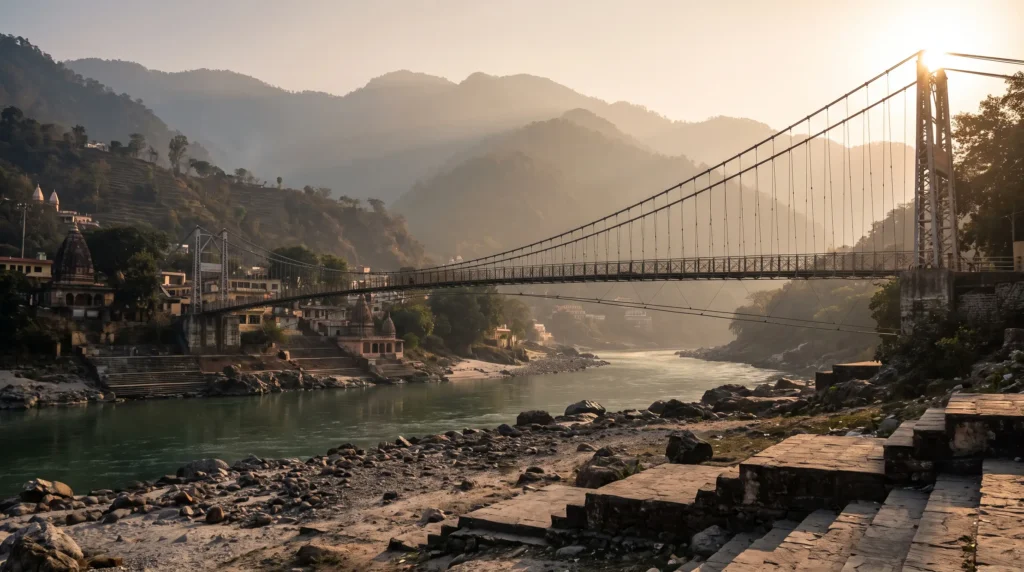
Rishikesh Travel Guide — The Ganges, the Himalayan Foothills & the World’s Yoga Capital
I’ve watched a lot of sunsets over a lot of rivers, and none of them come with the soundtrack Rishikesh gives you for free: temple bells, a few hundred voices chanting in unison, and the Ganges sliding out of the Himalayan foothills so clean and so green it barely looks real. This is a genuinely small town — a fraction of the size of Delhi or Mumbai — that punches wildly above its weight because it sits at the exact spot where the sacred and the adrenaline-soaked collide: ashrams and meditation halls on one bank, whitewater rafting and India’s highest bungee jump on the other. It’s also a dry, vegetarian-only town by local rule, which surprises first-timers expecting a party scene — Rishikesh’s whole appeal is that it isn’t one. Come for the yoga if that’s your reason, but stay for the fact that you can raft Grade IV rapids in the morning and sit cross-legged at a riverside aarti by dusk, all within walking distance of your guesthouse.
In This Guide
- Overview — Why Rishikesh Is the World’s Yoga Capital
- International Yoga Festival — Rishikesh’s Biggest Week
- Best Time to Visit Rishikesh (Season by Season)
- Getting There — Airport, Rail & Road
- Getting Around — Bridges, Autos & Walking
- Neighborhoods — Ram Jhula, Lakshman Jhula & Beyond
- Culture & People — Ashrams, Sadhus & the Ganga Aarti
- A Food Lover’s Guide to Rishikesh
- Off the Beaten Path
- Day Trips From Rishikesh
- Practical Information
- Budget Breakdown — What Rishikesh Actually Costs in 2026
- Frequently Asked Questions
Overview — Why Rishikesh Is the World’s Yoga Capital
Rishikesh sits in Dehradun district, Uttarakhand, on the right bank of the Ganges at about 340 metres elevation, right where the river leaves the Himalayan foothills and starts its long run across the plains. Locals and pilgrims call it the “Gateway to the Garhwal Himalayas,” and it’s a fair label — this is the last proper town before the road climbs toward Kedarnath, Badrinath and the other Char Dham shrines.
What put it on the global map, though, was 1968: the Beatles spent weeks at Maharishi Mahesh Yogi’s ashram here, and the association stuck so hard that Rishikesh has been marketed — accurately, at this point — as the “Yoga Capital of the World” ever since. Hundreds of ashrams, yoga schools and teacher-training programs now line both banks, alongside meditation retreats that range from genuinely rigorous to gently touristy. The town itself is small — barely six figures by the last census — which is part of the charm: you can walk the whole tourist core in under an hour.
By civic rule, Rishikesh is vegetarian-only and alcohol-free within town limits, which is worth knowing before you arrive expecting rooftop bars — the town’s nightlife is a chanting circle by the river, not a cocktail menu. That’s also exactly why it works: the sincerity is real, even where the marketing gets a little glossy.
International Yoga Festival — Rishikesh’s Biggest Week
If you can time a trip around one week, make it the International Yoga Festival, held annually in the first week of March and running since 1999 — it draws teachers and students from dozens of countries for a week of asana, pranayama and philosophy sessions, most of it centered on Parmarth Niketan ashram on the eastern bank. Even if you’re not enrolled, the evening Ganga Aarti during festival week swells into something bigger than the nightly version, with extra music and a genuinely electric crowd.
March also lands you in the best possible weather window — post-winter chill, pre-monsoon heat — and squarely inside high rafting season, so you can pair a morning on the river with an evening at the ashram without fighting either the cold or the crowds of peak December. Book ashram accommodation for festival week two to three months out; the good rooms go fast.
Best Time to Visit Rishikesh (Season by Season)
October – March · Cool season (peak)
Clear skies, comfortable days, cold mornings and nights, and the busiest rafting and yoga season of the year — this is when most first-timers should go. December and January can dip cold enough at night that you’ll want a proper layer; pack for it.
March – June · Warm season
The International Yoga Festival opens the season in March; by May and June, daytime highs regularly push toward 40°C (104°F), so plan river time and sightseeing for early morning or late afternoon. Rafting stays open through the end of June before the season closes for monsoon.
July – September · Monsoon
This is the season to actively avoid for river activities: rafting closes entirely from roughly 1 July to mid-September because the Ganges runs high, fast and unsafe through the Himalayan catchment, and July–August also bring the heaviest rainfall of the year. Landslides can disrupt mountain roads toward Kedarnath and Badrinath during this stretch, so day trips upcountry get riskier too. Yoga programs run year-round regardless, and monsoon-green hills are genuinely beautiful if river sports aren’t your priority.
Getting There — Airport, Rail & Road
Dehradun’s Jolly Grant Airport is the closest gateway, roughly 20 km from central Rishikesh — closer, in fact, than it is to Dehradun city itself — with domestic flights from Delhi, Mumbai and other major Indian hubs. Prepaid taxis and hotel pickups cover the airport run in about 40–50 minutes.
Rishikesh has its own railway station with links to Haridwar and onward connections across India, though Haridwar Junction — about 25 km away — is the better-connected hub for long-distance trains and is where most overnight services from Delhi terminate. By road, Rishikesh is roughly 240 km from Delhi’s international airport, a five-to-seven-hour drive depending on traffic through Meerut and Roorkee, and Delhi-based tour buses and shared taxis run this route constantly. If your visa or itinerary starts in Delhi, treat Rishikesh as a comfortable long day-trip-turned-multi-night stay rather than a flight connection.
Getting Around — Bridges, Autos & Walking
The tourist core of Rishikesh — the stretch around Ram Jhula and Lakshman Jhula — is genuinely walkable, and honestly should be walked: the two pedestrian suspension bridges over the Ganges are attractions in their own right, thick with monkeys, cows and incense smoke, and no vehicle traffic crosses them.
For anything further — Triveni Ghat, the railway station, day-trip pickups — shared and private auto-rickshaws are cheap and everywhere; agree the fare before you get in, since meters are rare. E-rickshaws now cover many of the same short routes at similarly low cost. Renting a scooter is common among longer-stay yoga students and gives you the most freedom for exploring the hills above town, but Indian road conditions and traffic norms take real getting used to — if you haven’t ridden in South Asia before, hire a driver instead for anything beyond the town center.
Neighborhoods — Ram Jhula, Lakshman Jhula & Beyond
Ram Jhula & Swarg Ashram
The spiritual center of gravity: the Ram Jhula bridge, built in 1986, connects to Swarg Ashram on the far bank, a car-free strip of ashrams, yoga shops and vegetarian cafés. This is where most short-course yoga students base themselves — walkable, riverside, and quiet after dark by design.
Lakshman Jhula
The older, more famous of the two suspension bridges, a couple of kilometres upstream, anchoring a livelier cluster of guesthouses, German bakeries and rooftop cafés with river views. It’s the more backpacker-social side of town without losing the incense-and-temple-bell atmosphere.
Tapovan
The hillside neighborhood above and behind Lakshman Jhula, and the real epicenter of the yoga-teacher-training scene — narrow lanes packed with studios, juice bars and long-stay guesthouses catering to students on month-long courses. Quieter and slightly removed from the day-tripper crowds below.
Triveni Ghat
The main ghat in the older part of town and the site of Rishikesh’s nightly Ganga Aarti — smaller and less choreographed than Haridwar’s version downstream, but arguably more intimate, with local families as much a part of the crowd as visitors.
Muni Ki Reti
The stretch of riverbank between the old town and Lakshman Jhula, home to some of Rishikesh’s best-known ashrams, including Parmarth Niketan, host of the International Yoga Festival. A good base if you want ashram immersion without being fully inside one.
The Rafting Belt (Shivpuri & Brahmpuri)
A scatter of riverside camps a few kilometres upstream, built almost entirely around rafting put-ins, bungee and zipline operators, and campfire-and-bonfire overnight stays. This is where the adrenaline half of Rishikesh’s split personality lives, including the country’s highest bungee jump at 83 metres and a kilometre-long zipline billed as Asia’s longest.
Culture & People — Ashrams, Sadhus & the Ganga Aarti
Rishikesh’s identity is built on its status as a tirtha — a river-crossing pilgrimage site — long before yoga tourism arrived, and that older devotional culture still sets the tone: saffron-robed sadhus, temple bells at dawn and dusk, and a steady flow of Hindu pilgrims heading toward the Char Dham shrines further into the mountains. The 1968 Beatles visit to Maharishi Mahesh Yogi’s ashram — now a semi-abandoned, graffiti-covered site nicknamed the “Beatles Ashram” and reopened to visitors as a heritage site — layered a second, more global identity on top, and the town has leaned into both.
The nightly Ganga Aarti — oil lamps, chanting, floating flower-and-candle offerings sent downriver — is the one ritual every visitor should see at least once, whether at Triveni Ghat or Parmarth Niketan. Dress modestly, remove shoes where asked, and photograph respectfully; this is worship, not performance, even though visitors are welcomed warmly.
A Food Lover’s Guide to Rishikesh
Rishikesh is entirely vegetarian by town rule — no meat, fish or eggs served within its limits, and no alcohol sold either — so the food culture leans hard into North Indian vegetarian classics and the global “yoga traveler” menu that’s grown up alongside it. Expect thalis (a rotating spread of dal, sabzi, roti, rice and pickle), fresh paneer dishes, and thick lassis — the saffron and rose versions are a Rishikesh specialty worth seeking out at the small stalls near Ram Jhula.
The town’s international student population has also spawned an entire genre of café menus: German bakeries with genuinely good sourdough and cinnamon rolls, Israeli-influenced hummus-and-falafel spots (a legacy of the heavy Israeli backpacker traffic through the region), and juice-and-smoothie bars catering to post-yoga appetites. Riverside cafés around Lakshman Jhula and Tapovan do the best sunset views with your chai; for a more local plate, eat where the crowd is Indian pilgrims rather than backpackers.
Off the Beaten Path
Beatles Ashram (Chaurasi Kutia)
The abandoned meditation huts where the Beatles composed much of the White Album in 1968, now reopened inside Rajaji Tiger Reserve with the concrete domes covered in fan and artist graffiti. Genuinely atmospheric and far less crowded than the main ghats.
Neelkanth Mahadev Temple
A Shiva temple in the forested hills about 28 km from town, reachable by a steep hike or a rough road drive, with a legend tying it to the churning-of-the-ocean myth. Come for the walk through the hills as much as the shrine itself.
Rajaji National Park edges
The park’s fringes run right up against Rishikesh’s outskirts — elephant and leopard territory, with quieter gates and lodges than the more famous safari parks further east, and a genuine chance of wildlife sightings without the Ranthambore-style crowds.
Kunjapuri Temple sunrise
A pre-dawn drive and short climb up to a hilltop Shakti temple delivers one of the best sunrise panoramas of the Himalayan snow line in the region — a local favorite that most first-time visitors never hear about.
Day Trips From Rishikesh
Haridwar
The obvious pairing, roughly half an hour downstream by road: Har Ki Pauri ghat, an even bigger nightly Ganga Aarti than Rishikesh’s own, and — if your dates align once every twelve years — the Kumbh Mela, one of the largest religious gatherings on Earth. Most visitors do Haridwar’s aarti as an evening trip and are back in Rishikesh by bedtime.
Dehradun
Uttarakhand’s state capital, about 45 km away, worth a stop for the Forest Research Institute’s colonial-era campus, Sahastradhara’s sulfur springs, and simply as the region’s transport and shopping hub if you need supplies Rishikesh’s smaller shops don’t carry.
Chardham Yatra towns (multi-day)
Rishikesh is the traditional launch point for the Char Dham pilgrimage circuit — Yamunotri, Gangotri, Kedarnath and Badrinath — which typically opens in late April and closes around Diwali in November, weather and snowline permitting each year. This isn’t a single day trip; treat it as a separate 5–10 day mountain expedition with its own planning, best arranged through a registered local operator given the altitude, road conditions and seasonal closures involved.
Mussoorie
A colonial hill station about two hours further into the mountains, with cooler air, mall-road strolling and views toward the Doon Valley — a popular add-on for travelers wanting one proper hill-station stop without committing to the full Chardham circuit.
Practical Information
Money. The Indian Rupee floats against major currencies and traded around 95 to the US dollar in mid-2026 — check a current rate before you go, since it moves. ATMs are common in the main tourist strip but scarcer once you head into the hills; carry more cash than you think you’ll need, since ashrams, small guesthouses and ghat-side stalls are rarely card-friendly.
Visa. Almost all foreign nationals, including US, UK and EU passport holders, need a visa before arrival — the e-Tourist Visa is the standard route, applied for online at least four days ahead of your flight, non-extendable and valid for entry only through designated airports and seaports. Keep your passport valid at least six months beyond arrival with two blank pages.
Safety. Both the US State Department and UK FCDO rate India an overall “exercise increased caution” / regionally-restricted advisory, with specific warnings concentrated on the Pakistan border zone, Jammu & Kashmir and Manipur — none of which cover Uttarakhand or Rishikesh. Standard precautions apply: solo female travelers should take extra care after dark, use registered taxis, and check current advisories before finalizing plans.
Health. Hepatitis A and B vaccination is generally recommended for travel to India, along with routine vaccines being up to date; drink bottled or filtered water, and be cautious of street-side ice. Connectivity: a local SIM or eSIM is cheap and fast to set up in Delhi or Dehradun. Plugs: Type C/D/M, 230V. Time zone: IST, UTC+5:30, no daylight saving.
Budget Breakdown — What Rishikesh Actually Costs in 2026
Rishikesh is one of the more affordable stops in India, and dramatically cheaper than most Western yoga-retreat pricing for a comparable experience.
Budget (US$15–30/day): Dorm bed or basic guesthouse room, thali meals at local dhabas, drop-in yoga classes, shared auto-rickshaws.
Mid-range (US$40–80/day): Private guesthouse or riverside hotel room, café meals, a half-day rafting trip, a short yoga-teacher-training taster course, private auto or scooter rental.
Luxury/retreat (US$120+/day): Riverside wellness resort with meals and daily yoga included, private guide for day trips, multi-day rafting-and-camping packages, Ayurvedic spa treatments.
Fixed costs to expect: rafting trip prices vary by rapid grade and distance covered, and government-authorized operators are worth the small premium over unlicensed ones given the safety stakes on Grade III–IV water. Tipping 5–10% is appreciated but not obligatory at most local restaurants.
Planning Your First Trip to Rishikesh
The easy first-timer split is river + retreat: fly or drive in via Dehradun’s Jolly Grant Airport, base yourself around Ram Jhula or Tapovan for four or five nights, and structure days around one rafting trip, a few drop-in yoga or meditation sessions, an evening at the Ganga Aarti, and a half-day trip to Haridwar. Five nights covers the essentials without rushing; a week or more lets you add a hill-station detour to Mussoorie or push further toward the Chardham circuit if the season allows. Rishikesh pairs naturally with a broader Himalayan itinerary — many travelers continue on toward Kathmandu or deeper into Nepal for more mountain time, or start their India trip in Delhi before heading north.
Frequently Asked Questions
Is Rishikesh safe for tourists in 2026?
Yes, generally — India’s overall advisory concerns (border zones, Jammu & Kashmir, Manipur) don’t extend to Uttarakhand or Rishikesh. Use registered taxis and rafting operators, take normal precautions after dark, and solo women travelers should take a bit of extra care, as advised for India generally.
Do I need a visa for Rishikesh?
Yes — Rishikesh has no separate visa regime from the rest of India. Almost all foreign visitors need an e-Tourist Visa arranged online before arrival, applied for at least four days ahead, entering only through designated airports or seaports.
Can I actually drink alcohol in Rishikesh?
Not within town limits — Rishikesh is a legally dry, vegetarian-only municipality, a rule tied to its status as a pilgrimage town. Some hotels just outside the municipal boundary may serve alcohol; don’t count on it inside the main tourist strip.
How many days do I need in Rishikesh?
Three nights covers the highlights — both bridges, the Ganga Aarti, one rafting trip. Five to seven nights lets you add a yoga course taster, Haridwar, and one hill day trip without feeling rushed.
Is rafting in Rishikesh safe for beginners?
Yes, provided you book with a government-authorized operator — most beginner trips run Grade I–II sections, with Grade III–IV stretches reserved for those with some experience or a higher risk tolerance. Rafting only runs September through June; the river is closed for safety during the July–August monsoon peak.
Rishikesh or Haridwar — which should I stay in?
Stay in Rishikesh for the yoga scene, the walkable bridges and the adventure-sports base; visit Haridwar as a half-day or evening trip for its bigger Ganga Aarti and, once every twelve years, the Kumbh Mela. Most travelers find one night in Haridwar unnecessary when it’s this close.
Ready to Explore Rishikesh?
A river clean enough to bless, bridges thick with monkeys and incense, a bungee jump above the same water where sadhus bathe at dawn — Rishikesh is the rare place where the spiritual-retreat brochure and the adventure-travel brochure are describing the same three streets. Go in the cool season, skip the monsoon, and let the temple bells set your alarm clock instead of your phone.
Explore More
- Delhi City Guide — the classic gateway before heading north to Rishikesh
- Kathmandu City Guide — more Himalayan foothills and temple culture
- Nepal Travel Guide — continue the mountain trip east
- Bali City Guide — for more of the yoga-and-wellness travel scene
How this guide was built
Published as part of Facts From Upstairs’ city guide series. Built from authoritative sources — Wikipedia entity pages for Rishikesh and Haridwar, the Uttarakhand Tourism Department’s official rafting page, the US State Department and UK FCDO India travel advisories, the US CDC traveler page for India, India’s official government e-Visa portal, and the Reserve Bank of India’s reference rate archive. Numeric and checkable claims carry inline citations.
Sources cited on this page
More city guides you might like
Plan your trip to Rishikesh
The booking tools we use ourselves. FFU may earn a commission at no extra cost to you.
Plan & book your trip to Rishikesh
Booking through these searches supports our guides at no extra cost to you.