
City Guide · Georgia · The Lowcountry Coast of the United States
Savannah Travel Guide — Oglethorpe’s 1733 Grid, 22 Surviving Squares & the Fall Shoulder Season That Quietly Beats St. Patrick’s Day
The first time I walked Savannah I did it wrong — head down, map out, trying to “do” the squares like a checklist. The second time I understood that the city was designed, in February 1733, precisely so that you would not have to hurry: James Oglethorpe laid out Georgia’s first settlement as a repeating pattern of wards, each built around an open square, and that pattern is still the street grid you walk today. Twenty-four squares were eventually built and 22 survive, canopied by live oaks and Spanish moss, inside one of the largest urban National Historic Landmark districts in the United States. This is a city of roughly 149,000 people that hosted about 12.9 million visitors in 2024 , where you can legally carry a cocktail between squares in a 16-ounce plastic cup, eat at a James Beard Outstanding Chef’s restaurant inside a 1938 Greyhound station, and be on a beach at Tybee Island 18 miles later. I have been in July heat that felt like a wet towel and in a March crowd so dense the St. Patrick’s parade took the whole morning to pass. My honest advice, and the reason this guide is timed for autumn: come between late September and mid-December, when the humidity finally lets go, the SCAD Savannah Film Festival fills the Broughton Street theatres, and the river lights up for Christmas — while keeping one eye on a hurricane season that does not formally end until 30 November. For the wider American frame (ESTA, tipping, driving, the dollar) read this alongside our United States travel guide.

In This Guide
- Overview — Why Savannah Still Runs on a 1733 Plan
- A Pocket History — Oglethorpe, Cotton, Fever, Sherman & Seven Women
- Fall 2026 — Film Festival, Christmas on the River & the Hurricane Tail
- Best Time to Visit Savannah (Season by Season)
- Getting There — SAV Airport, Amtrak & I-95
- Getting Around — Walking, the Free dot Shuttle & Parking
- Neighborhoods — Landmark District, Victorian, Starland & the Riverfront
- Culture — Gullah Geechee, the Slave Quarters, SCAD & the Ghost Economy
- Food & Drink — Shrimp and Grits, Mrs. Wilkes, The Grey & the To-Go Cup
- Off the Beaten Path — Bonaventure, Wormsloe, Pin Point & the Marsh
- Day Trips — Tybee, Fort Pulaski, Hilton Head, Charleston & Jekyll
- Practical Information
- Budget & Costs — What Savannah Actually Costs in Late 2026
- Planning — 5, 7 and 10-Day Itineraries
- Frequently Asked Questions
Overview — Why Savannah Still Runs on a 1733 Plan
Savannah is Georgia’s oldest city, founded on 12 February 1733 when James Oglethorpe and about 120 colonists landed on Yamacraw Bluff, 40 feet above the Savannah River, roughly 18 miles upstream from the Atlantic. What makes it unlike any other American city is not simply that it is old — Boston, Charleston and St. Augustine are older — but that its founding plan was never overwritten. Oglethorpe conceived the town as a repeatable module: a ward of 40 house lots (four “tythings” of ten), four larger “trust lots” reserved for churches and public buildings, all arranged around a central open square. He laid out the first four squares himself — Johnson, Wright, Ellis and Telfair — and the city kept stamping out copies until 1851, when the 24th square was built. Two were lost to 20th-century road and garage projects; Ellis Square, paved for a parking deck in 1954, was dug out and restored in 2010, which is why the count today is 22.
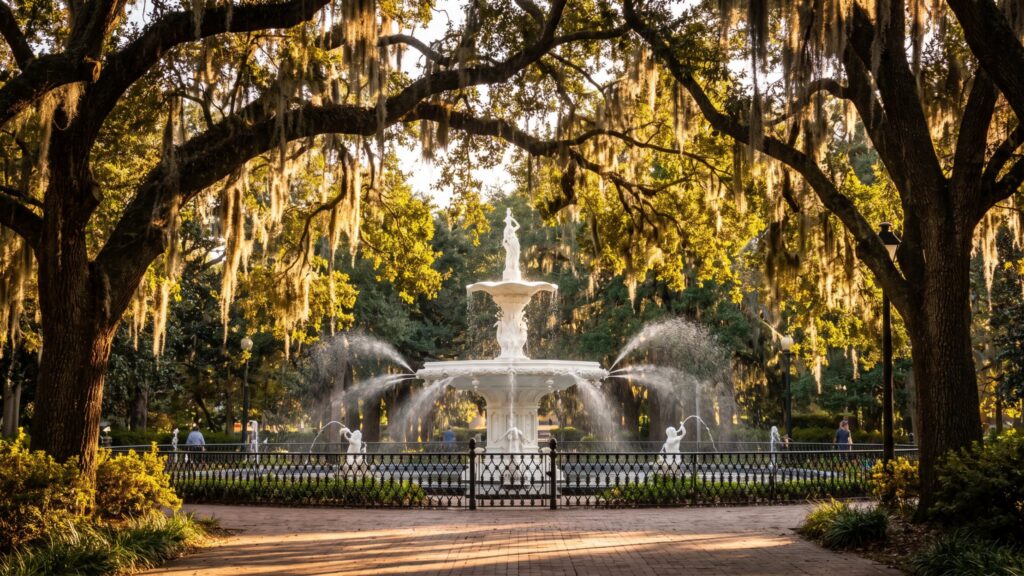
The result is a downtown that behaves like a park with a city threaded through it. Every two or three blocks the street opens into a square of live oaks, azaleas, benches, a fountain or a monument, and the traffic has to slow and go around. The whole ensemble — from the river south to Gwinnett Street, and from East Broad to Martin Luther King Jr. Boulevard — was designated a National Historic Landmark District on 13 November 1966, one of the largest urban landmark districts in the country. Forsyth Park, 30 acres of lawn and canopy with the white cast-iron fountain that has been running since 1858, closes the grid at its southern end.
Layered onto that geometry is an unusually dense cultural stack for a city this size. The Telfair, opened to the public in 1886, is the oldest public art museum in the South; its Owens-Thomas House & Slave Quarters is one of the most honest interpretations of urban slavery anywhere in the United States. First African Baptist Church, organised in 1773, is widely considered the oldest continuously active Black congregation in North America. The Savannah College of Art and Design, founded in 1978, has restored more than sixty historic buildings and floods the district with roughly 18,000 students who keep the coffee shops, galleries and the late-October film festival running. And on the working side of the river, the Port of Savannah is consistently among the busiest container ports in the United States, which is why enormous ships slide past River Street’s bars close enough to read the hull numbers.
What Savannah does not have is a beach of its own (Tybee Island, 18 miles east, covers that), a subway, or the polish of Charleston two hours north. What it has is a lived-in authenticity — people still occupy the 1820s townhouses on Jones Street — a serious food scene, a permissive attitude to a drink on the sidewalk, and real ghosts inherited from real yellow-fever epidemics and a real siege. It rewards slow travel more than almost any city in America.

A Pocket History — Oglethorpe, Cotton, Fever, Sherman & Seven Women
Georgia was the last of the thirteen British colonies, chartered in 1732 as a philanthropic and strategic project: a buffer between prosperous South Carolina and Spanish Florida, and a fresh start for England’s “worthy poor.” James Edward Oglethorpe, a 36-year-old soldier and member of Parliament, sailed with the first settlers and chose the bluff site with the consent of Tomochichi, the Yamacraw chief whose people already lived there; a boulder in Wright Square marks his grave. The Trustees’ original rules banned slavery, rum and lawyers; all three prohibitions collapsed within twenty years, and the ban on slavery was formally lifted in 1750, a decision that shaped everything that followed.
The Revolution reached the city hard. British forces took Savannah in December 1778, and the October 1779 attempt by French and American troops to retake it — the Siege of Savannah — was one of the bloodiest engagements of the war, killing among others the Polish cavalry general Casimir Pulaski, whose name is on the fort at the river mouth and the monument in Monterey Square. The British held the city until 1782.
Then came cotton. In 1793, at Mulberry Grove plantation a few miles upriver, Eli Whitney built the gin that made short-staple cotton profitable across the interior South — and made Savannah its port. By the mid-19th century the city was among the great cotton ports of the world; Factors Walk, the 1886 Cotton Exchange and the River Street warehouses are that trade’s surviving architecture. The wealth built William Jay’s Regency mansions — the Owens-Thomas House (1819) among them — and it was built on enslaved labour, the part of the story the Owens-Thomas House now tells with unusual directness.
The port city also imported disease. Yellow fever killed an official 666 people in 1820 in a town of about 7,500 — a toll that would be closer to 900 if Black residents had been properly counted — and returned in 1854 (about 1,040 dead) and 1876 (1,066 dead), when a fifth of the population fled. Those epidemics, and the burials they required under and around the growing city, are the historical bedrock of the ghost-tour industry — Colonial Park Cemetery, in the middle of the district, holds many of the 1820 dead.
In the Civil War, Savannah was spared the fate of Atlanta. General William T. Sherman’s March to the Sea ended here; the Confederate garrison slipped across the river on 20 December 1864 and Sherman telegraphed Lincoln two days later offering the city “as a Christmas gift,” with its 25,000 bales of cotton. Because the city surrendered rather than burned, its antebellum fabric survived — and Sherman’s meeting with Black ministers at the Green-Meldrim House in January 1865 produced Special Field Order No. 15, the “forty acres” land promise that was later revoked. Fort Pulaski, downriver, had already fallen in April 1862 to Union rifled cannon in a 30-hour bombardment that made every brick fort in the world obsolete overnight.
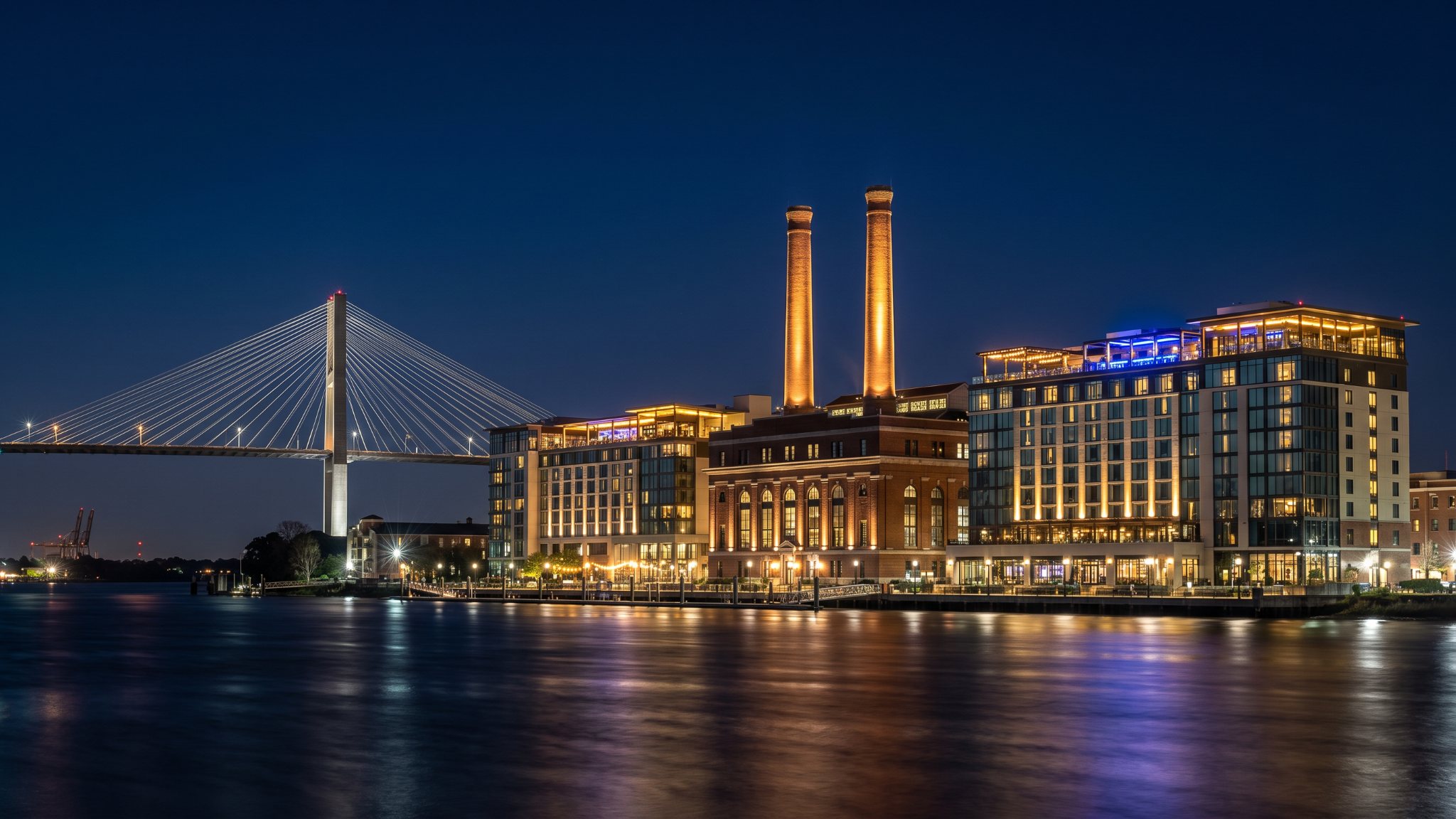
The 20th century nearly undid the survival. By the 1950s the district was shabby, the 1870 City Market had been demolished for a parking garage, and the 1820 Davenport House on Columbia Square was about to be flattened for a car park. Seven women organised the Historic Savannah Foundation in 1955, bought the house, and launched a preservation movement that has since saved more than 350 buildings. SCAD picked up the baton in 1979 when it bought the derelict 1893 Volunteer Guards Armory as its first building, and the 1994 publication of John Berendt’s Midnight in the Garden of Good and Evil — four years on the New York Times bestseller list — turned the restored city into a destination. The latest chapter is on the river: the 1912 Riverside power station, decommissioned in 2005, reopened in July 2020 as the $270 million Plant Riverside District with a 419-room JW Marriott inside the old turbine hall.
Fall 2026 in Savannah — Film Festival, Christmas on the River & the Hurricane Tail
If you are reading this in September 2026 and can choose your dates, the window I would pick is the eleven weeks between roughly 20 September and 10 December. The summer humidity finally breaks in the second half of September, October daytime highs settle into the mid-to-high 70s Fahrenheit (about 24–26°C), and November is the driest, most comfortable stretch of the Savannah year. The oaks do not turn — live oaks are evergreen — but the crepe myrtles and sweetgums do, the light goes gold by 4 p.m., and the ghost tours stop being an act of heat endurance.
The calendar is unusually strong this autumn:
- Savannah Jazz Festival — 18–20 September 2026. The 45th edition, with 15 free performances centred on the Forsyth Park bandshell; bring a blanket and a to-go cup.
- Savannah Bananas at Grayson Stadium — September, with Banana Ball playoffs in the first two weeks of October. The 30-game home schedule is sold by lottery and resale prices run well over $200, so this is a plan-ahead-or-skip item.
- SCAD Savannah Film Festival — 24–31 October 2026. The 29th edition: eight days of premieres, competition films, panels and red carpets at the Trustees and Lucas theatres on Broughton and Abercorn, with individual tickets on sale from 2 October. Hotels inside the district book out for the festival weekend; the Victorian District and Midtown are your fallback.
- Halloween week. Bonaventure and Colonial Park cemeteries, the ghost-tour operators and the bars all lean in; it is the single busiest ghost-tour week of the year, so book walks a fortnight ahead.
- Savannah Christmas Market at Plant Riverside — 19 November 2026 to 3 January 2027. A European-style outdoor market on the riverfront with performances and a Santa.
- Lighted Boat Parade — Saturday 28 November 2026. The 25th annual holiday kickoff: 30-plus decorated boats run the river from Eastern Wharf to Plant Riverside, with fireworks, and the paddlewheelers sell viewing cruises.
- Christmas on the River — 11–12 December 2026. Performances along the waterfront and the 34th Lighted Christmas Street Parade on the Saturday.
Now the catch, and it is a real one. Atlantic hurricane season runs from 1 June to 30 November, and the statistical peak is around 10 September; the Georgia coast’s worst recent scares have all fallen in the autumn window. Hurricane Matthew tracked just offshore as a Category 2 on 7–8 October 2016 and triggered a mandatory evacuation of Chatham County; Irma (September 2017) and Dorian (September 2019) prompted evacuation orders too; and Helene passed west of the city on 27 September 2024 with tropical-storm-force winds, killing 37 people across Georgia, mostly inland. Statistically, a given week in October is far more likely to be glorious than stormy — but you should buy trip insurance with a named-storm clause, know that Chatham County evacuates by zone (A east of the Truman Parkway, B between Truman and I-95, C west of I-95), and understand that in a mandatory evacuation I-16 goes one-way westbound for 125 miles. After about 15 November the risk becomes negligible and the Christmas-lights season is the calmest, cheapest, most under-visited fortnight of the Savannah year.

Best Time to Visit Savannah (Season by Season)
Savannah has a humid subtropical climate: long, hot, wet summers, short mild winters, and two shoulder seasons that are the whole reason to visit. July averages a daily high around 92°F (33°C); January highs sit near 60°F (16°C); the city gets roughly 48 inches (1,200 mm) of rain a year, mostly in summer thunderstorms, with humidity in the mid-70s per cent year-round. Two facts govern the calendar: the July–August heat index regularly tops 100°F (38°C) by noon, and hotel prices follow the tourist calendar rather than the thermometer, so the most comfortable months are not the cheapest.
Autumn (late September – early December) — the window I would choose
The humidity breaks in the second half of September, and from early October the city gives you highs in the 70s Fahrenheit (21–26°C), cool mornings, and November as the driest month of the year. The calendar is dense — the Jazz Festival in September, the Bananas playoffs and the SCAD Film Festival in October, Halloween, then the Christmas Market and Lighted Boat Parade from the third week of November — and the light is the best of the year for photographing the squares. The catches: October is now a peak-price month for hotels (a mid-range room averages around $160 a night, roughly what spring costs) ; the film-festival weekend books out the district; and the hurricane season does not close until 30 November, with the coast’s worst modern storms (Matthew 2016, Helene 2024) falling in late September and early October. Buy insurance, and treat the first half of November as the sweet spot.
Winter (mid-December – February) — mild, cheap and quiet
Genuinely mild by any northern standard: January highs around 60°F (16°C), lows in the low 40s (5–7°C), the occasional 75°F afternoon, and a light jacket rather than a coat. December is the cheapest hotel month of the year on average and January is close behind; the Christmas lights on the river and in the squares run until early January, and camellias bloom through the winter in Forsyth Park. The catches are short days (sunset before 5:30 p.m. in December), grey wet spells that can last three days, and the fact that several institutions take a winter break — Mrs. Wilkes closes from 1 January until mid-February. For a budget traveller who wants the squares almost to themselves, the second week of January is hard to beat.
Spring (March – May) — azaleas, and the St. Patrick’s Day surge
The classic Savannah postcard season: azaleas peak in the second half of March, dogwoods and wisteria follow, and highs climb from the high 60s to the mid 80s Fahrenheit by May. It is also the most expensive and crowded stretch of the year, and the reason is one date. St. Patrick’s Day — always 17 March, with a festival that runs for the better part of a week — brings crowds in the hundreds of thousands to a parade of some 280 units that takes three hours to pass, and the city adds a paid “festival zone” wristband on River Street and City Market. Historic District hotels fill six months out and rates double; Mrs. Wilkes shuts for the day; the squares are lovely and the streets are chaos. If you want the azaleas without the green beer, target the first week of March or the first half of April. Late May is already hot and thundery, and the Tybee beach season has begun.
Summer (June – mid-September) — heat, storms and Tybee
Savannah in July is 92°F with 75 per cent humidity and a near-daily late-afternoon thunderstorm; sand gnats come out at dusk on the marsh and the mosquitoes are serious. This is the season locals leave, and I would not schedule a walking-heavy first visit here. The compensations: hotel rates fall to their lowest outside December (August budget rooms average around $146) , Tybee is in full swing, the Bananas are playing, and the air-conditioned museum circuit is excellent. Walk before 10 a.m. and after 6 p.m., ride the free dot at midday, drink twice the water you think you need, and watch the National Hurricane Center from 1 June.
Getting There — SAV Airport, Amtrak & I-95
Savannah is a mid-sized regional gateway rather than a hub, and that shapes how you arrive: most overseas visitors connect through Atlanta, Charlotte, New York or Washington, most Americans either fly direct on one of a growing list of nonstops or drive in on I-95, and a small but happy minority arrive by overnight train. Whichever you pick, the good news is that the airport, the station and the interstate are all within 15 minutes of the Historic District.
Savannah/Hilton Head International Airport (SAV) — the default
SAV sits about 10 miles (16 km) north-west of downtown off I-95, and despite the “International” it has no scheduled overseas service; the name refers to customs facilities for private aircraft. As of 2026 it is served by eleven airlines — Allegiant, American, Avelo, Breeze, Delta, Frontier, JetBlue, Silver, Southwest, Sun Country and United — with nonstop flights to 34 US destinations including Atlanta, Charlotte, Chicago, Dallas, Boston, New York (JFK, LaGuardia, Newark and Westchester), Washington, Philadelphia, Houston, Denver, Minneapolis, Nashville and Fort Lauderdale; several routes are seasonal and thin out in winter. The terminal is small, calm and quick — 30 minutes from kerb to gate is typical outside holiday weekends. For international arrivals, Atlanta (ATL) is the obvious connection (a 55-minute hop), but note that Atlanta is also only a four-hour drive, and a one-way rental from ATL is a legitimate option for a Georgia road trip.
From SAV to the city
- Rideshare (Uber / Lyft) — the default. Meet at the marked pickup zone outside baggage claim; $30–45 to the Historic District, 20–25 minutes outside rush hour.
- Taxi — a metered rank outside arrivals; expect $35–50 to downtown. Confirm the flat rate before you get in.
- Rental car — all the majors are on-airport. Only worth it if you plan Wormsloe, Tybee, Fort Pulaski and a Charleston or Jekyll run; inside the district a car is a $24-a-day parking liability.
- CAT bus Route 3 — Chatham Area Transit runs a public route between the airport and downtown for a regular fare, though it is slow and infrequent; fine for a solo budget traveller with a backpack.
Amtrak — three daily trains
Savannah’s Amtrak station, at 2611 Seaboard Coastline Drive about four miles west of downtown, sees three daily long-distance trains: the Palmetto (daytime from New York and Washington via Charleston, terminating here), the Silver Meteor (New York–Miami overnight) and the Floridian, the Chicago–Washington–Miami through-service launched in November 2024. Count on 13–15 hours from New York, two from Charleston, and a $15–20 taxi from the station to the district; a roomette on the Silver Meteor is one of the last great East Coast overnights.
By road — I-95 and I-16
Savannah sits at the junction of I-95 (the Maine-to-Miami interstate, which passes ten miles west of downtown) and I-16 (the spur from Macon and Atlanta that ends at Montgomery Street on the edge of the district). Drive times: Charleston 2 hours; Jacksonville 2 hours; Atlanta 3.5–4 hours; Orlando 4 hours; Charlotte 4 hours; Nashville 8; Washington DC 8.5. The prettier approach from the north is US-17 through the Lowcountry marshes and over the Talmadge Bridge, which drops you onto Bay Street with the river on your left. Intercity coaches (Greyhound and FlixBus) also serve the city, from a stop near the Amtrak station, for the Atlanta, Jacksonville and Charleston corridors.
Getting Around — Walking, the Free dot Shuttle & Parking
📍 Savannah Map: Every Place in This Guide
On foot — the only way to see the squares
The Landmark District is roughly one mile by one mile, flat, shaded, and laid out so that you cannot walk more than three blocks without hitting a square. Bull Street is the spine: from City Hall on Bay Street it runs due south through Johnson, Wright, Chippewa, Madison and Monterey squares to Forsyth Park, about 1.2 miles, and if you walk nothing else, walk that. The paving is brick, tabby and old cobble in places, so wear real shoes; the steps down from Bay Street to River Street are steep and slick after rain, and the Factors Walk iron bridges are the more elegant route. Most Savannah accidents are ankles, not crime.
The dot — free shuttle, free ferry
Chatham Area Transit runs a fare-free downtown shuttle called the dot, funded by the City, on two loops (Downtown and Forsyth) that stop at the Visitor Center, the parking garages, River Street, City Market and Forsyth Park, seven days a week, roughly every ten minutes at peak. The same zero-fare programme covers the Savannah Belles Ferry, which crosses the river from River Street to Hutchinson Island and the convention centre every 20–30 minutes — the best free view of the waterfront and the container ships in the city. Regular CAT buses cover the rest of the city, including Tybee-adjacent routes only as far as the eastern islands; there is no public bus to Tybee beach itself.
Trolleys, pedicabs, bikes & rideshare
The hop-on-hop-off trolleys (Old Town Trolley, Old Savannah Tours) are a useful day-one orientation — about 90 minutes for the loop with a live narrator, $40–50 for a day ticket — but after the first lap, walk. Pedicabs cruise the squares ($10–20 a hop is fair). Uber and Lyft cost $8–15 for most rides inside the district and $40–55 each way to Tybee, with surge on festival nights. Bikes suit the flat Victorian District and the Forsyth–Starland run; the older brick and cobble is hard on wheels.
Parking — the real cost of driving in
If you do bring a car, budget for it. City garages (Whitaker Street, Robinson, Bryan Street, State Street, Liberty Street) charge $2 an hour to a $24 daily maximum on weekdays, with a $10 flat rate on Saturdays and Sundays; the underground Whitaker Street garage, 1,065 spaces beneath Ellis Square, is the most central. Street meters run $1.50–$2.50 an hour by zone through the Park Savannah app, but are free after 8 p.m. and all day Sunday. The best-value trick is the Visitor Day Pass ($15 for 24 hours, $24 for 48) from Mobility & Parking Services at 100 East Bryan Street, which covers city garages and most meters. Hotels in the district charge $30–50 a night for valet. Do not leave anything visible in a parked car: vehicle break-ins are the district’s most common crime.

Neighborhoods — Landmark District, Victorian, Starland & the Riverfront
Savannah’s neighbourhood map reads north to south from the river: the Landmark District is Oglethorpe’s grid, rowdy on River Street, commercial on Broughton and grand around the southern squares; below Forsyth Park the Victorian District picks up where the squares stop, and Starland carries the creative energy south to Victory Drive. Where you sleep shapes everything else.
The Landmark District (north) — River Street, City Market & Broughton
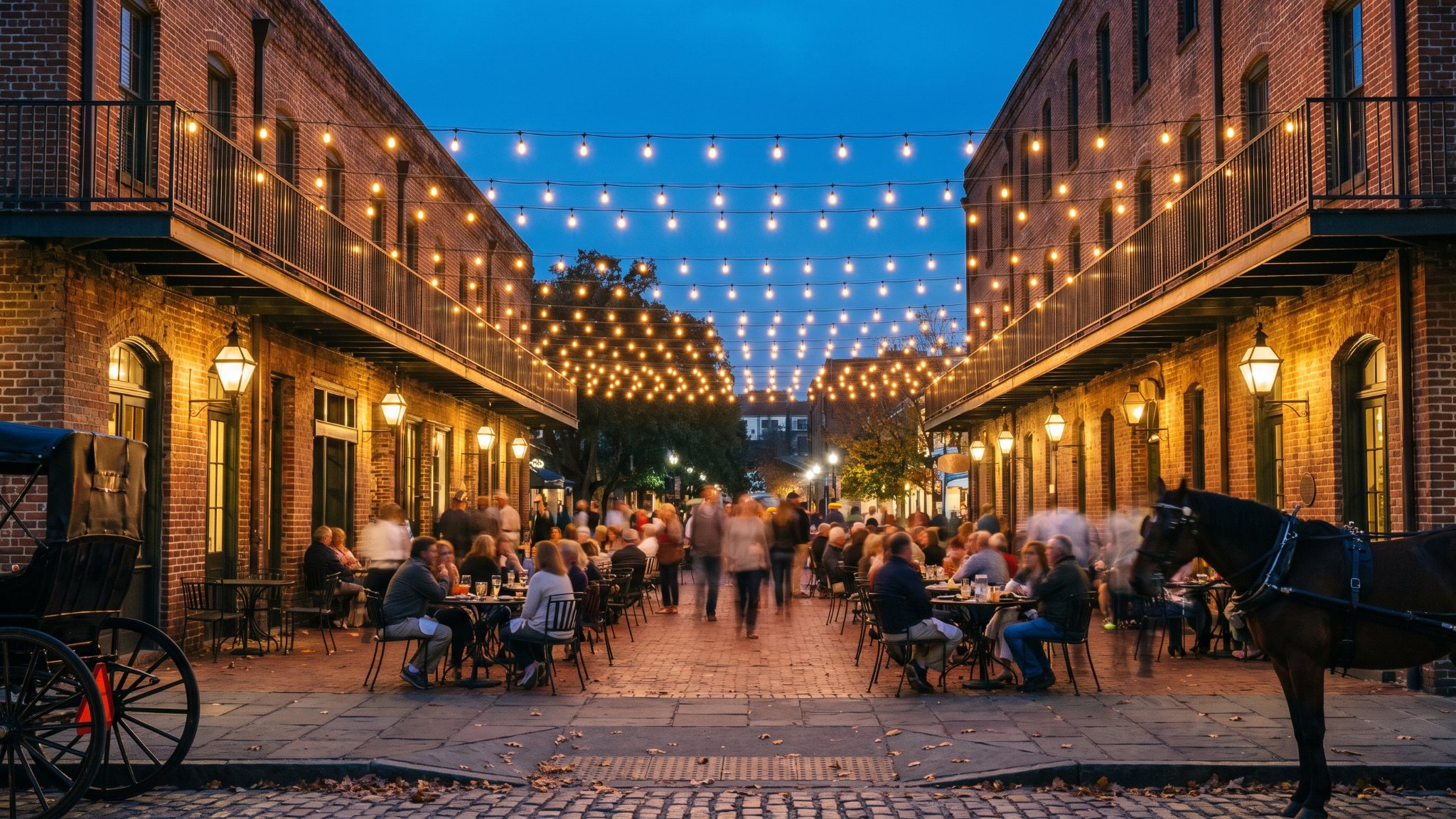
The northern third of the grid is the tourist engine. River Street is a half-mile of 1800s cotton warehouses, now bars, candy kitchens and souvenir shops, on ballast-stone cobbles with the ships going by; it is genuinely atmospheric at sunset and genuinely boozy after 10 p.m. on a Saturday. At its western end, Plant Riverside adds three rooftop bars, a dozen restaurants, a dinosaur skeleton in the hotel lobby and a much cleaner riverfront promenade. Up on the bluff, City Market is a four-block pedestrian courtyard of galleries, bars, pralines and live music between Ellis and Franklin squares — the successor to the 1870 market whose demolition started the preservation movement. Broughton Street is the main shopping street — Leopold’s, the Trustees Theater, national brands and SCAD shops — and the hotels between Bay and Broughton are the most convenient and least peaceful in town.
- River Street & Factors Walk; the Belles Ferry to Hutchinson Island
- Plant Riverside District (rooftop bars, Christmas Market from 19 November)
- City Market, Ellis Square & Franklin Square (First African Baptist)
- Broughton Street shopping, Leopold’s, the Trustees Theater
Best for: first-timers with two nights, nightlife, families who want the river. Sleep: big-brand and boutique hotels; expect noise.
The Landmark District (south) — the squares proper
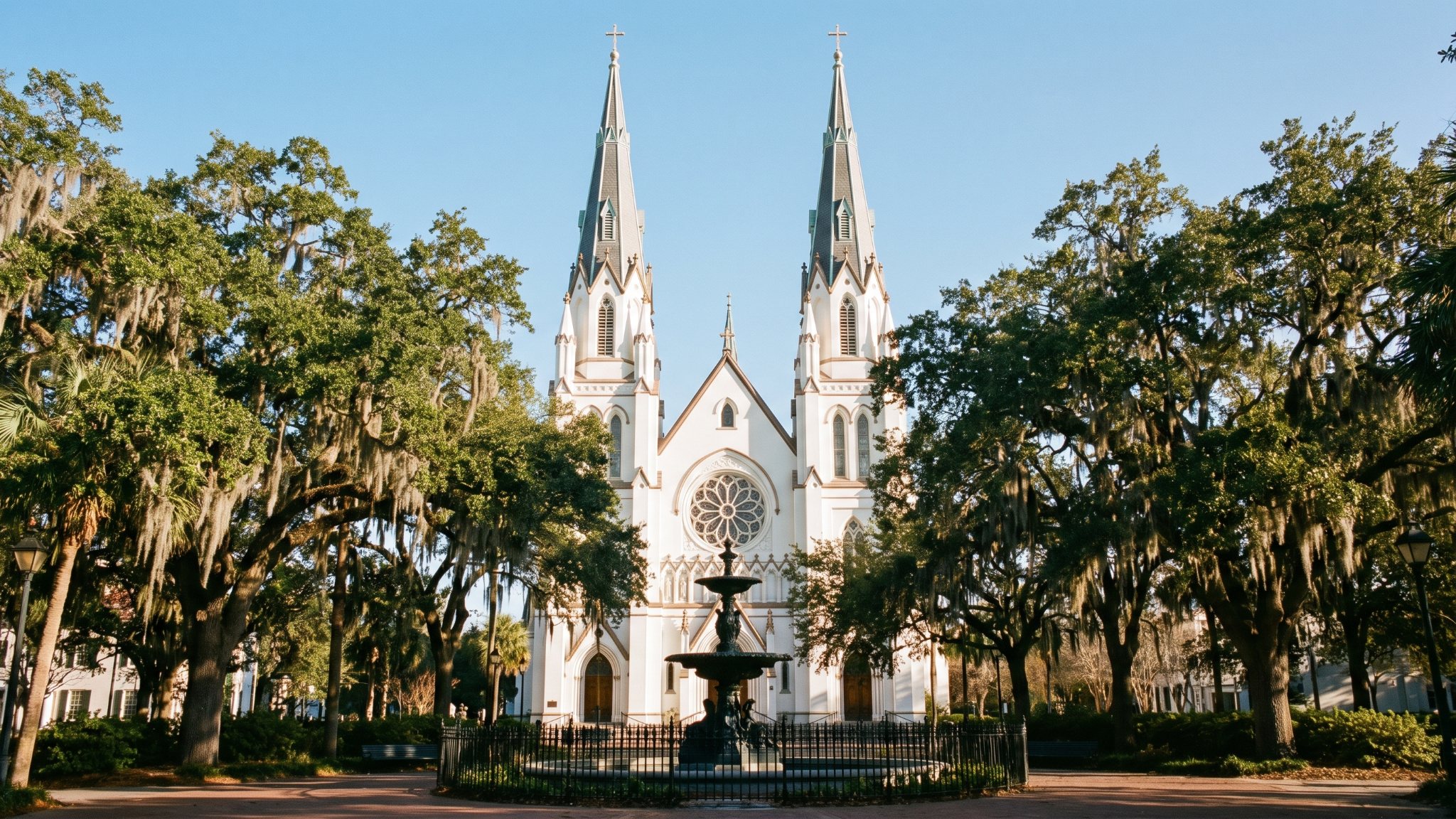
South of Liberty Street the grid quietens into what most people picture when they think of Savannah: Madison, Monterey, Lafayette, Calhoun and Chatham squares, Jones Street, the Cathedral, and the run of 1840s–60s townhouses that people still live in. The Mercer Williams House on Monterey Square is the Midnight house; the Cathedral Basilica of St. John the Baptist, its twin spires rebuilt after an 1898 fire, faces Lafayette Square and is free to enter; the Andrew Low House and the Juliette Gordon Low Birthplace — where the Girl Scouts founder was born in 1860 — bring in a steady stream of Girl Scout troops. This is where I would sleep: the inns on and around the squares put you five minutes from everything and a world away from River Street.
- Jones Street, Monterey Square & the Mercer Williams House
- Cathedral Basilica of St. John the Baptist (Lafayette Square)
- Juliette Gordon Low Birthplace & Andrew Low House
- Forsyth Park & the Saturday farmers’ market
Best for: romantics, architecture walkers, anyone staying three nights or more. Sleep: mansion inns and B&Bs, $250–500 in season.
Victorian District & Thomas Square
South of Forsyth Park the grid drops the squares and the houses switch to gingerbread: the Victorian District (roughly Gwinnett to Anderson streets) was built out in the 1870s–90s as the city’s first streetcar suburb, and its painted-wood mansions on Whitaker, Barnard and Habersham streets are a National Register district in their own right. It is quieter, 20–40 per cent cheaper for a rental or inn, and a 10-minute walk from the park; the trade-off is a longer walk to the river and a few blocks that feel unloved after dark.
Best for: value, repeat visitors, longer stays. Sleep: vacation rentals and small inns.
Starland District
A former 1930s dairy-and-warehouse strip along Bull Street south of 37th Street, now the city’s creative quarter — murals, vintage shops, coffee roasters, cocktail bars, breweries, the Starland Yard food-truck lot, and SCAD students everywhere. The 2024 pilot expansion of the to-go cup zone reached down Bull Street to Victory Drive partly to serve it. Back in the Day Bakery, the district’s anchor for 22 years, closed in February 2024 — a genuine loss — but the neighbourhood around it has only got busier.
Best for: a lunch and an afternoon; nightlife with locals rather than trolleys. Access: 25-minute walk from Forsyth or a $7 rideshare.
Culture — Gullah Geechee, the Slave Quarters, SCAD & the Ghost Economy

Black Savannah & the Gullah Geechee coast
Enslaved Africans made up roughly half the city’s population by the mid-19th century, and their descendants along this coast — the Gullah Geechee — retained more West African language, food and craft than any other African American community, thanks to the isolation of the Sea Islands. Congress designated the Gullah Geechee Cultural Heritage Corridor, running from Wilmington, North Carolina to Jacksonville, Florida, in 2006. Start at First African Baptist Church on Franklin Square, organised in 1773 by George Liele, an enslaved preacher, and housed since 1859 in a sanctuary built by enslaved and free Black members after their working hours; the diamond-pattern holes in the floor of the lower auditorium are an African cosmogram and, by church tradition, ventilation for people hidden on the Underground Railroad. Tours run Monday to Saturday at 1 p.m., $15. Then the Owens-Thomas House & Slave Quarters, where the Telfair reoriented the whole tour in 2018 around the nine to fourteen enslaved people who lived in the carriage house — the ceiling there still carries “haint blue” paint, the largest surviving example of the pigment believed to ward off spirits. Finish, if you have a car, at the Pin Point Heritage Museum, in the old A.S. Varn & Son oyster and crab cannery in the community founded by freed people in the 1890s — and the birthplace of Justice Clarence Thomas — open Thursday to Saturday.
The Telfair, the Jepson & the Bird Girl
The Telfair Academy, another William Jay mansion, opened as a museum in 1886 — the oldest public art museum in the South and the first in America founded by a woman, Mary Telfair. Its modern sibling, the Jepson Center, opened in 2006 to a Moshe Safdie design in white stone and glass on Telfair Square, and is the permanent home of Sylvia Shaw Judson’s Bird Girl, moved from Bonaventure Cemetery in 1997 after the Midnight cover made her plot unmanageable. A single $30 ticket covers all three Telfair sites for a week; the Owens-Thomas tour is timed and books out on weekends.
SCAD — the college that bought the city
The Savannah College of Art and Design enrols roughly 18,600 students across Savannah, Atlanta and online, and in Savannah it occupies more than sixty buildings and over two million square feet, nearly all of them historic structures it restored — the 1893 armory, a former synagogue, a Baptist church, a department store, a jail. For a visitor it means the SCAD Museum of Art (in an 1853 railway freight depot on MLK Boulevard), the shopSCAD store of student work, the Trustees and Lucas theatres, and the film festival — plus a permanent population of 20-somethings that keeps the bars and coffee shops honest.
The ghost economy
The city calls itself “America’s Most Haunted” and dozens of operators run walking, hearse and pub-crawl ghost tours every night of the year. The claim has real historical bones: Colonial Park Cemetery holds an estimated 9,000 burials, many from the 1820 epidemic, and the squares themselves were built over earlier graves. The commercial engine, though, was Midnight in the Garden of Good and Evil, Berendt’s account of the 1981 shooting at the Mercer House and the four trials of Jim Williams that followed; Clint Eastwood’s 1997 film added the Bonaventure scenes. Pick a tour led by a licensed guide (the city requires a tour-guide licence and the good operators say so), go on the coolest night, and treat it as the best-told history lesson you will get in town.
Food & Drink — Shrimp and Grits, Mrs. Wilkes, The Grey & the To-Go Cup

Savannah eats Lowcountry: the coastal Southern cooking built on rice, shrimp, crab, oysters, pork and the vegetables of a nine-month growing season, with Gullah Geechee cooking as its bedrock and a Greek, Irish and, lately, chef-driven overlay. The Georgia white shrimp season runs from roughly June into December, so an autumn visit puts you in the middle of it; oyster roasts start when the water cools in October. The city has one nationally famous restaurant, one nationally famous lunch line, one nationally famous ice-cream counter, and a hundred good places in between; the price spread runs from a $6 boiled-peanut bag at the farmers’ market to a $150 tasting menu.
Must-Try Dishes
| Dish | What it is & where |
|---|---|
| Shrimp and grits | Wild Georgia shrimp in a gravy (tasso ham, tomato or plain butter) over stone-ground grits. Originally a Gullah fisherman’s breakfast, now on every menu; best where the shrimp is local and the grits are coarse. $18–32. |
| She-crab soup | Cream and sherry bisque of blue crab meat and roe — the Lowcountry’s signature soup, Charleston-born but universal here. $9–14 a bowl. |
| Lowcountry boil | Shrimp, smoked sausage, corn and new potatoes boiled in Old Bay-style seasoning and dumped on newspaper. Order it at a Thunderbolt dock or Tybee shack, never in a hotel. $22–35. |
| Fried chicken, family style | The Mrs. Wilkes experience: fried chicken, cornbread dressing, black-eyed peas, okra gumbo, sweet-potato soufflé and a dozen more bowls passed around a table of ten strangers. $35 a head, cash, weekdays 11–2. |
| Red rice & Hoppin’ John | Tomato-and-bacon rice (a West African jollof descendant) and black-eyed peas with rice — the two Gullah Geechee dishes that explain the region’s food better than any shrimp. |
| Leopold’s tutti frutti | The 1919 house flavour (rum ice cream, candied fruit, pound cake) at the Broughton Street parlour, founded by the Greek Leopold brothers and reopened by their film-producer son Stratton in 2004; the queue is 20–40 minutes on a warm evening. |
The big three
- Mrs. Wilkes’ Dining Room (107 West Jones Street) — the boarding-house lunch that Sema Wilkes started serving in 1943, still run by her family. No reservations: the line forms on the Jones Street pavement from about 9:30 a.m., the doors open at 11, and it is Monday to Friday only, cash or cheque, $35 per adult tax included, closed 1 January to mid-February and on St. Patrick’s Day.
- The Grey (109 Martin Luther King Jr. Boulevard) — Mashama Bailey and Johno Morisano’s restaurant in the restored 1938 art-deco Greyhound terminal, opened December 2014. Bailey won the James Beard Award for Best Chef: Southeast in 2019 and Outstanding Chef in the United States in 2022 for her “port city Southern” cooking. Book a month out; the Grey Market on Jefferson Street is the walk-in lunch-counter version. The team announced three new Savannah concepts in July 2026, so check what has opened.
- Husk Savannah (12 West Oglethorpe Avenue) — Sean Brock’s Charleston original arrived in a restored 19th-century house in January 2018; heirloom-Southern ingredients, a serious bourbon list, and the easiest of the three to book.
Drinking — the to-go cup, explained properly
Savannah is one of a handful of American cities where you may walk the streets with a drink, and the rules are precise: a plastic cup of 16 ounces or less (no glass, cans or bottles), inside the open-container zone — broadly the Historic District from the river south to Jones Street between Martin Luther King Jr. Boulevard and East Broad Street, plus Hutchinson Island — with public-intoxication laws in full force. A 2024 pilot extended the zone down Bull Street to Victory Drive, taking in part of Starland; the boundary signs are posted and stepping outside them with a cup is citable. Bars pour into a go-cup on request. The drinking age is 21, ID is checked relentlessly, and a passport is the only ID many bars accept from foreigners.
Off the Beaten Path — Bonaventure, Wormsloe, Pin Point & the Marsh
“Off the beaten path” here means off the trolley route rather than obscure. Everything below needs a car, a bike or a $15–25 rideshare, and each rewards a morning.
Bonaventure Cemetery
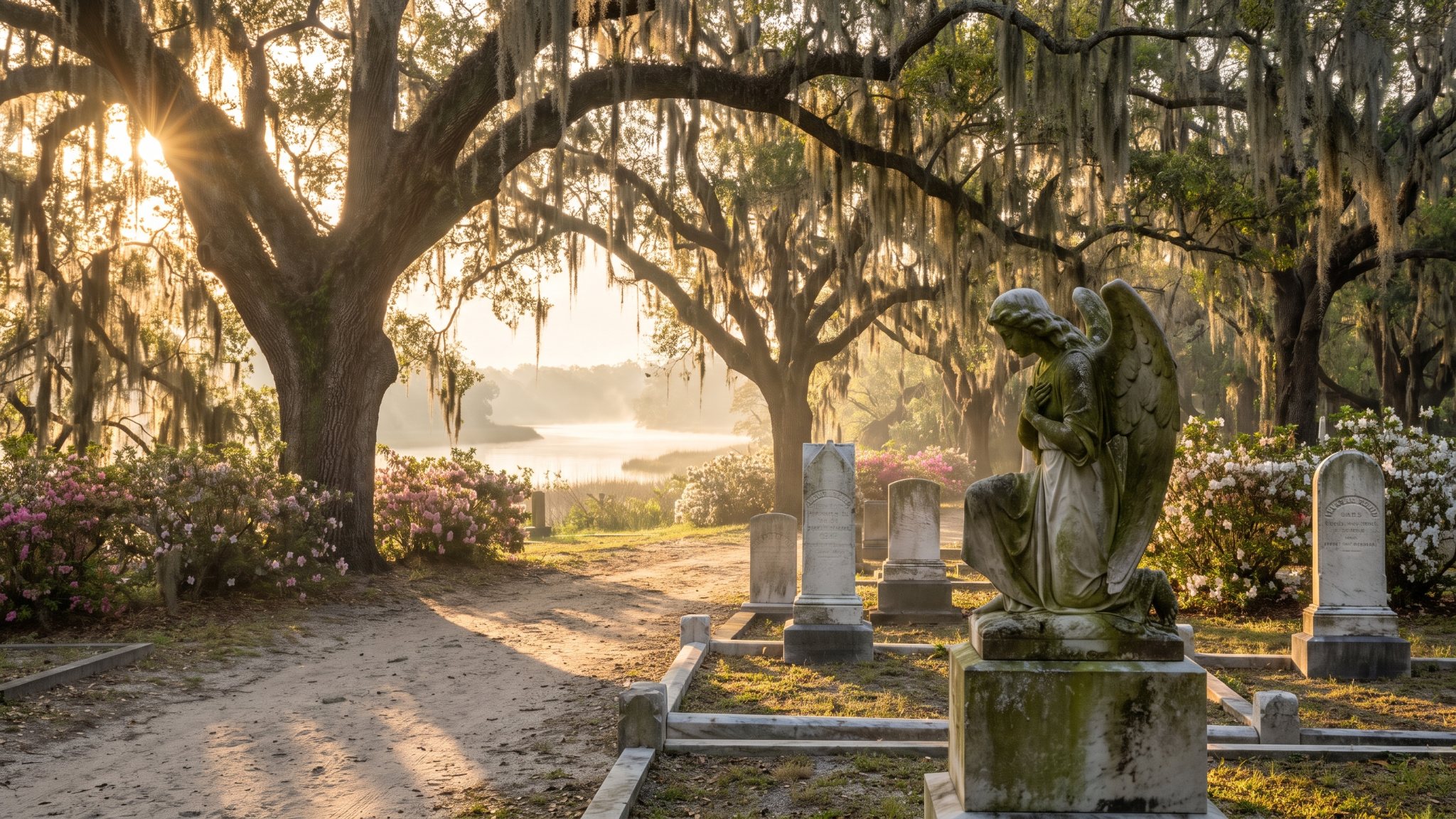
The plantation-turned-cemetery on a bluff over the Wilmington River, 160 acres of Victorian angels, live oaks, azaleas and Johnny Mercer’s bench, laid out from 1846 and city-owned since 1907. Gates open 8 a.m. to 5 p.m., 365 days a year, free. The Bird Girl is no longer here (she is at the Jepson), but Gracie Watson’s 1890 portrait statue, the Mercer plot and the Jewish section with its river views are. Come at opening, walk the river edge first, and pick up the Historical Society’s map at the gate; the Society runs free weekend tours on the second Saturday and Sunday of most months. Go on to Thunderbolt, five minutes further, for lunch on the shrimp docks.
Wormsloe State Historic Site
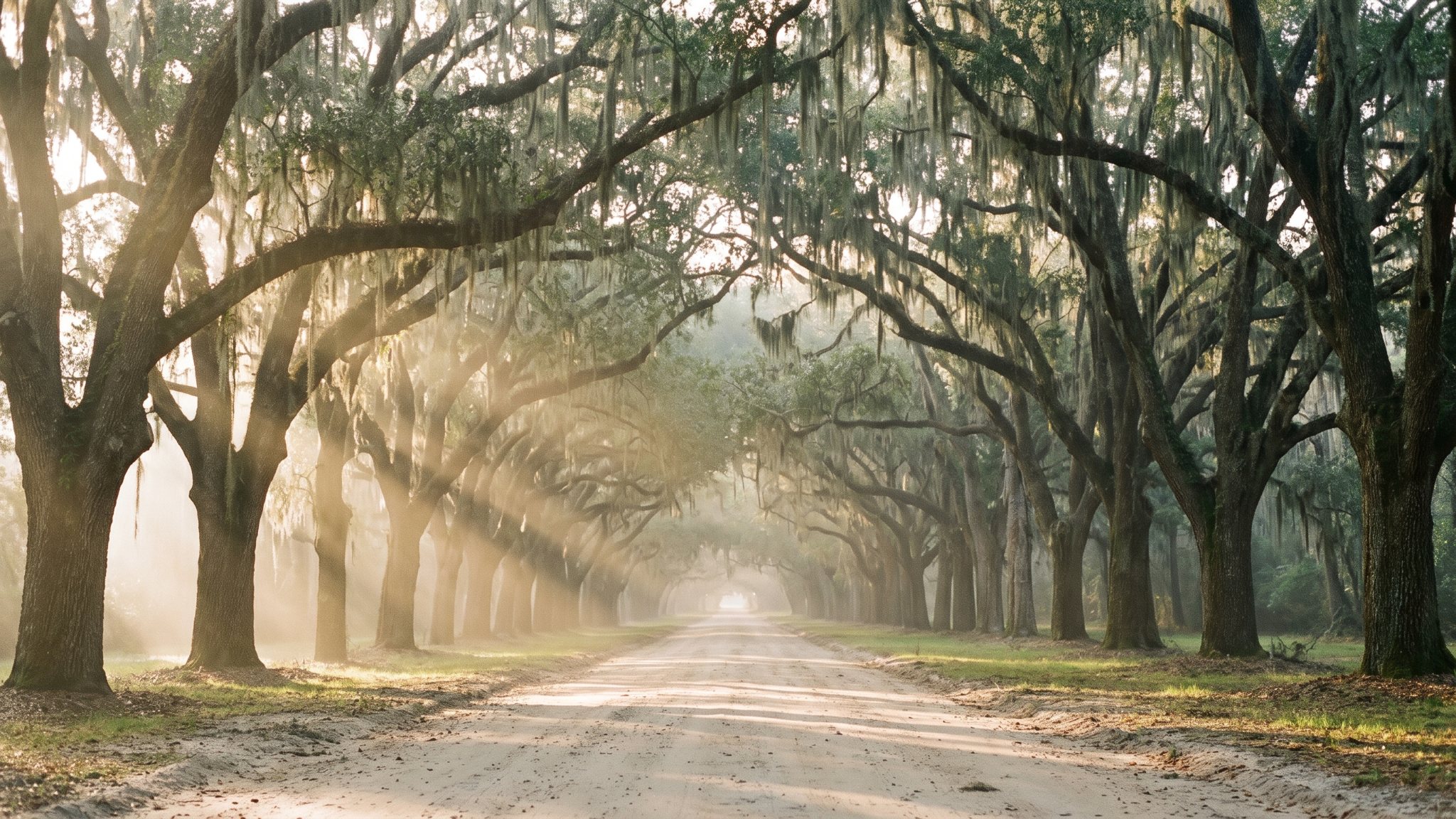
The tabby ruins of Noble Jones’s 1740s fortified house on the Isle of Hope, reached through the most photographed gate in Georgia and then a 1.5-mile avenue of some 400 live oaks planted in the 1890s. Open daily 9 a.m. to 4:45 p.m., $12 adults, with a small museum, a colonial-life demonstration area and marsh-edge trails. Arrive at opening for the avenue empty and the light low. Pair it with Bonaventure and Pin Point for the perfect south-east morning.
Pin Point Heritage Museum
Twenty minutes south on the Moon River, the community that freed people from Ossabaw Island founded in the 1890s, and the A.S. Varn & Son oyster and crab factory that employed most of it until 1985 — now a Coastal Heritage Society museum with residents’ oral histories, the shucking floor and the boats. Open Thursday to Saturday, 9 a.m. to 4 p.m. It is the most direct encounter with Gullah Geechee life available near the city, and almost no one goes.
Skidaway Island State Park & the Savannah National Wildlife Refuge
Two marsh escapes at opposite ends of the city. Skidaway Island State Park, 30 minutes south-east, has boardwalks through the salt marsh and maritime forest with fiddler crabs, herons and the occasional alligator; $5 parking. The Savannah National Wildlife Refuge, 15 minutes north across the river in South Carolina, is 31,000 acres of former rice fields with a four-mile drive along the old dikes; in autumn and winter it fills with ducks, and alligators sun on the banks year-round. Free. A kayak tour through the Skidaway or Moon River creeks at high tide, with dolphins, is the best $60–80 you will spend outside the district.
Day Trips — Tybee, Fort Pulaski, Hilton Head, Charleston & Jekyll

Tybee Island (30–40 minutes)
Savannah’s beach: 18 miles east along US-80 across the marsh, a three-mile-long, low-rise, slightly scruffy barrier island that feels more like the Carolina coast than Florida. The Light Station at the north end — a light has stood here since 1773, the current 145-foot tower dates to 1867 — is $14 for adults with the Battery Garland museum, 178 steps up. South Beach around the pier is the busy end with the bars and the Lowcountry-boil shacks; the North Beach by the lighthouse is quieter and watches the ships enter the river. Parking is the catch: $4 an hour or $25 a day from March to October, dropping to $2 an hour from 1 November to the end of February — another argument for autumn. There is no public bus; a rideshare runs $40–55 each way and the Tybee shuttle services vary by season. Ocean water stays swimmable into October (around 75°F / 24°C).
Fort Pulaski National Monument (25 minutes, en route to Tybee)
On Cockspur Island halfway to Tybee, the 1847 brick fort where a young Robert E. Lee helped design the drainage and where, in April 1862, Union rifled cannon on Tybee breached the seven-foot walls in 30 hours and ended the era of masonry fortification. The shell scars are still in the walls. Open daily 9 to 5, $10 for adults and free under 16; the marsh trails and the lighthouse view are a bonus.
Hilton Head Island, South Carolina (45–60 minutes)
The manicured resort island across the state line — 12 miles of wide, firm beach, 60 miles of bike paths, golf, and the Harbour Town lighthouse. It is the opposite of Tybee in every way, which is the reason to go if you want a bicycle beach day; Bluffton, on the way, has a sweet old-town and oyster houses on the May River.
Charleston, South Carolina (2 hours)
The other great colonial port of the Lowcountry, 105 miles north on I-95 and US-17, or two hours on the Palmetto train. Bigger, richer, more polished, with Rainbow Row, the Battery, the plantations along the Ashley and a food scene that rivals Savannah’s. A day trip is a rush; an overnight is the right way to compare the two, and we have a full Charleston city guide for it.
Jekyll Island & the Golden Isles (1.5 hours)
South down I-95, Jekyll Island was the Gilded Age winter club of the Rockefellers and Morgans; the restored Club hotel, Driftwood Beach’s bleached oaks and the Georgia Sea Turtle Center fill a day, for a modest per-car island fee. Beaufort, South Carolina, an hour north, is the smaller antebellum river town Hollywood uses when Savannah is too busy.
Practical Information
Savannah is one of the easiest American cities for a foreign visitor — small, English-speaking, card-friendly, safe in the places you will actually be — but it has three quirks worth understanding: the heat, the go-cup rules, and a property-crime picture that is mostly about parked cars. The table covers the decisions that matter on the ground.
| Topic | Savannah reality |
|---|---|
| Money | US dollar. Cards and contactless work everywhere except Mrs. Wilkes (cash), some food trucks and the pedicabs; ATMs charge $3–4 for out-of-network cards. Chatham County sales tax is 7 per cent on top of displayed prices, and hotel bills add an 8 per cent hotel-motel tax plus a $5-a-night Georgia state fee, so a “$200” room is about $235. |
| Tipping | 18–20 per cent at any sit-down restaurant (often added automatically for six or more); $1–2 a drink at bars; $2–5 a bag for hotel porters; 15–20 per cent for rideshare, tour guides and pedicabs. Ghost-tour guides work largely for tips — $5–10 a person is expected. |
| Safety | The Historic District, River Street, Forsyth and Tybee are heavily patrolled and, for tourists, low-risk; violent crime city-wide fell about 20 per cent from 2023 to 2025 and homicides dropped from 32 in 2022 to 26 in 2024, though the city’s overall rate remains above the US average. The realistic risks are car break-ins and vehicle theft (leave nothing visible, ever), late-night drunkenness on River Street, and a handful of blocks west of MLK Boulevard and south of Forsyth that feel isolated after dark. Solo travellers are fine; walk in company after midnight. |
| Heat & health | June–September heat indices above 100°F are routine; hydrate, walk early and late, and use the free dot shuttle at midday. Mosquitoes and biting midges are serious on the marsh at dusk from April to October. Tap water is safe. Emergency care: Memorial Health and St. Joseph’s/Candler are the two hospital systems; US healthcare is expensive, so carry travel insurance with at least $100,000 medical cover. |
| Hurricanes | Season 1 June–30 November, peak mid-August to mid-October. Watch the National Hurricane Center from five days out; Chatham County issues evacuation orders by zone (A, B, C), and hotels will not let you stay through a mandatory order. |
| The go-cup | Plastic, 16 oz or less, inside the marked Historic District zone (river to Jones Street, MLK to East Broad) plus the Bull Street corridor to Victory Drive; no glass, no cans, no drinking in cars or outside the zone. Drinking age 21, passport for ID. |
| Connectivity | All US carriers have full 5G downtown; an eSIM (Airalo, Holafly, T-Mobile prepaid) bought before arrival is simpler than a store SIM. Free Wi-Fi at the Visitor Center, most cafes and Plant Riverside. Plugs are Type A/B, 120 V. |
| Time zone | Eastern Time (UTC−5; UTC−4 during daylight saving, second Sunday in March to first Sunday in November). Sunset around 7:15 p.m. in late September, 5:25 p.m. in mid-December. |
| Accessibility | Brick and cobble paving, the River Street steps and the raised house-museum entrances are hard on wheels; the dot shuttle, Belles Ferry and Plant Riverside are fully accessible, and the trolleys have lifts. Forsyth Park and Bonaventure’s main lanes are paved. |
| Tours & tickets | Savannah licenses its tour guides; book ghost tours, the Owens-Thomas timed slot, First African Baptist and any film-festival screenings ahead in October. The Visitor Center at 301 MLK Boulevard (the 1860 Central of Georgia station) sells combined tickets and has the cheapest all-day parking in town. |
Budget & Costs — What Savannah Actually Costs in Late 2026
Savannah is cheaper than Charleston, far cheaper than Miami or New York, and more expensive than it was: the room supply of roughly 18,800 has barely grown while demand keeps rising, and Historic District hotels price accordingly. A mid-range room averaged around $160 a night in October and $150 in December on the booking sites, with the St. Patrick’s week and film-festival weekend running two to three times that; short-term rentals averaged about $309 a night city-wide. Everything else — the squares, the parks, Bonaventure, the churches, the ferry, the shuttle, the Jazz Festival — is free, which is why a careful traveller can do this city well on a modest budget. Figures below are per person, in US dollars, assuming a couple sharing a room; add 30–40 per cent for a solo traveller.
| Tier | Daily / person | Sleep | Eat | Transport | Activities | Extras |
|---|---|---|---|---|---|---|
| Budget | $110–160 | $55–90 (half a Midtown/airport-corridor chain room, hostel bed, or Victorian District rental in winter) | $30–45 (Mrs. Wilkes once, food trucks, a Leopold’s cone, grocery breakfasts) | $0–10 (dot shuttle, ferry, walking; one rideshare) | $10–25 (Bonaventure, the churches and squares free; one paid ghost tour) | $10–20 (go-cup beers, pralines) |
| Mid-Range | $220–380 | $120–220 (half a Historic District boutique hotel or inn, $240–440 a room in autumn) | $60–100 (one serious dinner, a Lowcountry lunch, coffee and ice cream) | $20–50 (rideshares, one Tybee round trip, or a rental car plus $24 garage) | $30–60 (Telfair three-site ticket $30, Wormsloe $12, First African Baptist $15, trolley day) | $20–40 (rooftop cocktails at Plant Riverside, a film-festival screening) |
| Luxury | $550+ | $300–600+ (half a square-front mansion inn, the Perry Lane, the JW Marriott river suites) | $120–220 (The Grey tasting menu, Husk, the Olde Pink House, a wine list) | $60–120 (private driver, valet, airport car) | $80–200 (private licensed guide, Bonaventure and Wormsloe by car, kayak with dolphins, a Bananas resale ticket) | $60–150 (spa, SCAD art, boat-parade cruise) |
Where Your Money Goes — Savannah Specifics
The bed is the budget. A room inside the grid costs two to three times the same room in Midtown or by the airport, and the premium buys walkability, which is the entire point — pay it for the first three nights and economise elsewhere. Food is the easy lever: the $35 Mrs. Wilkes lunch is the best-value meal in Georgia, and the farmers’ market, the Starland trucks and the Thunderbolt docks beat most $60 entrées. Transport should cost almost nothing if you stay in the grid; the dot, the ferry and your feet cover 90 per cent of a trip and the Tybee round trip is the one day rideshare adds up. The four paid essentials (Telfair three-site, First African Baptist, Wormsloe, one ghost tour) total about $85. The swing variables are the calendar (St. Patrick’s week and the film-festival weekend double the bed line), Bananas resale tickets, and parking, which quietly adds $24–50 a day to any car-based plan.
Money-Saving Tips
- Come in the first half of November or the second week of January — the same city at 40–50 per cent off the spring rate
- Sleep in the Victorian District or Thomas Square, 10–15 minutes’ walk from Forsyth, and save $80–150 a night
- Leave the car at home; if you must drive, buy the $15 Visitor Day Pass and park in a city garage, never at a hotel valet
- Eat the big meal at lunch (Mrs. Wilkes, the Grey Market, the Starland bistros) and go light at dinner with a go-cup on the squares
- Tybee parking falls to $2 an hour from 1 November; the ocean is still 75°F
Planning — 5, 7 and 10-Day Itineraries

Savannah itself needs three nights; the question is what you wrap around it. The city sits at the hinge of the Southeast coast — two hours from Charleston, four from Atlanta or Orlando, an easy stop on any I-95 road trip — and the itineraries below assume an autumn 2026 visit and a base inside the grid. Book the Owens-Thomas timed tour, any ghost walk, The Grey and (in late October) the film-festival screenings before you arrive; leave the rest loose.
5 days — the Savannah essentials
- Day 1 — The grid. Trolley loop for orientation at 9, Bull Street on foot from City Hall to Forsyth, Leopold’s, the Cathedral, Monterey Square at dusk, dinner at the Olde Pink House tavern.
- Day 2 — Black Savannah & the museums. Owens-Thomas House at 10, Mrs. Wilkes at 11 (join the line at 10:15), the Jepson and Telfair Academy in the afternoon, First African Baptist at 1 p.m. if you swap the lunch, ghost tour at 9.
- Day 3 — East to the sea. Bonaventure at 8, Fort Pulaski at 10, Tybee for a Lowcountry boil and the lighthouse, back for sunset on River Street and the Belles Ferry.
- Day 4 — South & the marsh. Wormsloe at opening, Pin Point (Thursday–Saturday), a high-tide kayak from Skidaway, dinner in Starland.
- Day 5 — Your Savannah. Forsyth farmers’ market (Saturday), the Railroad Museum and SCAD Museum, a rooftop at Plant Riverside, The Grey.
7 days — add Charleston
Days 1–5 as above, then the Palmetto train or US-17 north on Day 6 for two nights in Charleston: the Battery and Rainbow Row, a plantation on the Ashley, a Charleston dinner, and the Savannah-or-Charleston argument settled in person. Fly out of Charleston (CHS) or train back for a Savannah departure. Our Charleston guide has the detail.
10 days — the Lowcountry-to-Florida road trip
Fly into Charleston, two nights there, drive south via Beaufort and Hilton Head (one night) to Savannah for four nights (Days 4–7), then I-95 south with a night on Jekyll Island and a stop in St. Augustine, ending in Orlando on Day 10 — or push on to Miami. That routing gives you the three great historic ports of the Southeast in one arc, and our Orlando and Miami guides pick up the Florida end. For the inland alternative — Atlanta and the four-hour I-16 run — or the flight-connection logic, see the United States guide.
Frequently Asked Questions
How many days do I need in Savannah?
Three full days covers the essentials — one for the squares and Bull Street, one for the Owens-Thomas House, First African Baptist and the Telfair museums, and one for Bonaventure, Fort Pulaski and Tybee. A fourth adds Wormsloe, Pin Point and the marsh; a fifth lets you slow down, catch a Bananas game or a festival, and eat at The Grey. Most first-timers should book three or four nights inside the Historic District and treat Charleston as a separate overnight.
Is Savannah safe for tourists in 2026?
Yes, in the places you will be. The Historic District, River Street, Forsyth Park and Tybee are heavily patrolled, and the city’s violent crime fell about a fifth between 2023 and 2025, though Savannah’s overall rate is still above the US average. The realistic risks for visitors are vehicle break-ins (leave nothing visible), drunken scuffles on River Street late on weekends, and walking alone through the quieter blocks west of MLK Boulevard after midnight. Use the same sense you would in any American city and you will be fine.
What is the best time of year to visit Savannah?
Late September to early December, with the first half of November as the sweet spot: highs in the 70s Fahrenheit, low humidity, the Jazz Festival, the SCAD Film Festival (24–31 October 2026) and the Christmas lights from 19 November, at hotel rates below spring. Spring (March–April) is the azalea season but the priciest and busiest, especially St. Patrick’s week. Summer is hot, humid and thundery; winter is mild, cheap and quiet. Hurricane season runs 1 June to 30 November, so insure autumn trips.
Can I really drink alcohol on the street in Savannah?
Yes, within limits: a plastic cup of 16 ounces or less, inside the Historic District open-container zone (roughly the river south to Jones Street, between MLK Boulevard and East Broad, plus the Bull Street corridor to Victory Drive since the 2024 pilot), with no glass, cans or bottles and full enforcement of public-intoxication laws. Bars pour into “go-cups” on request. The rules change inside the St. Patrick’s festival zone, and the drinking age is 21 with strict ID checks.
How do I get from the airport into the city?
Savannah/Hilton Head International (SAV) is about 10 miles north-west of downtown; a rideshare or taxi takes 20–25 minutes and costs $30–50, and every rental agency is on-site. There is no international service, so overseas visitors connect through Atlanta, Charlotte, New York or Washington. A public CAT bus runs to downtown for a standard fare but is slow. If you arrive by Amtrak, the station is four miles west and a taxi to the district is $15–20.
Do I need a car in Savannah?
Not for the city: the Historic District is a mile square, flat and shaded, with a free shuttle (the dot) and a free ferry, and parking costs $24 a day in city garages plus $30–50 at hotel valets. You do want wheels for one day — Bonaventure, Wormsloe, Fort Pulaski and Tybee — and a one-day rental or two rideshares covers it. If you are road-tripping, buy the $15 Visitor Day Pass and use the garages rather than the meters.
Savannah or Charleston?
Savannah for the walkable squares, the go-cup, the lower prices and the livelier evenings; Charleston for polish, the peninsula’s grand houses, the plantations and a deeper fine-dining bench. They are two hours apart by car or train, and the right answer for a week is both — three nights here, two there.
Is Savannah really haunted, and are the ghost tours worth it?
The reputation has real footings — three yellow-fever epidemics that killed over 2,700 people between 1820 and 1876, a 1779 siege, a Civil War occupation and squares laid out over old burial grounds — and Midnight in the Garden of Good and Evil turned that into an industry. Believe what you like; the walking tours, led by city-licensed guides, are among the best-told history walks in America and worth $25–35 on the coolest night of your stay.
Ready to Walk Savannah?
Savannah rewards the traveller who slows to the pace Oglethorpe built into it: walk Bull Street from the river to Forsyth with a go-cup in hand, sit through a Mrs. Wilkes lunch with nine strangers, stand in the carriage house at the Owens-Thomas and the sanctuary at First African Baptist, and take the 8 a.m. light at Bonaventure and the 6 p.m. light on River Street. Pair this guide with our Charleston and New Orleans guides for the rest of the historic South, and the United States guide for the wider frame.
Explore More Guides
Where to stay: square-front inns and boutique hotels in the southern Landmark District, the big riverfront hotels around Plant Riverside for families, and the Victorian District or Starland for value and a local pace.
- United States Travel Guide — ESTA, tipping, driving, domestic flights and the wider country frame
- Charleston City Guide — the other Lowcountry port, two hours north, for the inevitable comparison
- New Orleans City Guide — the South’s other great historic port city of food, music and ghosts
- Nashville City Guide — the eight-hour drive north-west into music country
- Orlando City Guide — four hours south on I-95 for the theme-park leg of a Southeast road trip
- Miami City Guide — the end of the I-95 road trip and the Caribbean gateway
- Washington DC City Guide — the Silver Meteor’s northern half and the capital’s museums
- New York City Guide — where the overnight train to Savannah begins
- Chicago City Guide — the other end of Amtrak’s Floridian route through Savannah
- Bahamas Travel Guide — extend the coastal trip into the Caribbean from Florida
- All City Guides
Alex the Travel Guru
Alex has been coming to Savannah for the better part of two decades — in the March crush and the July soup, on the overnight Silver Meteor and up I-95 from Florida. The brief here reflects those visits, the City of Savannah and Visit Savannah’s published rules and calendars, the National Hurricane Center’s climatology, and the Telfair, Georgia State Parks and National Park Service pages — with a soft spot for Bonaventure at eight in the morning and the tutti frutti at Leopold’s.
More city guides you might like
Plan your trip to Savannah
The booking tools we use ourselves. FFU may earn a commission at no extra cost to you.
Plan & book your trip to Savannah
Booking through these searches supports our guides at no extra cost to you.