
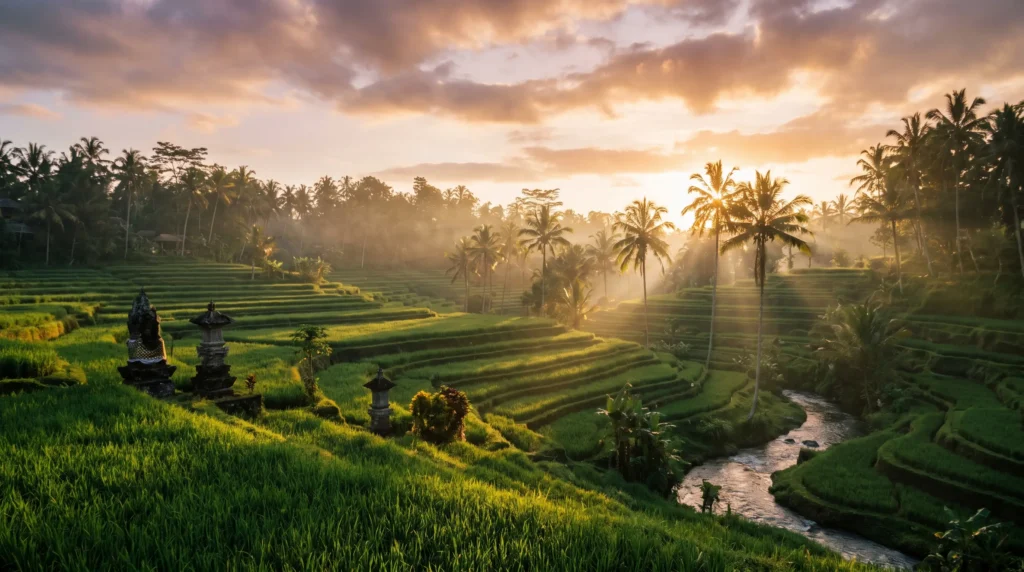
Ubud Travel Guide — Bali’s Rice Terraces, Rivers & the Island’s Cultural Heart
Everyone who tells you Ubud is “the spiritual one” and the coast is “the party one” is oversimplifying, but not by much. Ubud sits inland in Gianyar Regency, wrapped in rice paddies and river gorges, a town of roughly 75,000 people that somehow pulls in more than three million foreign visitors a year — more than Bali’s own capital. I’ve stayed here in the sticky heat of August and the grey drizzle of January, and both times the same thing struck me: you can hear roosters and gamelan practice from a yoga studio balcony, then walk fifteen minutes and be haggling over a sarong in traffic that hasn’t moved in ten minutes. Ubud is calm and chaotic at the same time, and that tension is exactly the appeal — just go in knowing which parts of the “eat, pray, love” reputation are real (the temples, the terraces, the artistry) and which are marketing (the total serenity is not guaranteed on Monkey Forest Road at 2pm).
In This Guide
- Overview — Why Ubud Is Bali’s Cultural Heart
- Nyepi, the Day of Silence — Bali’s Strangest, Most Beautiful Shutdown
- Best Time to Visit Ubud (Season by Season)
- Getting There — Ngurah Rai Airport & the Road In
- Getting Around — Walking, Scooters & Ride-Hail Rules
- Neighborhoods — Central Ubud, Penestanan, Campuhan & Beyond
- Culture & People — Temples, Offerings & the Balinese Calendar
- A Food Lover’s Guide to Ubud
- Off the Beaten Path
- Day Trips from Ubud
- Practical Information
- Budget Breakdown — What Ubud Actually Costs in 2026
- Frequently Asked Questions
Overview — Why Ubud Is Bali’s Cultural Heart
Ubud is technically a district (kecamatan) of nine villages — Ubud proper, Peliatan, Penestanan-adjacent Sayan, Kedewatan, Singakerta, Mas, Lodtunduh, Petulu and Padang Tegal — that has fused into one continuous, rice-paddy-veined town in Gianyar Regency, part of Bali’s Greater Denpasar area. Long before Instagram or “Eat, Pray, Love,” Ubud was already Bali’s court town for the arts: royal patronage in the 19th and 20th centuries drew painters, dancers and carvers, and the town has been marketed as the island’s arts-and-culture centre ever since.
What makes it different from the coast isn’t just geography — it’s the density of the sacred. Ubud sits inside the wider UNESCO-listed Cultural Landscape of Bali Province, a 19,500-hectare network of rice terraces and water temples built around the centuries-old subak irrigation system, inscribed in 2012 as an expression of the Balinese philosophy of Tri Hita Karana — harmony between people, nature and the spirit world. You feel that philosophy everywhere: family temples inside hotel compounds, tiny palm-leaf offerings (canang sari) refreshed on doorsteps every morning, gamelan rehearsals drifting out of banjar halls at dusk.
The trade-off is obvious the moment you land: Ubud’s popularity has outpaced its two-lane roads. Monkey Forest Road and the central market crossroads can gridlock for twenty minutes at a time in high season, and rice-terrace views now come with a queue of tripods. It’s still worth it — you just want a plan for the crowds, not a wish that they weren’t there.
Nyepi, the Day of Silence — Bali’s Strangest, Most Beautiful Shutdown
Time your trip around, or deliberately away from, one date: Nyepi, the Balinese Saka New Year, which in 2027 falls on 8 March. For 24 hours from 6am, the entire island — Ubud included — goes dark and silent: no lights, no fires, no work, no travel, and tourists are required to stay inside their hotel grounds. Ngurah Rai International Airport shuts completely for the full day, with zero arrivals or departures.
The night before is the opposite of silent: villages across Ubud parade giant papier-mâché ogoh-ogoh demon effigies through the streets to drums and gongs, then burn or retire them to scare off bad spirits before the island goes still. It’s genuinely one of the most memorable 48 hours you can spend in Bali — but build a two-day buffer either side of your flights, because nothing moves on Nyepi itself, including you.
Best Time to Visit Ubud (Season by Season)
May – September · Dry season (peak)
Bali sits close to the equator with warm temperatures year-round, but the west monsoon eases off from around May, bringing the driest, greenest-looking rice terraces and the busiest hotels. July and August combine school-holiday crowds from Australia and Europe with Ubud’s own festival calendar — book central accommodation weeks ahead.
April & October · Shoulder months
Transitional weather, thinner crowds, and generally lower rates than peak season. This is the value window regulars quietly prefer.
November – March · Wet season
The west monsoon runs roughly October through April, with the heaviest rainfall from December to March. Expect intense but short afternoon downpours rather than all-day washouts, lush terraces, and Ubud’s lowest villa prices. Nyepi (early-to-mid March most years) and the wettest weeks can overlap, so double-check dates before booking March travel.
Getting There — Ngurah Rai Airport & the Road In
I Gusti Ngurah Rai International Airport (DPS), on the southern isthmus near Kuta, is Bali’s only international gateway, with direct connections across Asia, Australia and the Middle East. Ubud has no airport or rail link of its own — everyone arrives by road, and the drive covers roughly 35–40 kilometres, typically taking 60–90 minutes and stretching past two hours in late-afternoon traffic.
Pre-booked airport transfers (through your hotel or an app) are the easiest option and cost roughly US$15–25; metered taxis and ride-hail apps work too, though ride-hail pickup is restricted or informally blocked in some spots right at the terminal. Private cars and shuttle vans are the norm — there is no train service anywhere on Bali. On arrival, remember the separate Bali tourist levy of IDR 150,000 per person, payable online in advance or at counters on arrival, distinct from the visa fee.
Getting Around — Walking, Scooters & Ride-Hail Rules
Central Ubud — the palace, market, Monkey Forest Road — is walkable, but the town’s outer villages (Penestanan, Sayan, Nyuh Kuning) sit far enough apart that you’ll want wheels. Scooter rental is the classic option (roughly US$5–7/day) and genuinely the fastest way through Ubud’s traffic, but Bali’s accident rate for inexperienced riders is real; an International Driving Permit and a helmet are non-negotiable, and plenty of visitors are better off hiring a driver instead.
A private driver for a half or full day (US$30–50) is how most people see the rice terraces and temples outside town — worth it for the local knowledge alone. Note that some banjar (village) associations in central Ubud restrict Grab and Gojek pickups to protect local taxi and ojek drivers, so apps sometimes route you to a meeting point a short walk from your actual location; this is normal, not a scam. Traffic on the two main north-south roads can be genuinely slow at rush hour, so budget more time than the map suggests.
Neighborhoods — Central Ubud, Penestanan, Campuhan & Beyond
Central Ubud & Monkey Forest Road
The commercial core: Ubud Palace (Puri Saren Agung), the art market, and the main strip running down to the Ubud Monkey Forest, home to roughly 750 long-tailed macaques. Densest concentration of restaurants, shops and traffic — convenient, but the least peaceful base.
Penestanan
A steep-staircase walk or short scooter ride from the centre, Penestanan keeps a village feel with rice-field views, boutique guesthouses and a slower pace, while staying close enough to walk into town.
Campuhan & the Ridge
Home to the Campuhan Ridge Walk, a roughly two-kilometre trail along a grassy spine between two rivers, and Pura Gunung Lebah, a riverside temple said to have been founded by the eighth-century priest Rsi Markandya near the confluence that gave Ubud its name. A good early-morning walk before the heat.
Sayan & Kedewatan
Ubud’s river-gorge luxury corridor, following the Ayung River — this is where the high-end resort villas with infinity pools overlooking the jungle canyon cluster, a few minutes’ drive from the centre.
Nyuh Kuning
South of the Monkey Forest, a quiet woodcarving village with a real community feel, popular with longer-stay digital nomads who want walking-distance access to town without the noise.
Peliatan
East of the centre, historically the dance and gamelan quarter, with regular traditional performances and a calmer, more residential streetscape than Monkey Forest Road.
Petulu
A rice-paddy village on Ubud’s northern edge, known for the herons and egrets that roost in its trees every evening at dusk — a low-key, free spectacle most visitors never hear about.
Culture & People — Temples, Offerings & the Balinese Calendar
Bali is Indonesia’s only Hindu-majority province, with Hinduism practiced by roughly 86% of the island’s population — a distinct Balinese form woven through with older animist and ancestor traditions. That faith is visible constantly in Ubud: family compounds built around household temples, tiny canang sari offerings of flowers, rice and incense placed on thresholds each morning, and a ceremonial calendar dense enough that you will almost certainly walk past a temple procession, cremation, or odalan (temple anniversary) during any given week.
The underlying philosophy is Tri Hita Karana — harmony between people, nature, and the spiritual realm — which also shapes the subak rice-irrigation cooperatives that UNESCO recognised across Bali in 2012. Practically: dress modestly and wear a sash (sarongs are usually provided) when entering temples, never step over an offering, and ask before photographing a private ceremony. Ubud Palace and Peliatan both host nightly traditional dance performances — Legong and Barong are the two most commonly staged — accompanied by gamelan orchestras, a good, low-effort way to see the art form the town was originally famous for.
A Food Lover’s Guide to Ubud
Start with nasi campur — a scoop of rice with a rotating cast of small dishes (shredded chicken, tempeh, boiled egg, sambal) that varies by warung and is the best-value lunch in town. Babi guling (Balinese suckling pig, spit-roasted with a turmeric-and-galangal spice paste) and bebek betutu (slow-steamed spiced duck, traditionally cooked overnight in banana leaves and rice husks) are the two celebration dishes worth seeking out at a dedicated warung rather than a hotel buffet.
Look for lawar (a mix of vegetables, coconut and minced meat, sometimes blood, in a fiery spice paste) and simple grilled fish with sambal matah, Bali’s raw shallot-lemongrass-chili relish. Ubud has also become Southeast Asia’s unofficial capital of health-conscious, plant-based dining — an entire industry of smoothie bowls, raw-food cafés and yoga-retreat kitchens has grown up alongside the traditional warungs, which is unusual and genuinely part of the town’s identity now, not just a tourist add-on. One caution: kopi luwak (civet coffee) is heavily marketed here, and much of what’s sold comes from caged, poorly treated civets — skip the “plantation tour” version unless you’ve verified the operation’s welfare standards yourself.
Off the Beaten Path
Jatiluwih Rice Terraces
Part of the same UNESCO-listed subak landscape as Ubud’s more famous terraces, Jatiluwih sits about 90 minutes northwest and sees a fraction of Tegallalang’s crowds for arguably better views.
Sidemen Valley
East of Ubud toward Mount Agung, a quieter valley of terraced rice fields, weaving villages and guesthouses with volcano views, popular with longer-stay travelers who want Ubud’s scenery without Ubud’s density.
Petulu’s Heron Roost
Thousands of white herons and egrets return to nest in this single village’s trees every evening — free, unpublicized, and a five-minute stop most day-trippers skip entirely.
Munduk
A misty highland village near Bali’s northern lakes, several waterfalls, and coffee and clove plantations — a genuine change of altitude and pace from the Ubud basin, about two hours away.
Day Trips from Ubud
Tegallalang Rice Terraces — the postcard terraces, 20 minutes north; arrive at opening time to beat both the heat and the tour buses.
Tirta Empul — a holy spring-water temple near Tampaksiring where Balinese Hindus and visitors alike undergo a ritual purification bath under carved spouts; modest dress and a sarong are required.
Goa Gajah (Elephant Cave) — a compact 9th–11th century rock-cut sanctuary with an elaborately carved cave entrance, a short detour on the road toward the coast.
Mount Batur sunrise trek — a pre-dawn start (pickup around 2am) for a roughly two-hour hike up an active volcano to watch sunrise over Lake Batur and, on clear days, Mount Agung beyond it.
Tegunungan Waterfall — a more-than-40-metre waterfall a short drive south of central Ubud, one of the easiest big waterfalls to reach without a long hike.
Most of these can be combined into a single loop with a hired driver for a full day; Mount Batur is worth doing on its own given the early start.
Practical Information
Money. The rupiah floats freely and has traded near IDR 18,000 to the US dollar through mid-2026 — always check a current rate before budgeting, since it moves. Cards are accepted at hotels and larger restaurants; carry cash for warungs, markets and drivers. Use bank-affiliated ATMs where possible and shield your PIN — skimming is a known issue at standalone machines.
Safety. Ubud is generally relaxed by regional standards, but Bali overall sees real levels of pickpocketing, snatch-and-grab theft, and reported drink-spiking and sexual assault in nightlife areas; the US State Department currently rates Indonesia Level 2 (“exercise increased caution”). Scooter accidents are the most common way tourists actually get hurt — wear a helmet and don’t ride if you haven’t handled one before. The UK FCDO separately flags volcanic-hazard exclusion zones elsewhere in Indonesia; check current advisories before combining Bali with other islands.
Health. The CDC recommends being current on routine vaccines plus hepatitis A and typhoid for Indonesia, avoiding tap water and unchlorinated fresh water, and using strong mosquito protection given dengue and Zika transmission; malaria risk in the Bali resort zone itself is negligible, but repellent is still worth it for evenings near rice paddies.
Connectivity & logistics. An eSIM (Telkomsel or XL coverage is strongest) is cheap and easy to activate on arrival. Plugs: European-style type C/F, 230V. Time zone: WITA, UTC+8, no daylight saving. Remember the separate Bali tourist levy of IDR 150,000 per visitor, payable online before arrival or at the airport.
Budget Breakdown — What Ubud Actually Costs in 2026
Ubud remains one of the better-value bases in Bali, especially outside the central tourist strip.
Budget (US$35–60/day): guesthouse or hostel room, warung meals (US$2–4 a plate), scooter rental, occasional Grab/Gojek rides.
Mid-range (US$90–180/day): boutique hotel or rice-view villa, restaurant dinners, a half-day private driver (US$30–50), a yoga class or spa treatment, entrance fees for temples and waterfalls.
Luxury (US$300+/day): Sayan or Kedewatan river-gorge resort villa with private pool, full-day driver and guide, multi-day wellness retreat programming, fine dining.
Fixed costs to expect: the IDR 150,000 Bali tourist levy per person, small temple “donation” entry fees (often IDR 15,000–50,000), and the visa-on-arrival fee if your nationality requires one. Tipping isn’t mandatory but 10% or rounding up for drivers and guides is appreciated and increasingly expected.
Planning Your First Trip to Ubud
The classic split is rice terraces + coast: fly into DPS, head straight to Ubud for three to four nights (Tegallalang, Tirta Empul, Campuhan Ridge, a cooking class), then move south to the beaches for the back half of the trip. A private driver hired for one full day covers Tegallalang, Tirta Empul and Goa Gajah comfortably; save Mount Batur for a dedicated early morning. If you’re building a longer Southeast Asia route, pair Ubud with our full Bali guide for the island overview, our Indonesia guide for the wider archipelago, or continue on to Thailand or Singapore as a regional hub.
Frequently Asked Questions
Is Ubud safe for tourists in 2026?
Ubud itself is one of the calmer parts of Bali, but the island overall carries a US State Department Level 2 advisory for petty crime, occasional drink-spiking reports in nightlife areas, and scooter-accident risk. Use common sense with belongings in crowded markets, wear a helmet on any scooter, and keep drinks in sight.
Do I need a visa for Bali?
Most nationalities, including the US, UK, EU and Canada, qualify for visa-on-arrival at IDR 500,000 (roughly US$35), valid for 30 days with one 30-day extension available through an immigration office. Your passport needs at least six months’ validity, and it’s worth applying for the e-VOA online before you fly to skip the airport queue.
Should I avoid Bali during Nyepi?
Not necessarily — it’s a remarkable cultural experience — but plan around it, not through it. The airport closes fully for 24 hours (8 March 2027) with zero flights, so don’t book arrivals or departures on that date or the one after.
How many days do I need in Ubud?
Three nights covers the highlights (Monkey Forest, Tegallalang, one temple, one cooking class); four to five lets you add Mount Batur sunrise, Sidemen or Jatiluwih, and an actual slow morning without an itinerary.
Is Ubud too touristy now?
Central Monkey Forest Road, yes, especially midday in peak season — but walk ten minutes into Penestanan, Nyuh Kuning or Petulu and the crowds thin out fast. The trick is basing yourself slightly outside the core rather than avoiding Ubud altogether.
Ubud or the Bali coast (Seminyak/Canggu)?
Choose Ubud for rice terraces, temples, wellness culture and a cooler inland climate; choose the coast for beach clubs, surf and nightlife. Most first-time visitors do both — Ubud rarely works as a beach substitute and vice versa.
Ready to Explore Ubud?
Rice terraces at sunrise, a river gorge villa with the jungle doing all the talking, and a night market plate of babi guling that costs less than a coffee back home — Ubud earns its reputation, catches and all. Go for the temples and terraces, budget extra time for the traffic, and you’ll understand within a day why so many people who meant to stay a week end up staying a month.
Explore More
- Bali Travel Guide — the island beyond Ubud, coast to coast
- Indonesia Travel Guide — the wider archipelago
- Thailand Travel Guide — pair Ubud with a Southeast Asia loop
- Singapore Travel Guide — a regional hub for onward flights
How this guide was built
Published as part of Facts From Upstairs’ city guide series. Built from authoritative sources — Wikipedia’s Ubud and Bali entity pages, UNESCO’s Cultural Landscape of Bali Province inscription, Indonesia’s official e-VOA immigration portal, Bank Indonesia’s exchange-rate statistics, the US State Department’s Indonesia travel advisory, the UK FCDO’s Indonesia advisory, and the US CDC’s Indonesia traveler health page. Numeric and checkable claims carry inline citations.
Sources cited on this page
- Wikipedia — Ubud
- Wikipedia — Bali
- UNESCO — Cultural Landscape of Bali Province: the Subak System
- Indonesia Directorate General of Immigration — e-VOA
- Bank Indonesia — Foreign Exchange Rates
- US State Department — Indonesia Travel Advisory
- UK FCDO — Indonesia Travel Advice
- US CDC — Indonesia Traveler Health
- Antara News — Ngurah Rai Airport Nyepi Closure
- Office Holidays — Hari Raya Nyepi
- Rome2Rio — Ngurah Rai Airport to Ubud
More city guides you might like

Plan your trip to Ubud
The booking tools we use ourselves. FFU may earn a commission at no extra cost to you.
Plan & book your trip to Ubud
Booking through these searches supports our guides at no extra cost to you.