
Mandalay Travel Guide — Myanmar’s Last Royal Capital, U Bein Bridge & the Honest Truth About Visiting in 2026
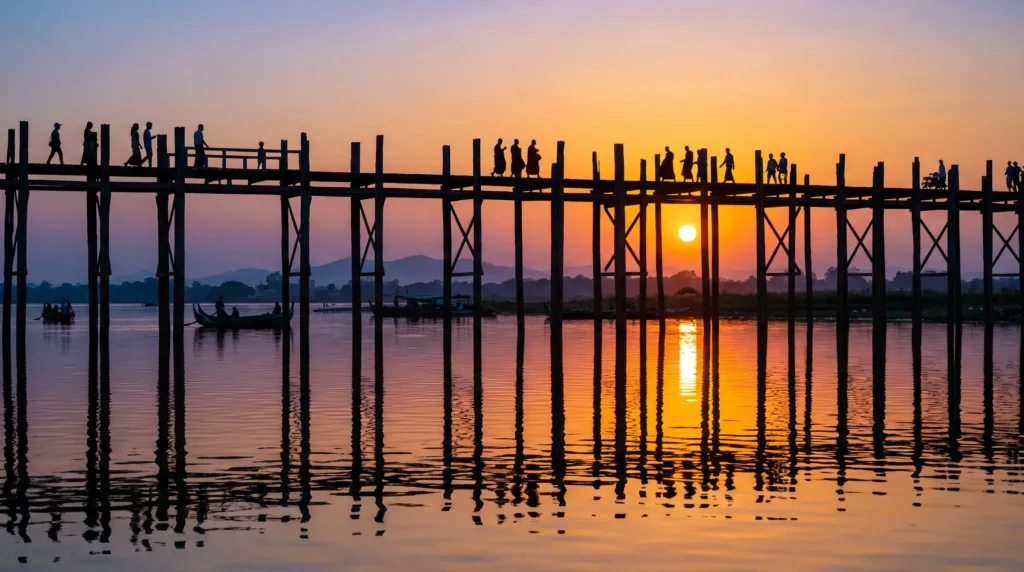
I want to love-bomb Mandalay the way I do most cities on this site, and honestly, the raw material is there: it was the last royal capital of the last Burmese dynasty, founded by King Mindon in 1857 on the banks of the Irrawaddy River. Monks in maroon robes still file past teak monasteries at dawn, gold-leaf pounders still work Mahamuni’s Buddha image by hand, and the world’s longest teak footbridge still fills with silhouettes at sunset over Taungthaman Lake. But I’m not going to bury the other half of the story under a postcard. Myanmar is currently under a US State Department Level 4 “Do Not Travel” advisory and a UK FCDO advisory against all but essential travel to most of the country, tied to the civil conflict that has run since the 2021 coup. This guide covers Mandalay honestly — the temples and the caveats both — so you can make an informed call rather than a postcard-informed one.
In This Guide
- Overview — Why Mandalay Still Matters
- Thadingyut — Myanmar’s Festival of Lights
- Best Time to Visit Mandalay
- Getting There — MDL Airport & Overland Routes
- Getting Around — Trishaws, Taxis & Scooters
- Neighborhoods — Palace, Hill & the Old Capitals
- Culture & People — Monasteries, Gold Leaf & Marionettes
- A Food Lover’s Guide to Mandalay
- Off the Beaten Path
- Day Trips — Amarapura, Sagaing & Mingun
- Practical Information — Including the Safety Situation
- Budget Breakdown — What Mandalay Actually Costs in 2026
- Frequently Asked Questions
Overview — Why Mandalay Still Matters
Mandalay sits on the east bank of the Irrawaddy River, about 631 kilometres north of Yangon, and was the last royal capital of independent Burma before British annexation in 1885. King Mindon built the walled Mandalay Palace and moved his court here in 1857, and the city has functioned as the cultural and religious heart of the Burmese-speaking heartland ever since — locals still call it the last capital of a “golden land,” and it holds the country’s densest concentration of monasteries, with well over 700 pagodas inside the city limits.
The highlights are genuinely extraordinary: Kuthodaw Pagoda, built by Mindon in 1857, surrounds itself with 729 marble slabs inscribed with Buddhist scripture, nicknamed “the world’s largest book.” Mandalay Hill rises 240 metres over the old palace moat with covered stairways and a summit pagoda for sunset views across the plain. A short trishaw ride away, Mahamuni Buddha Temple houses an image so revered that generations of devotees have pressed gold leaf onto it until the figure has become a lumpy, glowing mass — a genuinely strange and moving thing to see in person.
Here’s the honest part, though, and I’d rather say it now than bury it: Myanmar has been under a US State Department Level 4 “Do Not Travel” advisory, its highest level, citing armed conflict, civil unrest, arbitrary law enforcement and landmines, and the UK FCDO advises against all but essential travel to large parts of the country, including areas north of Mandalay Region. Independent travelers do still visit Mandalay and Bagan through licensed operators, but this isn’t a destination to book on autopilot — read the full Practical section below before you buy a flight.
Thadingyut — Myanmar’s Festival of Lights
If you can time a trip around one date, make it the full-moon day of the Burmese lunar month of Thadingyut, which falls in October and marks the end of the Buddhist Rains Retreat (Vassa) and the Buddha’s legendary descent from heaven. The three-day festival is Myanmar’s second-biggest celebration after the April water festival, and it’s built entirely around light: households line their gates with candles and paper lanterns, and pagodas glow with thousands of oil lamps. Mahamuni Buddha Temple in Mandalay is one of the country’s most famous places to see it, alongside Yangon’s Shwedagon.
It’s a genuinely beautiful, low-key way to see Mandalay at its most devotional rather than its most touristed — no fireworks-and-crowds spectacle, just a city quietly lit by candlelight for three nights. Hotel rates tick up around the date, but nothing like the premium you’d pay for equivalent festivals in more heavily marketed destinations.
Best Time to Visit Mandalay
Late October – February · Cool, dry season (peak)
The comfortable window: daytime highs in the high 20s to low 30s Celsius, clear skies, and the best conditions for climbing Mandalay Hill or cycling out to Amarapura. This is also when most festivals — Thadingyut in October, Tazaungdaing in November — land, so book guesthouses ahead around those dates.
March – May · Hot season
Mandalay is one of the hottest cities in Southeast Asia in this stretch — April and May routinely exceed 37°C, with recorded highs as steep as 45°C. Thingyan, the mid-April water festival and Burmese New Year, is riotous fun if you don’t mind being soaked by strangers on every street corner, but sightseeing during the heat of the day is genuinely rough going.
June – September · Rainy season
Mandalay sits in Myanmar’s central “dry zone,” so rains here are lighter and shorter than in Yangon or the delta — usually a heavy afternoon downpour rather than an all-day washout. Upside: Taungthaman Lake beneath U Bein Bridge fills up and looks its best in July and August, when reflections under the bridge are at their most photogenic.
Getting There — MDL Airport & Overland Routes
Mandalay International Airport (MDL) sits about 35 kilometres south of the city in Tada-U, roughly an hour’s drive to the center. It’s mostly a domestic hub with connections to Yangon, Nay Pyi Taw and Heho (for Inle Lake), plus a handful of regional international routes — Bangkok, Chiang Mai and destinations in southern China. Most travelers still arrive via a connecting domestic flight from Yangon, where the bulk of international long-haul service lands.
Overland, buses and the slow, scenic rail line connect Mandalay with Bagan (about 178km, 5–6 hours by bus, closer to 12 by train) and with Yangon (roughly 12–15 hours by overnight bus). A daytime river ferry between Mandalay and Bagan is a classic if unhurried option, taking around 11–12 hours downriver. Given the security situation described in the Practical section, confirm current road conditions and operator recommendations with your accommodation or a licensed tour operator before booking any overland leg, rather than assuming pre-2021 routes are automatically fine.
Getting Around — Trishaws, Taxis & Scooters
Mandalay is laid out on a rigid grid around the old palace moat, which makes orientation easy but distances deceptive — the city sprawls further than the compact old quarter suggests. Taxis (unmetered, agree the fare first) and app-based ride-hailing cover longer hops cheaply. Trishaws (bicycle rickshaws) are the classic way to potter around the palace moat and nearby pagodas at a slower pace, and drivers often double as informal guides.
Rented scooters and bicycles are widely available and popular for day trips to Amarapura and Sagaing, though road conditions and traffic norms differ from what Western visitors are used to — insurance coverage and international permit rules are worth checking before you rent. For the palace complex itself and the Mandalay Hill approach, hiring a car or trishaw for a half-day is the easiest way to string several sights together without the midday heat wearing you down.
Neighborhoods — Palace, Hill & the Old Capitals
The Royal Palace & Moat
The geographic and symbolic center of the city: a two-kilometre-square walled complex ringed by a wide moat, rebuilt after wartime destruction on King Mindon’s original 1857 footprint. Most of the interior remains a military compound with limited public access, but the moat walk and watchtowers are worth the loop, especially near sunset.
Mandalay Hill
A 240-metre hill just northeast of the palace, climbed via covered, shaded stairways lined with shrines, or reached by road for the sunset crowd. The summit pagoda gives the best single panorama of the city, the river and the plain beyond — arrive with enough daylight to descend safely if you’re walking down.
Mahamuni Quarter
South of the old city, home to the Mahamuni Buddha Temple and the gold-leaf pounding workshops that supply it — narrow lanes where you can watch artisans hammer gold into leaf sheets thin enough to see through, a craft that’s been handed down through the same families for generations.
Kuthodaw & Sandamuni Pagoda Cluster
East of the palace, this cluster of whitewashed stupas houses Kuthodaw’s 729 inscribed marble tablets — walk the rows slowly and you’re essentially reading an entire canon of Buddhist scripture carved in stone.
Zegyo Market & Downtown
The city’s central market and commercial core, a sensory-overload grid of textiles, jade, produce and street food stalls. It’s also where you’ll find most budget guesthouses and the jumping-off points for shared taxis to outlying sights.
Amarapura (former capital, south of the city)
Mandalay’s immediate predecessor as royal capital, now effectively a southern suburb, home to U Bein Bridge and Taungthaman Lake plus the large working monastery of Mahagandayon, famous for its lines of monks filing to the midday meal.
Inwa (Ava) & Sagaing (across the river)
Older still — Inwa served as capital on and off for nearly 400 years — reached by a short river crossing and pony-cart rides among ruined monasteries and leaning stupas. Sagaing Hill, visible across the water, is famously blanketed in monasteries and nunneries. Both sit within Sagaing Region, which carries specific current travel-advisory cautions covered in the Practical section below — check the latest guidance before planning this leg.
Culture & People — Monasteries, Gold Leaf & Marionettes
Mandalay is widely considered the cultural and religious capital of the Burmese-speaking heartland, in a country where Buddhism is the majority faith, followed by close to 88% of the population. Burmese is the official language, and while it’s the working language of daily life here, English is common enough in hotels, guesthouses and tour operations that independent travel is manageable without it.
Traditional crafts run deep: Mandalay is Myanmar’s center for gold-leaf pounding, marble Buddha carving, silk weaving and the ornate string-puppet tradition known as yoke thé, still performed at a handful of small marionette theaters around town. Monastic life is visible everywhere — maroon-robed monks collecting alms at dawn, novice ceremonies (shinbyu) marked with processions, and enormous working monasteries like Mahagandayon in nearby Amarapura that house thousands of monks and novices. Dress modestly at religious sites (shoulders and knees covered, shoes off before entering pagoda platforms) and always ask before photographing monks or ceremonies up close.
A Food Lover’s Guide to Mandalay
Mandalay’s signature dish is mohinga, the fish-and-rice-noodle soup often called Myanmar’s national breakfast, though you’ll find it eaten happily any time of day from street carts and market stalls. Equally essential is Mandalay mee shay (also called mont hin gar or Mandalay noodles), a dry noodle dish tossed with pork, bean sprouts and a savory sauce that’s distinct enough from Yangon’s noodle culture to have its own name and its own local pride.
Look for shan noodles too, reflecting the Shan communities of the surrounding hills, along with tea-leaf salad (lahpet thoke) — fermented tea leaves tossed with crunchy fried beans, nuts and cabbage, eaten as a snack or a palate-cleanser. Mandalay’s tea shops are a genuine cultural institution: low plastic stools, sweet milky tea, and a running social scene from early morning to late evening. Zegyo Market is the best single stop for street-food grazing, and riverside restaurants along the Irrawaddy are a pleasant, unhurried spot for a sunset dinner.
Off the Beaten Path
Marionette Theater
A handful of small family-run yoke thé puppet theaters still perform nightly for visitors — an intimate, dying art form that’s worth catching precisely because it’s not guaranteed to still exist in another decade.
Gold-Leaf Workshops
Beyond the tourist-facing shops near Mahamuni, wander the surrounding lanes to watch the actual hammering process — teams of workers pounding gold between layers of bamboo paper for hours to produce leaf thin enough to apply to a Buddha image.
Shwe In Bin Kyaung Monastery
A lesser-visited teak monastery south of downtown, intricately carved and largely free of the crowds that gather at the bigger-name sights — one of the better places in the city for quiet, unhurried photography.
Jade Market
Mandalay is a major hub for Myanmar’s jade trade; the wholesale jade market is a working, unglamorous space where dealers inspect and haggle over raw stone — fascinating to observe even if you’re not buying.
Day Trips — Amarapura, Sagaing & Mingun
The classic “Ava, Amarapura, Sagaing, Mingun” loop covers Mandalay’s four old satellite capitals and river sights in a single long day, usually by hired car or boat combination. Amarapura‘s U Bein Bridge — 1.2 kilometres of teak planking supported by roughly a thousand posts, built between 1849 and 1851 and generally described as the oldest and longest teak bridge in the world — is the standout, best walked at golden hour when fishermen and monks cross in silhouette.
Mingun, reached by boat about 11 kilometres up the Irrawaddy from Mandalay, holds two extraordinary half-finished monuments: the Mingun Bell, at roughly 90 tonnes reputedly the largest ringing bell in the world, and the Mingun Pahtodawgyi, an unfinished 1790 stupa that would have stood 150 metres tall — the world’s largest — had construction not stopped, reportedly after an astrologer’s prophecy and later cracked further by an 1839 earthquake.
Sagaing Hill, across the river, is covered in hundreds of whitewashed stupas and working monasteries and nunneries, a genuinely serene counterpoint to Mandalay’s traffic. One important caveat: Mingun and Sagaing fall within Sagaing Region, and current UK FCDO guidance advises against travel to parts of this region as part of the broader regional risk picture — check the live FCDO and State Department pages for the specific townships in question before booking this loop, rather than relying on a pre-2021 itinerary template. Inwa (Ava), reached by a short river ferry and pony cart, rounds out the loop with atmospheric ruins and far fewer visitors than Bagan.
Practical Information — Including the Safety Situation
Safety — read this first. As of this guide’s publication, the US State Department rates Myanmar Level 4: Do Not Travel, its most severe advisory tier, citing armed conflict, civil unrest, arbitrary enforcement of local laws, poor healthcare access, landmines and risk of wrongful detention. The UK FCDO advises against all but essential travel to large parts of the country and against all travel to several border regions and the north of Mandalay Region specifically, while noting the situation can shift with little warning. Mandalay city itself sees a trickle of independent and small-group travelers going through licensed local operators, but this is not a “book it like Bangkok” destination — check both advisories in full, buy travel insurance that explicitly covers travel to advisory areas, register with your embassy, and reassess close to your travel date rather than relying on this guide alone.
Money. The Myanmar Kyat traded around 2,090 to the US dollar as of July 2026, per the Central Bank of Myanmar’s reference rate. Card acceptance and ATM reliability are limited outside major hotels; carry crisp, unmarked, unfolded US dollars for exchange and larger purchases, as damaged or old-series bills are frequently refused.
Health. The CDC lists malaria as a risk in parts of Myanmar and recommends discussing prophylaxis with a travel clinic before departure, along with routine and hepatitis A/typhoid vaccinations common to the region. Drink bottled or filtered water, and bring a basic medical kit — pharmacy stock and English-speaking care are inconsistent outside the main hotels.
Connectivity & practicalities. Local SIMs (Ooredoo, Mytel, MPT) are available at the airport and in the city for data; hotel Wi-Fi is generally serviceable in the city center. Plugs: mostly type C, D and G sockets — bring an adapter. Time zone: Myanmar Standard Time, UTC+6:30, a genuinely unusual half-hour offset worth double-checking against your connecting flights.
Budget Breakdown — What Mandalay Actually Costs in 2026
Mandalay is inexpensive by regional standards, noticeably cheaper than Bangkok or Chiang Mai for equivalent comfort, though the exchange-rate volatility of recent years means it’s worth budgeting a little padding.
Budget (US$25–45/day): Simple guesthouse, street-food mohinga and noodle-shop meals, shared taxis and trishaws, self-guided pagoda visits.
Mid-range (US$70–140/day): Comfortable hotel with a pool, a hired car and driver for the Amarapura–Sagaing–Mingun loop, restaurant meals, entry fees for the archaeological zone and major temples.
Upscale (US$250+/day): River-view or heritage-style hotel, private guided touring, riverside dining, a hot-air balloon or scenic flight add-on if pairing the trip with nearby Bagan.
Fixed costs to expect: a combined archaeological-zone ticket covering several major sights, small per-site donations at working monasteries, and boat-hire fees for the Mingun and Inwa river crossings. Tipping is appreciated but not obligatory the way it is in some neighboring countries.
Planning Your Mandalay Trip
Most itineraries pair Mandalay with Bagan (a short flight or a scenic if long boat/bus ride away) for a classic “old capitals and temple plains” week, sometimes extending to Inle Lake for a third stop. Three nights in Mandalay is enough to cover the palace, Mandalay Hill, Mahamuni and a full-day Amarapura–Sagaing–Mingun loop without rushing. Given the advisory situation detailed above, this is a trip worth booking through a licensed local operator who can advise on current road conditions and no-go areas, rather than freelancing a full overland circuit. If you’re weighing Southeast Asia options more broadly, our Chiang Mai guide and Siem Reap guide cover two other major temple-and-monastery destinations in the region with more settled current travel conditions.
Frequently Asked Questions
Is Mandalay safe to visit in 2026?
Be honest with yourself about this one. The US State Department rates all of Myanmar Level 4: Do Not Travel, its highest advisory level, and the UK FCDO advises against all but essential travel to much of the country, including all travel to the north of Mandalay Region. Travelers who do go generally use licensed local operators, stay current on the situation right up to departure, and carry insurance that covers advisory-level destinations. This is not a guide encouraging you to ignore that advice — verify it yourself before booking.
Do I need a visa?
Yes. Most nationalities, including US, UK and EU citizens, need a visa, and the tourist e-Visa (roughly US$50, arranged online in advance) is the standard route, allowing entry through Mandalay International Airport among other approved points. Confirm current validity and stay-length rules on the official portal before applying, as policies have shifted since the coup.
How many days do I need in Mandalay?
Two to three full days covers the city and the Amarapura–Sagaing–Mingun loop comfortably. Add a day if you want an unhurried Mandalay Hill sunset, a marionette show, and time to just sit in a tea shop and watch the city go by.
Can I combine Mandalay with Bagan and Inle Lake?
Yes — it’s the standard circuit. Bagan is a short flight or a longer overland/river trip away; Inle Lake is roughly 260 kilometres and typically reached by road or a short flight via Heho. A ten- to twelve-day trip covers all three without feeling rushed.
What currency should I bring?
US dollars in pristine, unfolded condition, to exchange for Kyat locally at the going Central Bank reference rate. Card acceptance is limited outside larger hotels, so plan on carrying more cash than you would in, say, Bangkok.
Is Mandalay worth it if I’ve already seen Bagan’s temples?
Different flavor of the same tradition: Bagan is about scale and sheer temple density across a plain; Mandalay is a living, working monastic capital where the culture around the monuments — gold-leaf workshops, tea shops, marionette theaters, thousands of resident monks — is as much the draw as the buildings themselves.
Thinking About Mandalay?
A teak bridge full of silhouettes at sunset, a Buddha image built up in gold leaf over centuries, monasteries that still run on the same rhythms they did under the last Burmese kings — Mandalay is one of the most quietly moving cities I can point you to in Southeast Asia. Just make sure you go in with eyes open: check the current advisories, book through people who know the ground conditions, and treat this as a trip that rewards preparation rather than spontaneity.
Explore More
- Chiang Mai City Guide — another temple-dense former royal capital, an easy regional flight away
- Siem Reap City Guide — Angkor’s temple plains, the region’s other great ancient capital
- Luang Prabang City Guide — saffron-robed monks and a UNESCO-listed old royal capital in Laos
- Bangkok City Guide — the region’s major air hub for onward Southeast Asia connections
How this guide was built
Published as part of Facts From Upstairs’ city guide series. Built from Wikipedia entity pages for Mandalay, Myanmar, U Bein Bridge, Mingun, Mandalay International Airport, the Thadingyut Festival and Myanmar’s visa policy; the official Myanmar e-Visa government portal; the Central Bank of Myanmar’s reference exchange rate; the US State Department’s Burma travel advisory; the UK FCDO’s Myanmar travel advice and regional-risks pages; and the US CDC traveler page for Burma (Myanmar). Numeric and checkable claims carry inline citations. Given the fast-moving security situation, always verify the safety and visa sections against the live government sources before booking travel.
Sources cited on this page
- Wikipedia — Mandalay
- Wikipedia — Myanmar
- Wikipedia — U Bein Bridge
- Wikipedia — Mingun
- Wikipedia — Mandalay International Airport
- Wikipedia — Thadingyut Festival
- Myanmar eVisa — Official Tourist Notice
- Central Bank of Myanmar — Reference Exchange Rate
- US State Department — Burma Travel Advisory
- UK FCDO — Myanmar Travel Advice
- UK FCDO — Myanmar Regional Risks
- US CDC — Burma (Myanmar) Traveler Page
More city guides you might like
Plan your trip to Mandalay
The booking tools we use ourselves. FFU may earn a commission at no extra cost to you.
Plan & book your trip to Mandalay
Booking through these searches supports our guides at no extra cost to you.