
Toronto, Canada: Where 180 Nations Share a Subway Grid
Part of our Canada travel guide.
Toronto City Guide
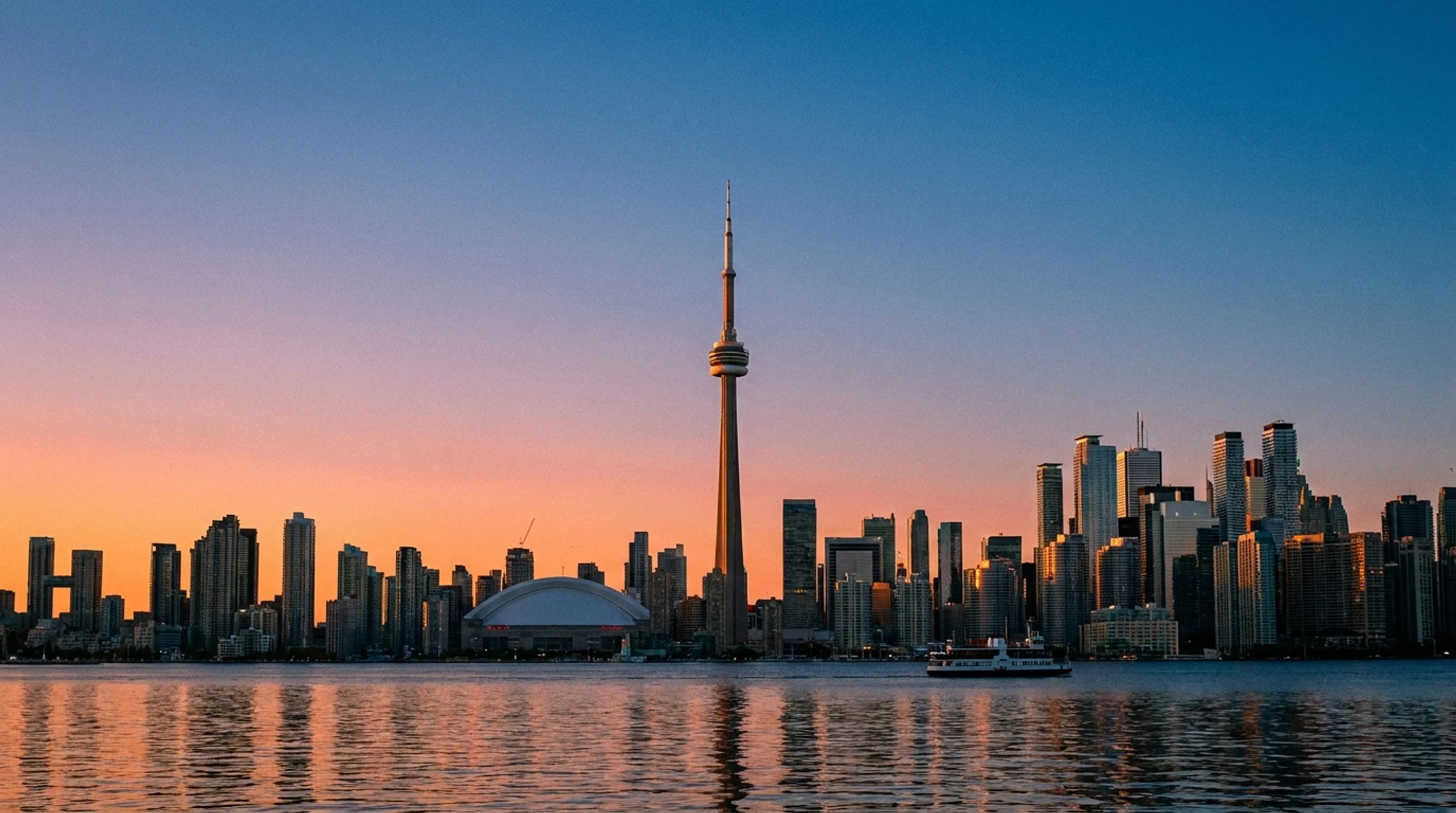
Table of Contents
Why Toronto?
Toronto is Canada’s largest city and financial engine — roughly 3.0 million residents inside the city proper as of 2024 and approximately 6.4 million across the Greater Toronto Area, making it the fourth-largest metropolitan area in North America after Mexico City, New York, and Los Angeles. More than half of Toronto’s population was born outside Canada, a proportion higher than any other city of its size on Earth.
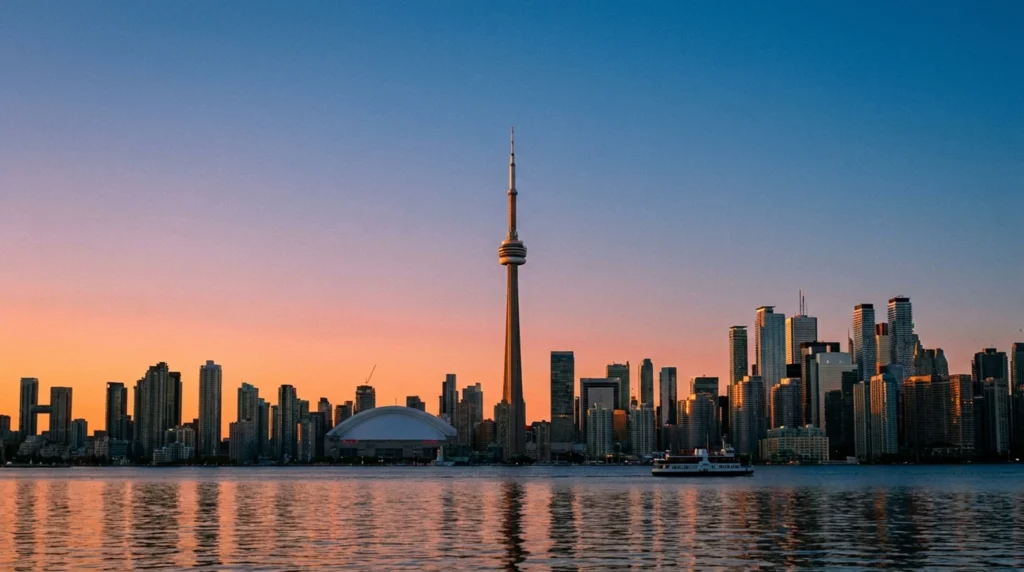
Toronto’s GDP exceeds C$450 billion per year, the Toronto Stock Exchange is the world’s ninth-largest by market capitalisation, and Pearson International (YYZ) moved 47 million passengers in 2023, making it Canada’s busiest airport by a wide margin. The skyline is anchored by the CN Tower — a 553-metre communications and observation structure that held the world’s-tallest-free-standing-structure title for 32 years (1975 to 2007). Yet the city’s defining quality isn’t its towers; it’s the layering underneath them — Victorian bay-and-gable houses four blocks from glass banking skyscrapers, a Sri Lankan kothu roti vendor next to a Portuguese bakery next to a Jamaican jerk spot, all under the same CN Tower silhouette.
The scale of Toronto’s diversity is unique even among multicultural cities. The BBC in 2016 described it as the most diverse city on Earth, with visible-minority residents forming a majority for the first time and more than 180 distinct ethnic origins recorded in census data. More than 160 languages are spoken in Toronto District School Board classrooms, the TTC operates wayfinding signage in multiple scripts at stations like Agincourt and Pape, and entire neighbourhoods have formed around specific immigrant communities — six Chinatowns spread across the GTA, Greektown on Danforth, Little Portugal off Dundas West, Little India on Gerrard, and Koreatown running north along Bloor.
The contradictions are the charm. Toronto holds the world’s largest underground shopping complex — the 30-kilometre PATH walkway linking 1,200 shops under downtown — yet the largest urban park on its doorstep is the car-free Toronto Islands, a 15-minute ferry from downtown to 600 acres of Blue Flag beaches and a 1808 lighthouse. The 2024 Michelin Guide recognised 13 starred restaurants in Toronto, including two 2-star venues — yet the city’s most-loved meal is a C$9 peameal bacon sandwich from a 1803-founded public market.
This guide covers the 10 neighbourhoods that define Toronto, the multicultural food corridors behind its world reputation, the museums and sports venues that anchor its cultural calendar, the five day trips that turn Toronto into a regional base camp for Niagara and Prince Edward County, and the TTC, PATH, budget, and winter-gear details that make a first trip run smoothly on arrival from Pearson International.
Neighborhoods: Finding Your Toronto
📍 Toronto Map: Every Place in This Guide
Toronto is organised as a loose grid of distinct neighbourhoods, each with its own dominant immigrant community, architectural scale, and reason to visit. The 10 below cover the widest range of traveller priorities, from first-timer downtown sightseeing to countercultural markets, design districts, museum rows, and East End brunch streets. A base near a subway line (Line 1 Yonge-University or Line 2 Bloor-Danforth) puts any of these within 20–30 minutes by TTC.
Downtown & Financial District
Downtown Toronto is the glass-canyon core of Canadian finance and the engine of the PATH underground walkway — the world’s largest underground shopping complex by Guinness, linking Union Station, the Eaton Centre, and most Bay Street office towers through 30 kilometres of tunnels and 1,200 shops. The Toronto Stock Exchange sits on Bay Street north of King, the CN Tower and Rogers Centre define the southwestern skyline, and the St. Lawrence Market (1803) anchors the eastern edge. Union Station, the 1927 beaux-arts terminal, is the single busiest transit hub in Canada — moving 300,000+ passengers a day across VIA Rail, GO Transit, UP Express, and the TTC subway.
- CN Tower and Ripley’s Aquarium of Canada
- Scotiabank Arena (Raptors, Leafs) and Rogers Centre (Blue Jays)
- PATH 30-km underground shopping network
- St. Lawrence Market (1803 South Market, named world’s best food market by Nat Geo Traveler in 2012)
- Union Station (1927 beaux-arts terminal)
Best for: first-timers, sports fans, skyline photography, business travel. Access: Union Station (Line 1 Yonge-University, all GO Transit lines, UP Express).
Distillery Historic District
The Distillery District is the best-preserved collection of Victorian industrial architecture in North America — 47 heritage buildings of the former Gooderham & Worts whisky works, founded 1832 and once the largest distillery in the British Empire. The pedestrian-only cobblestone lanes now house more than 70 galleries, cafes, breweries, chocolatiers, and the Soulpepper Theatre company’s Young Centre for the Performing Arts. The annual Toronto Christmas Market (mid-November through December 23) has turned the district into Canada’s most photographed winter scene; a C$6–10 entry fee applies on weekends. Ontario Spring Water Sake Company, opened 2011, was the first sake brewery in North America outside Japan.
- Case Goods Lane galleries and Distillery Sunday Market
- SOMA Chocolatemaker and Balzac’s Coffee Roasters
- Young Centre for the Performing Arts (Soulpepper Theatre)
- Toronto Christmas Market (late Nov–Dec 23)
- Ontario Spring Water Sake Company
Best for: design nerds, couples, photographers, winter visitors. Access: 504 King streetcar to Parliament Street stop; 10-minute walk south from Castle Frank Station.
Kensington Market
Kensington Market is Toronto’s countercultural open-air bazaar — four tight blocks of Victorian row houses converted into vintage clothing shops, Caribbean produce stands, Jewish appetizing stores, Latin American bakeries, and tattoo parlours. The market has been continuously operating as an immigrant trading quarter since the early 20th century, with successive waves of Jewish, Portuguese, Caribbean, and Latin American communities layering on top of each other. The last Sunday of every month from May through October, the streets close to cars for Pedestrian Sundays — a block-party scale event with live music and open-door galleries. Kensington was designated a National Historic Site in 2006.
- Augusta Avenue food row (Seven Lives tacos, Rasta Pasta, Jumbo Empanadas)
- Kensington Pedestrian Sundays (last Sunday May–October)
- Blue Banana Market (three-floor indoor bazaar)
- Courage My Love (vintage landmark operating since 1975)
- Sanagan’s Meat Locker and Global Cheese
Best for: food wanderers, thrift hunters, countercultural travellers. Access: Spadina Station then 510 Spadina streetcar south; or 10-minute walk from St. Patrick Station.
Queen West & West Queen West
Queen West runs west from University Avenue to Roncesvalles, threading through three distinct strips: the Fashion District, the Entertainment District, and West Queen West — the last of which Vogue crowned the second-coolest neighbourhood in the world in 2014. Graffiti Alley parallels Queen between Spadina and Portland, hosting more than a kilometre of rotating large-scale murals and stencil work. The Museum of Contemporary Art Toronto (MOCA) relocated to a restored 1919 aluminium-casting factory at 158 Sterling Road in 2018, anchoring the northern edge of the Junction Triangle. Trinity Bellwoods Park, further west, functions as Toronto’s summer lawn hangout.
- Graffiti Alley (Queen W from Spadina to Portland, parallel alley)
- Trinity Bellwoods Park
- The Drake Hotel and Gladstone House (both boutique with live music)
- Museum of Contemporary Art Toronto (MOCA, 158 Sterling Rd)
- Type Books and the 1920s Queen West design corridor
Best for: design-focused travellers, nightlife, creative types. Access: 501 Queen streetcar (runs 24 hours on the Blue Night network) or Osgoode Station / Queen Station.
Yorkville
Yorkville is Canada’s Rodeo Drive — a former 1960s hippie village (Joni Mitchell and Neil Young both played its coffeehouses) that gentrified into the country’s densest concentration of luxury retail and five-star hotels. The Royal Ontario Museum anchors the district at Bloor & University; the 2007 Daniel Libeskind Crystal addition is its architectural signature. During TIFF (early September), Yorkville’s sidewalks turn red-carpet for 11 days: the Hazelton Hotel, Four Seasons Toronto, and Park Hyatt become the unofficial festival headquarters.
- Royal Ontario Museum and the Crystal addition
- Bata Shoe Museum (only shoe museum in North America)
- Hazelton Hotel and Four Seasons Toronto (TIFF central)
- Yorkville Village and the Mink Mile (Bloor Street West luxury strip)
- TIFF Bell Lightbox (King W) and Yorkville red-carpet sidewalks in September
Best for: luxury travel, museum days, TIFF attendees. Access: Bay Station or Museum Station (Line 1 Yonge-University).
Leslieville & Riverside
Leslieville is a Victorian streetcar village on the east side of the Don River that gentrified from Toronto’s industrial backyard into its most food-forward residential neighbourhood over the last 15 years. Queen Street East from Broadview to Greenwood is lined with brunch spots and independent coffee roasters; Riverside (the stretch between the Don and Broadview) has its own antique row. Woodbine Beach and Ashbridges Bay — both Blue Flag-certified lake beaches — sit a short streetcar hop further east, making this the best base for travellers who want a residential feel with quick streetcar access downtown. The Beaches, further east still, is a Victorian boardwalk community with the city’s longest lakefront trail.
- Rooster Coffee House and Tandem Coffee Roasters
- Leslieville Cheese Market and Maha’s Egyptian Brunch
- Queen East antique row
- Ashbridges Bay and Woodbine Beach (Blue Flag)
- Riverside Eats & Drinks strip along Queen East
Best for: food-forward travellers avoiding downtown, families, long stays. Access: 501 Queen streetcar east to Greenwood; or Broadview Station + 504 King streetcar south.
Little Italy & College Street
Little Italy centres on College Street between Bathurst and Ossington — a post-war Italian immigrant district where green-white-red lamp-post banners still line the pavement even as the demographics have shifted toward Portuguese, Brazilian, and young professionals. The neighbourhood comes alive after dark; patios are standing room only from May through September and the Taste of Little Italy street festival in mid-June closes College for a weekend. Café Diplomatico — “the Dip” — has anchored the corner of College and Clinton since 1968.
- College Street from Bathurst to Ossington
- Café Diplomatico outdoor patio (since 1968)
- Bar Raval (Antoni Gaudí-inspired Catalan tapas bar)
- Sicilian Sidewalk Café gelato
- Royal Cinema (1939 independent theatre)
Best for: nightlife, patio dining, summer visitors. Access: 506 Carlton streetcar; or Queen’s Park Station + 15-minute walk.
Chinatown & Spadina
Downtown Chinatown is the largest of Toronto’s six Chinatowns (the GTA also has Mississauga, Markham, Richmond Hill, Scarborough, and East Chinatown on Gerrard). Dundas meets Spadina at its heart — a four-block intersection of Cantonese supermarkets, Vietnamese pho houses, Malaysian kopitiams, and Taiwanese bubble tea shops. The neighbourhood is layered: Cantonese roots from the 1970s, Vietnamese arrivals after 1975, Hong Kong capital flight in the 1980s and 90s, and mainland Chinese migration in the 2000s. Ten Ren’s Tea Time opened its first North American location here in 1997, before bubble tea was a global category. The Art Gallery of Ontario (AGO), Frank Gehry’s 2008-renovated childhood-neighbourhood institution, is a 10-minute walk east on Dundas.
- Dundas–Spadina intersection (heart of Chinatown)
- Rol San Restaurant and Pho Hung
- Ten Ren’s Tea Time (original North American bubble tea)
- Chinatown Centre and T&T Supermarket
- Art Gallery of Ontario (AGO) 10-min walk east
Best for: dim sum, late-night noodles, cheap eats, AGO visits. Access: St. Patrick Station or Spadina Station; 510 Spadina streetcar.
The Annex
The Annex is the University of Toronto’s leafy residential backyard — Victorian mansions carved into student rentals, row houses on elm-lined streets, and a Bloor Street West strip of independent bookshops and dive bars. The neighbourhood is the birthplace of Toronto’s indie rock scene (Broken Social Scene, Feist, Metric, Stars, Arts & Crafts record label all formed in its basements), and Lee’s Palace on Bloor remains a cornerstone venue since 1985. Margaret Atwood’s old writing room was in the Annex; so was Jane Jacobs’ last home. Casa Loma, Toronto’s 1914 Edwardian castle on the Davenport escarpment, is a 15-minute walk north.
- Bloor Street West between Bathurst and Spadina
- Mirvish Village (redeveloped Honest Ed’s site)
- Lee’s Palace live music and the Bloor Hot Docs Cinema
- Bata Shoe Museum and Casa Loma
- Spadina House Museum (1866)
Best for: literary travellers, students, bookshop browsing, live music. Access: Spadina Station or Bathurst Station (Line 2 Bloor-Danforth).
Liberty Village & The Ex
Liberty Village is a former 19th-century industrial district under the western arm of the Gardiner Expressway, where red-brick factories were converted into tech-company lofts, breweries, and condo towers. Adjacent Exhibition Place hosts the 18-day Canadian National Exhibition (“The Ex”) from mid-August through Labour Day — Canada’s largest fair, drawing 1.4 million visitors with the Canadian International Air Show as its weekend finale. BMO Field on the same grounds hosts Toronto FC (MLS) and the Toronto Argonauts (CFL). Liberty Village’s late-night scene centres on King West’s club row five minutes east.
- Liberty Market Building and Liberty Commons food hall
- Mascot Brewery and Craft Beer Market
- Lamport Stadium (Toronto Arrows rugby)
- BMO Field at Exhibition Place (Toronto FC, Argonauts)
- CNE grounds (Canadian National Exhibition, mid-Aug to Labour Day)
Best for: craft beer, CNE visitors, TFC matches, King West nightlife. Access: Exhibition GO station; 504 King or 511 Bathurst streetcars.
The Food
Toronto is one of the most multicultural food cities on Earth — more than 9,000 restaurants across the city, roughly 180 distinct cuisines, and ethnic food corridors that double as neighbourhoods. The defining experience is not any single dish but the rate at which you move between them: a Jamaican patty for breakfast, a Sri Lankan kothu for lunch, a Persian ice cream in the afternoon, and a Michelin-starred tasting at dinner are all possible in a single day within a compact downtown radius. What makes this unusual is authenticity — Toronto’s immigrant cooks are almost always first- or second-generation arrivals running family kitchens, not an outside chef’s interpretation, so recipes read closer to the source than in almost any North American city. Chef Matty Matheson, the late Anthony Bourdain on his Parts Unknown Toronto episode, and the New York Times T Magazine have all described Toronto’s cumulative food culture as the richest immigrant-driven dining scene on the continent. The 2024 Michelin Guide recognised 13 starred restaurants in Toronto — two 2-stars (Sushi Masaki Saito and Edulis) and 11 one-stars — in only its second edition covering the city, plus 18 Bib Gourmand listings for under-C$60 tasting menus.
Toronto Classics — Peameal & Poutine
Toronto’s two homegrown comfort dishes anchor the food scene before you get anywhere near world cuisine. Peameal bacon — wet-cured pork loin rolled in yellow cornmeal — was invented by William Davies’ Toronto meat-packing plant in the late 19th century, giving Toronto its old “Hogtown” nickname back when the Davies plant slaughtered up to 600,000 hogs a year and shipped preserved pork to Britain as the backbone of Ontario’s meat-packing economy. The peameal-bacon-on-a-bun at Carousel Bakery in St. Lawrence Market has been named one of the best sandwiches in the world by multiple food publications — a stack of pan-seared peameal on a soft kaiser with yellow mustard — and remains Toronto’s single most-photographed street food. Poutine (fries, fresh cheese curds, hot brown gravy) arrived in Toronto from rural Quebec in the 1950s but the city has localised it with every topping imaginable — butter chicken, pulled pork, duck confit, Montreal smoked meat, Korean bulgogi, and a short-rib version at Bar Begonia that shows up on “best poutine in Canada” lists. Order the classic first; the toppings come later.
- Carousel Bakery (St. Lawrence Market South Market) — peameal bacon sandwich on kaiser with mustard (C$9, ~$6.50)
- Paddington’s Pump (St. Lawrence Market) — classic peameal bun with yellow mustard (C$8, ~$5.75)
- Poutini’s House of Poutine (Queen W) — classic poutine with fresh Québec cheese curds (C$11, ~$8)
- Smoke’s Poutinerie (multiple locations) — butter chicken poutine (C$12, ~$8.50)
- Ted’s Restaurant (Bathurst) — duck-confit poutine (C$17, ~$12)
Multicultural Food Corridors — Toronto’s Defining Flavour
The real Toronto food experience is geographic. Gerrard India Bazaar on Gerrard Street East is North America’s largest South Asian shopping district — four blocks of sari shops, paan vendors, tandoori kitchens, and the city’s best chaat counters, anchored by Lahore Tikka House since 1996. Roncesvalles Village is Little Poland, with Polish delis and pierogi counters operating since the 1950s; the Roncesvalles Polish Festival in mid-September is the largest Polish festival outside Poland, with street-side kielbasa grills and folk-dance performances. Six distinct Chinatowns are spread across the Greater Toronto Area — downtown Chinatown (Cantonese roots), East Chinatown on Gerrard (Vietnamese after 1975), Scarborough’s Agincourt (Hong Kong and mainland Chinese), Markham (Taiwanese), Richmond Hill (mainland Chinese), and the newer Mississauga cluster around Dixie Road. Greektown on the Danforth runs nearly two kilometres of souvlaki patios from Broadview to Pape; the annual Taste of the Danforth festival in August draws 1.5 million visitors over one weekend. Scarborough’s Lawrence East corridor has the city’s — and arguably North America’s — best Sri Lankan, Tamil, Hakka Chinese, and East African food, with Hot Stars, Rashnaa, and Federick Restaurant all within a 15-minute radius of Kennedy Station.
- Hanoi 3 Seasons (Gerrard East) — Vietnamese bun bo Hue (C$15, ~$11)
- Seven Lives Tacos y Mariscos (Kensington) — Baja fish taco (C$8 each, ~$5.75)
- Hot Stars Sri Lankan (Scarborough) — chicken kothu roti (C$14, ~$10)
- Messini Authentic Gyros (Danforth) — pork gyro pita (C$12, ~$8.50)
- Pai Northern Thai Kitchen (Duncan St) — khao soi gai (C$22, ~$16)
- Schnitzel Queen (Queen E) — pork schnitzel sandwich (C$11, ~$8)
Beyond Peameal and Poutine
Beyond the two headline dishes, Toronto’s everyday plates are drawn from immigrant communities that have carried recipes here intact and raised them inside neighbourhood restaurants, often family-run across multiple generations. Jamaican beef patties are sold from corner shops, subway-station concourse counters, and bakery windows for about the same price as a Tim Hortons coffee — a turmeric-yellow flaky pastry hand pie filled with spiced ground beef, usually eaten with a coco bread wrap. Chinese-Hakka chili chicken is a Greater Toronto Area specialty invented in Scarborough’s Chinese-Indian community in the 1970s when Hakka Chinese families resettled to Toronto from Kolkata, carrying a cuisine that didn’t exist anywhere else first — deep-fried chicken in chili-garlic-soy glaze. Portuguese churrasco chicken lines Ossington Avenue in Little Portugal, slow-roasted over charcoal with peri-peri marinade; the famous “Churrasco of St. Clair” queues run down the block on Friday and Saturday nights. Toronto-style “Halal Cart” plates (chicken over rice with white yogurt-mayo and hot red sauce) have emerged as their own downtown street-food genre around Yonge-Dundas Square, with brothers-run carts staking out the same corners every evening.
- Jamaican beef patty — flaky turmeric-yellow pastry hand pie, grab one from Patty King or Randy’s Patties (C$4, ~$2.90)
- Chinese-Hakka chili chicken — Scarborough invention, at Federick Restaurant on Midland Ave (C$18, ~$13)
- Portuguese churrasco chicken — charcoal half-chicken with peri-peri at Churrasco of St. Clair (C$16, ~$11.50)
- Ethiopian injera platter — spongy teff flatbread with shiro and doro wat at Nazareth Restaurant on Bloor W (C$20, ~$14)
- Filipino sisig — sizzling pork-cheek plate at Lamesa Filipino Kitchen or Kanto by Tita Flips (C$16, ~$11.50)
- Toronto butter tart — Ontario’s signature sweet, runny at Wanda’s Pie in the Sky in Kensington (C$4, ~$2.90)
Food Markets & Grocers
Toronto’s food-market ecosystem runs deeper than St. Lawrence alone. The Saturday-only Withrow Park farmers’ market in Riverdale pulls small Ontario producers from May through October; Junction Farmers’ Market operates Saturdays year-round with an indoor winter format; and the Evergreen Brick Works Farmers’ Market — set in a restored brick factory in the Don Valley ravine — draws food celebrities and has its own free TTC shuttle from Broadview Station on Saturdays. For grocery runs: T&T Supermarket is the pan-Asian chain (Chinatown, Cherry Street, Warden Power Centre) where you will find live king crab, durian, and a full Hong Kong-style bakery inside one roof; Iqbal Halal Foods on Thorncliffe Park is the largest halal supermarket in the city, with a butcher counter that pulls queues down the aisle on Saturday afternoons; and Summerhill Market is the neighbourhood-grocer equivalent of a Whole Foods, with prepared meals from C$14 (~$10) and a genuinely obsessive baked-goods counter. For Italian, Cheese Boutique in Etobicoke runs a walk-in cheese cave and a salumi room that sell to most of the city’s fine-dining kitchens; for Portuguese, Nova Era Bakery on College is the go-to for natas the same day they are baked.
Coffee, Cocktails & Craft Beer
Toronto’s third-wave coffee scene has matured over the last 15 years into one of North America’s strongest — Pilot Coffee Roasters, Propeller, De Mello, Sam James, and Rooster Coffee all roast locally and pour through Leslieville, Liberty Village, King West, and the Annex. Baristas will quietly direct you to single-origin pour-overs from C$5; a flat white at a serious shop runs C$5.75. Toronto also leads Ontario in licensed craft breweries, with more than 60 inside city limits — Bellwoods Brewery on Ossington, Godspeed on Coxwell, and Blood Brothers on Geary Avenue pour the most adventurous sour and saison programmes in the country. Natural-wine bars concentrate around Queen West and Dundas West (Paris Paris, Archive, Grey Gardens); classic cocktail rooms including BarChef on Queen West (international best-bar lists) and Civil Liberties on Bloor West pour C$18–24 drinks with genuine depth. Happy-hour culture is limited — Ontario’s Alcohol and Gaming Commission restricts advertised drink discounts — but prix-fixe early-dinner and brunch-cocktail specials often land at the same effective price point.
Food Experiences You Can’t Miss
- St. Lawrence Market Saturday morning — the 1803 South Market opens at 7am with 120+ vendors across two floors; the North Market farmers’ building adds Saturday-only farm stalls. Admission free.
- Kensington Market Pedestrian Sunday — the last Sunday of May through October the streets close to cars and the market becomes a Caribbean-Latin-Jewish block party with buskers and open galleries.
- Taste of the Danforth (first weekend August) — Greektown hosts Canada’s largest street festival with 1.5 million visitors over three days and 65+ souvlaki patios with takeaway plates from C$6.
- Michelin Toronto — 2024 Michelin Guide recognised 13 starred restaurants, with Sushi Masaki Saito (2-star omakase, C$680) and Edulis (2-star Italo-French, C$220 tasting) leading.
- Winterlicious & Summerlicious — city-run prix fixe festival where 200+ restaurants offer three-course lunches from C$25 and dinners from C$35 each January-February and July.
- Evergreen Brick Works Saturday Farmers’ Market — year-round Saturday market 8am–1pm in a restored industrial-era brick factory in the Don Valley, with free TTC shuttle from Broadview Station.
- Night market season — Toronto Night Market (June), Richmond Hill’s T&T Night Market (three weekends in summer), and Scarborough’s Taste of Asia (June) cover hawker-style eats across a three-month summer window.
Cultural Sights
Toronto’s cultural institutions are geographically compressed — the big seven sights below all sit within a 3-kilometre radius of Queen’s Park, meaning a determined traveller can cover four or five in a single day with a TTC day pass. Admissions stack up fast; the Toronto CityPass bundles the CN Tower, ROM, Ripley’s Aquarium, and either Casa Loma or the AGO for C$119 (~$85), saving about 40% versus gate prices.
CN Tower
The defining silhouette of the Toronto skyline — a 553.33-metre communications and observation tower that held the world’s-tallest-free-standing-structure record for 32 years, from opening in 1975 until Burj Khalifa’s completion in 2007. Visitors ride glass-floored elevators to the LookOut level at 346m and the SkyPod at 447m; the EdgeWalk hands-free outdoor circuit at 356m straps you to a harness and lets you lean over the edge. The 360 Restaurant at 351m rotates once every 72 minutes and waives the base admission for diners. Founded 1975. Admission C$49 adult for LookOut (~$35), C$69 with SkyPod (~$49), EdgeWalk C$225 (~$161). Open daily 9am–10pm (extended summer).
Royal Ontario Museum (ROM)
The ROM is Canada’s largest museum, holding 18 million objects across world cultures, art, and natural history. The Michael Lee-Chin Crystal — a Daniel Libeskind deconstructivist addition completed 2007 — is the architectural signature, a 10-storey intersecting prismatic volume punching out of the 1914 heritage building. Inside, the main draws are the bat cave, the Chinese temple art collection (largest outside China), the dinosaur gallery, and the T. rex-sized Futalognkosaurus specimen. Founded 1914. Admission C$26 adult (~$19). Tue–Sun 10am–5:30pm, with free Tuesday evenings 5–8:30pm by timed online booking.
Art Gallery of Ontario (AGO)
The AGO is one of North America’s largest art museums, and Frank Gehry’s 2008 expansion wrapped his childhood-neighbourhood museum in a torqued-glass facade along Dundas Street West. The permanent collection is strongest on Group of Seven Canadian landscape painting (Lawren Harris, Tom Thomson, Emily Carr), contemporary Indigenous art, and European masters including a full gallery of Rubens and Rembrandt. The Henry Moore sculpture centre, opened 1974, was the first public gallery dedicated to a single sculptor outside his lifetime. Founded 1900. Admission C$30 adult (~$22). Tue–Sun 10:30am–5pm; free every Wednesday 6–9pm via the AGO Free Wednesday Nights programme.
Casa Loma
A 1914 Edwardian Gothic Revival castle built by Canadian financier Sir Henry Pellatt on the Davenport escarpment, a 2-kilometre ridge north of downtown that was the shoreline of glacial Lake Iroquois 12,000 years ago. 98 rooms, secret passages, stables, a 250-metre underground tunnel to the stables, a five-acre garden, and battlements that offer the best southern skyline view from the north. Pellatt lost the castle to the city in 1924 after the Home Bank collapse; the City of Toronto has operated it as a public attraction since 1937. Founded 1914. Admission C$40 adult (~$29). Daily 9:30am–5pm (last entry 4pm).
St. Lawrence Market
A continuously operating public market since 1803 — National Geographic Traveler named it the world’s best food market in 2012. The 1845 South Market building is the main hall, with two floors of 120+ permanent stalls selling peameal bacon, cheese, seafood, and baked goods. The basement hosts an art gallery in the former city jail (the original 1845 cells remain visible). The Saturday-only North Market farmers’ building, rebuilt by Norman Foster Architects in 2020, adds 70+ farm stalls from Southern Ontario. Founded 1803. Free admission. Tue–Sat (hours vary), South Market 7am–6pm; closed Sun–Mon.
Distillery Historic District
The best-preserved collection of Victorian industrial architecture in North America — 47 heritage buildings of the former Gooderham & Worts whisky works, founded 1832 and once the largest distillery in the British Empire. Pedestrian-only cobblestone lanes now house galleries, cafes, breweries, chocolatiers, and the Soulpepper Theatre company. Free admission; opening hours vary by venue but most shops and cafes are open 10am–7pm daily. Founded 1832.
Hockey Hall of Fame
Housed in the former 1885 Bank of Montreal building at Yonge and Front Streets, the Hockey Hall of Fame is the spiritual home of hockey and the permanent residence of the Stanley Cup between NHL championship wins. The Great Hall, with its stained-glass dome, holds every major NHL trophy in rotation, including the original 1893 Stanley Cup donated by Lord Stanley of Preston. Interactive goalie and shooter simulators let visitors face slap shots at full NHL pace. Founded 1943, this location since 1993. Admission C$25 adult (~$18). Open daily, hours vary seasonally — typically 10am–5pm.
Ontario Science Centre & Ripley’s Aquarium
Two family-focused collections bracket the cultural-sights list. The Ontario Science Centre, opened 1969 in a Raymond Moriyama-designed ravine complex in Don Mills, was the world’s first interactive science museum and pioneered the hands-on exhibit format that was later copied globally. The building is closed for redevelopment through 2028, with exhibits relocated to Harbourfront and temporary pop-up spaces. Ripley’s Aquarium of Canada, next to the CN Tower at the base of the skyline, holds 20,000 aquatic animals and the 96-metre Dangerous Lagoon underwater tunnel. Admission C$49 adult (~$35). Open daily 9am–9pm.
Entertainment
Toronto is the entertainment capital of English-speaking Canada — the third-largest live-theatre market in the English-speaking world after New York and London, home to all five Canadian major-league sports teams’ signature venues, and host to TIFF (Toronto International Film Festival), the most important film festival on the North American fall calendar. On any given weekend the city layers a Maple Leafs or Raptors game at Scotiabank Arena, a touring Broadway musical at one of the Mirvish theatres on King West, a standup set at Second City, a Drake or Weeknd homecoming show at Rogers Centre, and a rooftop DJ set on King West — all within a walkable downtown core. Budget travellers punch above their weight here because so many venues run rush-seat lotteries, free days, or half-price same-day booths that make the top tier accessible at student prices.
Major-League Sports
Toronto is the only Canadian city with franchises in both Major League Baseball (Toronto Blue Jays, at Rogers Centre) and the NBA (Toronto Raptors at Scotiabank Arena — 2019 NBA champions, the first non-US team to win the title). It’s also home to the NHL’s most valuable franchise (Toronto Maple Leafs, also Scotiabank Arena), Major League Soccer’s Toronto FC at BMO Field (2017 MLS Cup champions), and the CFL’s oldest franchise the Toronto Argonauts. Typical cost C$35–300+ (~$25–215). Maple Leafs and Raptors games sell out months in advance; the secondary market is active. Blue Jays tickets are the easiest — same-day tickets from C$25 are often available on StubHub.
TIFF (Toronto International Film Festival)
TIFF is one of the world’s top three film festivals and the official launch runway for the North American awards season — it has consistently broken a Hollywood star’s Oscar campaign since the 2000s (Slumdog Millionaire, 12 Years a Slave, Green Book, Parasite, Nomadland, and CODA all had career-defining TIFF screenings). Runs 11 days in early-to-mid September, centred on the TIFF Bell Lightbox on King Street West and red-carpet venues across Yorkville. Typical cost C$30–75 per screening (~$22–54). Ticket packages go on sale in early August; individual non-premiere tickets open a few days before each screening. Red-carpet premieres at Roy Thomson Hall require festival passes (C$500+) or press accreditation.
Live Music & Comedy
Massey Hall (1894, 2,500 seats, “the Grand Old Lady of Shuter Street”) and Roy Thomson Hall (1982, acoustic signature venue) anchor the historic scene. Lee’s Palace on Bloor (since 1985), the Horseshoe Tavern on Queen W (since 1947), the Danforth Music Hall, and The Rec Room at Roundhouse Park handle indie and touring acts. Second City Toronto (since 1973) has been a primary feeder of Saturday Night Live and Schitt’s Creek talent; Catherine O’Hara, Eugene Levy, Martin Short, and Mike Myers all came through its mainstage. Typical cost C$25–150 (~$18–108). Smaller venues often release same-week tickets on Songkick or direct; Second City mainstage shows book 2–3 weeks out.
Mirvish Theatre District
Toronto is the third-largest English-language theatre market in the world after New York and London, with the Royal Alexandra Theatre (1907), the Princess of Wales, the Ed Mirvish Theatre, and the twin Elgin and Winter Garden Theatres (the last operating Edwardian stacked double-decker theatre in the world) clustered around King West and Yonge. Mirvish Productions stages the Toronto runs of major Broadway and West End musicals (Hamilton, & Juliet, Come From Away originated here). Typical cost C$55–175 (~$40–125). Mirvish runs rush-seat lotteries for day-of tickets at C$25–35; the TO Tix booth at Yonge-Dundas Square sells half-price same-day seats.
Rooftop Bars & Late-Night
Toronto’s rooftop-bar game has intensified since 2015 — the Broadview Hotel’s Rooftop, the Drake Hotel’s Sky Yard, Lavelle (King West), KOST at Bisha Hotel, and the Shangri-La’s Robert all pour cocktails to skyline views. Bars province-wide close at 2am; after-hours dance clubs stay open until 4am via special municipal permits. Typical cost C$16–24 cocktails (~$12–17). Rooftops take reservations on OpenTable or Resy; summer weekends book 1–2 weeks ahead. Ontario cannabis is legal for 19+ and sold only through government-licensed OCS retailers.
Toronto Islands
A 15-minute ferry from the Jack Layton Ferry Terminal reaches Centre, Ward’s, and Hanlan’s Point islands — 600 acres of car-free parkland with Blue Flag beaches, Centreville amusement park, the 1808 Gibraltar Point lighthouse (the oldest lighthouse on the Great Lakes), and the best skyline view in Toronto looking back across the harbour. Hanlan’s Point is a clothing-optional beach designated by the city since 1999. Typical cost C$9.11 round-trip ferry (~$6.55), bike rental on Centre Island C$10–12/hour. Advance-book summer weekend tickets online — walk-up queues at peak July-August routinely run 2+ hours.
Day Trips
Toronto sits within a two-and-a-half-hour radius of some of Ontario’s biggest signature landscapes and a major international border. The five day trips below cover the full range: the most iconic waterfall in North America; a car-free island archipelago reachable by a short harbour ferry from the Jack Layton Terminal; Ontario’s fastest-growing cool-climate wine region; the province’s largest ski resort; and an underrated waterfall-belt city an hour west.
Niagara Falls (90 min by GO Train or car)
Niagara is the most iconic day trip in Canada — the Horseshoe Falls drop 57 metres and the combined flow over the three waterfalls exceeds 168,000 cubic metres per minute at peak. Take the Hornblower Niagara Cruise (C$38 adult, ~$27) into the mist at the base of the Horseshoe, walk behind the curtain on the Journey Behind the Falls tour, or ride the SkyWheel 53 metres up from Clifton Hill. The Niagara Parks Commission runs the WEGO shuttle bus along the waterfront with 60+ stops. Weekend GO Train service runs from Union Station through the warm-weather months on the Niagara Falls corridor; off-season, drive the QEW highway (about 130 km, roughly 90 minutes without traffic). Practical tip: skip the Clifton Hill tourist-trap strip and walk the waterfront Niagara Parks path to the Table Rock viewing platform at the top of the Horseshoe.
Toronto Islands (15 min by ferry from Jack Layton Terminal)
The closest day trip — technically inside city limits — functions as a complete escape from downtown. Centre Island holds family attractions including Centreville amusement park; Ward’s Island is a quiet cottage community of 260 year-round residents living in restored 1920s cottages; Hanlan’s Point has a clothing-optional beach that has been officially designated since 1999. Rent bikes on Centre Island (C$10–12/hour, ~$7–9), swim at Blue Flag-certified beaches, or picnic on the Ward’s Island boardwalk with the skyline in front of you. Practical tip: book ferry tickets online in advance from June through August — walk-up queues at the ferry dock routinely run 2+ hours in peak summer.
Prince Edward County Wineries (2h 30min by car)
Ontario’s fastest-growing cool-climate wine region — 40+ wineries on a limestone peninsula jutting into Lake Ontario 230 kilometres east of Toronto. Norman Hardie, Closson Chase, Huff Estates, and Grange of Prince Edward produce nationally respected Chardonnay, Pinot Noir, and sparkling. Base in the town of Picton or Wellington; Sandbanks Provincial Park on the south shore has Canada’s largest freshwater sand-dune system, including three Blue Flag beaches. Practical tip: there’s no direct train — rental car is mandatory. Designated-driver wine tours through PEC Wine Tours run full-day itineraries with 4 wineries and lunch from C$180 (~$130) per person.
Blue Mountain & Collingwood (2 hours by car)
Blue Mountain Resort is Ontario’s largest ski area — 42 runs across a 251-metre vertical and 145 skiable acres on the Niagara Escarpment, 155 kilometres northwest of Toronto via Highway 400. The Intrawest-designed pedestrian village feels more Whistler-adjacent than any other Ontario resort. In winter, ski, snowboard, or tube; in summer, the Ridge Runner Mountain Coaster and the 420-metre suspension bridge over Scenic Caves take over. The 30-minute drive west to Thornbury is worth it for Ontario’s best craft cider (Thornbury Village Cider House). Practical tip: there’s no train service. Parkbus runs direct winter shuttles from downtown Toronto at C$80 round-trip (~$57).
Hamilton & the Waterfalls (1 hour by GO Train or car)
Hamilton markets itself as the “Waterfall Capital of the World” — the Niagara Escarpment cuts through the city and produces more than 100 named waterfalls, including Webster’s Falls and Tew’s Falls in Spencer Gorge Conservation Area. GO Transit’s Lakeshore West line runs from Union Station to Hamilton’s West Harbour Station in about one hour. Dundas’ town centre, the Bruce Trail, the Cootes Paradise nature reserve, and the Art Gallery of Hamilton fill a full day. Dundurn Castle (1835), a 40-room Regency-style mansion with costumed guides, charges a modest C$13 admission (~$9.50) and offers kitchen-garden tours in summer. Practical tip: free parking at waterfall access points fills early on weekends — arrive first thing in the morning or use the GO Train to West Harbour Station and rideshare from there.
Seasonal Guide
Spring (March – May)
Spring arrives late in Toronto — daily highs climb from -1°C in early March to 18°C by late May and you can expect a surprise snow squall as late as April 10. The signature spring event is the Sakura cherry-blossom bloom in High Park, where 2,000 Somei-Yoshino cherry trees — a 1959 gift from the people of Tokyo — peak for 10–14 days in late April and early May and draw roughly 1 million visitors. The Blue Jays home opener lands in early April at Rogers Centre; patios reopen by mid-May. Spring is the best shoulder-season value; hotel rates drop 25–30% below summer peak, and TIFF-season premium hasn’t kicked in yet.
Summer (June – August)
Toronto’s summer is hot and humid — daily highs 22–27°C with humidex spikes to 40°C in July. This is the peak festival stretch. Pride Toronto (last weekend of June) is North America’s largest Pride parade with 1.7 million attendees; Toronto Caribbean Carnival (“Caribana”, late July to early August) is the largest Caribbean festival in North America with a 1.3 million-person parade on Lake Shore Boulevard; the Canadian National Exhibition (CNE) runs 18 days from mid-August through Labour Day, with the Canadian International Air Show as its weekend finale. Hotel rates run 30–50% above winter; book 2–3 months out for weekends. This is also the only window for ferry-free island access and Blue Flag beach swimming.
Autumn (September – November)
Autumn is Toronto’s most underrated season. Daily highs run 3–20°C across the three months. TIFF (Toronto International Film Festival) takes over King Street West and Yorkville for 11 days in early-to-mid September, turning the city into a red-carpet commercial zone. Fall-colour peak in High Park, the Don Valley ravines, and Mount Pleasant Cemetery runs mid-October. Nuit Blanche, on the first Saturday of October, turns downtown into an overnight contemporary-art crawl from sunset until sunrise, free and sprawling across 100+ installations. TIFF week (September) is the most expensive hotel week of the year; the two October shoulder weeks either side of it are reasonable.
Winter (December – February)
Toronto winter is genuinely cold — average daily highs -4°C to 0°C and nightly lows -10°C, with wind chill values routinely hitting -25°C on bad days. The Cavalcade of Lights ceremony at Nathan Phillips Square kicks off the holiday season in late November, and the square’s outdoor skating rink plus the Harbourfront Centre rink are both free with skate rental. The Toronto Christmas Market in the Distillery District (mid-November through December 23) charges C$6–10 entry on weekends. Winterlicious prix fixe festival runs late January through early February at 200+ restaurants. Hotel rates are at their annual low from mid-January through February — up to 40% below summer.
Getting Around
Toronto is designed around a simple grid — Yonge Street (the north-south spine) meets Bloor (the main east-west artery) at Bloor-Yonge Station, and most neighbourhoods reference their distance from that intersection. The TTC (Toronto Transit Commission) operates the subway, streetcar, and bus network; GO Transit and UP Express cover regional rail. Pearson Airport (YYZ) is 25 minutes from downtown via the UP Express train and typically 35–50 minutes by taxi or rideshare depending on traffic on the Gardiner Expressway and 427.
TTC Subway & Streetcars
The Toronto Transit Commission runs a four-line subway — Yonge-University Line 1 (the U-shape), Bloor-Danforth Line 2 (east-west), the now-closed Scarborough Line 3 (replaced by the Scarborough Subway Extension, opening 2030), and the short Sheppard Line 4 — plus a 10-line streetcar network that is the largest in North America. Subway runs roughly 6am–1:30am weekdays and 8am–1:30am Sundays. The single adult fare is C$3.35 via PRESTO or contactless credit/debit tap, C$3.35 via PRESTO e-Ticket, or C$3.35 cash (exact change only). One fare covers unlimited transfers across subway, streetcar, and bus within a two-hour window.
GO Transit & UP Express
GO Transit runs commuter rail across the Greater Toronto and Hamilton Area — seven lines radiating from Union Station — and GO Buses cover smaller towns outside the rail footprint. The UP Express is a dedicated airport train from Union Station to Pearson Terminal 1, covering the 25-kilometre route in 25 minutes, every 15 minutes, for C$12.35 with PRESTO (~$8.90). Interchange with the TTC subway is at Union Station’s lower level. GO Train weekend service adds seasonal Niagara Falls trains May-October.
PRESTO & Open Payment
PRESTO is the regional contactless transit card covering TTC, GO, UP Express, and all GTA-Hamilton transit agencies. Buy at subway stations (C$4 card fee, ~$2.90) plus loaded balance. Since August 2023, Toronto rolled out Open Payment — any contactless Visa, Mastercard, Amex, or mobile wallet taps directly at every TTC subway turnstile, streetcar, and bus for the same C$3.35 fare as PRESTO, so a dedicated card purchase isn’t necessary for short visits. A TTC day pass is C$13.50 (~$9.70) for unlimited subway, bus, and streetcar rides.
Airport Access
- UP Express train (Union Station ↔ Pearson Terminal 1) — 25 min, C$12.35 (~$8.90)
- TTC 52 Lawrence West bus (Lawrence West Station ↔ Pearson Terminal 1) — 55 min, C$3.35 (~$2.40)
- Pearson airport taxi to downtown — 35–50 min, flat rate C$60–75 (~$43–54)
- Uber / Lyft Pearson to downtown — 35–50 min, C$45–70 surge-dependent (~$32–50)
Taxis
Flag-fall C$4.25 plus C$1.75 per kilometre. Rideshare (Uber, Lyft) is almost always cheaper than a metered taxi and universally available across the city; taxis are common at airports and train stations but less common on the street than in New York or London. Beck Taxi is the largest local fleet. Accessibility service (wheelchair-accessible vehicles) is available through Beck’s WAV taxis and the TTC Wheel-Trans service.
Navigation Tips
Apps: the Transit app is the standard for real-time TTC/GO/streetcar arrivals; Google Maps works for transit directions and is actually more reliable than TTC’s own route planner. Toronto’s grid is numbered on a 100-per-block system from Yonge-Bloor outward, making addresses easy to locate once you learn the pattern (123 Queen Street West means just past Bay Street; 500 Queen Street West means at Spadina, and 1,000 Queen Street West puts you near Ossington). Street names switch from “East” to “West” at Yonge, so Queen West and Queen East are the same street split by the Yonge axis. Streetcar tracks share pavement with cars; never pass a streetcar stopped at a stop with its rear doors open — it’s a C$110 provincial fine and genuinely dangerous, since passengers step directly into the lane. Cyclists have a growing network of protected bike lanes along Bloor, Richmond, Adelaide, and the Martin Goodman Trail along the waterfront; Bike Share Toronto offers C$15 day passes with unlimited 30-minute trips at 700+ docking stations.
Budget Breakdown: Making Your Canadian Dollar Count
Toronto is mid-priced by North American city standards — cheaper than New York or San Francisco, roughly on par with Chicago or Seattle, and more expensive than Montreal. The Canadian dollar trades at roughly C$1.39 per US$1 in April 2026, giving US travellers a modest 29% implicit discount before tax.
| Tier | Daily | Sleep | Eat | Transport | Activities | Extras |
|---|---|---|---|---|---|---|
| Budget | C$100–150 (~$72–108) | Hostel dorm C$45–65 (~$32–47), budget motel C$90–120 (~$65–86) | C$30–45/day (~$22–32) from Kensington, Chinatown, St. Lawrence Market | TTC day pass C$13.50 (~$9.70) | Free: St. Lawrence Market, Distillery District, Harbourfront, Trinity Bellwoods | AGO free Wed nights, ROM free Tue nights |
| Mid-Range | C$280–420 (~$200–300) | Boutique hotel or Airbnb C$220–320 (~$158–230) | C$75–110/day (~$54–79) sit-down dinners, brewery lunches | Day pass + occasional Uber, C$30–40/day (~$22–29) | CN Tower + ROM + Raptors balcony, C$90–160/day (~$65–115) | Toronto Islands ferry, Hockey Hall of Fame, rooftop cocktails |
| Luxury | C$700+ (~$500+) | Four Seasons, Shangri-La, Ritz-Carlton, Hazelton, C$600–1,100+ (~$432–792) | Sushi Masaki Saito omakase C$680 (~$490), Edulis C$220 (~$158), Alo C$245 (~$176) | Private transfers, Uber Black, occasional helicopter tour | TIFF premieres, Raptors courtside, CN Tower 360 Restaurant | Private yacht charter on Lake Ontario, Niagara helicopter |
Where Your Money Goes
Accommodation is Toronto’s single largest expense — downtown hotels average C$280–450 per night year-round, peaking at C$500+ during TIFF, CNE, and major conventions such as Collision Conference. On top of the nightly rate, Ontario layers 13% HST and the City of Toronto adds a 6% Municipal Accommodation Tax, so a headline C$300 room realistically lands at about C$357 on the folio. Food runs inexpensive to moderate: a peameal sandwich at St. Lawrence Market is C$9, a dim sum lunch in Chinatown C$20, a brewery dinner C$50, and fine dining C$150–250 per person before wine. Alcohol is the sneaky line item — Ontario’s provincial monopoly means a glass of house wine at a sit-down restaurant is routinely C$14–18 and craft-beer pints C$10–12. Transit is genuinely cheap (C$3.35 single ride, C$13.50 day pass, with free transfers inside a two-hour window); rideshare and taxis stack quickly if you use them as a default — a 15-minute Uber runs C$18–28 depending on surge.
Money-Saving Tips
- Ride TTC with the two-hour transfer — one C$3.35 fare covers any number of transfers in a 120-minute window via PRESTO tap or Open Payment, so a round-trip out and back downtown costs exactly one fare if you finish inside the window.
- ROM is free Tuesday nights 5–8:30pm (reserve a timed ticket online); AGO is free every Wednesday 6–9pm via the ongoing AGO Free Wednesday Nights programme, which alone can save a family of four roughly C$120 on a single museum evening.
- Winterlicious (late January to early February) and Summerlicious (mid-July) drop fine-dining prices to C$25–65 at 200+ restaurants; same menus, about 40% off the regular tab, and reservations open three weeks before each edition on the city’s booking portal.
- Airbnb in Leslieville, Parkdale, or The Annex runs 30–40% below downtown hotel rates and still sits on a subway or streetcar line within an easy ride of the CN Tower.
- Bundle with the Toronto CityPASS — one pre-paid voucher covers the CN Tower, Royal Ontario Museum, Ripley’s Aquarium, and your choice of Casa Loma or the AGO for C$119 (about a 40% discount versus paying each gate individually).
- Skip the taxi line at Pearson and take the UP Express to Union Station — at C$12.35 per adult via PRESTO it is a fraction of the C$60–75 flat-rate taxi fare, and faster during rush hour.
- Most fine-dining kitchens run prix fixe “industry” or early-bird menus Monday and Tuesday for roughly 25–35% off the standard tasting — Alo, Edulis, and Richmond Station are among the restaurants that quietly offer weekday-only deals.
Practical Tips
Language
English is the working language of 97% of Torontonians. Toronto District School Board teaches in more than 160 languages, and the city has no dominant second language after English — different neighbourhoods speak Cantonese, Mandarin, Punjabi, Tagalog, Portuguese, Italian, Korean, or Tamil as the local lingua franca. You never need a phrase book. French is printed on federal signage and taught in schools but not commonly spoken on the street — opening in French, as you would in Montreal, isn’t expected here.
Cash vs. Cards
Toronto is functionally cashless. Interac debit tap works at 99% of retail including street food, subway turnstiles, and farmers’ market stalls; Visa and Mastercard are universal; American Express is accepted at chain restaurants, hotels, and fine dining but not reliably at Chinatown or Kensington independents. Keep C$40–60 in cash for tips, parking meters in older neighbourhoods, and the rare cash-only taco stand. ATMs are ubiquitous at bank branches — avoid third-party ATMs in bars or convenience stores, which charge C$3–6 per withdrawal.
Safety
Toronto is consistently ranked among the world’s safest cities of its size — The Economist’s Safe Cities Index 2021 placed it 2nd overall and 1st in Canada. Standard urban caution applies in the Entertainment District late Saturday nights and along Yonge Street after 2am bar-closing. Every TTC subway station has Designated Waiting Areas (DWA) — yellow floor markings with intercoms to the collector’s booth — for late-night solo waits. 911 handles police, fire, and ambulance; non-emergency TTC issues route to 416-393-4636.
What to Wear
Layer, always. Toronto weather swings 15°C in a single spring day. In winter (December through February), a proper winter coat (down, rated to -15°C), waterproof insulated boots, a warm hat, and gloves are genuinely non-negotiable — this isn’t fashion, it’s survival; wind chill regularly hits -25°C in January and February. Summer is hot and humid (22–32°C with humidex spikes to 40°C); shorts, t-shirts, and air-conditioning-ready light layers. Spring and autumn sit around 10°C and call for rain shells and a warm mid-layer.
Cultural Etiquette
Canadians queue, and cutting a line — at the TTC turnstile, at Tim Hortons, or anywhere else — is one of the fastest ways to be marked as rude. Holding doors for the next person is a default. Toronto is one of the most diverse cities on Earth, so the “normal” dress, religion, diet, and language vary block by block; treat difference as neutral, not exotic. Indigenous land acknowledgments are standard at public events — Toronto sits on the traditional territory of the Mississaugas of the Credit, the Anishnabeg, the Chippewa, the Haudenosaunee, and the Wendat peoples, and is covered by Treaty 13.
Connectivity
5G coverage is universal in Toronto from Rogers, Bell, and Telus — the three dominant Canadian carriers. All three resell through Freedom Mobile and public-mobile virtual brands (CDN$40/month 20GB plans are standard retail). Every TTC subway station and most streetcar and bus stops have free city Wi-Fi via the TConnect programme (no registration, 15-minute renewable sessions) since 2020. Airalo, Holafly, and other international eSIM providers work for short stays and are typically cheaper than a domestic SIM for visits under two weeks.
Health & Medications
Toronto hospitals are world-class — Toronto General, Sunnybrook, and SickKids (the largest paediatric hospital in Canada) are the top three. Non-resident visitors pay out of pocket; an ER visit runs C$800–1,800 without insurance, and a routine physician consult at a walk-in clinic runs C$100–200. Travel insurance is effectively mandatory for any non-Canadian visitor. Shoppers Drug Mart and Rexall are open late (some 24-hour); most pharmacies will fill short-term prescriptions from US or EU providers with a fax or email from the original clinic.
Luggage & Storage
Union Station and the main GO Bus Terminal offer lockers at C$8–12 per day (~$6–9). Pearson Terminal 1 and Terminal 3 have paid storage at Smarte Carte desks at C$15–25 per day (~$11–18). Most Airbnb hosts allow an early-bag drop; full-service luggage drops via Bounce and Stasher operate throughout downtown at C$8–10 per day (~$6–7). TTC and GO don’t allow oversized luggage on subway turnstiles at rush hour — travel outside 7–9am and 4–7pm windows with check-in bags.
Frequently Asked Questions
How many days do I need in Toronto?
Three to four full days covers the core. Day 1: CN Tower, Rogers Centre, Harbourfront, St. Lawrence Market, and Distillery District. Day 2: Royal Ontario Museum, Yorkville, Art Gallery of Ontario, and Kensington Market / Chinatown. Day 3: Toronto Islands (a full day in summer) or Casa Loma plus Queen West. Add a fourth day for Niagara Falls, or for the Canadian National Exhibition if travelling in mid-August. Five to six days lets you reach Prince Edward County wineries or Blue Mountain, add a proper Scarborough Sri Lankan or Hakka Chinese food crawl, and catch a Blue Jays or Raptors game.
Is Toronto good for solo travellers?
Unusually so. Toronto ranks among the top 5 safest major cities globally in The Economist’s Safe Cities Index, the subway and streetcar network runs late (last trains roughly 1:30am), rideshare is universally available, and restaurant counter seating is common so single diners never feel out of place. The multicultural fabric means no neighbourhood feels demographically homogeneous, which matters for solo travellers who don’t want to stand out. Hostels like HI Toronto and The Planet Traveler in Kensington are well-rated, and Toronto’s density means you’re rarely isolated — even a quiet residential street is usually a short walk from a subway stop or 24-hour streetcar line.
Do I need a PRESTO card for the TTC?
Not anymore. Since August 2023, Toronto’s Open Payment rollout means any contactless Visa, Mastercard, American Express, or Apple Pay / Google Pay card taps directly at every TTC subway turnstile, streetcar, and bus for the same C$3.35 single fare as PRESTO — no card purchase needed. If you’re staying seven or more days and plan heavy transit use, a PRESTO monthly pass (C$156) or day passes (C$13.50) still make sense. For shorter trips, just tap your credit card or phone.
What about the language barrier?
There isn’t one. English is the default across the entire city. Toronto’s immigrant communities learn English in adult ESL classes and at work, and customer-service workers are effectively required to speak it to function. You might overhear Cantonese in Chinatown or Tamil in Scarborough or Punjabi in Brampton, but the person serving you coffee will address you in English. French is taught in schools and printed on federal signage but not commonly spoken; opening a conversation with “bonjour” is not required or expected, unlike in Montreal where it’s basic courtesy.
When is the best time to see cherry blossoms in Toronto?
Late April through early May in High Park. The 2,000 Somei-Yoshino cherry trees were donated by the people of Tokyo in 1959 to thank Canada for sheltering Japanese-Canadian families in the post-WWII years. Peak bloom typically runs 10–14 days starting around April 25, with exact dates varying year to year depending on winter severity — follow the High Park Nature Centre’s annual bloom tracker. The city closes car access to High Park during peak-bloom weekends to manage the 1 million visitors; take TTC Line 2 to High Park Station or the 506 Carlton streetcar to Parkside Drive.
Can I use credit cards everywhere?
Yes. Toronto is essentially cashless — Visa and Mastercard tap work at 99% of retail including street food trucks, Tim Hortons drive-thrus, and TTC subway turnstiles. American Express is accepted at chains, hotels, and fine dining but less reliably at independent restaurants in Chinatown, Kensington, or Gerrard India Bazaar. Keep C$40–60 cash on hand for Chinatown independents, parking meters in older residential neighbourhoods, and small tips to hotel and taxi staff. Interac debit (the Canadian domestic network) works universally for residents but most visitor debit cards won’t tap into it — use your Visa or Mastercard.
Is Toronto a good winter destination?
If you like cold-weather cities, absolutely. December through February is genuinely cold — average daily highs -4°C to 0°C, windchill to -25°C on bad days — but downtown is interconnected via the PATH, 30 kilometres of underground pedestrian tunnels linking Union Station, the Eaton Centre, and most Bay Street office towers. You can traverse much of downtown without going outside. Seasonal highlights include free skating at Nathan Phillips Square, the Toronto Christmas Market in the Distillery District, the Cavalcade of Lights ceremony in late November, and Winterlicious prix fixe festival in January. Pack real winter gear — this isn’t London-mild.
Should I fly into Pearson (YYZ) or Billy Bishop (YTZ)?
Fly into Pearson (YYZ) for international arrivals — it’s Canada’s busiest airport with direct flights from 180+ destinations and UP Express train to downtown in 25 minutes for C$12.35. Billy Bishop (YTZ), the city-centre island airport, is smaller but only a 10-minute taxi from downtown; it’s served primarily by Porter Airlines flying to a limited set of North American cities including Boston, New York (Newark), Chicago, Halifax, Montreal, and Ottawa. Use YTZ if you’re on a Porter route and want to skip Pearson’s 50-minute downtown transfer; use YYZ for everything else including every transatlantic and transpacific flight.
Ready to Experience Toronto?
Toronto rewards travellers who come hungry. From Scarborough’s Sri Lankan kothu to a downtown peameal bun older than Canada itself, from TIFF red carpets in September to 81 Blue Jays home games from April through October, the city layers 180 nationalities into one subway grid and calls it home. For the full country context before you land, read the Canada Travel Guide — including the Rockies, Montreal bagels, and the Quebec City walled old town you should probably add to a second trip. Canada’s country guide also covers the eTA process, domestic flight times, and the VIA Rail corridor if you’re extending east to Montreal or Quebec City.
Explore More City Guides
Where to Stay
Toronto hotels guide — our full accommodation breakdown by neighbourhood, with 40+ hotels across budget, mid-range, and luxury.
- Vancouver City Guide — Pacific-rainforest seawall city on Canada’s west coast
- Montreal City Guide — Canada’s French-speaking cultural capital and bagel-vs-smoked-meat capital
- Quebec City Guide — the only walled city north of Mexico, UNESCO-listed old town
- Canada Country Guide — coast-to-coast travel context for planning
- All City Guides — browse our full city-guide index
Alex the Travel Guru
Alex the Travel Guru has crossed 60+ countries chasing the world’s best food cities, the biggest film festivals, and the rail routes that connect them. Toronto is Alex’s pick for the most honest melting-pot city on Earth — the place where a Jamaican patty, a Portuguese pastel de nata, and a Persian saffron ice cream are all five-minute walks from the same streetcar stop. Alex lived three years in the Annex, spent six months documenting the Scarborough food corridors, and has ridden every subway branch and streetcar line enough times to know which car catches the best CN Tower view when you surface at Union Station.
More city guides you might like
Plan your trip to Toronto
The booking tools we use ourselves. FFU may earn a commission at no extra cost to you.
Plan & book your trip to Toronto
Booking through these searches supports our guides at no extra cost to you.