
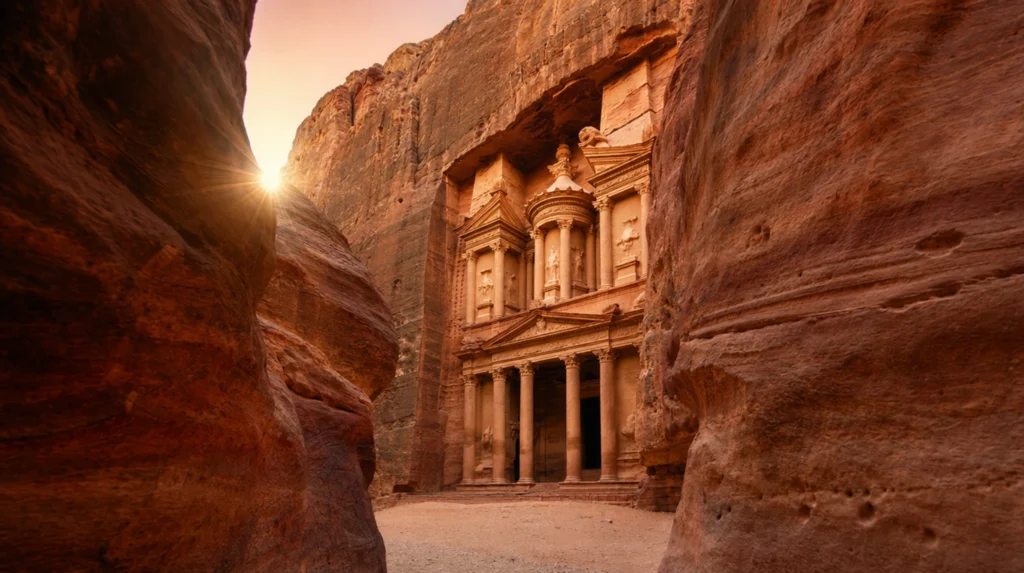
Languages of Jordan
All languages of Western Asia →fluent beta classical · classes by phone with Maya at ranas.ai/maya
Jordan Travel Guide — Petra, Wadi Rum & Bedouin Hospitality
Jordan Travel Guide
📋 In This Guide
- Overview — Why Jordan Belongs on Every Bucket List
- 🌸 Spring in Petra & Wadi Rum 2026
- Best Time to Visit Jordan (Season by Season)
- Getting There — Flights & Arrival
- Getting Around
- Top Cities & Regions
- Jordanian Culture & Etiquette
- A Food Lover’s Guide to Jordan
- Off the Beaten Path
- Practical Information
- Budget Breakdown
- Planning Your First Trip to Jordan
- Frequently Asked Questions
Overview — Why Jordan Belongs on Every Bucket List
Jordan is a small country wedged between Syria, Iraq, Saudi Arabia, Israel, and the West Bank, and it somehow manages to hold more history per square kilometre than almost any place on Earth. In 89,342 km² of mostly desert, the Hashemite Kingdom fits a rose-red Nabataean city, a Mars-like sandstone valley, the lowest point on the planet, a fully preserved Roman provincial capital, and a population of roughly 11 million that is among the most welcoming you will meet in the region.
The country runs about 400 kilometres north to south and 350 kilometres east to west at its widest, which means a visitor can stand on Mount Nebo at breakfast, float on the Dead Sea at noon, walk the Siq into Petra by sunset, and sleep in a Bedouin camp in Wadi Rum — all inside a single weekend, if they push it. Roughly 75% of Jordan is arid or semi-arid, but altitudes range from 1,854 m at Jabal Umm ad Dami to 430 m below sea level at the Dead Sea shore — the lowest exposed point on Earth. The effect is a country that can go from snow in Amman in January to 40°C in Aqaba in July without crossing a border.
Two things strike most first-time visitors. The first is Bedouin hospitality, which is not a hotel-brochure phrase here: a guide in Wadi Rum who has just met you will pour you sweet bedouin tea over a fire within ten minutes, and a shopkeeper in Amman’s downtown will frequently refuse the first offer of payment. The second is the scale of the archaeology. Jordan holds six UNESCO World Heritage Sites — Petra, Quseir Amra, Um er-Rasas, Wadi Rum, the Baptism Site at Al-Maghtas, and As-Salt. Many of them are uncrowded even at peak season.
Jordan received roughly 6.1 million tourists in 2024, a modest number given what’s on offer, which means Petra at dawn can feel genuinely private if you time it right. The currency is the Jordanian Dinar (JD), pegged to the US dollar at roughly 1 JOD = 1.41 USD since the mid-1990s. A plate of falafel and hummus costs about 2 JD, a full mansaf dinner at a local restaurant runs 10-15 JD, and a night in a well-reviewed mid-range Amman hotel sits around 70 JD. What follows is a practical primer for planning the country end to end.
🌸 Spring in Petra & Wadi Rum 2026 — You’re Right on Time
Spring is objectively the best season to be in Jordan, and 2026’s window is already open. Between early March and mid-May, daytime temperatures in Petra and Wadi Rum sit at a forgiving 18-25°C, the desert briefly blooms with wild poppies, anemones, and black iris (Jordan’s national flower), and the crushing summer heat has not yet arrived. If you can only go once, go now.
There is one caveat that reshapes any 2026 spring trip: Ramadan. The holy month runs from the evening of 17 February to 19 March 2026, which overlaps the first third of spring. Tourism sites stay open but many local restaurants shut during daylight; iftar at sundown becomes a social highlight rather than an inconvenience if you plan for it.
- Ramadan 2026: 17 February – 19 March
- Peak spring window: 20 March – 15 May 2026 (wildflowers and 20-25°C days)
- Black iris bloom: late March through April across the Jordan Valley rim
- Wadi Rum: mornings cool enough for long hikes; evenings still warm in a sleeping bag
- Petra: arrive at the gate by 06:00 for the Siq in soft light and 12°C air
- Dead Sea & Wadi Mujib: water warm enough to float and canyon trails open from 1 April
- Jerash Festival of Culture and Arts: July in the Roman ruins — second hook for a return trip
Best Time to Visit Jordan (Season by Season)
Spring (Mar–May)
The peak season by consensus. Amman rises from 7°C mornings to 22°C afternoons, Petra and Wadi Rum sit at a comfortable 18-25°C, and a short wildflower bloom from late March carpets the northern highlands in poppies and black iris. Expect higher hotel rates in April and early May, full Petra parking lots by 10:00, and the first tour buses returning to Jerash. Ramadan 2026 covers 17 February – 19 March, so factor shortened daylight opening hours into the first half of spring. Book Petra hotels 6-8 weeks ahead.
Summer (Jun–Aug)
Hot and dry, with wide regional swings. Amman tops out around 30-32°C in July and August and is largely tolerable; Aqaba and the Dead Sea basin routinely reach 38-42°C; Petra and Wadi Rum can hit 40°C by midday with almost no shade. Summer is the lowest-price season — outside the Jerash Festival in July, which fills the Roman theatres for three weeks with folk dance and classical concerts — and it is the only sensible time to ski in Jordan (you cannot, actually, but the Aqaba diving is at its best with 27°C water). Hike before 08:00 or after 16:00 and hydrate obsessively.
Autumn (Sep–Nov)
The quiet second peak. Daytime highs drop back through 28°C in September to a pleasant 15-20°C by late November, nights cool off, and Wadi Rum stars sharpen in the drier air. Crowds are thinner than April, hotel rates are 20-30% lower, and the Dead Sea water stays bathtub-warm through October. Olive harvest season starts in late October across the northern hills — many rural guesthouses put on press-your-own-oil days. A very solid alternative to spring for travellers with schedule flexibility.
Winter (Dec–Feb)
Split personality. Amman can drop to 2°C at night with occasional snow, Petra hits single digits and closes trails during rare rain-induced flash floods, but Aqaba stays a balmy 12-22°C and is a genuine winter-sun destination. Hotel rates are the lowest of the year. The trade-off is daylight: Petra’s best photographic hours shrink, and a dust or rainstorm can wipe out a day in Wadi Rum. Pack layers, a proper waterproof shell, and a flexible itinerary. Bedouin camps keep fires going all night.
Shoulder-season tip: Late March (post-Ramadan) and early October are the sweet spots — warm enough for shorts by day, cool enough for a jacket at a Wadi Rum fire, with hotel rates 15-25% below the April peak.
Getting There — Flights & Arrival
Jordan has two international airports that matter for tourism and a handful of overland crossings. Most first-time visitors fly into Amman, loop south via Petra and Wadi Rum, and fly out of Aqaba.
- Queen Alia International (AMM) — Jordan’s primary gateway, 32 km south of Amman; the Sariyah Express airport bus reaches Tabarbour station in about 45 minutes for 3.30 JD.
- King Hussein International (AQJ) — Aqaba’s Red Sea airport, 9 km north of the city centre; a 10-minute taxi into town and the natural exit point after Wadi Rum.
- Amman Civil (Marka) (ADJ) — a small regional airport handling limited charter and intra-regional flights.
Flight times: London Heathrow to Amman is around 5 hours non-stop, Frankfurt is 4 hours 20 minutes, New York JFK direct on Royal Jordanian is about 11 hours, Dubai is 3 hours, and Istanbul is 2 hours 30 minutes.
Flag carrier: Royal Jordanian, member of Oneworld, plus regional low-cost carriers including flydubai, Pegasus, and Wizz Air.
Visa / entry: Most Western passport holders get a visa on arrival at QAIA for 40 JD single-entry, or free as part of the Jordan Pass if staying at least 3 nights.
Getting Around — JETT Buses, Rental Cars & the King’s Highway
Jordan has no passenger rail network to speak of, so intercity travel is by bus, rental car, or driver-hire. Distances are modest — the country is only 400 km long — and three trunk roads stitch everything together: the fast Desert Highway down the east side, the scenic King’s Highway through the mountains, and the Dead Sea Highway along the rift valley floor. Driving is on the right.
- JETT bus: Jordan’s air-conditioned coach operator, running fixed schedules between Amman, Petra, Aqaba, and the Dead Sea.
- Amman → Petra (Wadi Musa): 3 h 30 m by JETT bus or 3 h by car via the Desert Highway
- Amman → Wadi Rum: 4 h by car via the Desert Highway; no direct public bus — combine JETT Aqaba plus pickup
- Amman → Aqaba: 4 h by car, or 1 h by Royal Jordanian domestic flight
- Amman → Jerash: 45 minutes by car or local minibus from Tabarbour
Rental cars: The most flexible option for covering Petra, Wadi Rum, and the Dead Sea. Budget on 25-40 JD per day for a compact with basic insurance; international firms (Hertz, Budget, Sixt) operate desks at Queen Alia airport. Fuel is roughly 0.95 JD per litre for petrol.
Taxis & ride-hail: In Amman, yellow taxis are metered; insist on the meter (starts at 0.25 JD). Careem and Uber both operate in Amman and Aqaba and are often cheaper and less stressful than negotiating cash fares. White-and-green service taxis run fixed routes.
Apps: Google Maps works everywhere; Careem for ride-hail; Visit Jordan’s official app for site opening hours.
Top Cities & Regions
📍 Map of Jordan: Every Place in This Guide
🕌 Amman
The capital, home to roughly 4 million residents — more than a third of the country. Amman’s split personality runs between the ancient downtown (al-Balad), where the Roman Theatre, Citadel, and gold souks sit within walking distance, and the modern western hills of Abdoun and Sweifieh with their cafes, rooftop bars, and embassies. Plan 2-3 days: one for downtown and the Citadel, one for the neighbourhoods, and one for Jerash or the Dead Sea.
- Amman Citadel (Jabal al-Qal’a) with the Temple of Hercules and Umayyad Palace
- Roman Theatre, Hashemite Plaza, and the downtown gold souk
- Rainbow Street, Jabal Amman, and the King Abdullah I Mosque
- Signature dishes: mansaf at Sufra, knafeh at Habibah, falafel at Hashem
🏛️ Petra
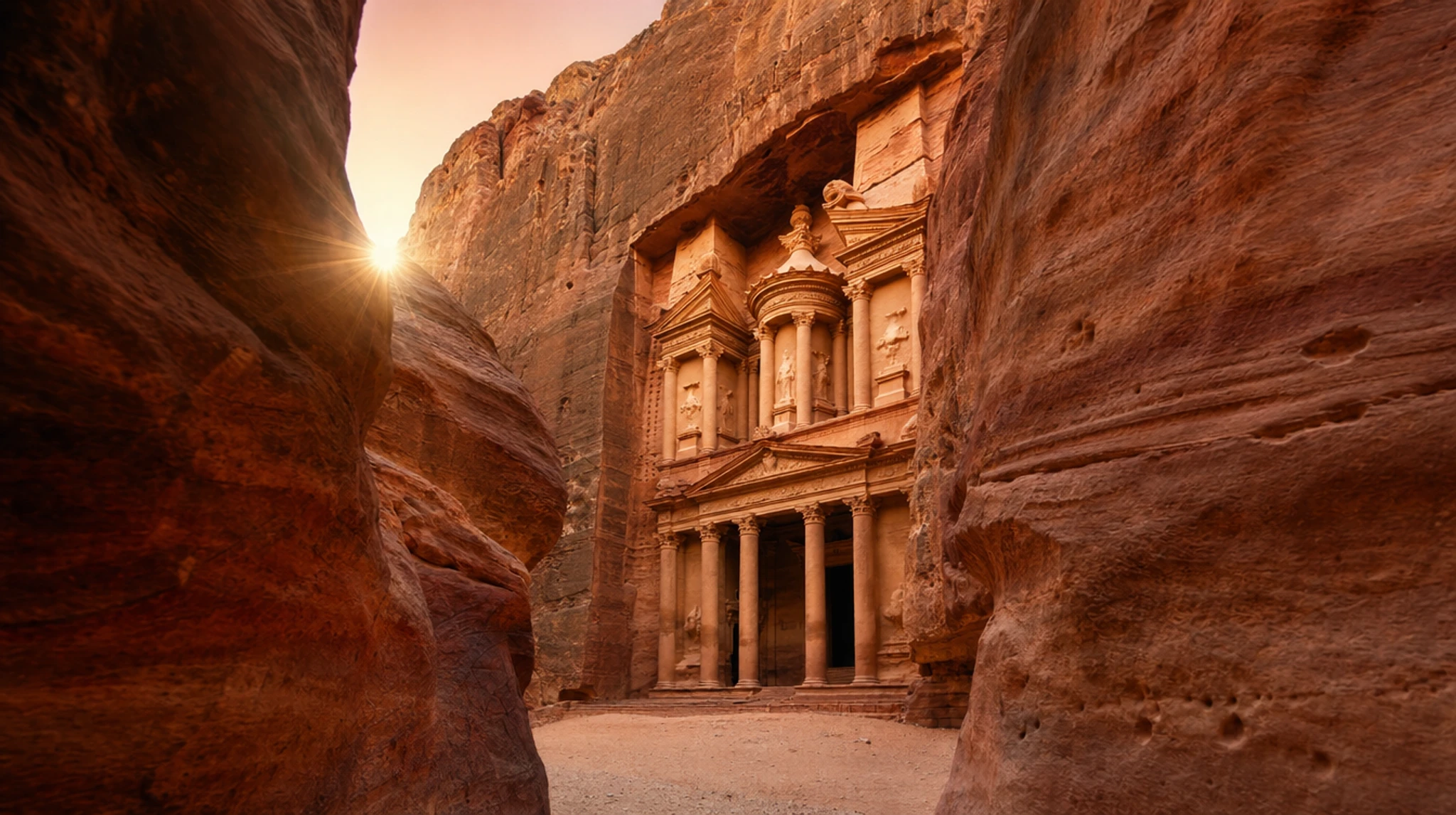
The Nabataean capital carved into rose-red sandstone, inscribed as a UNESCO World Heritage Site in 1985 and voted one of the New Seven Wonders of the World. The modern town is Wadi Musa, which exists almost entirely to serve the site. Plan at minimum two days — one to walk through the Siq and front monuments, one to hike to the Monastery — and if you have a third, add Petra by Night.
- The Siq and Al-Khazneh (the Treasury), at the end of a 1.2 km sandstone slot
- The Monastery (Ad-Deir) via an 800-step ascent — larger than the Treasury and less crowded
- Royal Tombs, the Colonnaded Street, and the High Place of Sacrifice
- Signature dishes: maqluba, zarb Bedouin oven, sage tea at the Little Petra viewpoint
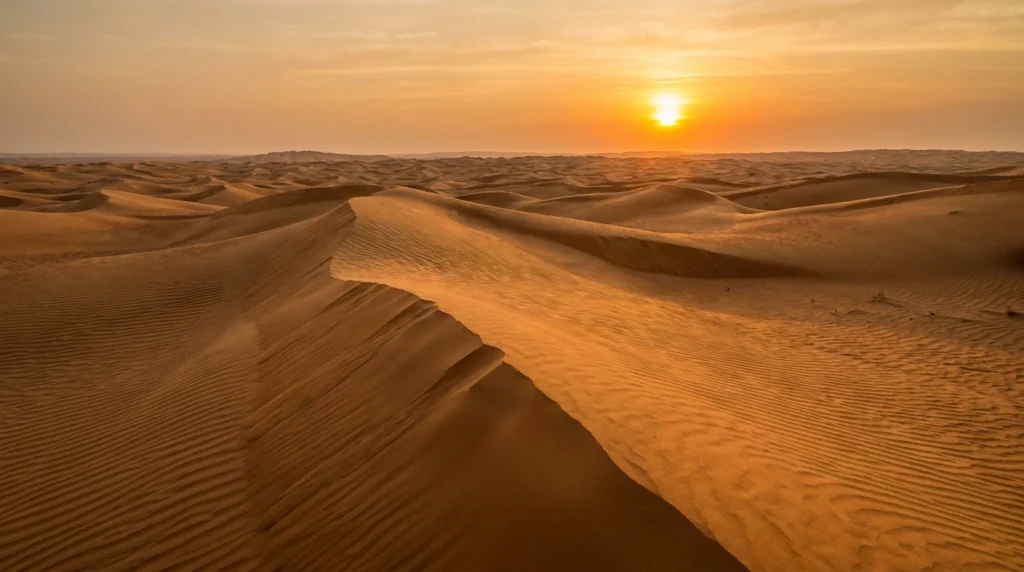
🏜️ Wadi Rum
A 720 km² protected desert — the Valley of the Moon — a UNESCO Mixed Heritage Site since 2011 for both its sandstone geology and its Bedouin cultural landscape. Wadi Rum is the default overnight desert experience in Jordan: traditional goat-hair Bedouin camps, modern “bubble” domes with glass ceilings for stargazing, and 4×4 jeep tours linking the best red-sand canyons.
- 4×4 tour to Lawrence’s Spring, Khazali Canyon, and the Red Sand Dune
- Petroglyphs at Jebel Khazali and the Anfishiyyeh inscriptions
- Overnight in a Bedouin or bubble camp with a zarb dinner under the stars
- Signature dishes: zarb, saj bread with za’atar, sweet Bedouin tea
🐠 Aqaba
Jordan’s only Red Sea port and its diving capital. Aqaba has a 27 km coastline with reefs close enough that several dive sites are reached from shore. The city is a Special Economic Zone, which means looser alcohol rules, duty-free shopping, and a more relaxed dress code than Amman.
- Cedar Pride wreck dive and the Japanese Gardens reef
- Aqaba Marine Park and the Underwater Military Museum
- Mamluk Aqaba Castle and the Great Arab Revolt Flagpole
- Signature dishes: sayadieh spiced fish rice, grilled Red Sea hamour, Aqaba prawns
🏟️ Jerash
One of the largest and best-preserved Roman provincial cities outside Italy, 48 km north of Amman and an easy half-day trip. Jerash’s Oval Plaza, Hadrian’s Arch, and the South Theatre give a ground-level sense of a working Decapolis city. The annual Jerash Festival of Culture and Arts every July fills the ancient theatres with folk dance and concerts.
- Oval Plaza (Forum) with 56 standing Ionic columns
- Hadrian’s Arch, the Cardo Maximus, and the Nymphaeum fountain
- Temples of Zeus and Artemis and the South Theatre
🌊 Dead Sea & Madaba
The lowest point on Earth at 430 m below sea level, paired with the mosaic city of Madaba and the biblical summit of Mount Nebo. An easy day trip from Amman or a two-night resort stay along the Dead Sea Highway. The water is ten times saltier than the ocean, so you float involuntarily.
- Floating in the Dead Sea and the mineral mud treatments at Amman Beach
- St George’s Church in Madaba and its 6th-century Byzantine map mosaic
- Mount Nebo — the biblical summit from which Moses saw the Promised Land
Jordanian Culture & Etiquette — What to Know Before You Go
The Essentials
- Dress modestly in public. Jordan is a Muslim-majority country. Shoulders and knees covered for men and women in towns and at religious sites; women should carry a scarf for mosque visits. Resort and beach zones in Aqaba and at Dead Sea hotels are relaxed.
- Right hand only for eating and giving. The left hand is traditionally considered unclean. Accept tea, hand over money, and eat shared mansaf with the right hand.
- Greetings matter. As-salamu alaykum (“peace be upon you”) is the universal greeting and its reply wa-alaykum as-salam is worth learning. Handshakes are standard between men; wait for a woman to extend her hand first.
- Tipping is expected. 5-10% in restaurants where no service charge is added, 1-2 JD for hotel porters and housekeeping, and rounding up taxi fares.
- Ramadan sensitivity. During the holy month (17 Feb – 19 Mar 2026) do not eat, drink, or smoke in public during daylight — including in your car at traffic lights. Hotels serve guests discreetly.
Bedouin Hospitality
- Accept the tea. Refusing sweet Bedouin tea (shai bedawi) or bitter Arabic coffee (qahwa sada) is a minor slight — if you genuinely cannot drink more, take one sip and set the cup aside.
- Three cups of coffee is a ritual. In traditional tents, the first cup is for the soul, the second for the sword, the third for guests — shake the cup side-to-side when you’ve had enough.
- Shoes off on carpets. At Bedouin camps and in homes, leave shoes at the edge of the rug.
- Take photographs of people only after asking. Particularly of women and at mosques; a smile and a gesture usually suffice to get or refuse permission.
A Food Lover’s Guide to Jordan
Jordanian food sits at the crossroads of Levantine mezze traditions, Bedouin pit-roasting, and Ottoman sweets. Meals are communal and slow by design: a spread of small hot and cold mezze (hummus, mutabbal, fattoush, tabbouleh, warak enab) arrives first, followed by a shared main — most often mansaf, maqluba, or a mixed grill. Bread is not a side but a utensil; a flatbread is used to scoop, wrap, and eat nearly everything. The single best budget move in Amman is a late-morning sit-down at Hashem downtown for falafel, foul, and hummus for under 3 JD per person, then an afternoon kanafeh at Habibah around the corner.
Must-Try Dishes
| Dish | Description |
|---|---|
| Mansaf | Jordan’s national dish: lamb simmered in fermented dried yoghurt sauce (jameed) served over saffron rice and thin shrak bread, eaten communally with the right hand. Typical price: 10-15 JD per person. |
| Maqluba | “Upside-down” rice pot layered with fried aubergine, cauliflower, potato, and chicken or lamb, flipped dramatically at the table before serving. |
| Knafeh | The national dessert: warm sweet cheese pastry topped with shredded filo, soaked in orange-blossom syrup, and dusted with crushed pistachios. Best at Habibah in Amman for about 2 JD a slice. |
| Falafel and hummus | The breakfast staple: a full plate at Hashem or Abu Jbara runs 2-3 JD, paired with foul medames (stewed fava beans), fresh flatbread, and sweet mint tea. |
| Mezze plates | Small-plate starters: mutabbal (smoky aubergine), fatteh (yoghurt-and-chickpea), tabbouleh (parsley-forward salad), warak enab (vine leaves), and labneh with za’atar and olive oil. |
| Zarb | The Bedouin underground barbecue: lamb, chicken, and vegetables slow-cooked for 3-4 hours in a sand pit oven; the canonical Wadi Rum camp dinner, served family-style. |
| Sayadieh | A fisherman’s rice dish from Aqaba: deeply spiced caramelised-onion rice topped with grilled or poached Red Sea fish (hamour, sultan ibrahim). |
Street Food & Coffee Culture
Jordan’s street food layer is cheap, plentiful, and largely pork-free. Shawarma (chicken or lamb carved from a spit and wrapped in saj bread) runs 1.5-3 JD, a chicken mansaf-plate at a local eatery is 5-7 JD, and a grilled halloumi sandwich from a downtown cart sits around 1 JD. Coffee is central to the day: bitter Arabic coffee flavoured with cardamom in tiny cups, Turkish-style coffee in small pots, and sweet mint tea served glass-by-glass in the souks. A proper sit-down coffee at a cafe in Jabal Amman costs 2-3 JD; a glass of fresh-squeezed pomegranate juice from a downtown stand is 1 JD. Alcohol is available at hotels, licensed restaurants, Aqaba, and Dead Sea resorts; a local Amstel or Philadelphia lager at a bar runs 4-6 JD.
- Chains and institutions: Hashem (downtown Amman falafel), Habibah (kanafeh), Sufra, Fakhr el-Din (upscale mansaf)
- Signature items: mansaf with jameed, knafeh na’ama, shawarma wraps, saj bread, sweet Bedouin tea, cardamom Arabic coffee
Off the Beaten Path — Jordan Beyond the Guidebook
Dana Biosphere Reserve
A 292 km² reserve stretching from 1,500 m sandstone cliffs down to 50 m below sea level, protecting more than 800 plant species and four distinct bio-geographical zones. The RSCN-run Feynan Ecolodge at the bottom of the valley is lit entirely by candlelight, off-grid, and reached by 4×4 from Dana village. The 14 km Dana-to-Feynan trek through the wadi is the country’s best single multi-day hike and one of the quietest corners of the Jordan Rift.
Umm Qais (Gadara)
A hilltop Greco-Roman city in Jordan’s far north, sitting directly above the Sea of Galilee. On a clear morning the terrace has simultaneous sightlines into Syria, Israel, and the Palestinian territories. The black-basalt colonnades and the octagonal Byzantine terrace church are extremely well preserved, and Umm Qais village below runs small cooperative restaurants serving northern specialties like galayet bandora (tomato-and-chilli stew with bread).
Wadi Mujib
Jordan’s Grand Canyon: a wet-canyon hike that drops dramatically through red sandstone into the Dead Sea. The Siq Trail starts at the Mujib Biosphere Reserve gate near sea level minus 400 m and involves an hour of swimming and scrambling upstream against a moderate current. The trail opens 1 April and closes at the end of October because winter rain produces flash floods. Book through the Wild Jordan Center.
Shobak Castle
A 1115 CE Crusader fortress perched on a desert bluff between Petra and the Dead Sea, built by Baldwin I of Jerusalem as part of his Oultrejordain frontier. Far less visited than Kerak Castle an hour to the north, Shobak is often entirely empty at sunset — inside, a Mamluk-era tower still overlooks the Nabataean foothills, and a stepped tunnel drops 375 steps to a secret water cistern.
Ajloun Forest Reserve
A 13 km² oak and pistachio woodland north of Jerash, protected by the Royal Society for the Conservation of Nature. The reserve has a handful of waymarked trails between 2 km and 8 km and a small eco-tourism village with cabins. Ten minutes away, Ajloun Castle (Qal’at ar-Rabad) was built in 1184 CE by Saladin’s general Izz al-Din Usama as the Ayyubid counter to Crusader positions in the Jordan Valley — and still has its star-shaped footprint, glacis, and a commanding view across to Mount Gilead.
Practical Information
Quick reference for once you’ve locked dates. Values below were current as of April 2026.
| Currency | Jordanian Dinar (JD / JOD); 1 USD ≈ 0.71 JD (19 Apr 2026); the JOD is pegged to the USD at roughly 1 JOD = 1.41 USD since 1995. |
| Cash needs | Card is accepted at hotels, mid-range restaurants, and supermarkets. Carry 50-100 JD cash for Petra horse carriages, tips, small shops, and rural taxis. |
| ATMs | ATMs are widespread in Amman, Aqaba, Wadi Musa (Petra), and Madaba. Arab Bank, Capital Bank, and Jordan Ahli Bank ATMs reliably accept foreign cards; expect a 3-5 JD fee per withdrawal. |
| Tipping | Expected. 5-10% in restaurants without a service charge, 1-2 JD for porters and housekeeping, round up taxis. |
| Language | Arabic is the official language. English is widely spoken in tourism, hospitality, and signage in Amman, Petra, and Aqaba. Google Translate works offline with Arabic. |
| Safety | Jordan itself is stable and considered one of the Middle East’s safer destinations. Standard urban precautions; check government advisories for border zones with Syria and Iraq. |
| Connectivity | 4G/5G nationwide in cities; Zain, Orange, and Umniah tourist SIMs from 10 JD. eSIMs (Airalo, Holafly) work at QAIA on landing. |
| Power | Type C/D/F/G plugs, 230V, 50Hz |
| Tap water | Not reliably potable. Drink bottled water (0.35 JD for 1.5 L) and use it for brushing teeth in budget accommodation. |
| Healthcare | Good private hospitals in Amman (King Hussein Medical Centre, Istishari, Jordan Hospital). Travel insurance is strongly recommended. Pharmacies are plentiful and English-speaking in urban areas. |
| Emergencies | Dial 911 for police, ambulance, and fire; 117 for the Tourism Police in heritage zones including Petra. |
Budget Breakdown — What Jordan Actually Costs
💚 Budget Traveller
Expect roughly $50-80 per day on hostels (Amman has several good ones around 12-18 JD for a dorm), falafel-and-hummus meals for 2-3 JD, JETT buses between cities, and the Jordan Pass amortised over a week. Petra is the single biggest line item: the Pass turns a 50 JD one-day Petra entry into essentially a free visit plus the 40 JD visa waiver. A proper Wadi Rum night in a basic Bedouin camp with dinner and breakfast starts around 30 JD. Stretch the budget further with street shawarma and free sites: Amman Citadel (3 JD), the Roman Theatre, and every mosque and downtown souk.
💙 Mid-Range
Plan $100-200 per day for a 3-star hotel in Amman (55-90 JD a night), two sit-down meals with mezze and a main (15-25 JD per person), a rental car with basic insurance at 30 JD per day, and the Jordan Pass covering most major monuments. This is where most independent visitors land, and it’s the tier where a 7-night loop of Amman-Petra-Wadi Rum-Aqaba-Dead Sea produces the best cost-to-experience ratio. Add 40-60 JD per person for a mid-range Wadi Rum bubble camp dinner and stargazing.
💜 Luxury
$350+ per day unlocks 5-star stays (Four Seasons Amman, Mövenpick Petra, Kempinski Ishtar Dead Sea, from 200-300 JD), a private driver for the full week (130-180 JD per day), premium Wadi Rum bubble camps with glass ceilings (120-250 JD per person), and fine dining at Sufra, Fakhr el-Din, or Beit Sitti cooking classes.
| Tier | Daily (USD) | Accommodation | Food | Transport |
|---|---|---|---|---|
| Budget | $50-80 | Hostel dorm / basic Bedouin camp 12-30 JD | Falafel, shawarma, street food ($3-8/meal) | JETT buses + shared taxis ($8-15/day) |
| Mid-Range | $100-200 | 3-star hotel / mid Wadi Rum camp 55-90 JD | Mezze dinners, mansaf, cafes ($15-30/meal) | Rental car + occasional taxi ($30-50/day) |
| Luxury | $350+ | 5-star hotel / bubble dome 200-300 JD | Fine-dining mezze ($60+/person) | Private driver ($180+/day) |
Planning Your First Trip to Jordan
A first trip to Jordan works best at 7-10 days. That window fits Amman, the big three (Petra, Wadi Rum, Dead Sea), plus Jerash and Aqaba without feeling rushed.
- Buy the Jordan Pass before you fly. Three tiers — 70, 75, or 80 JD — depending on how many days you spend in Petra. It covers the 40 JD visa fee at Queen Alia plus 40+ attractions including Petra, Wadi Rum, and Jerash. Requires a minimum 3-night stay.
- Book flights into AMM and out of AQJ. Open-jaw routing saves a 4-hour backtrack up the Desert Highway and lets you end on a beach day.
- Decide on a rental car or driver. Distances are short but signage outside Amman is inconsistent. A car gives flexibility for the King’s Highway; a hired driver removes stress and costs roughly double.
- Check Ramadan dates. Ramadan 2026 covers 17 February – 19 March. Tourism sites stay open but plan meals around iftar (sundown) and pack snacks for day trips.
- Layer your packing. Modest clothing for towns (long trousers, covered shoulders), sturdy hiking shoes for Petra, a warm fleece for desert nights, and a light waterproof for winter/spring surprises.
Classic 8-Day Itinerary: Amman 2 days (+ Jerash day trip) → Dead Sea 1 night → Petra 2 days → Wadi Rum 1 night → Aqaba 1 day → fly out of AQJ.
Cities & Regions to Explore
Frequently Asked Questions
Is Jordan expensive to visit?
By regional standards Jordan is mid-range: cheaper than the UAE or Israel, more expensive than Egypt. Petra alone is a significant line item — a 1-day entry is 50 JD without the Jordan Pass, but the Pass turns it essentially free on a 3+ night trip. A realistic all-in daily budget is about $80 at the low end and $200 mid-range, with cheap street food, moderate taxi costs, and above-average hotel prices in Petra and the Dead Sea.
Do I need to speak Arabic?
No. Arabic is the official language, but English is widely spoken in tourism, hospitality, and at all major sites — signage, menus, and hotel staff in Amman, Petra, Wadi Rum, and Aqaba work reliably in English. Learn As-salamu alaykum, shukran (thank you), and min fadlak (please), and you will be welcomed warmly even with no other Arabic.
Is the Jordan Pass worth it?
Almost always yes, for any visit of 3+ nights. The Pass costs 70, 75, or 80 JD depending on how many days in Petra, and covers the 40 JD visa fee plus single-entry to 40+ attractions including Petra, Wadi Rum, Jerash, and Amman Citadel. Even a 4-day trip covering Petra once saves roughly 20 JD versus paying entry fees individually.
Is Jordan safe for solo travellers?
Yes. Jordan is widely considered one of the safest countries in the Middle East for tourism, including for solo and female travellers. Amman, Petra, Wadi Rum, and Aqaba are entirely comfortable with standard urban precautions. Border zones with Syria and Iraq are closed to tourism; check current government advisories before travel.
When is the peak season?
Spring (March to May) and autumn (September to November). Petra and Wadi Rum are too hot from June to August (40°C+ in the desert) and cold and occasionally wet in winter. Aqaba stays mild year-round and is a good winter-sun destination.
Can I get by as a vegetarian or vegan?
Yes, easily — Levantine cuisine is vegetarian-friendly by default. Mezze, hummus, mutabbal, tabbouleh, falafel, foul, and warak enab are all plant-based. Strict vegans need to ask about yoghurt (common in mansaf and maqluba) and ghee in sweets. HappyCow lists dedicated vegan restaurants in Amman.
What is the Jordan Pass and how does it work?
The Jordan Pass is a prepaid tourist pass bundling the visa-on-arrival fee plus entry to 40+ attractions. Buy online at jordanpass.jo before arrival, save the PDF or QR code to your phone, show it at passport control to waive the 40 JD visa, then show the same code at each site’s gate. It requires a minimum 3-night stay to waive the visa portion.
Ready to Explore Jordan?
Start with our city guides to Amman, Petra, and Wadi Rum, or jump straight to the full Jordan trip-cost breakdown.
Explore More
Cities we cover in Jordan
Cities to explore in Jordan
Deep-dive guides to specific cities, neighbourhoods, and food scenes — written with the same magazine voice.
More country guides you might like
Plan your trip to Jordan
The booking tools we use ourselves. FFU may earn a commission at no extra cost to you.
Plan & book your trip to Jordan
Booking through these searches supports our guides at no extra cost to you.