
Languages of San Marino
All languages of Southern Europe →fluent beta classical · classes by phone with Maya at ranas.ai/maya
San Marino Travel Guide — Europe’s Oldest Republic on a Cliff-Top, One Day Trip from the Adriatic
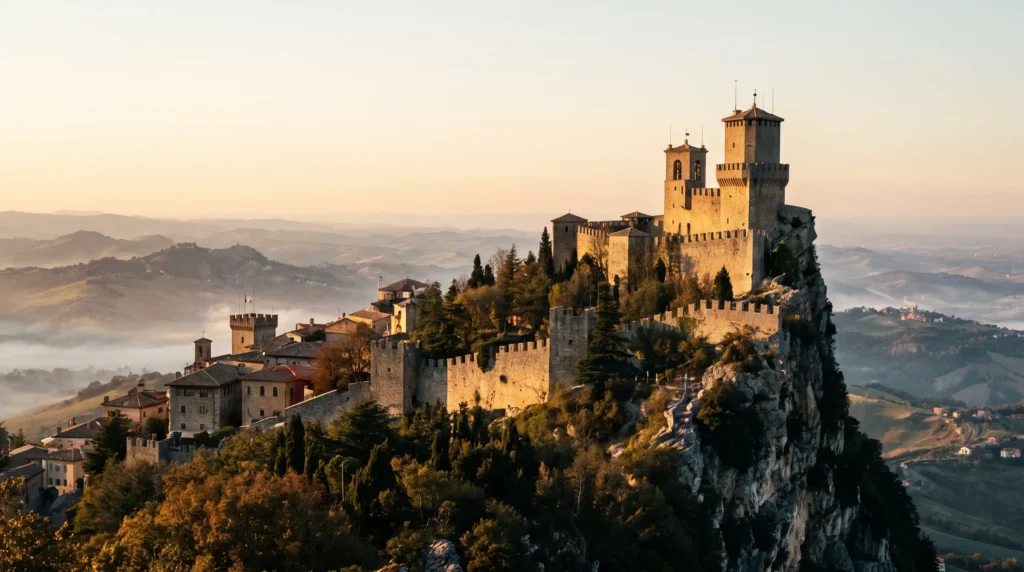
I almost didn’t bother with San Marino. It gets sold as a novelty stop — “world’s oldest republic,” tick the box, buy a fridge magnet, back on the coach to Rimini by lunch. Then I actually climbed the switchback path up Monte Titano and stood on the ramparts between the first and second towers with the whole Romagna coastline laid out below like a map, and I got it: this isn’t a gimmick country, it’s a genuinely fortified medieval hill town that happens to have run its own affairs, more or less uninterrupted, since the year 301. You can walk the whole historic centre in an afternoon, which is exactly the catch: most visitors arrive as a day-trip add-on from the beach resorts and never see it in the quiet hours, when the tour buses have gone and the fog sometimes settles below the cliff so the whole city floats above the clouds. Come for the novelty, stay for the view — and if you can, stay for a night, because that’s when San Marino stops being a postcard and starts being a place.
In This Guide
- Overview — Why a Microstate Smaller Than Most Cities Is Worth the Detour
- September 3 — The Feast of San Marino & the Crossbow Palio
- Best Time to Visit San Marino (Season by Season)
- Getting There — Rimini, Bologna & the Bus Up the Mountain
- Getting Around — Cable Car, Footpaths & Why You Don’t Need a Car
- Top Regions — The Nine Castelli
- Culture & People — 1,700 Years of Staying Independent
- A Food Lover’s Guide to San Marino
- Off the Beaten Path
- Practical Information
- Budget Breakdown — What San Marino Actually Costs in 2026
- Planning Your First Trip
- Frequently Asked Questions
Overview — Why a Microstate Smaller Than Most Cities Is Worth the Detour
San Marino is one of the smallest countries on Earth — about 61 square kilometres, roughly a third the size of Washington, D.C. — and one of the oldest, tracing its founding to a stonemason named Marinus who supposedly fled religious persecution and set up a small Christian community on Monte Titano in AD 301. Whatever the historical accuracy of that origin story, the republic’s continuity is real and well-documented: it is widely recognized as the oldest surviving sovereign state and the oldest constitutional republic in the world, having kept its own government running through the entire span of the Roman Empire’s fall, the Renaissance, Napoleon, Italian unification, and two world wars.
Completely landlocked and completely surrounded by Italy — one of only three countries in the world enclaved entirely within a single other nation — San Marino sits about 10 kilometres inland from the Adriatic coast near Rimini. Its capital, the City of San Marino, is perched dramatically on the ridge of Monte Titano at 739 metres, with three medieval fortress towers — Guaita, Cesta and Montale — strung along the peaks like beads on a spine. UNESCO inscribed the historic centre and Mount Titano as a World Heritage Site in 2008, specifically citing San Marino as testimony to the continuity of a free republic since the Middle Ages.
What San Marino does not have is much room to spread out, and that shapes everything about visiting it. There is no need for internal flights or long bus rides — the whole country can be crossed by car in about twenty minutes — but there is also no way to “get off the beaten path” in the way you might in a large country. The trick, instead, is timing: come outside the midday coach-tour crush, and a place that reads as a tourist trap at noon reads as one of the more atmospheric fortified towns in Europe by early morning or after dinner.
September 3 — The Feast of San Marino & the Crossbow Palio
If you can build a trip around one date, make it 3 September, the Feast of San Marino and the traditional anniversary of the Republic’s founding. The day mixes a solemn Mass and religious procession at the Basilica of San Marino with the country’s biggest secular spectacle: the Palio Grande, a crossbow tournament between teams from the nine historic castelli (municipalities), fought out in historical costume at the Cava dei Balestrieri, the Crossbowmen’s Quarry below the towers. The tournament traces its rules to the Republic’s Statutes of 1300, and the modern Crossbowmen’s Federation has staged the event at the Quarry every year since 1971.
Beyond that single date, San Marino runs a busy calendar of medieval-costume events through spring and summer — flag-throwers, crossbow drills and open-air markets pop up around the Old Town on weekends, especially in the lead-up to the Days of Medieval Ambience each July. If your dates don’t line up with any of it, don’t worry: the towers, the ramparts and the view are the real headline act, and those run twelve months a year.
Best Time to Visit San Marino (Season by Season)
April – June · Spring shoulder (sweet spot)
Mild temperatures, wildflowers on the mountain paths, and noticeably thinner coach-tour traffic than midsummer. This is the best window for photographing the towers without a crowd in every frame, and hotel rates in the historic centre are gentler than July–August.
July – August · Peak season
Hot, bright, and the busiest by far — San Marino sits a short drive from the Adriatic’s biggest beach-resort strip (Rimini, Riccione), and a huge share of its day-visitors are beachgoers on a half-day detour. Expect the Old Town streets to be genuinely packed from mid-morning to early evening; staying overnight is the single best way to dodge the worst of it, since the coach groups clear out by early evening.
September – October · Second shoulder
Warm, golden light, the 3 September Palio, and grape-harvest season in the surrounding Romagna hills. A strong contender for the best all-round month to visit.
November – March · Winter
Quiet, cool, occasionally foggy or below-freezing on the summit, and some smaller shops and restaurants scale back hours. The upside: you may have entire ramparts to yourself, and on clear winter days the visibility from the towers stretches to the Adriatic and, on the best days, reportedly toward the Dalmatian coast across the sea.
Getting There — Rimini, Bologna & the Bus Up the Mountain
San Marino has no airport or train station of its own, and no international air or rail links — every visitor arrives by road, usually via Italy. The closest airport is Federico Fellini International in Rimini, about 27 kilometres away; Bologna’s Guglielmo Marconi Airport is roughly 132 kilometres, and Ancona’s airport about 115 kilometres, both requiring a connecting shuttle or train to Rimini first.
The simplest route for most travelers: fly into Rimini or Bologna, take a train to Rimini’s railway station, then catch one of the daily buses (run by operators including Fratelli Benedettini and Bonelli Bus) that climb directly into San Marino — tickets are bought on board. By car, San Marino is reached off the A14 Bologna–Ancona motorway via the Rimini Sud exit (then the SS72 superhighway) or the Rimini Nord exit and the SP258 provincial road. Because there is no border checkpoint, there is nothing to clear — you simply drive, or ride, straight in.
Getting Around — Cable Car, Footpaths & Why You Don’t Need a Car
The entire country can be driven end-to-end in around twenty minutes, so most visitors never need a car once they’ve arrived. The historic centre atop Monte Titano is pedestrian and largely car-restricted; if you’re driving up, you’ll park below the walls and walk or ride in.
The single most useful piece of transport infrastructure is the cable car (funivia) linking Borgo Maggiore, the lower town where most parking and the bus terminal sit, to the Old Town — departures roughly every 15 minutes, with one-way and round-trip fares in the single-digit euros. Walking between the towers along the ramparts is the best way to see the historic centre — steep in places, cobbled throughout, and genuinely photogenic from every angle. To reach the outlying nine castelli, a small local bus network connects the towns, though a rental car (picked up in Rimini) is the easiest way to explore beyond the capital in a single day.
Top Regions — The Nine Castelli
City of San Marino (Città di San Marino)
The historic capital and the reason most people come: the Three Towers (Guaita, Cesta, Montale), the Basilica di San Marino, the Palazzo Pubblico with its Guard of the Rock ceremony, and a tangle of cobbled lanes lined with everything from serious museums to crossbow-and-fudge souvenir shops. Come for opening hours or after the day-trip coaches leave for the best experience of it.
Borgo Maggiore
The “lower town” directly below the capital, connected by cable car — home to the Thursday market, more everyday local life, and considerably cheaper food and parking than the Old Town above.
Serravalle
San Marino’s largest and most populous municipality, and its commercial and industrial hub — less picturesque, but the practical gateway for anyone arriving from Rimini by road.
Domagnano, Acquaviva & Faetano
Smaller castelli scattered through the rolling countryside below the capital, mixing vineyards, small workshops and quiet village churches — a good half-day detour by rental car if you want San Marino without any other tourists in the frame.
Chiesanuova, Fiorentino & Montegiardino
The most rural of the nine castelli, threaded with hiking paths across the wooded hills around Monte Titano’s foothills — Montegiardino is the smallest municipality in the country by population.
The Nine Castelli, together
San Marino’s local government is organized into nine municipalities (castelli), each with its own council — a structure that has persisted for centuries and gives even this tiny country a genuine sense of distinct small-town identities rather than one undifferentiated blob of “San Marino.”
Culture & People — 1,700 Years of Staying Independent
San Marino’s political system is one of its most distinctive features: the country is governed as a parliamentary republic led by two Captains Regent, elected every six months from opposing parties to jointly serve as co-heads of state — a deliberate check against any single leader accumulating power over more than half a year. It’s a small detail that visitors rarely notice, but it explains a lot about how a country this size has avoided being absorbed by its much larger neighbor for over a millennium.
Culturally, San Marino is thoroughly Italian in language and daily life — Italian is the official language, and the food, dress and rhythms of the day mirror the surrounding Romagna region — but the Sammarinese carry a distinct national identity built on that founding myth of Marinus and a fierce, often-repeated pride in never having been conquered. San Marino also claims a notable historical first: it was among the earliest states to abolish the death penalty, doing so in 1865. Tourism is not a side note to the economy here — it accounts for a substantial share of GDP, alongside banking, ceramics, textiles and the country’s famous postage stamps and coins, which are collected worldwide.
A Food Lover’s Guide to San Marino
Sammarinese cuisine is essentially Romagnol cooking with a few homegrown specialties layered on top — unsurprising, given the country is a single hilltop surrounded by that Italian region on all sides. The oldest and most everyday dish is the piadina, a flatbread of wheat flour, water and lard griddled on a hot terracotta or cast-iron testo and folded around fillings like stracchino cheese, rocket and prosciutto crudo.
The dessert-souvenir every visitor takes home is Torta Tre Monti (“Three Peaks Cake”) — crisp wafer layers separated by cocoa-hazelnut cream and coated in dark chocolate, its stepped shape a deliberate echo of Monte Titano’s triple summit. Alongside it sits bustrengo, a rustic peasant pudding of stale bread, cornmeal, raisins, dried figs, honey and lemon zest — traditionally a Christmas dish but sold year-round in the Old Town’s pastry shops. Wash it down with a glass of San Marino’s own DOC wines — Sangiovese and the local Biancale grape are the ones to look for — and don’t skip the hand-made fresh pasta that fills most sit-down restaurant menus alongside oven-roasted meats.
Off the Beaten Path
Cesta Tower and the Museum of Ancient Weapons
Cesta sits at the highest of Monte Titano’s three peaks and houses a museum of historic arms and armor — far less crowded than Guaita, the tower closest to Piazza della Libertà, but arguably the better view.
The nine castelli countryside
Rent a car in Rimini and spend a half-day looping through Domagnano, Acquaviva, Fiorentino and Montegiardino — vineyards, hilltop churches and village bars where nobody is selling crossbow keychains.
Cava dei Balestrieri outside tournament days
The Crossbowmen’s Quarry hosts occasional smaller shooting demonstrations outside the big 3 September Palio; check the crossbow federation’s calendar for off-peak dates and you can watch the sport practiced without the festival crowds.
State Museums after 5pm
San Marino’s museums and the Basilica keep the Old Town animated well past when the day-trip coaches depart — an evening walk along the ramparts between Guaita and Cesta as the coast lights come on below is, for my money, the single best experience the country offers, and it costs nothing.
Practical Information
Money. San Marino uses the euro despite not being an EU member, under a monetary agreement that also lets it mint its own commemorative euro coins — genuine collector’s items sold at local banks and shops. Cards are widely accepted in the historic centre; carry some cash for smaller shops in the outlying castelli.
Borders and documents. There is no passport control entering San Marino — because it has no airport, seaport or border checkpoints of its own, you’ll clear entry requirements at whichever Schengen point of entry (almost always Italy) you use to reach it. Keep your Schengen-area documentation in order regardless — San Marino itself won’t stamp anything, but Italy will have already checked you in.
Safety. San Marino is small, wealthy and low-crime, and most travel-advisory attention on the region centers on general guidance for Italy rather than anything specific to San Marino; check your government’s current travel advice for Italy before you go, since it’s the country you’ll transit through.
Health. No special vaccinations are required; routine vaccines (including MMR) should be current, and hepatitis A/B are reasonable considerations for any traveler in the region as with elsewhere in Europe. Tap water is safe to drink throughout the country.
Connectivity. An Italy-covering eSIM works fine here since San Marino sits inside Italian mobile networks in practice; Wi-Fi is reliable in hotels and cafés in the Old Town. Plugs: European two-pin (Type C/F), 230V. Time zone: Central European Time (UTC+1, UTC+2 with DST), same as Italy.
Budget Breakdown — What San Marino Actually Costs in 2026
Because most visitors treat San Marino as a day trip from the Adriatic coast rather than a standalone destination, actual overnight prices in the historic centre run a bit higher than nearby Rimini for comparable quality — you’re paying a premium for sleeping inside the walls.
Budget (US$60–100/day): A day-trip approach entirely — base in Rimini or Riccione, bus or drive up for the day, piadina lunch, cable car ride, walk the towers, no overnight cost in San Marino at all.
Mid-range (US$150–230/day): A hotel or guesthouse inside or just below the Old Town, sit-down dinners of fresh pasta and local wine, museum entries to the towers and Palazzo Pubblico, a rental car day to see the outlying castelli.
Luxury (US$350+/day): The nicer hotels with terrace views over the Romagna coastline, private guided history tours of the fortifications, and fine-dining tasting menus built around Sammarinese DOC wines.
Fixed costs to expect: cable car fares (a few euros each way), small entry fees for the towers and museums, and nothing resembling a departure tax or entry fee for the country itself, since there’s no formal border to cross.
Planning Your First Trip to San Marino
The realistic first-timer plan: pair San Marino with a few days on the Adriatic coast or a longer Italian itinerary, since it doesn’t sustain a standalone week-long trip. Fly into Bologna or Rimini, spend one full day (ideally including an early morning or evening) in the historic centre — towers, Basilica, cable car down to Borgo Maggiore — then continue into Emilia-Romagna and beyond. It slots naturally onto a broader Italy trip, especially one that already includes Bologna as a food-and-transit base; from there it’s an easy add-on before continuing toward Florence or Venice for the bigger Renaissance and canal-city stops.
Frequently Asked Questions
Is San Marino safe for tourists in 2026?
Yes — San Marino is small, wealthy and low on serious crime, and it doesn’t appear as a standalone risk on most government travel-advisory sites; treat it the same as you would the surrounding Italian region and follow current government guidance for Italy, since you’ll transit through it either way.
Do I need a visa or a passport stamp for San Marino?
There’s no separate San Marino visa and no passport control at all — you satisfy entry requirements at whatever Schengen border you use to reach it (almost always Italy), and your passport won’t be stamped by San Marino itself.
Is San Marino a day trip or worth staying overnight?
Most visitors do it as a half-day or full-day trip from Rimini or Riccione, and that’s genuinely enough to see the Three Towers and the Old Town. But if your schedule allows one night, staying inside the walls after the coach tours leave — an evening walk on the ramparts with the coast lit up below — is worth it.
What currency does San Marino use?
The euro, even though San Marino isn’t an EU member — it operates under a formal monetary agreement and even mints its own euro coins, which collectors seek out specifically.
How do I get from Rimini to San Marino without a car?
Take the train to Rimini’s station, then catch one of the daily direct buses up into San Marino — tickets are bought on board and the ride climbs straight to the bus terminal near Borgo Maggiore, from where the cable car whisks you up into the historic centre.
Is San Marino just a tourist trap?
Parts of it lean that way — the main shopping streets between Piazza della Libertà and the towers are thick with souvenir stalls selling crossbows and duty-free goods at midday. But the fortifications, the Basilica, and the views themselves are the real thing, and if you time your visit around the coach-tour rush (early morning, evening, or shoulder season), the “tourist trap” feeling mostly disappears.
Ready to Explore San Marino?
A fortress republic older than most of Europe’s current borders, three medieval towers strung along a single mountain ridge, and a view of the Adriatic that costs nothing but the climb — San Marino punches far above its 61 square kilometres. Go for the novelty of the world’s oldest republic; stay long enough to catch it after the coaches leave, when it stops feeling like a stamp in a passport and starts feeling like the fortified hill town it actually is.
Explore More
- Italy Travel Guide — the country San Marino sits inside, from Rome to the Dolomites
- Bologna City Guide — the nearest major airport and food-capital gateway
- Florence City Guide — pair San Marino with Tuscany’s Renaissance icon
- Venice City Guide — continue north for canals after the cliff-top towers
How this guide was built
Published as part of Facts From Upstairs’ country guide series. Built from authoritative sources — UNESCO’s San Marino Historic Centre and Mount Titano World Heritage inscription, the official Visit San Marino tourism board and Sammarinese cultural site sanmarinosite.com, the US State Department’s Italy travel advisory, the US CDC traveler page for San Marino, and Wikipedia entity pages for San Marino, Monte Titano, the Three Towers, and San Marino’s visa policy. Numeric and checkable claims carry inline citations.
Sources cited on this page
- Wikipedia — San Marino
- UNESCO — San Marino Historic Centre and Mount Titano
- Wikipedia — Monte Titano
- Wikipedia — Visa Policy of San Marino
- Visit San Marino — How to Get There
- San Marino Site — Cava dei Balestrieri & the Palio
- San Marino Site — Food and Wine
- US State Department — Italy Travel Advisory
- US CDC — San Marino traveler page
More country guides you might like
Plan your trip to San Marino
The booking tools we use ourselves. FFU may earn a commission at no extra cost to you.
Plan & book your trip to San Marino
Booking through these searches supports our guides at no extra cost to you.