
Languages of Slovenia
All languages of Southern Europe →fluent beta classical · classes by phone with Maya at ranas.ai/maya
Slovenia Travel Guide — Alps, Adriatic & Karst in One 20,271 km² Country
I have been recommending Slovenia to first-time European travellers for so long that I have started to feel mildly evangelical about it, and the reason is geometrical: in a country smaller than New Jersey you can wake up at a 475-metre alpine lake the colour of mint, drive 80 minutes south through Karst limestone country and stand inside the second-deepest underground river canyon in Europe, then keep going another 90 minutes and watch the sun fall into the Adriatic from a Venetian harbour wall. My favourite Slovenia argument with travel friends is whether the Bled cream cake or the walnut potica is the country’s best dessert (I always argue potica, because anything that has its own EU Traditional Speciality Guaranteed certificate deserves the win) — and my second-favourite is whether you should anchor a first trip in Ljubljana, Bled or the Soča Valley. Treat this guide as the brief I would hand my own sister before her first flight into Ljubljana Jože Pučnik, with a vignette already on the windscreen and a head torch in her hand luggage.

In This Guide
- Overview — Why Slovenia Punches Above Its Size
- From Carantania to the Eurozone — A Pocket History
- Best Time to Visit Slovenia (Season by Season)
- Lake Bled Through the Seasons 2026
- Getting There — LJU, Trieste, Venice & Klagenfurt
- Getting Around — Trains, Vignettes & the Adriatic Rail Tunnel
- Top Cities & Regions — Ljubljana, Bled, the Soča & the Karst
- Slovene Culture & Etiquette
- A Food Lover’s Guide — From Potica to Kranjska Klobasa
- Off the Beaten Path — Vintgar, Predjama, Idrija & Sečovlje
- Practical Information
- Budget Breakdown
- Planning Your First Trip to Slovenia
- Frequently Asked Questions
Overview — Why Slovenia Punches Above Its 20,271 km²
Slovenia is a small, almost improbably dense country on Europe’s geological hinge — 20,271 km² wedged between the eastern foot of the Alps, the head of the Adriatic, the Karst limestone plateau and the Pannonian plain. It borders Italy to the west, Austria to the north, Hungary to the far north-east and Croatia along a 670-kilometre line to the south and south-east. Just 2,130,986 people lived here in July 2025 according to the Statistical Office figures the Slovenian Tourist Board now publishes alongside its facts page, making Slovenia one of the EU’s smallest member states by population. The capital, Ljubljana, sits in a basin between the Alps and the Karst plateau at an elevation of 295 metres and houses just over 301,000 residents — roughly one in seven Slovenes.
The first story of Slovenia is variety. Britannica describes the country as containing “portions of four major European geographic landscapes — the European Alps, the karstic Dinaric Alps, the Pannonian and Danubian lowlands and hills, and the Mediterranean coast.” No country in Europe packs that mix into a smaller box. The Julian Alps in the north-west reach 2,864 metres at Mount Triglav, the country’s national peak, while 90 minutes south the Karst plateau collapses into the Postojna and Škocjan cave systems and the same drive west drops you into the Soča River canyon — and another hour beyond that, into Piran, a Venetian harbour town on the country’s 46.6-kilometre Adriatic coastline.
The second story is heritage stacked at startling density. Slovenia counts five UNESCO World Heritage Sites — the Škocjan Caves (inscribed 1986 for the largest known underground river canyon in Europe), the Prehistoric Pile Dwellings around the Alps (2011, transnational), the Heritage of Mercury at Almadén and Idrija (2012), the Ancient and Primeval Beech Forests across Europe (2017, transnational) and the works of architect Jože Plečnik in Ljubljana (2021). Add UNESCO Intangible Cultural Heritage entries for Idrija lace (2018), the door-to-door rounds of Kurentovanje pre-Lent carnival, and the dry-stone walling tradition shared with seven other Mediterranean countries, and you reach a country where almost every village has some cultural credential to its name. The pile-dwelling sites at the Ljubljana Marshes alone date to between 5,200 and 3,500 years before the present and represent the oldest known wooden wheel ever recovered from a European archaeological context.
The third story is conservation. Slovenia is roughly 60% forested — by area the third-most-forested country in Europe after Finland and Sweden — and the Slovenian Tourist Board reports that protected areas occupy approximately one-third of national territory. Triglav National Park alone covers 880 km², about 4% of the country, and dates back in protection terms to 1924 (the modern statute is from 1981). Slovenia was the first country in the world to be branded a “Green Destination of the World” in 2016 by the Green Destinations Foundation, and in 2017 the country brand “I Feel Slovenia” pivoted to a national green-tourism standard that now covers more than 200 destinations and accommodation providers. The current STO campaign — the same “It’s all in our nature” reel embedded above — explicitly fuses landscape and athlete identity, building on Slovenia’s outsized Olympic medal haul (climber Janja Garnbret, cyclist Tadej Pogačar, judoka Andreja Leški) per capita.
The fourth story is the practical one that explains why first-time European travellers keep coming back to recommend Slovenia: it is the most efficient country in Europe to visit. Slovenia joined the European Union on 1 May 2004, NATO on 29 March 2004, the Schengen Area on 21 December 2007 and the Eurozone on 1 January 2007 — meaning passport checks, currency exchange and roaming charges effectively disappeared inside one calendar quarter. Tourism arrivals reached 5.87 million in 2022 (a 46.6% rebound from 2021), with 3.94 million foreign arrivals — Germans, Italians and Austrians lead the foreign markets, with Britons, Americans and the Dutch close behind. Ljubljana Jože Pučnik Airport (LJU) handled 1,438,713 passengers in 2024, a 13.3% jump on 2023 and well on the recovery curve back to its 2019 peak. The European Commission’s Eurostat publishes the Slovenia country dashboard for further verification, and the Bank of Slovenia anchors the statistical baseline through the Eurosystem. Reuters, BBC, the Guardian, the New York Times, the Financial Times, Politico Europe and Deutsche Welle all maintain dedicated Slovenia coverage to triangulate against.
Practically, Slovenia in 2026 is the easiest country in Central Europe to use as a base. English is fluent across tourism; you can self-drive every flagship sight (a vignette, not a toll plaza, is how Slovenia charges motorway use); the tap water is excellent everywhere; the currency is the euro; the trains are punctual, electrified and €15-and-under for cross-country journeys; and the entire country fits inside a 7-day rental-car loop with a single hotel pivot if you want it. Lonely Planet has called Slovenia “Europe’s most diverse small country,” National Geographic has profiled the Soča Valley as one of the world’s “most beautiful” rivers, and Travel + Leisure, AFAR, Condé Nast Traveler and Bradt Guides all maintain dedicated Slovenia desks with current 2026 itinerary recommendations. Pack a head torch (for Postojna and the alpine refuges), a microfibre travel towel (for Bohinj swims), and one neutral fleece — even a July evening at Lake Bled rarely tops 18 °C.

From Carantania to the Eurozone — A Pocket History of Slovenia
Slovenia’s prehistory reads like a small geological encyclopaedia. The Ljubljana Marshes preserve the oldest known wooden wheel in the world, a 5,150-year-old axle-wheel pair excavated in 2002 and now displayed at the City Museum of Ljubljana — the same UNESCO-listed Pile Dwellings landscape that links Slovenia’s wetlands to similar Neolithic sites across the Alpine arc. The Iron Age cemeteries at Stična and the rich Hallstatt-period burials at Vače produced bronze ritual vessels (situlae) that now anchor the European-archaeology rooms of half a dozen continental museums. Roman Emona — modern Ljubljana — was founded around 14 AD on the trade route between the Adriatic and the Danube, and the visible Roman walls and mosaic floors along Mirje and Rimska streets still mark the city’s ancient grid.
The Slavic story begins in the late 6th century AD when Carantania — Karantanija in the modern Slovene — formed as one of the first identifiable Slavic principalities in Europe, centred on what is now southern Carinthia and inheriting a famous ducal investiture ceremony at the Prince’s Stone (Knežji kamen). The territory passed under Frankish then Habsburg rule from the 14th century, and for the next six hundred years the Slovene-speaking population lived as a peasant majority inside the German-speaking Inner Austrian crown lands of Carniola, Styria, Carinthia and the Littoral. The Protestant reformer Primož Trubar published the first books in Slovene — the *Catechismus* and *Abecedarium* — in 1550, giving the language a printed standard 250 years before any Slovene state existed. The 19th-century cultural awakening, anchored in France Prešeren’s poetry (Slovenia’s national anthem is the seventh stanza of his “Zdravljica”) and in newspapers founded by Janez Bleiweis, transformed a peasant lingua franca into a literary one.
The 20th century starts with bloodshed and ends with sovereignty. The Isonzo Front of the First World War — twelve battles fought between Italian and Austro-Hungarian armies along the Soča River from May 1915 to November 1917 — killed more than half a million soldiers in a 90-kilometre corridor, a casualty density second only to the Western Front and the foundation of Ernest Hemingway’s *A Farewell to Arms*. After the collapse of Austria-Hungary, Slovene-speaking lands joined the Kingdom of Yugoslavia (initially the Kingdom of Serbs, Croats and Slovenes) in 1918, were partitioned by Nazi Germany, Fascist Italy and Hungary in 1941, and re-emerged as a constituent republic of socialist Yugoslavia under Marshal Tito from 1945. The post-war settlement transferred Trieste to Italy and gave Slovenia the 46.6-kilometre stretch of coast between Italy and Croatia that it still holds.
The transition that matters most for travellers is the cleanest in 20th-century European history. Slovenia declared independence on 25 June 1991 after a 90% referendum vote, fought a 10-day war in late June and early July 1991 in which 19 Slovene and approximately 44 Yugoslav People’s Army soldiers were killed (a remarkably small toll relative to the wars that followed in Croatia and Bosnia), and signed the Brioni Accord on 7 July 1991 to end hostilities. The European Communities recognised Slovenia in January 1992; the country adopted its constitution in December 1991; and a remarkable 13-year run of accessions followed: NATO and the European Union on 29 March and 1 May 2004, the euro and the Schengen Area in 2007, the OECD in 2010. Slovenia held the rotating presidency of the EU Council in the first half of 2008 (the first new member state to do so) and again in the second half of 2021.
The 21st century has been quiet by Balkan standards and noisy by global ones. Slovenia hosted the Trump–Putin summit in Bled-adjacent Ljubljana suburbs in 2018, weathered a banking crisis in 2013 without an IMF bailout, and currently records GDP per capita of approximately USD 34,301 — the highest in the post-Yugoslav region and roughly 90% of the EU average. Politically, Robert Golob’s Freedom Movement won the 2022 election in a tilt away from a populist incumbent, and the country has run an active solidarity policy with Ukraine since February 2022. Reuters, Politico Europe, Deutsche Welle, the Slovenia Times English-language paper, Total Slovenia News and the Slovenian Press Agency (STA) maintain the up-to-date reporting, while Britannica’s *The Editors of Encyclopaedia Britannica* keep the country page revised.

Two practical hangovers from this history are worth flagging before you arrive. The first is architecture: Ljubljana’s signature look — colonnaded riverbanks, a triple bridge, a cone-roofed Central Market, a National and University Library that looks half medieval and half art-deco — is overwhelmingly the work of Jože Plečnik (1872–1957), the architect whose interwar urban-design programme was inscribed as Slovenia’s most recent UNESCO World Heritage Site in July 2021. The second is multilingualism: Italian and Hungarian are co-official in coastal and Prekmurje municipalities respectively, German remains widely spoken across the Alps for purely historical reasons, and Slovene itself uses dual grammatical number — a third number between singular and plural that survives only in this language and a couple of others worldwide. A traveller who can manage “hvala” (thanks) and “prosim” (please / you’re welcome / pardon) will sail through the country.
Best Time to Visit Slovenia (Season by Season)
Slovenia sits on the border between three European climate zones — humid subtropical along the Adriatic, oceanic across most of the interior, and continental in the north and east — which means there is no genuinely bad month, only different versions of the country. Ljubljana averages 10.9 °C across the year, peaks at 27 °C in July and drops to about 0 °C in January, with annual rainfall above 1,300 mm; the alpine regions receive frequent winter snowfall and the coast stays mild enough to see olive harvests in November. The Slovenian Environment Agency (ARSO) runs the live forecast and historical climate dashboards and is worth bookmarking for a serious trip.
Spring (March – May)
The most underrated season. Snowmelt swells the Soča to its brightest emerald between mid-April and mid-June, the cherry-blossom corridor at Goriška Brda peaks in the first week of April, and Lake Bled’s island church re-opens to pletna boats once the lake ice clears. Daytime highs run 12 °C in March and 22 °C in late May; ski lifts at Kranjska Gora and Vogel typically close their last week between 7 and 14 April. Tulip festivals at Mozirski Gaj (last weekend of April) and the Volčji Potok arboretum (first three weeks of May) are a reliable mid-spring detour.
Summer (June – August)
The peak window — and the only window where you genuinely need to book Bled and Bohinj accommodation more than 30 days out. Daytime highs hit 28–32 °C in Ljubljana and the coast, water temperatures peak at 24 °C at Lake Bled and 25 °C in the Adriatic at Piran, and the Triglav summit window opens fully in mid-June and closes around the second weekend of October. The Ljubljana Festival (early July to late August) brings open-air opera and ballet to the Križanke courtyard; Lent Festival in Maribor (last week of June) is the largest open-air festival in Slovenia by audience. Avoid mid-July to mid-August on the coast — Italians and Austrians arrive in convoys and Piran’s old town becomes single-file walking.
Autumn (September – November)
The connoisseur’s season and probably my single favourite. September runs warm (highs 22–25 °C), August’s crowds disperse the day after Slovenian schools restart on 1 September, and the Bohinj and Bled foliage turns from late September through mid-October — yellow-gold beech, copper Norway maple and rust-orange larch — for the cleanest photographs of the year. Wine harvest runs late August to late October across all three Slovenian wine regions (Goriška Brda, Vipava, Štajerska); Martinovanje (St Martin’s Day, 11 November) marks the official conversion of must to new wine and is celebrated with goose, mlinci pasta and red cabbage in every village inn.
Winter (December – February)
Slovenia’s quiet season everywhere except its ski resorts. Kranjska Gora and Krvavec open in late November when conditions allow; Vogel above Lake Bohinj is the most photogenic ski lift in the country and runs a 1,535-metre cable car you can ride for the view alone. The Ljubljana Christmas market and ice rink set up around 30 November and run through 2 January; the Krampus parade in Ptuj on 5 December is a remarkable pre-Christmas devil-mask procession; Kurentovanje, the country’s largest carnival, takes over Ptuj for ten days before Lent (typically mid-February). Daytime highs run -2 to 5 °C in the interior and 6–10 °C on the coast; bring proper winter layers north of Postojna.
Shoulder-season tip: the second half of September and the first two weeks of October combine the warmest hiking weather, the brightest Soča colour, the start of harvest and the lowest hotel prices outside the November–March slump. If you can only travel one fortnight in Slovenia, that is it.
Lake Bled Through the Seasons 2026 — Photographing the Most Photographed Lake in Slovenia
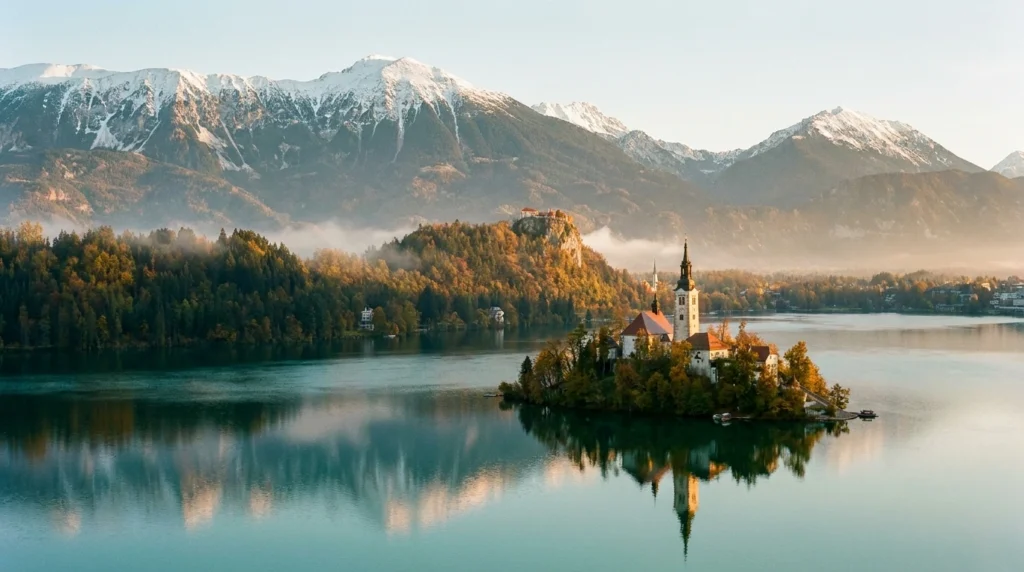
Bled is the country’s signature postcard for a reason — a 2,120-metre-long glacial-tectonic lake at 475 m elevation, the only natural island in Slovenia capped by a 17th-century pilgrimage church, a medieval castle on a 130-metre limestone cliff above the north shore, and the eastern wall of the Julian Alps as the backdrop. The trick to photographing Bled in 2026 is timing the season window precisely; the lake looks like four different countries across the year.
- First snowmelt clear: mid-March to mid-April (lake-ice melt-out is typically 7–21 March; the shoreline trail dries by 15 April)
- Peak summer swimming: 15 June – 25 August, with the lake at 22–24 °C and the Bled Rowing Centre on the western shore busy from 06:00 to 21:00
- Autumn foliage peak: 5 – 25 October — beech and larch on Mala and Velika Osojnica turn copper-gold, the cleanest reflections of the year happen on still mornings between 06:30 and 08:00
- Winter freeze (rare): only seven full freezes recorded in the last 40 years; the most recent was January 2017, when locals cleared the surface for skating between the rowing club and the island
- Pletna boat season: daily 09:00–18:00 between Easter and 31 October; reduced “on demand” service Nov–Mar weather permitting

Getting There — Ljubljana (LJU), Trieste, Venice & Klagenfurt
Slovenia has one international airport plus three excellent within-three-hours alternatives across the borders. Most North-American and long-haul travellers fly into Trieste, Venice or Vienna and connect overland; most short-haul European travellers fly direct into LJU.
- Ljubljana Jože Pučnik (LJU) — 24 km north-west of Ljubljana centre, 9.5 km east of Kranj, owned by Fraport since 2014. Handled 1,438,713 passengers in 2024 (+13.3% YoY); top routes are Istanbul (Turkish Airlines, ~192,000 passengers), Frankfurt (Lufthansa, ~138,000) and London Stansted (Ryanair). 30+ airlines including Lufthansa, Turkish, Air France, KLM, easyJet, Wizz Air, Air Serbia.
- Trieste (TRS) — 130 km from Ljubljana via the A1/A4 motorways (1h 30min drive) or hourly Goopti shuttle (€20–30, 2h). Useful for Ryanair flights from London, Frankfurt-Hahn and several Italian cities.
- Venice Marco Polo (VCE) — 240 km from Ljubljana (3h drive); the major intercontinental gateway, served by Delta, Air Canada, KLM, Lufthansa, Emirates and seasonal North-American carriers. The 03:00 Goopti and Flixbus services to Ljubljana run year-round.
- Klagenfurt (KLU) and Graz (GRZ) — Austrian alternatives that put you 60 km north of Bled and 90 km north of Maribor respectively, useful for travellers booking award tickets through Lufthansa Group.
- Zagreb (ZAG) — 140 km from Ljubljana, 1h 50min by motorway. Useful for Croatia Airlines connections and onward Adriatic itineraries.
Flight times (representative non-stop): London 2h 15min, Frankfurt 1h 30min, Istanbul 2h 30min, Paris 2h 10min. There are no scheduled non-stop flights from North America to LJU in 2026 — connect via Frankfurt, Munich, Istanbul, Paris-Charles-de-Gaulle, Vienna or Zurich.
Flag carrier: Slovenia has had no national flag carrier since Adria Airways went bankrupt in September 2019. The market is now served by Lufthansa Group (frequent connections via Frankfurt and Munich), Turkish Airlines (the largest carrier into LJU), Air France-KLM, easyJet and Ryanair.
Visa / entry: Slovenia is in the Schengen Area since 21 December 2007. Citizens of the United States, United Kingdom, EU member states, Canada, Australia, New Zealand, Japan and approximately 60 other visa-exempt countries enter without a visa for up to 90 days in any 180-day period. ETIAS (European Travel Information and Authorisation System) pre-authorisation will become mandatory for visa-exempt non-EU travellers from late 2026 — apply online (€7, valid 3 years). The new EU Entry/Exit System (EES) launched in October 2025 replaces passport stamping with a biometric record at first crossing.
Getting Around — Trains, Vignettes & the Adriatic Rail Tunnel
Slovenia is small enough that the cross-country drive from Maribor in the north-east to Piran on the Adriatic takes 3 hours 15 minutes on the motorway, and Ljubljana sits within a 90-minute drive of every flagship sight in this guide. Self-drive is the dominant mode for first-time visitors; the train + bus combination is excellent for the Ljubljana–Bled–Bohinj triangle and the Ljubljana–Maribor corridor; cycling and walking dominate inside Triglav National Park.
- Slovenian Railways (SŽ): 1,209 km of track including 610 km electrified and 331 km double-track. The InterCity Slovenija (ICS) tilting EMU runs Ljubljana–Maribor at up to 160 km/h with mandatory seat reservations. Cross-country Ljubljana–Maribor takes 1h 50min and costs about €11.
- Ljubljana–Bled: hourly trains to Lesce-Bled station (52 minutes, €6–7) plus a 5-minute taxi or bus to the lakeshore. The direct Ljubljana–Bled bus runs roughly half-hourly and drops you 200 metres from the lake (1h 20min, €7).
- Ljubljana–Bohinj: the historic Bohinj Railway (Bohinjska proga) runs from Jesenice through a 6,327-metre tunnel under the Julian Alps to Bohinjska Bistrica and onward to Nova Gorica — one of the most scenic rail journeys in Europe and the only direct rail crossing between the alpine north and the Soča/Adriatic south.
- Ljubljana–Piran/Portorož: direct buses (FlixBus, Nomago) run 6–8 times daily, 2h 30min, €13–18. There is no direct passenger rail to Piran; the train terminates at Koper, then a 30-minute bus.
Motorway vignette: Slovenia uses an electronic e-vinjeta (since December 2021) for all motorways and expressways. A passenger-car 7-day vignette costs €16, monthly €32 and annual €117.50 (2026 tariffs); buy online at evinjeta.dars.si or at any petrol station near a border crossing. The fine for driving a motorway without one is €300+. Rental cars from LJU come with the vignette pre-applied; cross-border rentals usually do not.
Driving notes: right-hand drive, 0.05% blood-alcohol limit (0.00% for drivers under 21 or with under three years’ licence), seatbelts and dipped headlights mandatory at all times. The IDP is technically required for non-EU licence holders. Mountain passes (Vršič, Mangart) close from late October until late May.

Apps: SŽ Mobile (rail tickets), Avrigo / Nomago (intercity bus), Urbana (Ljubljana city transit, hire a card from the green vending machines for €2 deposit + top-up), evinjeta.dars.si (motorway vignette purchase), Bolt and Uber (operating in Ljubljana since 2021).
Top Cities & Regions — Ljubljana, Bled, the Soča Valley & the Karst
📍 Map of Slovenia: Every Place in This Guide


Ljubljana — The UNESCO Capital You Can Walk in Two Hours
Slovenia’s capital is small (301,268 residents in 2025; 163.8 km² across the municipality) and unusually walkable — the entire pedestrianised old town can be crossed in 25 minutes, and the views from Ljubljana Castle are a 70-minute round-trip on foot or a 4-minute funicular up. The signature look — colonnaded riverbanks along the Ljubljanica, the cone-roofed Central Market, the National & University Library and the famous Triple Bridge in front of Prešeren Square — is the work of architect Jože Plečnik (1872–1957) and was inscribed as Slovenia’s fifth UNESCO World Heritage Site in July 2021.
- Plečnik’s Triple Bridge & Prešeren Square — the city’s photogenic centre, with the Robba Fountain, the pink Franciscan Church and access to the riverside cafés
- Dragon Bridge (1901) — the Vienna Secession masterpiece guarded by four bronze dragons that have become Ljubljana’s unofficial mascot
- Ljubljana Castle — medieval fortress with Romanesque, Gothic and Renaissance layers, accessible by funicular from the Central Market in 4 minutes
- Metelkova Mesto — the autonomous arts squat in former Yugoslav Army barracks, the centre of independent Ljubljana nightlife after dark
- Tivoli Park — 5 km² of city park designed in 1813 and renovated by Plečnik, perfect for an early-morning run before the city wakes up
Lake Bled & Bohinj — Triglav National Park
The two glacial lakes north-west of Ljubljana sit inside Triglav National Park (880 km², 4% of Slovenia, established 1924/1981) — the country’s only national park and the third-oldest in Europe. Lake Bled (475 m elevation, 1.45 km², 29.5 m max depth, with the only natural island in Slovenia and a 17th-century pilgrimage church on it) is the country’s signature image; Lake Bohinj (4.1 km²) is its larger, quieter, less-developed sibling 26 km west, surrounded entirely by national-park land and bordered by the Savica Waterfall and the Vogel cable car.
- Lake Bled island church — 99-step Baroque staircase to the pilgrimage Church of the Assumption, dating to 1655 with a 52-metre tower
- Bled Castle — the oldest castle in Slovenia (built 1011 on Emperor Henry II’s grant), perched on a 130-metre cliff above the lake
- Vintgar Gorge — 1.6-km wooden walkway through a 50-100 metre limestone canyon carved by the Radovna river, ending at the 13-metre Šum Falls (the largest river waterfall in Slovenia)
- Vogel cable car (Bohinj) — 1,535 m vertical lift to a 1,840-metre summit station with panoramic Triglav views; runs year-round as both ski lift and viewing gondola
Piran & the Slovenian Riviera
Slovenia’s 46.6-kilometre Adriatic coast packs a surprising amount of architectural and cultural variety into the smallest stretch of coastline of any maritime EU country. Piran sits on a narrow peninsula at the tip of the Gulf of Trieste, with 3,733 residents living inside Venetian walls that survive in fragments along the perimeter. The town was 91% Italian-speaking in 1945; the post-war exodus to Italy reshaped the population to roughly 70% Slovene by 2002.
- Tartini Square (Tartinijev trg) — the oval marble main square named after composer Giuseppe Tartini (born here 1692), with the Antonio Dal Zotto bronze monument at the centre
- St George’s Cathedral and bell tower — climb 146 wooden steps for the postcard view over the red-tile rooftops to the Bay of Trieste
- Sečovlje Salt Pans — a 750-hectare landscape park 7 km south, the only working hand-harvested medieval salt evaporation pans on the Adriatic, where saltworkers still rake fior di sale at dawn from May to September
- Portorož — Slovenia’s only true beach resort, immediately adjacent to Piran, with thalassotherapy spas built on the same salt-rich Mediterranean tradition
Soča Valley — Bovec, Kobarid & the Emerald Beauty
The 138-kilometre Soča River starts at 876 metres in the Trenta Valley inside Triglav National Park and is rare in retaining its emerald-green colour for the entire course — the result of crystal-clear snowmelt picking up suspended limestone particles (rock flour) that scatter blue and green wavelengths. The valley between Bovec and Kobarid is the country’s adventure-sports capital — whitewater rafting, kayaking, hydrospeed, canyoning, paragliding from Mt Stol and via ferrata above Bovec are all on the menu from late April to mid-October.
- Bovec — the rafting town and trailhead for the Mangart Pass and Triglav approach via Trenta
- Kobarid — site of the 1917 Battle of Caporetto, the WWI Walk of Peace, and the Kobarid Museum (one of the best WWI museums in Europe)
- Tolmin Gorges — twin gorges where the Tolminka and Zadlaščica rivers meet, including the Devil’s Bridge and the thermal Hudičev mostek viewpoint
- Vršič Pass — Slovenia’s highest motoring pass (1,611 m), with 50 numbered hairpins built by Russian POWs in WWI; closed mid-November to early May
Postojna & Škocjan Caves — UNESCO Karst
The Karst plateau south-west of Ljubljana gave the world the word “karst” itself — the geological term for limestone landscapes shaped by water dissolution. Slovenia’s Classical Karst region is dotted with sinkholes, blind valleys and underground rivers; two cave systems define the visit.
Postojna Cave is a 24.34-kilometre system carved by the Pivka River — Slovenia’s second-longest cave, but its most-visited tourist site (over 28 million visitors since opening to the public in 1819). The 5-kilometre tour starts on a 3.5-km electric cave train (operating since 1872, the only one of its kind in the world), then walks the final 1.5 km past stalagmites, stalactites and the white “spaghetti” ceilings. The cave is also home to the olm (Proteus anguinus), the largest cave-dwelling vertebrate in the world, with eggs successfully hatched on display in 2016.
Škocjan Caves (UNESCO 1986, the first Slovene World Heritage Site) is the wilder, less-trodden alternative — 6.2 kilometres of explored passages including Martel’s Chamber, at 2.2 million cubic metres the largest known underground cavern in Europe. The Reka River disappears here into a 34-kilometre underground passage and resurfaces at Monfalcone in Italy as the Timavo. The 2-hour guided tour crosses the river on a 47-metre-high suspension bridge — an unforgettable five minutes for anyone afraid of heights.
Maribor & Pohorje — Štajerska Wine Country
Slovenia’s second city is a 97,522-resident university town on the Drava River, anchor of the Štajerska region and home to two superlatives that travel guidebooks struggle to fact-check but Guinness World Records confirms: the 400-plus-year-old Žametovka grapevine on Lent (the world’s oldest still-producing grapevine, since 2004) and the Mariborsko Pohorje ski resort directly south of the city, which hosted Alpine Skiing World Cup races for decades before Vipiteno took the early-January slot. The University of Maribor (founded 1975) keeps the city demographically young and its café terraces packed.
- Old Vine House (Hiša Stare trte) — a small museum on the Lent riverbank protecting the 400-year-old grapevine, with tasting room
- Mariborsko Pohorje — 220 km of hiking trails in summer, 41 km of ski runs in winter, accessible by cable car directly from the south edge of town
- Lent Festival — late June, the largest open-air festival in Slovenia by audience, with stages along the Drava riverfront
- Ptuj — 25 km south, Slovenia’s oldest documented town (Roman Poetovio), home of the UNESCO-listed Kurentovanje carnival in February
Logar Valley & the Kamnik-Savinja Alps
The Logar Valley (Logarska dolina) is a 7-kilometre glacial trough in the Kamnik-Savinja Alps in northern Slovenia — narrower, steeper and considerably less crowded than Triglav National Park. The valley terminates at the 90-metre Rinka Waterfall, accessible via a 30-minute walk from the upper car park. The surrounding municipality of Solčava protects the valley as a regional park and the Solčava Panoramic Road climbs to a series of high-mountain farms with summer cheese-making.
- Rinka Waterfall — 90 metres, the second-highest waterfall in Slovenia after Boka (106 m, in Triglav)
- Solčava Panoramic Road — a 36-kilometre loop through high-mountain farmsteads
- Velika Planina — a karst high plateau 30 km west, with conical-roofed shepherd huts that have stood for over 600 years
Kranjska Gora — Skiing & the Vršič Pass
Kranjska Gora (population 1,488 in 2025) is Slovenia’s premier alpine resort, sitting at 810 m elevation in the Sava Dolinka valley where Austria, Italy and Slovenia meet. The town hosts the FIS Alpine Ski World Cup Vitranc Cup (slalom and giant slalom, March) and is the gateway to the Planica ski-jumping centre — site of the world ski-jumping records (the FIS Ski Flying World Championships).
- Vitranc 1 & 2 ski runs — 30 km of pistes, longest 4.4 km, served by 18 lifts
- Planica Nordic Centre — five ski-flying hills including Letalnica bratov Gorišek (HS240, the largest hill in the world for many years)
- Vršič Pass road (1,611 m) — closed mid-November to early May; 50 numbered hairpins built by Russian POWs in WWI memorialised at the Russian Chapel
- Lake Jasna — twin artificial lakes at the foot of the Vršič climb, photogenic at golden hour
Slovene Culture & Etiquette — What to Know Before You Go

Slovenia is a culturally Central European country with strong Mediterranean and Pannonian inflections at its edges, and the etiquette is mostly that of mainstream Western Europe — quieter than Italy, slightly less formal than Austria, more demonstratively friendly than Germany. The 2002 census recorded 73.4% Catholic affiliation; nearly 90% of Slovenes identify as ethnic Slovenes; Italians and Hungarians have constitutionally protected minority status with co-official languages in coastal and Prekmurje municipalities; the small Roma minority is concentrated in the Dolenjska and Prekmurje regions.
The Essentials
- Greetings: a firm handshake on first meeting, with eye contact. “Dober dan” (good day) for daytime greetings, “živijo” between friends. First names come quickly with younger Slovenes; titles persist with academics and older shopkeepers.
- Tipping: 10% in restaurants is courteous if service has been good — round up the bill rather than leaving coins on the table. Taxi drivers expect rounded fares, not percentages. Hotel housekeeping and porters appreciate €1–2 per service.
- Punctuality: Slovenes are punctual to the minute for business and social meetings. A 19:00 dinner reservation means 19:00, not 19:15.
- Dining: wait until everyone has been served before starting; “dober tek” (enjoy your meal) is the universal pre-meal phrase. Bread is taken with the hands, not cut individually. Toasting is “na zdravje!” and you must make eye contact during the clink — locals enforce this with surprising seriousness.
- Shoes off indoors: in private homes, always remove shoes at the entrance. Many traditional pensions and apartment rentals expect the same.
Mountain & Cave Etiquette
- Triglav National Park rules permit free-riding on marked trails only; off-trail wandering is a fineable offence. Camping is restricted to designated mountain huts (planinske koče) operated by the Alpine Association of Slovenia (PZS).
- Cave touring (Postojna, Škocjan, Križna jama) is led only — no independent visits. Photography flash is permitted at Postojna; banned at Škocjan to protect cave fauna.
- The Triglav summit climb culminates in a “baptism” ritual where first-time summiters are gently birched on the buttocks at the summit cross by their guide — a tradition that has endured among Slovene mountaineers for nearly a century.
- Mountain refuge dinner (večerja) is served at fixed time (typically 18:00–19:30); arrive on time or you eat cold leftovers.
Religious & Public Holiday Notes
- Almost everything closes on 1 January (Solstice/New Year), 8 February (Prešeren Day, Slovenia’s Cultural Day), Easter Monday, 1 May (Labour Day), 25 June (Statehood Day), 15 August (Assumption), 31 October (Reformation Day), 1 November (All Saints’), 25–26 December (Christmas), and 26 December (Independence and Unity Day). Tourist sites stay open; banks and most shops do not.
- Sunday closures are real outside Ljubljana — most supermarkets close, only petrol stations and tourist-zone bakeries stay open.
- Local festivals: Kurentovanje (Ptuj, late February), Lent Festival (Maribor, late June), Pust (Carnival, week before Lent), Martinovanje (Wine of the Year, 11 November).
A Food Lover’s Guide to Slovenia — From Potica to Kranjska Klobasa

Slovenia officially recognises 24 gastronomic regions across its 20,271 km², and as of January 2023 holds 24 EU-protected food products — an extraordinary density for a country smaller than New Jersey. The Karst pršut (prosciutto) ages on the limestone winds, the Idrija žlikrofi dumplings carry an EU PGI from a single mining town, the Kranjska klobasa (Carniolan sausage) became a protected geographical indication in January 2015 over Austrian and German objections, and the Slovenska potica walnut roll secured EU Traditional Speciality Guaranteed status in April 2021.
Must-Try Dishes
| Dish | Description |
|---|---|
| Potica | Rolled walnut pastry baked in a conical potičnik mould — the national festive dessert. Walnut is the classic; tarragon and poppy-seed are the connoisseur fillings. Holds EU TSG status since April 2021. |
| Kranjska klobasa | Carniolan sausage — boiled or grilled pork (75%+) and bacon (max 20%) with garlic, salt and black pepper, traditionally served with mustard and horseradish. EU PGI since 2015. |
| Prekmurska gibanica | An astonishing eight-layer pastry from the Prekmurje plain — poppy seeds, walnuts, apple, cottage cheese, alternating four times — held together with cream and pastry. EU TSG since 2010. |
| Idrijski žlikrofi | Tiny ear-shaped dumplings stuffed with potato, bacon and onion from the mercury-mining town of Idrija. Traditionally served with bakalca lamb stew. EU PGI since 2010. |
| Jota | The classic Karst stew — sauerkraut or sour turnip, beans, potato, smoked pork ribs, garlic, bay leaf — slow-cooked. The country’s defining cold-weather comfort food. |
| Štruklji | Rolled dough dumplings, sweet (cottage cheese, walnut) or savoury (tarragon, herbs). Served as a side, dessert or main; over 70 documented regional fillings. |
| Bled cream cake (kremšnita) | The 1953 invention of Hotel Park’s pastry chef Ištvan Lukačević — vanilla custard, whipped cream, two thin layers of puff pastry, dusted with icing sugar. Officially protected since 2016. |
| Karst pršut | Air-cured prosciutto from the Kras plateau, salted dry (no smoke) and aged 12+ months in the bora wind. Serves as the country’s most reliable starter from a borderless Italian-Slovene tradition. |
Wine — Three Regions, 22,300 Hectares
Slovenia produces 80–90 million litres of wine a year from 22,300 hectares of vineyards across three regions. Around 75% is white. Only 6.1 million litres a year are exported, mostly to the United States, Bosnia, Croatia and Czechia — meaning almost every bottle worth drinking is poured at home.
- Primorska (the Littoral) — Goriška Brda (Rebula whites and Merlot/Cabernet blends), Vipava (Zelen and Pinela autochthonous whites), Kras (Teran red on the limestone), Slovenian Istria (Refošk and Malvasia)
- Posavje (Lower Sava) — the only region where reds outweigh whites; signature Cviček PTP (a tart, light blended red-white field wine) and Bizeljčan sparkling traditions
- Podravje (Drava) — the country’s largest region (97% white); famed for late-harvest and ice wines from Riesling, Sauvignon Blanc and Šipon (Furmint)
Where to Eat
Slovenia has two restaurants currently holding two Michelin stars (Hiša Franko in Kobarid under Ana Roš, the country’s most internationally celebrated chef; and Atelje in Ljubljana), eight more with one Michelin star, and dozens of Michelin-recommended Bib Gourmand bistros. The Slovenian Tourist Board’s “Slovenia. Unique Experiences” platform curates the high end at the boutique level. Outside the formal-dining scene, look for the gostilna — a traditional Slovene inn typically run by a single family, where the kitchen serves whatever the morning’s foraging produced. The Open Kitchen (Odprta kuhna) market every Friday on Pogačar Square in Ljubljana, March to October, brings 50+ kitchens onto a single open square — the best single afternoon to taste Slovenia.
Off the Beaten Path — Slovenia Beyond the Postcards


Vintgar Gorge
Just 4 kilometres north-west of Bled, the 1.6-kilometre Vintgar Gorge has been accessible to visitors since 1893, when Žumer Galleries — wooden walkways pinned to the canyon walls — opened the gorge to walkers. The Radovna River cuts between cliffs 50–100 metres tall through pools and rapids, ending at the 13-metre Šum Falls — the largest river waterfall in Slovenia. The 1906 Bohinj Railway stone-arch bridge runs 33 metres above the gorge, the largest intact stone-arch railway bridge in the country. Capacity-controlled timed tickets since 2019 — book online before arrival.
Predjama Castle & Caves
Eleven kilometres from Postojna Cave, Predjama Castle is the world’s largest cave-mouth fortress — a Renaissance structure (current building 1570) pressed under a 123-metre limestone overhang and accessible via a hidden vertical shaft that the famous 15th-century robber-baron Erazem of Predjama used to break a Habsburg siege by smuggling food in (and according to local legend, lobbing fresh cherries down on the besiegers). The castle is open year-round; the cave system behind the castle is only open on guided summer tours. Combined ticket with Postojna Cave saves 30%.
Idrija — Mercury Heritage & Lace
The mining town of Idrija (population 5,794) earned UNESCO World Heritage status in 2012 for its mercury mine, one of two on the planet to receive the inscription (paired with Spain’s Almadén). Mercury was discovered here in the late 15th century; production at peak supplied 13% of world mercury, second only to Almadén. The Antonijev Rov mine tour drops 22 metres underground through preserved 18th-century shafts. Idrija lace, recognised by UNESCO Intangible Cultural Heritage in 2018, has been hand-bobbin-made by women here since 1696 and is the country’s most enduring craft tradition. The town is also the official home of idrijski žlikrofi dumplings (EU PGI 2010).
Sečovlje Salt Pans & the Slovenian Riviera Wetlands
Seven kilometres south of Piran, the 750-hectare Sečovlje Salt Pans (Sečoveljske soline) are the only working medieval salt evaporation pans on the Adriatic, with hand-harvested fior di sale (cvetlična sol) raked at dawn from May to September. The landscape park (Krajinski park Sečoveljske soline) protects the largest single coastal wetland in Slovenia and is a critical migratory bird stop on the Mediterranean flyway — over 270 species recorded, with breeding common terns, redshanks and Mediterranean gulls. The on-site Lepa Vida Thalasso Spa uses the brine and mud directly from the pans.
Lipica Stud Farm
The Lipica stud farm in the Karst plateau (founded 1580 by Habsburg Archduke Charles II) is the original home of the Lipizzaner horse breed — the white show horses better known today as the Spanish Riding School in Vienna. The farm received its first 24 broodmares and 6 stallions from Spain in 1581 and has bred Lipizzaners continuously for 444 years. The Lipica school of classical dressage entered UNESCO’s Intangible Cultural Heritage list in 2022, jointly with Austria, Italy, Hungary, Slovakia, Croatia, Bosnia and Romania. The farm offers daily morning training rides plus a Lipikum museum, and is one of the few European stud farms that produced a horse personally gifted to Queen Elizabeth II (October 2008).
Velika Planina & the Sheperd Plateau
An hour and a quarter drive north of Ljubljana into the Kamnik-Savinja Alps, Velika Planina is a high-altitude plateau (1,666 m) whose conical-roofed shepherd huts have stood since at least the 16th century — almost destroyed by retreating German forces in 1944, then reconstructed in 1948 in the original style. Around 50 huts and a small wooden chapel cluster across the plateau; cattle still summer here from May to September, and the herders sell freshly made cheese to visitors. Reach it via the cable car from Kamniška Bistrica, then a chair lift to the plateau.
Practical Information
| Currency | Euro (€); Slovenia joined the Eurozone on 1 January 2007. ATMs everywhere, contactless near-universal. |
| Cash needs | Carry €30–50 for hut dinners, market purchases and small village inns; everywhere else takes cards. The Postojna and Lipica visitor centres still occasionally prefer cash for car-park fees. |
| ATMs | Found at every petrol station, supermarket and post office; bank-network ATMs (NLB, Nova KBM, SKB, Sberbank Slovenia) charge no fees on European bank cards. Independent “Euronet” ATMs charge €5–8 per withdrawal — avoid. |
| Tipping | 10% in restaurants if service warrants; round up taxi fares; €1–2 per service for housekeeping. No tipping at bars or cafés (rounding up is more than sufficient). |
| Language | Slovene is the sole national official language; Italian and Hungarian are co-official in Adriatic and Prekmurje municipalities. English is fluent in tourism, German strong in Alps, Italian strong on coast. Slovene uses dual grammatical number — a rare feature shared with very few other Indo-European languages. |
| Safety | US State Department Level 1: Exercise Normal Precautions (lowest tier). Crime against tourists is rare. Mountain rescue is professional; the genuine risks are alpine weather, gravel-road accidents and tick-borne encephalitis between April and October — vaccinate if planning extended forest exposure. |
| Connectivity | EU roaming-at-home rules apply for EU/EEA SIMs (no extra charges). Local providers Telekom Slovenije, A1 Slovenija and Telemach all sell prepaid tourist SIMs at LJU airport from €15 for 30 GB. 5G coverage is universal in cities and most major valleys. Free Wi-Fi in every café and on Slovenian Railways trains. |
| Power | Type C and Type F (Schuko) plugs, 230V / 50Hz — the standard mainland-European plug used in Germany, Austria, Italy, France and most of the EU. UK and US travellers need an adapter; Australian and Asian standards are different. |
| Tap water | Excellent everywhere. Slovenia’s 2016 constitutional amendment recognises drinking water as a public good. The Bohinj public-supply water has been tested as some of the lowest-mineral, most-bottle-equivalent tap in Europe — bring a refillable bottle and skip the plastic. |
| Healthcare | EU member with comprehensive public system; EU/EEA travellers covered by EHIC/GHIC. Non-EU travellers need private travel insurance. Pharmacies (lekarna) are widespread and well-stocked; out-of-hours rotation is posted on every pharmacy door. Universal emergency number 112; police 113. |
Budget Breakdown — What Slovenia Actually Costs
💚 Budget Traveller
€60–95 per day all-in for one person staying in hostels, riding intercity buses, eating bakery breakfasts and gostilna lunches, and entering one paid attraction a day. Ljubljana hostel beds run €22–35 in summer (Hostel Tresor and Hostel Celica are the established standouts); a daily Urbana card on Ljubljana city transit is €3 for 90 minutes; the Postojna Cave 90-minute combined ticket is €31.90 (2026), Bled Castle is €15. Cooking your own dinners with a Mercator or Hofer supermarket shop drops €15–20 a day. Slovenia has only marginal hostel infrastructure outside Ljubljana, Bled and the Soča Valley — book ahead in summer.
💙 Mid-Range
€130–200 per day per person for a couple sharing a 3-star hotel or pension, renting a small car with vignette included, eating at gostilne (traditional inns) or mid-range restaurants, and entering 1–2 paid attractions a day. Mid-range Bled accommodation (Hotel Lovec, Hotel Park, Pension Mlino) runs €130–180 a night; a Skoda Fabia rental from LJU is €40–55/day all-in including the vignette; gostilna mains are €11–18; Postojna + Predjama combo is €43.90; Triglav National Park entry is free. This is the bracket where Slovenia represents most efficient mid-range value — better food than Italy at the price, more dramatic scenery than Austria.
💜 Luxury
€350–600+ per couple per night for boutique alpine lodges, Michelin-starred restaurants, helicopter or vintage-train transfers, and private guides. Hiša Franko (Ana Roš’s two-Michelin-star inn in Kobarid) runs about €240 per person for the eight-course tasting menu plus wines — book six weeks out. Vila Bled (Tito’s former summer residence overlooking the lake) and Hotel Kendov Dvorec near Idrija set the standard for boutique stays; the Kempinski Palace in Portorož is the country’s main international-luxury beachfront option. A bespoke 10-day private-guided alpine + caves + coast itinerary through a high-end DMC such as Visit Good Place runs €15,000–22,000 per couple all-in.
| Tier | Daily (EUR) | Accommodation | Food | Transport |
|---|---|---|---|---|
| Budget | €60–95 | Hostel dorm or budget room | Bakery + supermarket + 1 gostilna meal | Bus / train |
| Mid-Range | €130–200 | 3-star hotel or pension | 2 sit-down meals + café stops | Compact rental car + vignette |
| Luxury | €350–600+ | Boutique alpine lodge or 5-star | Michelin / fine dining | Premium rental or private driver |
Note: Slovenia’s tourist tax (turistična taksa) is a small but mandatory €2.50 per person per night in tourist municipalities (€3.13 in Ljubljana and Bled), collected separately at check-in.
Planning Your First Trip to Slovenia
- Book the flights and the rental car together. Time your arrival into Ljubljana Jože Pučnik (LJU) for late morning, pick up the rental at the airport (where the vignette is pre-installed), drive 50 km north to Bled and check in by 17:00 — this gets you the lake’s golden hour on day one. If flying via Trieste or Venice, allow an extra 90–180 minutes of road time and consider a one-night stop in Friuli Venezia Giulia or Venice itself.
- Spend the first three nights in Bled or Bohinj. Use the lake region as a base for Triglav National Park, Vintgar Gorge and the Bohinj-Vogel cable-car day. Day-trip the Soča Valley by climbing the Vršič Pass (closed mid-November to early May — check ARSO weather) or take the Bohinj Railway through the 6,327 m tunnel down to Most na Soči for a no-driving day.
- Pivot south through the Karst on day four or five. Postojna Cave + Predjama Castle is a half-day combo; the Sečovlje Salt Pans, Lipica Stud Farm and lunch in Piran is the next half. Stay one night in Piran or Portorož on the Slovenian Riviera; the sunset view from St George’s bell tower is mandatory.
- Anchor the last two nights in Ljubljana. The capital deserves at least 36 hours — the Plečnik UNESCO walking tour, the Ljubljana Castle funicular, dinner at a riverbank gostilna, the Friday Open Kitchen market (mid-March to late October) on Pogačar Square, and a morning at the National Gallery before the airport return.
- Pre-book the high-leverage tickets the same week your flights are confirmed. Postojna Cave train tickets, the Bled Island pletna boat, the Vogel cable car, the Hiša Franko tasting menu (six-week wait list), the Vintgar Gorge timed entry, and any Triglav summit hut bookings (the busy week of 14–22 August fills 3 months out). Everything else can be walked up to.
Classic 7-Day Itinerary: Day 1 LJU airport → Bled (sunset). Day 2 Bled island, castle, Vintgar Gorge. Day 3 Bohinj + Vogel cable car. Day 4 Soča Valley over Vršič Pass to Bovec/Kobarid. Day 5 drive south to Postojna + Predjama, evening Piran. Day 6 Piran old town + Sečovlje Salt Pans, drive to Ljubljana. Day 7 Ljubljana old town + airport.
Frequently Asked Questions
Is Slovenia expensive to visit in 2026?
Less than Italy or Austria, more than Croatia or Hungary. A backpacker couple lives on €60–95 a day all-in; a mid-range couple on €130–200; a luxury Bled-or-Soča week lands at €350–600 per couple per night. Eurozone membership since 2007 means no currency surprises and card acceptance is universal. Petrol is currently around €1.55/litre (cheaper than Italy by 5–8 cents); restaurant mains €11–18 in mid-range gostilne; supermarket bread, wine and cheese are 25–40% cheaper than in Austria. The genuine cost trap is high-summer accommodation in Bled, Bovec and Piran — book the second you have flight dates.
Do I need to speak Slovene?
No. English is near-universal in tourism, with German fluent across the Alps and Italian fluent on the coast. Slovene is the sole national official language and uses dual grammatical number (a third number between singular and plural that survives in only a handful of Indo-European languages worldwide), but no traveller has ever needed it; the basics — “hvala” (thank you), “prosim” (please / you’re welcome / pardon), “dober dan” (good day) and “na zdravje!” (cheers) — are genuine politeness rather than necessity. Slovene road signs use the Latin alphabet plus three extra letters: č, š, ž.
Is Lake Bled worth visiting if it’s so famous?
Yes — and the trick is to stay overnight. Day-trippers from Ljubljana flood the lake from 11:00 to 16:00 in summer; anyone who arrives the previous evening, takes the 06:30 walk to Mala Osojnica viewpoint and rents a SUP at sunrise gets the photos everyone covets at less than 10% of the crowd density. The first week of October combines warm enough water for swimming, peak foliage, the global postcard and roughly half the Instagram volume of late July. If you can possibly afford a third night to detour into Bohinj, do — it’s the genuine alpine peace that Bled once was.
Is Slovenia safe for solo travellers?
Among the safest countries in Europe, full stop. The US State Department maintains a Level 1 advisory (the lowest), violent crime against tourists is rare, and walking Ljubljana old town at midnight is a normal activity for local women. Standard pickpocket caution applies in the Ljubljana train station and on summer Bled buses; nothing more. The genuine risks are alpine — weather changes on Triglav, gravel-road accidents on the Vršič Pass, and tick-borne encephalitis between April and October if you plan extended forest activity. Vaccinate for TBE if you’ll be hiking serious miles in the deep summer.
Do I need a vignette to drive in Slovenia?
Yes — and yes, you really do. Slovenia operates an electronic e-vinjeta system since December 2021. A 7-day vehicle vignette costs €16 for a passenger car (2026 tariff), monthly €32, annual €117.50; available online at evinjeta.dars.si or at any petrol station near a border crossing. Driving any motorway or expressway without one is a €300+ fine even on a 200-metre slip-road. Rental cars from LJU airport include the vignette pre-applied; cross-border rentals from Trieste, Venice or Zagreb usually do not — check the contract or buy your own before crossing.
When is the best month for the Soča Valley?
Late May through mid-June for the snowmelt rafting and the cleanest emerald colour, or early September for hiking weather without August crowds. The river is at its brightest turquoise in spring when limestone particles are most concentrated; July and August are the busiest weeks; October locks the Vršič Pass in cloud and closes most rafting operators by mid-month. Whitewater grades III–IV (Bovec section) require commercial guiding; calm sections (Trnovo–Most na Soči) are SUP-able for novices. The cleanest single weekend for photographers is typically the second weekend of June.
Can I do Slovenia + Croatia + Italy in one trip?
Easily. Trieste airport sits 80 km from Ljubljana, Venice Marco Polo is 240 km, Zagreb is 140 km. A common 10-day loop is fly into Venice, drive the Soča and Bled, finish in Ljubljana, then continue to Zagreb or Plitvice. All three countries are inside Schengen as of 2023 (Croatia joined that January), so border checks are passport-free in all directions. Rail also works — Ljubljana–Venice via Trieste runs 6 daily; Ljubljana–Zagreb takes 2h 20min. The genuine constraint on tri-country itineraries is rental-car cross-border fees, which can add €60–120 to a one-way drop.
Is the tap water really safe everywhere?
Yes — Slovenia consistently ranks among the cleanest public water supplies in Europe. The 1991 constitution explicitly recognises water as a public good, and a 2016 amendment to Article 70a made access to drinking water a constitutional right (the first such recognition in any European country). Bring a refillable bottle; every café, bar and restaurant will refill it without questions. Mountain refuges in Triglav National Park source their water directly from springs and have it tested annually; even the highest hut, Triglavski Dom na Kredarici (2,515 m), serves potable tap. Skip the plastic bottle.
What’s the deal with the dual grammatical number?
Slovene is one of only a handful of Indo-European languages — alongside Sorbian, the now-extinct Old Church Slavonic, and most of Insular Celtic — that retains a distinct grammatical “dual” (dvojina) form between singular and plural. When two Slovenes do something, the verb takes a different ending than when one or three+ do. It’s a linguistic feature that disappeared from English around the 12th century and from German around the 16th; Slovenes have kept it for over 1,300 years. The country’s 1991 declaration of independence was officially sung in dual form by parliament, which is the kind of detail you can drop into a Ljubljana dinner conversation and feel cleverer than you were before.
Ready to Explore Slovenia?
Five UNESCO World Heritage sites, the only natural island in the country anchoring its most photographed lake, the second-longest cave system in Europe (with a working underground train), 138 kilometres of emerald river, 46.6 km of Adriatic coastline at a Venetian harbour town, and a single 20,271 km² country in which Alps, Mediterranean, Karst and Pannonia meet inside a 90-minute rental-car drive of each other. Book your Bled and Bovec nights the same week your flights are confirmed, time the trip for the second half of September through the first ten days of October, pre-load the e-vignette before you cross the border — and let one of Europe’s most efficient countries reorganise your understanding of what an EU member state can pack into half the size of Switzerland.
Explore More
Slovenia sits at the crossroads of the Alps, the Adriatic and Central Europe, so it pairs naturally with the cities just over each border. Start with our flagship Ljubljana guide, then plan the wider loop.
- Ljubljana City Guide — the green capital, your first stop and the natural base for the whole country
- Venice City Guide — barely 2.5 hours west by car or bus, the classic add-on across the Italian border
- Vienna City Guide — the Habsburg capital that shaped Slovenian architecture, an easy train or drive north
- Dubrovnik City Guide — the Adriatic finale if you continue down the coast through Croatia
- Budapest City Guide — the great Danube capital that anchors a Central-European rail loop with Ljubljana
- Munich City Guide — the Bavarian gateway many travellers fly into before driving south to the Julian Alps
- Zurich City Guide — the Swiss Alpine hub for travellers chaining together the great mountain capitals
- All Country Guides
More country guides you might like
Plan your trip to Slovenia
The booking tools we use ourselves. FFU may earn a commission at no extra cost to you.
Plan & book your trip to Slovenia
Booking through these searches supports our guides at no extra cost to you.