
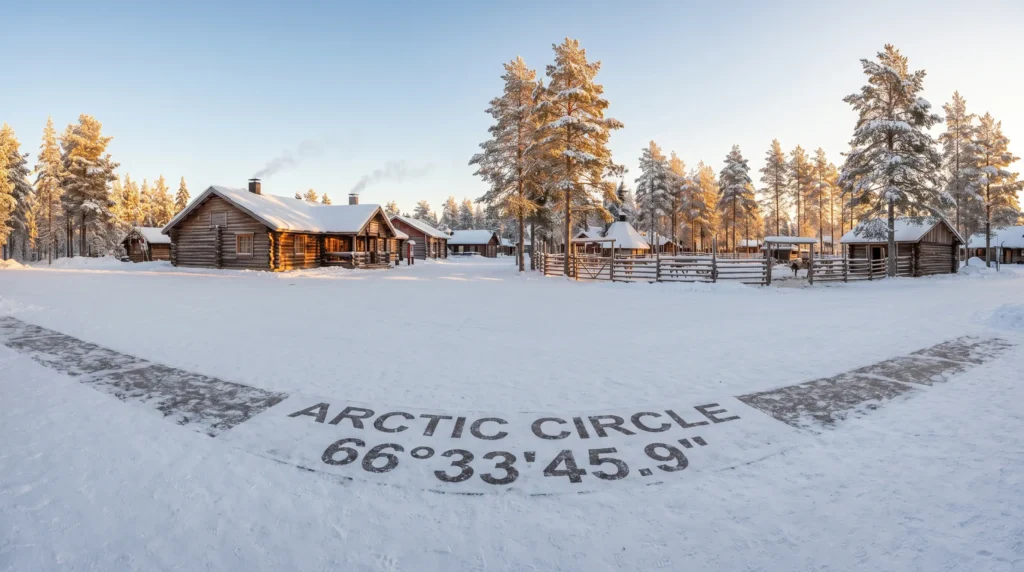
Rovaniemi Travel Guide — Santa’s Official Hometown, the Arctic Circle & Finland’s Wildest Skies
Rovaniemi is a city that got flattened by war, rebuilt itself in the shape of a reindeer’s head, and then quietly became the one place on Earth with the legal right to call itself Santa Claus’s hometown. I’ve stood on the painted Arctic Circle line here in December at 1pm, in full darkness, and again in June at midnight, in full sun — same spot, same city, two completely different planets. That’s the trick of this place: it’s a real working capital of Finnish Lapland with about 66,000 residents, two universities and a city hall, that also happens to run one of the most polished single-purpose tourist attractions in the world eight kilometres up the road. You can do husky sledding and aurora hunting in the same 48 hours you spend eating reindeer stew and touring a science museum shaped like a river of light. It’s genuinely magical, it’s also genuinely expensive and genuinely cold, and I’d rather tell you both halves before you book than let the marketing do it for me.
In This Guide
- Overview — Why Rovaniemi Is More Than a Santa Stopover
- Aurora Season & Christmas — The Two Rovaniemis
- Best Time to Visit Rovaniemi (Season by Season)
- Getting There — RVN Airport & the Overnight Train
- Getting Around — Walkable Core, Excursion Buses
- Neighborhoods — City Centre, Arctic Circle & the Fells Beyond
- Culture & People — Sámi Heritage, Reindeer & Reconstruction
- A Food Lover’s Guide to Rovaniemi
- Off the Beaten Path
- Day Trips from Rovaniemi
- Practical Information
- Budget Breakdown — What Rovaniemi Actually Costs in 2026
- Frequently Asked Questions
Overview — Why Rovaniemi Is More Than a Santa Stopover
Rovaniemi sits at the confluence of the Kemijoki and Ounasjoki rivers, about six kilometres south of the Arctic Circle, and serves as the administrative and commercial capital of Finnish Lapland. That capital status matters more than the sleigh-bell branding suggests: this is a real city with government offices, two universities and roughly 10,000 students, not a theme park built around one man in a red suit.
What most visitors don’t know going in is the city’s origin story. Retreating German forces destroyed roughly 90 percent of Rovaniemi’s buildings during World War II, and the entire city was rebuilt from scratch afterward — with a master plan from Finnish architect Alvar Aalto, who reportedly laid the street grid out in the shape of a reindeer’s antlers. The result is a modernist, deliberately planned northern city, a striking contrast to the older wooden towns further south.
The headline attraction, obviously, is Santa Claus Village, sitting directly on the Arctic Circle line eight kilometres north of downtown, where you can meet Santa daily, year-round, and post a letter from his official post office. But treat that as the opener, not the whole show. Rovaniemi is also the gateway to Finnish Lapland’s fells, one of the best-connected small Arctic cities on the continent for winter tourism, and a genuinely good base for reindeer and husky excursions, aurora chasing, and — if you come in summer — canoeing under a sun that never sets.
Aurora Season & Christmas — The Two Rovaniemis
Rovaniemi essentially runs two entirely different tourist seasons on the same latitude. From roughly late August through early April, long dark nights make this one of the more reliable places in Europe to chase the aurora borealis; local operators commonly advertise success rates in the high nineties across a multi-night stay, though no honest guide (this one included) can promise you a specific night. December is the emotional peak — Christmas markets, Santa Claus Village at its most theatrical, and polar night giving even midday a blue twilight glow — but it’s also the most expensive and most crowded month of the year, so book accommodation and Santa-related excursions well in advance.
Then flip the calendar to June 7 through July 6, the city’s roughly month-long window of continuous midnight sun, when the same streets fill with river cruises, rafting, and golf played at 11pm in full daylight. There’s no wrong season here, just very different packing lists.
Best Time to Visit Rovaniemi (Season by Season)
December – March · Winter peak
Snow cover, Christmas markets, husky and reindeer safaris, snowmobiling, and the best odds for northern lights on long, dark nights. December averages just a few minutes of daylight; the trade-off is that darkness is exactly what aurora hunters want. Snow typically covers the ground for around 175 days a year here, so expect it reliably from November into April. Prices and crowds peak hardest around Christmas and New Year.
September – November · Aurora shoulder, lower prices
Same dark-sky advantage as winter, without full snow cover or peak-season pricing. Good for travelers who want the lights without the sub-zero husky-safari premium.
April – May · Quiet shoulder
Melting snow, fewer tourists, lower rates — but also the least reliable weather and a lull between winter activities ending and summer ones starting.
June – August · Midnight sun & green season
Endless daylight in June and July, hiking, canoeing and rafting on the Kemijoki and Ounasjoki, and noticeably fewer crowds than winter despite the novelty. Mosquitoes are a real factor in July in the surrounding wetlands and forests — pack repellent.
Getting There — RVN Airport & the Overnight Train
Rovaniemi Airport (RVN) is Finland’s second-busiest airport by passenger numbers after Helsinki-Vantaa, and one of only three Finnish airports with jet bridges. It sits roughly 8–9 kilometres from the city centre and handles well over a million passengers a year, with the heaviest traffic during the Christmas “Santa flight” season from charter and scheduled carriers connecting the UK, continental Europe and Scandinavia, alongside frequent domestic hops from Helsinki.
The romantic overland option is the VR overnight sleeper train from Helsinki — sometimes marketed as the “Santa Claus Express” — an approximately 880-kilometre, roughly 12-hour journey with 2- and 3-berth sleeper cabins, arriving in Rovaniemi mid-morning after a night’s sleep. It’s slower than flying but a genuinely enjoyable way to watch Finland turn from birch forest to snow-white fell out the window.
Getting Around — Walkable Core, Excursion Buses
Central Rovaniemi is compact and walkable — the main shopping street, Arktikum museum, city hall and river bridges are all within a 20-minute walk of each other. For Santa Claus Village, eight kilometres north, local bus line 8, the seasonal Santa’s Express, and an Airport Express service that routes via the village all connect the dots without needing a rental car.
For anything beyond the city — husky and reindeer farms, snowmobile trails, Ranua Zoo, the fells around Levi or Ylläs — book an organized excursion or rent a car; public transit thins out fast once you leave the city limits. Winter driving requires studded tires (standard on Finnish rentals in season) and real caution on icy rural roads; many first-timers are better off leaving that driving to a guide.
Neighborhoods — City Centre, Arctic Circle & the Fells Beyond
City Centre (Keskusta)
The Aalto-planned downtown: Lappia Hall, the city library and city hall form a modernist civic cluster, alongside the main pedestrian shopping street Koskikatu, where the tourist information office sits. This is where you’ll eat, sleep and shop between excursions.
Arktikum & the Riverside
Home to the Arktikum Science Museum — its long glass corridor is one of the city’s most photographed landmarks — and the Jätkänkynttilä (“Lumberjack’s Candle”) bridge spanning the Kemijoki, a striking piece of civic architecture worth walking across at dusk.
Santa Claus Village & the Arctic Circle Line
Eight kilometres north of downtown on Highway 4 toward Ivalo, this is the officially designated hometown of Santa Claus, where the Arctic Circle itself is marked in the central square — you can literally stand with one foot in the Arctic and one foot out of it. Beyond the Santa meet-and-greet, expect reindeer paddocks, husky yards, shops, restaurants and the genuinely functioning Santa Claus Main Post Office. It’s open every day of the year, and it’s far less kitsch in the quiet summer months than in the December scrum.
Ounasvaara
The forested fell just across the river from downtown, with cross-country and downhill ski slopes, mountain-bike trails in summer, and a ski jump — genuinely useful for a half-day of activity without leaving the city.
Napapiiri & Surrounding Wilderness
The broader Arctic Circle (“Napapiiri” in Finnish) district blends into taiga forest and lake country that’s the actual departure point for most husky, reindeer and snowmobile safaris — book these as excursions rather than expecting to explore independently.
Culture & People — Sámi Heritage, Reindeer & Reconstruction
Rovaniemi itself is a Finnish-majority city, but it functions as the gateway to Sápmi, the traditional homeland of the Sámi — the only Indigenous people recognized within the European Union. The Sámi homeland proper sits further north (the municipalities of Enontekiö, Inari, Utsjoki and part of Sodankylä), and Finland’s Sámi Parliament, established in 1973 as the first elected Sámi body in the Nordic countries, sits in Inari rather than Rovaniemi. Reindeer herding remains a genuine Sámi and Finnish-Lapland livelihood, not just a tourist prop, though most reindeer-farm visits around Rovaniemi are aimed squarely at visitors — a fine experience, just worth knowing the difference between a working herd and a photo-op paddock.
The rebuilding-from-rubble story after World War II is central to local identity here in a way it isn’t in most Nordic capitals; Alvar Aalto’s postwar plan is still visible in the street grid and civic buildings today, and locals will happily point out the “antlers” if you ask.
A Food Lover’s Guide to Rovaniemi
Reindeer is the signature protein of Lapland cuisine, most classically as poronkäristys — sautéed thin-sliced reindeer served with mashed potato, lingonberry sauce and pickled cucumber. You’ll also find reindeer in soups, on skewers, and smoked as a starter. Freshwater fish — whitefish, Arctic char and salmon — shows up grilled, smoked or as soup (lohikeitto), and root vegetables and forest berries (lingonberry, cloudberry, bilberry) fill out the plate in a cuisine built around a short growing season.
Cloudberries in particular are a Lapland specialty, often served as a dessert with cream or turned into liqueur. Finnish coffee culture is strong here too — Finland has one of the highest per-capita coffee consumption rates in the world — and a proper Finnish sauna, ideally followed by a plunge in snow or icy water, is as much a cultural food-adjacent ritual as anything on a menu.
Off the Beaten Path
Ounasvaara at Dawn
Most visitors treat Ounasvaara as a ski hill; almost nobody hikes it for sunrise in shoulder season, when you get a wide fell view over the city and river valley without another soul around.
Arktikum’s Northern Lights Exhibit, Off-Season
Skip the December queue and visit the science museum’s aurora and Arctic-science exhibits in May or September — same content, a fraction of the crowd.
Summer Canoeing on the Ounasjoki
During the midnight sun window, paddling the Ounasjoki at 10pm in full daylight is a genuinely strange, wonderful experience that almost no one associates with “Santa’s hometown.”
A Sámi-Owned Reindeer Visit
Ask your operator or the tourist office specifically for a Sámi-family-run reindeer farm rather than a generic one — the experience and the economics of your visit change meaningfully.
Day Trips from Rovaniemi
Ranua Wildlife Park
About 80 kilometres south of Rovaniemi (roughly an hour’s drive), this Arctic zoo specializes in northern species — polar bears, wolverines, lynx and snowy owls among them — in naturalistic enclosures, and runs a dedicated shuttle bus from the city.
Levi & the Ylläs-Levi Fells
Finland’s best-known ski resort area sits around 170 kilometres north of Rovaniemi, roughly a two-and-a-half-hour drive or bus ride, with downhill skiing, extensive cross-country trails and some of the country’s most photographed fell scenery. Doable as a long day trip, better as an overnight.
Pyhä-Luosto National Park
A couple hours southeast, this national park pairs old-growth fell forest with modest but scenic peaks — a good lower-key alternative to the busier Levi crowds for hiking or snowshoeing.
Kemijoki River Cruises
In summer, short cruises run the river system right from the city, an easy half-day add-on if you’re based in Rovaniemi without a car.
Practical Information
Money. Finland uses the euro; it was one of the original adopters in 1999, with notes and coins circulating since 2002. Cards, including contactless, are accepted almost everywhere — Finland is one of the more cash-light societies in Europe, so you can comfortably travel with minimal euros in hand.
Visa. Finland is a full Schengen member; US, UK, Canadian, EU and most Western passport holders enter visa-free for up to 90 days within any 180-day period. Make sure your passport is valid at least three months beyond your planned departure from the Schengen area.
Safety. The US State Department rates Finland at its lowest advisory level, “Exercise Normal Precautions,” citing low crime rates overall, with petty pickpocketing and online romance/financial scams as the main concerns for visitors. The bigger practical risk in Rovaniemi is winter weather itself — heavy snowfall, gale-force wind and transport disruption between December and February — so build flexibility into winter itineraries.
Health. Tap water is safe to drink throughout Finland, and no special vaccines are required beyond staying current on routine immunizations; check the CDC’s Finland traveler page before you go for the latest specific guidance.
Connectivity & practicalities. An EU-compatible eSIM or local prepaid SIM gets you strong 4G/5G coverage even outside the city. Plugs: European two-pin (Type C/F), 230V. Time zone: Eastern European Time (UTC+2, UTC+3 in summer with DST).
Budget Breakdown — What Rovaniemi Actually Costs in 2026
Rovaniemi is not a cheap destination, especially in winter — you’re paying Nordic prices plus a premium for Arctic excursions with real overhead (dog teams, snowmobiles, guides).
Budget (US$90–150/day): Hostel or budget hotel in the city centre, self-catering or casual cafés, walking the compact downtown, one shared-group excursion (a basic husky or reindeer visit) rather than several.
Mid-range (US$200–350/day): Mid-tier hotel, restaurant meals including a reindeer dinner, one or two guided excursions (aurora hunting, snowmobile safari), a Ranua Zoo day trip.
Luxury (US$500+/day): Glass-igloo or aurora-cabin accommodation, private guided excursions, a Levi or Ylläs overnight add-on, fine dining.
Fixed costs to budget for: winter excursions (husky/reindeer/snowmobile) commonly run US$100–250 per person each, and December accommodation rates can run two to three times shoulder-season prices — book early if you’re set on a Christmas-week trip.
Planning Your First Trip to Rovaniemi
The classic first-timer plan is three or four nights: fly into RVN, spend a day in the city centre (Arktikum, the riverside, Ounasvaara), dedicate a full day to Santa Claus Village and a reindeer or husky excursion, and reserve at least two evenings for aurora hunting if you’re visiting between September and March. Add a Ranua Zoo day trip or a Levi overnight if you have five nights or more. Rovaniemi pairs naturally with a broader Nordic itinerary — combine it with our Helsinki city guide if Helsinki has one, or extend into neighboring Scandinavia via our Norway or Sweden guides, or continue the aurora chase further north with our Reykjavik guide.
Frequently Asked Questions
Do I need a visa to visit Rovaniemi?
Finland is a Schengen country, so US, UK, Canadian and EU passport holders can enter visa-free for up to 90 days within any 180-day period. Make sure your passport has at least three months’ validity remaining beyond your planned departure.
When are the northern lights visible in Rovaniemi?
Broadly late August through early April, when nights are dark enough — though nothing is ever guaranteed, and cloud cover matters as much as the aurora itself. Operators advertise strong multi-night success rates, but treat any single-night promise skeptically.
Is Rovaniemi safe?
Yes — the US State Department rates Finland at its lowest advisory tier, “Exercise Normal Precautions,” with petty theft and online scams as the main concerns rather than violent crime. The real hazard is winter weather and icy roads, not people.
Can I really meet Santa Claus year-round?
Yes — Santa Claus Village on the Arctic Circle line is open every day of the year, not just during the Christmas season, though the atmosphere (and the crowds and prices) shift enormously between a quiet July afternoon and the last week of December.
How cold does it actually get?
Rovaniemi’s average annual temperature sits just under freezing, and deep winter regularly drops well below zero Fahrenheit-equivalent territory. Layered thermal wear, not fashion, is the priority for a December or January visit.
Rovaniemi or Levi/Ylläs for a ski-focused trip?
Choose Rovaniemi as your base if you want a real city with an airport, museums and a Santa-Village day trip alongside your snow activities; choose Levi (about 170km north) if skiing and fell scenery, not urban amenities, are the whole point of the trip.
Ready to Explore Rovaniemi?
Standing on a painted line in the snow with the Arctic on one side and everywhere else on the other, watching green light ripple overhead after a day of husky sledding — that’s not a marketing brochure, that’s just a normal Tuesday in Rovaniemi in February. It costs real money and demands real layers, but few cities this size deliver an experience this specific. Go in winter for the full spectacle, or go in June for the midnight sun and have the whole place practically to yourself.
Explore More
- Finland Travel Guide — the full country beyond Lapland
- Norway Travel Guide — fjords and aurora further west
- Sweden Travel Guide — Scandinavia’s other Arctic neighbor
- Reykjavik City Guide — for more far-north lights and ice
How this guide was built
Published as part of Facts From Upstairs’ city guide series. Built from authoritative sources — Wikipedia’s Rovaniemi and Rovaniemi Airport entity pages, Britannica’s Rovaniemi entry, the official Visit Rovaniemi tourism board site, the European Commission’s page on Finland and the euro, Finland’s Ministry for Foreign Affairs visa guidance, the UK FCDO Finland entry-requirements page, the US State Department’s Finland travel advisory, the US CDC traveler page for Finland, the Sámi Parliament of Finland’s official site, and VR (Finnish Railways) night-train information. Numeric and factual claims carry inline citations.
Sources cited on this page
- Wikipedia — Rovaniemi
- Wikipedia — Rovaniemi Airport
- Britannica — Rovaniemi
- Visit Rovaniemi — official tourism board
- Visit Rovaniemi — Santa Claus Village
- Visit Rovaniemi — Ranua Wildlife Park
- European Commission — Finland and the euro
- Finland Ministry for Foreign Affairs — visa to visit Finland
- UK FCDO — Finland entry requirements
- US State Department — Finland Travel Advisory
- US CDC — Finland traveler page
- Sámi Parliament of Finland — About Us
- VR (Finnish Railways) — Night trains
More city guides you might like
Plan your trip to Rovaniemi
The booking tools we use ourselves. FFU may earn a commission at no extra cost to you.
Plan & book your trip to Rovaniemi
Booking through these searches supports our guides at no extra cost to you.