
Languages of Solomon Islands
All languages of Melanesia →fluent beta classical · classes by phone with Maya at ranas.ai/maya
Solomon Islands Travel Guide — WWII Wrecks, Marovo Lagoon & the Pacific’s Last Untouched Frontier
I’ll be honest about why most people haven’t been to the Solomon Islands: there’s barely any tourism infrastructure to get in your way. That’s the whole appeal. This is a nation of six major islands and roughly 990 smaller ones scattered across the South Pacific between Papua New Guinea and Vanuatu, home to under a million people. Fifty-some Japanese and Allied warships still rest on the seabed of Ironbottom Sound off Guadalcanal, one of the fiercest naval battlegrounds of the Second World War, and you can dive down to most of them without another boat in sight. Inland and out on the water lives a Melanesian culture that never got flattened into a resort brochure — shell-money economies, log-canoe racing, and villages where English is a second or third language behind Pijin and one of dozens of local tongues. This isn’t an easy trip. Flights are pricey, ATMs are scarce outside four towns, and healthcare is thin once you leave Honiara. But if what you want is real, undiluted Melanesia and reef diving that dive magazines still call world-class, this is where it lives.
In This Guide
- Overview — Why the Solomon Islands Is the Pacific’s Last Untouched Frontier
- Independence Day (July 7) & the Start of the Dry Season
- Best Time to Visit the Solomon Islands (Season by Season)
- Getting There — HIR, Solomon Airlines & Regional Connections
- Getting Around — Twin Otters, Banana Boats & the Weekly Ferry
- Top Regions — Guadalcanal, Western Province & Beyond
- Culture & People — Melanesian Villages, Pijin & Shell Money
- A Food Lover’s Guide to the Solomon Islands
- Off the Beaten Path
- Practical Information
- Budget Breakdown — What the Solomon Islands Actually Costs in 2026
- Frequently Asked Questions
Overview — Why the Solomon Islands Is the Pacific’s Last Untouched Frontier
The Solomon Islands sits east of Papua New Guinea and northwest of Vanuatu, a scattered nation of six major islands — Guadalcanal, Malaita, New Georgia, Choiseul, Santa Isabel and Makira — plus roughly a thousand smaller ones, spread across a national territory of about 28,900 square kilometres of land. It became independent from the United Kingdom on 7 July 1978 and remains a Commonwealth realm, which is why English is the official language even though barely anyone uses it as a first tongue.
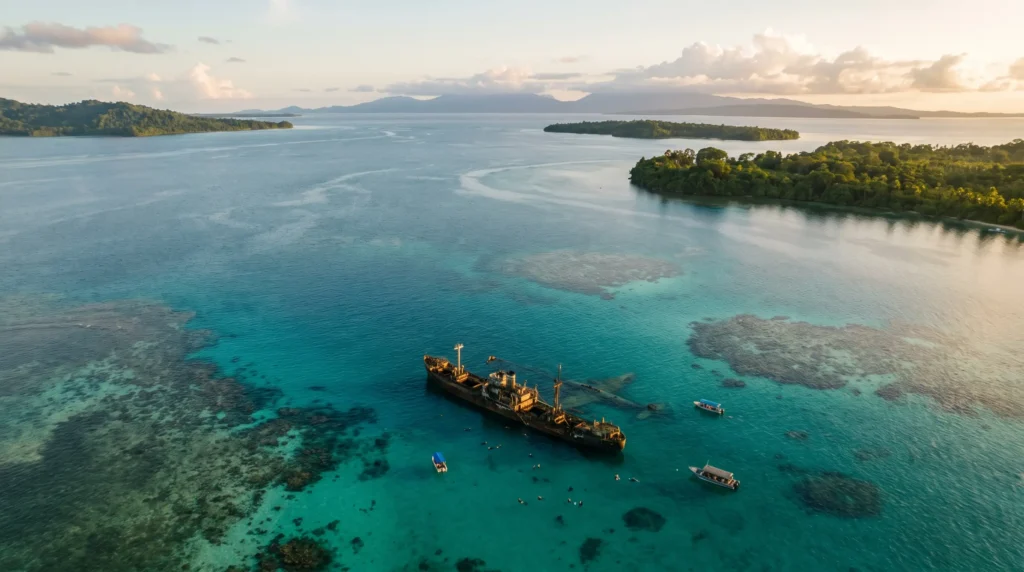
Two things define the country for travelers. The first is history: Guadalcanal was the site of one of the Pacific War’s longest, bloodiest campaigns, and the strait between Guadalcanal, Savo and the Nggela Islands — nicknamed Ironbottom Sound by Allied sailors — still holds more than fifty sunken warships from five major naval battles fought there in 1942–43. The second is water: the reefs, lagoons and drop-offs around the Western Province rank among the least-dived, best-preserved in the Pacific, anchored by Marovo Lagoon, the largest double-barrier enclosed lagoon on Earth.
What the country doesn’t have is much tourism scaffolding — no resort strips, limited domestic flights, patchy ATMs, and a government tourism office that’s still building out its digital presence. That’s precisely why the diving is this good and the villages this real. Budget more time, more cash buffer and more patience than a Fiji or Vanuatu trip, and you’ll get something neither of those can offer anymore.
Independence Day (July 7) & the Start of the Dry Season
If you’re reading this in early-to-mid July, you’re right at the start of the best window of the year. Independence Day, 7 July, marks the anniversary of the country’s 1978 break from British rule and is celebrated nationally with parades, church services, cultural performances and canoe races, concentrated in Honiara but marked in villages nationwide. It also lands squarely inside the dry season, which runs May through October — so an Independence Day trip doubles as a dry-season trip, with calmer seas for diving and boat transfers and a lower chance of a washed-out village visit.
A second date worth knowing: 7 August marks the anniversary of the 1942 US landings that opened the Battle of Guadalcanal, remembered with small memorial ceremonies around Honiara and at the American and Japanese war memorials on the island. Neither event is a mass-tourism spectacle — expect community-scale gatherings, not stadium fireworks — but both give a trip a reason to land on a specific week rather than “sometime this year.”
Best Time to Visit the Solomon Islands (Season by Season)
May – October · Dry season (peak)
Lower humidity, calmer seas, the best visibility for wreck and reef diving, and the safest window for inter-island boat transfers. July through September is generally considered the pick of the year for sightseeing and cultural events. This is also, unsurprisingly, when the (still modest) flow of dive tourists peaks — book Western Province lodges and live-aboards a few months out.
November – April · Wet season
Hot, humid, and wet, with the heaviest rainfall from January to March; annual totals commonly run 3,000–3,500mm. Rain tends to fall in short, dramatic afternoon downpours rather than all-day drizzle, so it’s rarely a washout, but rural roads and unpaved airstrips can turn to mud. This window also carries the country’s (low-frequency, but nonzero) tropical cyclone risk, generally November to mid-May — travel insurance with cyclone/medevac cover is non-negotiable regardless of season.
Shoulder consideration
Because domestic flights and the inter-island ferry are already infrequent, build slack into any itinerary that crosses provinces — a missed connection in the Solomons can cost you two or three days, wet season or dry.
Getting There — HIR, Solomon Airlines & Regional Connections
Honiara International Airport (HIR), on Guadalcanal, is the country’s sole international gateway. National carrier Solomon Airlines flies HIR to Brisbane and Sydney (Australia), Nadi (Fiji), Port Vila (Vanuatu) and Port Moresby (Papua New Guinea), which is how most visitors arrive — via Brisbane or Nadi rather than a direct long-haul.
Most nationalities including US, UK, EU, Australian, New Zealand and Commonwealth passport holders get a visitor’s permit on arrival — no advance visa needed — valid for an aggregate of up to three months in any twelve-month period, provided you carry a passport valid six months beyond arrival, a return or onward ticket, and evidence of sufficient funds. UK guidance describes a shorter initial 30-day stamp for some travelers, so confirm your specific allowance with the airline or Solomon Islands Immigration Division before you fly, and extend at an immigration office in-country if needed.
Getting Around — Twin Otters, Banana Boats & the Weekly Ferry
This is an archipelago nation, so island-hopping is the default mode of travel, and it takes patience. Solomon Airlines’ domestic network links Honiara to provincial airstrips on small turboprops (often twin otters) — the hop from Honiara to Munda in Western Province takes roughly an hour by air versus about ten hours on the weekly passenger ferry. Schedules are thin (some routes fly only a few times a week) and subject to weather cancellation, so build buffer days around any flight-dependent plan.
Within lagoons and between village islands, the workhorse is the open “banana boat” — a fibreglass skiff with an outboard, run by lodges, dive operators or informal local charter. Roads exist mainly around Honiara and a handful of provincial centres; away from those, boats and footpaths do the job cars would elsewhere. ATMs are limited to Honiara, Gizo, Munda and Auki, so carry more cash than you think you’ll need once you leave the capital.
Top Regions — Guadalcanal, Western Province & Beyond
Honiara & Guadalcanal
The capital and the gateway for almost every visitor. Guadalcanal was the epicentre of the 1942–43 campaign, and Honiara’s surroundings hold war memorials, the National Museum, and easy access to Ironbottom Sound’s wreck-diving sites just offshore. Most people transit through rather than linger — a couple of days for war history and logistics is typical before heading to the outer islands.
Western Province — Marovo Lagoon
The country’s marquee natural attraction: the largest double-barrier enclosed lagoon in the world, roughly 700 square kilometres of water framed by two extinct volcanic islands, ringed by villages known for wood carving and traditional log-canoe building. It sits on UNESCO’s tentative list, a strong signal of how highly its biodiversity and cultural landscape are rated even without full inscription.
Munda & Gizo (New Georgia)
The Western Province’s two real tourism hubs, both with airstrips, dive operators and a cluster of guesthouses. Gizo is the province’s capital and closest thing the Solomons has to a laid-back dive town; Munda anchors the Marovo/New Georgia lagoon network and WWII airstrip history of its own.
Rennell & East Rennell
Home to East Rennell, the Solomon Islands’ only UNESCO World Heritage Site — the largest uplifted coral atoll on the planet, centred on brackish Lake Tegano and its endemic wildlife. It’s remote even by Solomons standards, and it’s currently on UNESCO’s List of World Heritage in Danger due to logging pressure — go now, respectfully, with a local guide, while it’s still intact.
Malaita
The most populous province outside Guadalcanal and a stronghold of traditional custom life, including the shark-calling communities of the Langa Langa and Lau Lagoon artificial islands, built by hand from coral rubble generations ago.
Makira, Choiseul & Santa Isabel
The quiet majority of the country — sparsely visited provinces with rainforest interiors, subsistence-farming villages and virtually no tourist infrastructure. For travelers who’ve already done Guadalcanal and Western Province, this is where “off the beaten path” stops being a marketing phrase.
Culture & People — Melanesian Villages, Pijin & Shell Money
The Solomon Islands is overwhelmingly Melanesian, with small Polynesian, Micronesian and Chinese minority communities, and the population is around 97% Christian, split roughly between Protestant denominations (about 79%) and Catholic (about 20%). Beneath that shared faith sits one of the most linguistically dense countries on Earth — dozens of distinct local languages, held together day to day by Solomon Islands Pijin, the country’s true lingua franca alongside official English.
Traditional custom life remains genuinely active rather than performed for visitors: shell money is still made and exchanged for bride-price and compensation in parts of Malaita, log canoes are still hand-carved and raced in Western Province, and village land is held under customary tenure across most of the country. Village-stay tourism exists but is small-scale and locally run — arrange it through a recognised lodge or provincial tourism contact rather than showing up unannounced, and always ask before photographing people or ceremonies.
A Food Lover’s Guide to the Solomon Islands
Solomon Islands food is built around what the reef and the garden provide: fish (often grilled or cooked in coconut cream), taro, sweet potato, cassava and rice, with tropical fruit — pawpaw, pineapple, mango — filling the gaps. A staple worth seeking out is poi (pounded taro or cassava) and lap lap-style parcels of root vegetable and coconut cream steamed in banana leaf, cousins of dishes found across Melanesia and the wider Pacific.
Honiara’s Central Market is the best single place to see the range of local produce and the closest thing to a food scene the country has; outside the capital, expect meals to come from your lodge’s kitchen or a village host rather than a restaurant menu. Fresh reef fish and lobster feature heavily at coastal lodges, and kava is consumed in parts of the country, though less centrally than in Vanuatu or Fiji. Bring a taste for simple, unfussy cooking — the food here is about freshness, not plating.
Off the Beaten Path
Diving Ironbottom Sound
More than fifty Japanese and Allied warships from the Battle of Savo Island, the Naval Battle of Guadalcanal, and three other 1942–43 engagements lie in these waters, from destroyers to the battlecruisers Hiei and Kirishima. It’s one of the world’s great wreck-diving sites and still sees a fraction of the traffic of comparable Pacific locations — many wrecks require advanced or technical certification given their depth.
East Rennell’s Lake Tegano
A brackish lake ringed by limestone cliffs on the world’s largest raised coral atoll, home to 21 endemic bird species, a bat population, and Crocker’s sea snake, found nowhere else on Earth. Getting there takes real effort and a local guide — which is exactly why it’s still this untouched.
Marovo Lagoon by dugout canoe
Skip the outboard for an afternoon and hire a paddled canoe with a village guide through Marovo’s inner channels — mangroves, giant clam gardens and carving workshops that the banana boats blow past.
Langa Langa & Lau Lagoon artificial islands
Hand-built coral islands off Malaita, home to shell-money workshops and (in Lau Lagoon) shark-calling traditions — arrange a respectful visit through a Malaita-based guide rather than turning up solo.
Practical Information
Money. The Solomon Islands Dollar (SBD) floats against a basket of currencies and is set daily by the Central Bank of Solomon Islands, trading recently around 8 SBD to 1 US dollar. ATMs exist only in Honiara, Gizo, Munda and Auki — carry sufficient cash for anywhere else, including most Western Province lodges.
Safety. The US State Department rates Solomon Islands Level 2 (Exercise Increased Caution), citing crime, unexploded WWII ordnance and the potential for civil unrest with little notice. UK guidance flags specific caution around Honiara’s squatter settlements and the airport road, and notes police resources are limited. Never touch unexploded ordnance on land or underwater — it remains a live hazard decades on.
Health. Malaria transmission occurs nationwide, so antimalarial medication is recommended for all travelers; hepatitis A, hepatitis B and typhoid vaccination are also advised, especially for rural stays. Healthcare facilities are basic outside Honiara — pack a proper medical kit and confirm your travel insurance covers medevac.
Connectivity. Mobile data thins out fast beyond Honiara, Gizo and Munda; expect lodges elsewhere to run on generator power and limited or no Wi-Fi. Plugs: Australian/NZ-style three-pin, 220–240V. Time zone: UTC+11, no daylight saving.
Budget Breakdown — What the Solomon Islands Actually Costs in 2026
This is not a cheap Southeast-Asia-style backpacker destination — remoteness and thin infrastructure push prices up, particularly for domestic flights and imported goods.
Budget (US$70–120/day): Honiara guesthouse or a simple Western Province village lodge, local market food, domestic ferry over flights where the schedule allows, snorkeling instead of guided dives.
Mid-range (US$180–350/day): A dive lodge in Munda or Gizo, two-tank dives (commonly in the US$120–180 range once tanks, boat and guide are included), a domestic flight or two, guided village or war-history tours.
Luxury (US$450+/day): Live-aboard dive charters through Western Province and Marovo Lagoon, private boat charters to Rennell or Malaita, and the handful of higher-end lodges that cater to serious divers and researchers.
Fixed costs to plan for: departure tax at Honiara airport, cash-only realities once you leave the four ATM towns, and a healthy contingency fund for weather-delayed flights.
Planning Your First Trip to the Solomon Islands
The classic first-timer route pairs history with reef: fly into Honiara (HIR), spend two or three days on WWII sites and an Ironbottom Sound dive or two, then fly on to Munda or Gizo for four to six nights in Western Province diving Marovo Lagoon and the surrounding reefs. Ten to fourteen days lets you add a Malaita custom-village visit or push out to remote Rennell. Because this is a Pacific-hopping region, it pairs naturally with a stop in Fiji via the Nadi connection, or Australia through the Brisbane gateway most visitors already fly through.
Frequently Asked Questions
Is the Solomon Islands safe for tourists in 2026?
The US State Department rates it Level 2, Exercise Increased Caution, citing crime (particularly petty theft and occasional violent crime in Honiara), unexploded WWII ordnance, and the possibility of civil unrest arising with little warning. Tourist-frequented dive lodges and villages are generally calm; use registered operators, avoid known problem areas around Honiara after dark, and check current government advisories before you go.
Do I need a visa?
Most US, UK, EU, Australian, New Zealand and Commonwealth passport holders get a visitor’s permit on arrival, valid for an aggregate of up to three months within a twelve-month period, without applying in advance. Carry a passport valid six months beyond arrival and proof of onward travel, and confirm your specific allowance with your airline or the Immigration Division since some guidance describes a shorter initial stamp.
Do I need malaria medication?
Yes — the CDC recommends antimalarial medication for all travelers, since transmission occurs throughout the country, split roughly 70% P. vivax and 30% P. falciparum. Start your course before arrival as directed by your prescriber and continue it after you leave.
Solomon Islands or Vanuatu or Fiji?
Choose the Solomon Islands for WWII wreck diving, near-empty reefs and genuinely unmediated Melanesian custom life; Vanuatu for a more developed but still low-key mix of volcanoes and culture; Fiji for the easiest infrastructure, widest resort choice and best flight connections. The Solomons rewards patience and a bigger contingency budget more than either.
What’s the cheapest way to see Marovo Lagoon?
Take the weekly passenger ferry from Honiara instead of flying, base yourself at a family-run village guesthouse rather than a dive resort, and join local banana-boat transfers between villages instead of chartering privately.
Ready to Explore the Solomon Islands?
Fifty sunken warships in water clear enough to see them from the surface, a lagoon so big it swallows two volcanic islands whole, and villages where the tourist season hasn’t yet changed anything. The Solomon Islands takes more effort to reach than almost anywhere else in the Pacific — that effort is exactly what’s kept it this real.
Explore More
- Fiji Travel Guide — the easiest Pacific gateway near the Solomons
- Australia Travel Guide — the Brisbane/Sydney connection most visitors fly through
- Samoa Travel Guide — more Pacific island culture and custom life
- Philippines Travel Guide — for more world-class, low-crowd wreck and reef diving
How this guide was built
Published as part of Facts From Upstairs’ country guide series. Built from authoritative sources — Wikipedia entity pages for Solomon Islands, East Rennell, Marovo Lagoon, Ironbottom Sound and Honiara International Airport; UNESCO’s East Rennell World Heritage listing; the Central Bank of Solomon Islands exchange-rate statistics; Tourism Solomons, the national tourism board; the Solomon Islands visitor-visa page (visitsolomons.com.sb); the US State Department’s Solomon Islands travel information; the UK FCDO’s Solomon Islands travel advice; and the US CDC’s Solomon Islands traveler health page. Numeric and checkable claims carry inline citations.
Sources cited on this page
- Wikipedia — Solomon Islands
- Wikipedia — East Rennell
- Wikipedia — Marovo Lagoon
- Wikipedia — Ironbottom Sound
- Wikipedia — Honiara International Airport
- Central Bank of Solomon Islands — Exchange Rates
- Tourism Solomons — official tourism board
- Tourism Solomons — Visitor Visa Information
- US State Department — Solomon Islands
- UK FCDO — Solomon Islands travel advice
- US CDC — Solomon Islands traveler page
More country guides you might like
Plan your trip to Solomon Islands
The booking tools we use ourselves. FFU may earn a commission at no extra cost to you.
Plan & book your trip to Solomon Islands
Booking through these searches supports our guides at no extra cost to you.