
City Guide · Scotland · Lothian
Edinburgh, Scotland: UNESCO Twin City, Festival Capital, Birthplace of the Enlightenment
Part of our Scotland travel guide.
I have spent more wet afternoons in Edinburgh than in any other British city, and the place still rewards me on every approach from Waverley. We tell first-time travellers that Edinburgh is two cities laminated against each other — a medieval Old Town climbing to the castle on the spine of an extinct volcano, and a Georgian New Town drawn on a grid by an unknown 22-year-old in 1766 — and that both halves carry a single UNESCO inscription as a paired masterpiece. My favourite Edinburgh ritual is a 7 a.m. walk up Calton Hill before the Dugald-Stewart-monument silhouettes, then a flat white in Stockbridge and a long, slow read at the National Library. The city ships the world’s largest arts festival every August and a population of just under 514,000 that swells past one million during the Festival window. Treat this guide as the brief I would hand my own family before they boarded the LNER Azuma at London Kings Cross.

Table of Contents
Why Edinburgh?
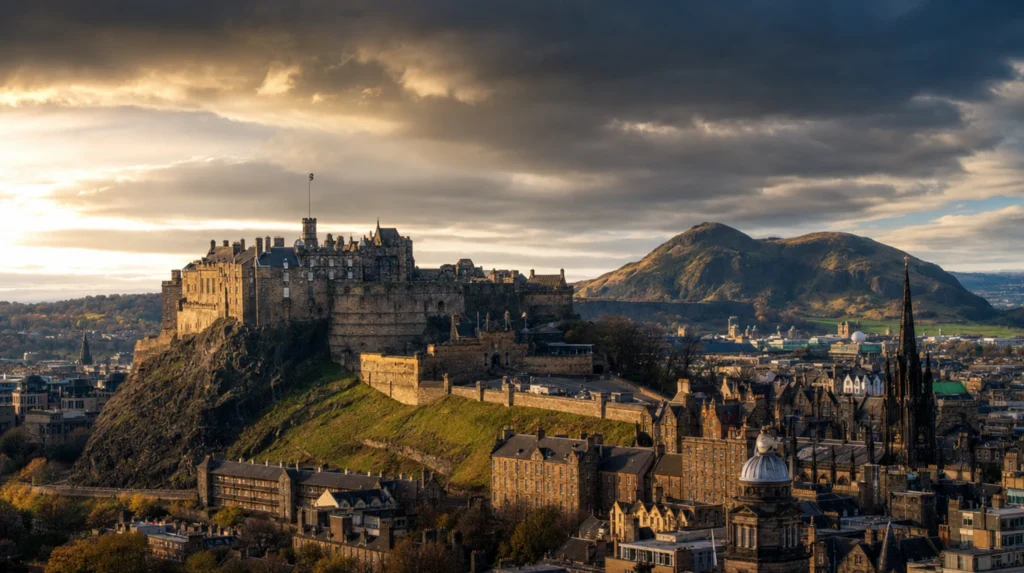
Edinburgh is one of only two capital cities on the planet whose entire historic core — both the medieval town and the planned Georgian extension — is inscribed as a single UNESCO World Heritage Site. The Old Town climbs the spine of an extinct volcano from Holyroodhouse up to the castle on Castle Rock, a kilometre-long cobbled ridge that has been the capital of Scotland since 1437 , while the New Town — drawn on a grid by the 22-year-old James Craig in 1766 — sits to the north across the drained Nor’ Loch (today’s Princes Street Gardens). The two halves carry one inscription, recognised in 1995, because the contrast between them is the point.
The city of just under 514,000 residents punches well above its weight on culture. Edinburgh is the birthplace of the Scottish Enlightenment — David Hume, Adam Smith, James Hutton, Joseph Black and Robert Adam all lived and worked within a 30-minute walk of one another in the back half of the eighteenth century — and the National Library of Scotland still holds the working papers of that generation in the same George IV Bridge building today. The Royal Mile threads the spine of that heritage through St Giles’ Cathedral down to the Palace of Holyroodhouse, the working Scottish residence of the British monarch.
What makes Edinburgh feel bigger than its population is the density of public culture for its scale. Every August the city hosts the Edinburgh Festival Fringe — the largest arts festival on Earth, running 25 days with more than 3,000 shows in 250+ venues — alongside the Edinburgh International Festival , the Royal Edinburgh Military Tattoo on the castle esplanade , and the Edinburgh International Book Festival. The population doubles in August. Then on Hogmanay (Dec 30–Jan 1) the city throws a three-day street party that ends with thousands of pipers on Princes Street and a torchlight procession down the Royal Mile.
The city is also the launchpad for a Scottish itinerary. Edinburgh Airport (EDI) is 13 km west , the LNER Azuma reaches London Kings Cross in around 4h 20m on a direct service , the East Lothian coast at North Berwick is 50 minutes by ScotRail , Stirling Castle is an hour by train, and the Highlands gateway at Loch Lomond is a 90-minute drive west. Plan three full days here as your urban anchor, then either ride the rail spine north or build a Highlands week from this base.
The city’s scale is what travellers most often misjudge in advance. The full Old Town is 1.5 km long; the New Town is the same again to the north; together they form a walkable square that you can cross in 30 minutes from any corner. That density — 514,000 residents , 700+ listed buildings in the Old Town alone, and a two-volcano backdrop in Castle Rock and Arthur’s Seat — lets the city pack five Tier-1 sights, three Michelin restaurants, two world-class national-museum complexes and the world’s densest cultural festival into a 2 km2 footprint. Few European capitals reward walking the way Edinburgh does, and almost none combine a UNESCO old town and a UNESCO new town as a single inscription.
Best Time to Visit Edinburgh

Edinburgh has four distinct seasons, all damper than visitors expect. The UK Met Office Edinburgh climate normals show mean July highs around 19°C, January highs around 6°C, and rainfall well-distributed across the calendar — about 670 mm a year, with no truly dry month. Pack layers, a waterproof shell and shoes you can walk cobbles in for any visit; the city makes no concession to the weather even in August.
Spring (March – May)
The shoulder ahead of Festival season. Daffodils carpet Princes Street Gardens and the Meadows from late March, daylight stretches past 8 p.m. by mid-May, and average highs climb from 9°C to 14°C. Hotel prices are at their off-season floor and museums run at locals’ pace. The single drawback is unstable weather: Edinburgh in April can deliver a snow shower, a sun-trap afternoon and a sideways downpour on the same Royal Mile walk.
Summer (June – August)
August is the absolute peak. The Edinburgh Festival Fringe runs 25 days from early August with 3,000+ shows , alongside the Edinburgh International Festival and the Royal Edinburgh Military Tattoo. Hotel rates double, the Royal Mile is solid with street performers, and you should book accommodation a year ahead for any August dates. June and early July are quieter and warmer (highs 17–19°C), with daylight to 10 p.m. at solstice and a calmer Old Town.
Autumn (September – November)
The smartest non-Festival window. September delivers Festival energy without Festival prices once the crowds clear by the second week, the Doors Open Days programme opens 100+ historic buildings free to the public on the last weekend of September , and golden hour over Calton Hill is at its longest from late October. November turns the city interior — pubs, museums, whisky bars — with sunset before 4 p.m. and average highs of 8°C.
Winter (December – February)
Hogmanay anchors the calendar. The three-day street party on Dec 30–Jan 1 ends with the world’s largest fireworks display over the castle and a torchlight procession down the Royal Mile ; book by September. January and February deliver storm-season volatility — named UK storms regularly cross Lothian — but also empty galleries, off-season hotel rates and a chance of dry-cold clarity over Arthur’s Seat that visitors never expect.
Getting There — Airport, Tram, LNER
Edinburgh Airport (EDI)
Edinburgh Airport sits 13 km west of the city centre off the M8/M9, handles direct flights from across Europe and a growing North-American long-haul roster, and is Scotland’s busiest. From the terminal you have three good options into town: the Airlink 100 express bus runs every 10 minutes to Waverley Bridge in roughly 30 minutes for a few pounds ; Edinburgh Trams run every 7–10 minutes from the airport stop directly to Princes Street and York Place in around 35 minutes ; or a black cab to most central postcodes runs roughly 25–30 GBP. Skip the rental car unless you are leaving the city the same day — central Edinburgh is hostile to cars and parking is punitive.
By rail — LNER from London Kings Cross
The London–Edinburgh East Coast Mainline is one of Europe’s great train rides. LNER’s Azuma electric tilt-trains cover the 632 km from Kings Cross to Waverley in about 4h 20m on a non-stop service, with full bistro service, reliable Wi-Fi, and the Northumberland coast sliding past your window for the last 90 minutes. Advance fares from 50 GBP make this faster, cheaper and far less stressful than flying for any non-emergency London trip. ScotRail handles every other direction inside Scotland from the same Waverley platforms.
Getting Around
Walking is the answer
Edinburgh’s historic core is a 1.5 km square. From the castle to Holyroodhouse along the Royal Mile is a kilometre downhill, Princes Street to Stockbridge is 25 minutes on foot, and Waverley to the Meadows is 15 minutes through the gardens. Treat walking as the default mode and the city pays you back: you stumble into closes (the medieval back-alleys), stair-streets (the pends), and pocket gardens that no transit map shows. The pavements are slabbed sandstone; the gradients are steep around George IV Bridge and the Mound; the cobbles will eat unsuitable shoes inside two hours.
Lothian Buses
The city’s primary transit is Lothian Buses — a council-owned network with the densest urban service in Scotland and exact-fare-only payment on board, or contactless tap. A single is 2.00 GBP, an all-day DAYticket 5.00 GBP, and a Ridacard week 24.00 GBP — among the cheapest urban transit in the UK. Night buses run on the busiest corridors after 11 p.m.
Edinburgh Trams
A single line runs from the airport east through Murrayfield, Haymarket, Princes Street and York Place to Newhaven on the Leith waterfront. Useful for the airport run and for getting down to Leith Shore for dinner, but the network is too small to matter for general sightseeing.
Cycling and taxis
The city is rolling out segregated cycle lanes through Leith Walk and along the Water of Leith. Black cabs are licensed at the airport and the major ranks (Waverley, the West End, Tollcross); flag-down a metered black cab on Princes Street is reliable. Uber and Bolt operate but supply is patchy outside peak hours.
Neighborhoods: Finding Your Edinburgh
📍 Edinburgh Map: Every Place in This Guide


Old Town
The medieval spine. From the castle on Castle Rock down a kilometre of cobbled Royal Mile (Castlehill, Lawnmarket, High Street, Canongate) to Holyroodhouse, with closes peeling off either side into back-alley pockets like Mary King’s Close that the city literally built over in the 1750s. The whole strip is part of the UNESCO Old & New Towns inscription , and the highest density of pubs, kilt-shops, whisky bars and ghost-tours in the city. The medieval street pattern is preserved nearly intact — the closes still bear the names of the merchants and lawyers who lived in them in the 16th and 17th centuries — and Grassmarket at the bottom of the West Bow is the city’s pub-and-music spine outside Festival weeks.
- Edinburgh Castle — Crown Jewels of Scotland and the Stone of Destiny
- St Giles’ Cathedral — the High Kirk of the Scottish Reformation
- The Real Mary King’s Close — the buried 17th-century street under the Royal Mile
Best for: first-time visitors, history-led travel, Festival immersion. Access: Waverley station 5 minutes’ walk; bus 35 along the Royal Mile.
New Town
Edinburgh’s 18th-century answer to the medieval crowding of the Old Town — James Craig’s 1766 grid extends north of Princes Street Gardens through three parallel avenues (Princes, George, Queen) anchored by Charlotte and St Andrew Squares. The architecture is uniform Georgian sandstone, the streets are wide and orthogonal, and the entire half-square-kilometre is part of the UNESCO inscription. The National Trust for Scotland’s Georgian House at 7 Charlotte Square is the canonical interior visit. Adam-brothers terraces line the north sides; Princes Street Gardens (the drained Nor’ Loch valley) sits between New Town and Castle Rock with lawns, the Ross Bandstand, and the steepest castle-rock view in the city.
- Charlotte Square & the Georgian House (NTS interior)
- Scottish National Gallery on the Mound
- Princes Street Gardens with castle views
Best for: shopping, museum days, restaurant nights. Access: Waverley + Princes Street tram stop.
Stockbridge
A village of independent shops, second-hand bookshops and Sunday markets a 20-minute walk north-west of the Old Town across the Water of Leith. The Sunday market on Saunders Street runs every week and pulls Edinburgh’s food scene out into one place: artisan breads, oysters, Caribbean BBQ, hot pretzels. Royal Botanic Garden Edinburgh sits on the northern edge with free entry to the 28-hectare outdoor gardens (ticketed glasshouses) and the Water of Leith Walkway runs through the riverside on its way to Dean Village.
- Stockbridge Sunday market on Saunders Street
- Royal Botanic Garden Edinburgh (free outdoor; ticketed glasshouses)
- Water of Leith Walkway (Stockbridge to Dean Village)
Best for: Sunday afternoons, slow-living visitors, food-curious. Access: 20-min walk from Princes Street; bus 24/29/42.
Leith
Edinburgh’s historic port city, swallowed administratively in 1920 but still sociologically distinct. The Shore is the restaurant spine — a cobbled riverside strip with Restaurant Martin Wishart’s Michelin star , gastropubs, and craft-beer bars — and the Royal Yacht Britannia is permanently berthed at Ocean Terminal as a museum ship. The Pitt Street Food Market runs Friday–Saturday with 30+ vendors.
- Royal Yacht Britannia at Ocean Terminal
- The Shore restaurant strip on the Water of Leith
- Pitt Street Food Market (Fri/Sat)
Best for: dinner nights, contemporary Edinburgh, post-dock-redevelopment vibe. Access: tram to Newhaven; bus 22/16.
Bruntsfield & Marchmont
The Edinburgh University belt, immediately south of the Meadows park. Bruntsfield Place is a 1-km strip of independent cafes, the Edinburgh Bookshop, and family-run delis, while Marchmont’s tenement streets are the city’s densest student quarter (and consequently rich in cheap eats). The Meadows itself is the city’s 25-hectare central park, hosting Festival fringe shows in August and lined with cherry blossom in late April.
- Bruntsfield Place independent strip
- The Meadows park (Festival overflow venue)
- The Edinburgh Bookshop on Bruntsfield Place
Best for: longer stays, locals’-rhythm visits, family travel. Access: bus 23/27/45.
Tollcross & the West End
The theatre and art-school quarter immediately west of the Old Town, anchored by the Lyceum Theatre , the Filmhouse art-cinema, and the Edinburgh College of Art at Lauriston Place. Summerhall, the former Royal Dick School of Veterinary Studies, hosts year-round contemporary visual-art and a major Festival fringe venue programme every August. The Tollcross junction itself is the city’s late-night hinge — pubs and curry houses run their kitchens later here than anywhere else inside the central postcodes — and the Bruntsfield Links / Meadows park edge starts five minutes south of the junction.
- Lyceum Theatre & Royal Lyceum company
- Summerhall — year-round visual art + Aug Fringe venue
- Edinburgh College of Art (Lauriston Place)
Best for: theatre nights, contemporary culture, Aug Fringe deep-dive. Access: 10-min walk from Princes Street; bus 10/27.
Dean Village
A pocket of milled red-sandstone tenements in the Water of Leith gorge, 10 minutes’ walk west of Princes Street. The path drops sharply from the New Town through the Dean Bridge (designed by Telford in 1832) to the river, then follows the Water of Leith Walkway through Stockbridge. The whole walk takes under an hour and lifts the city off you for that hour. The village functioned as a milling community for nearly 800 years; the converted mill buildings on the riverbank are some of the oldest residential addresses in central Edinburgh and the most photographed.
Calton Hill
Not strictly a residential neighborhood but the city’s panoramic anchor at the New Town’s eastern edge. A 10-minute climb from Princes Street drops you onto a 100 m tabletop with the National Monument (the unfinished Athenian replica), Nelson’s Monument, the Dugald Stewart Monument and a panorama that takes in the castle, Holyroodhouse, Arthur’s Seat, the Forth and the New Town in a single 360. Free, open 24/7, and at its best at golden hour or in the dawn 30 minutes before sunrise.
Best for: first-light photographers, golden-hour walkers, anyone with one extra evening hour. Access: Stairs from Waterloo Place, 10-min climb.
- Dean Bridge (Thomas Telford, 1832)
- Water of Leith Walkway (Dean Village to Stockbridge)
- The Scottish National Gallery of Modern Art (10-min walk west)
Best for: photographers, weekend afternoons, slow walkers. Access: 10-min walk from Princes Street; no direct bus.
The Food

Haggis (and the vegetarian version that is now genuinely good)
Haggis is the national dish — sheep offal, oats, onions, suet and spices, cooked in a casing — served traditionally with neeps (mashed swede or turnip) and tatties (mashed potato), sometimes with a whisky cream sauce. The vegetarian version (lentils, oats, mushrooms, root vegetables, the same spice profile) is now ubiquitous and, on a good kitchen, indistinguishable in mouthfeel from the original. Order it once on Day 1 and order it again on Day 3 from a different chef — the regional spice notes vary considerably.
- The Witchery by the Castle — theatrical Old Town room two doors from the castle gate; haggis tower starter (~16 GBP)
- Scran & Scallie — Tom Kitchin’s Stockbridge gastropub; haggis-neeps-tatties (~17 GBP)
- The Devil’s Advocate — Old Town close-pub with a strong veg-haggis option (~14 GBP)
The full Scottish breakfast
The full Scottish is the full English plus three additions: haggis, tattie scones (potato scones, shallow-fried), and either Lorne sausage (square sliced sausage) or black pudding from a Stornoway maker. Most Edinburgh hotels serve a respectable plate; the better breakfasts come from independent kitchens.
- Urban Angel — New Town brunch institution; full Scottish ~14 GBP
- Söderberg — Swedish bakery chain with cinnamon-bun side games; brunch plates ~10 GBP
- Mimi’s Bakehouse — Leith Shore brunch with home-baked goods (~13 GBP)
Fish & chips and the Edinburgh seafood scene
Edinburgh sits on the Forth estuary and the seafood is excellent. The fish-supper baseline is haddock and chips wrapped in paper, salt-and-sauce on top (a brown-vinegar-and-Daddies-sauce blend that is unique to Edinburgh and Glasgow). The mid-tier is a sit-down fish bar; the top tier is one of the city’s seafood specialists.
- Bertie’s Restaurant & Bar — New Town fish-bar; fish-supper (~17 GBP)
- Ondine — Old Town seafood specialist on George IV Bridge; oyster & chowder lunch (~28 GBP)
- The Fishmarket Newhaven — harbour-front fish & chips at the Newhaven tram terminus (~14 GBP)
The Indian curry scene
Edinburgh has a curry tradition stronger than most British cities its size, descended from the same wave of South-Asian migration that gave Glasgow chicken tikka masala. Lothian Road is the dense quarter; Leith Walk and Newington carry the second tier. Expect tandoori served late into the night (most curry houses run kitchens until 11.30 p.m.) and BYOB on a few of the older institutions.
- Dishoom Edinburgh — St Andrew Square; Bombay-cafe-style breakfast and dinner (~25 GBP for two courses)
- Mother India’s Cafe — small-plates Indian on Infirmary Street; tasting (~22 GBP)
- Suruchi — Old Town veteran; Scottish-Indian fusion menu in English+Scots (~23 GBP)
Whisky bars and tasting flights
Edinburgh is a Lowland whisky city — closer in flavour profile to a soft, gentle, lighter dram than the peat-heavy Islays. The city has its own active distillery again at Holyrood Distillery in St Leonard’s, the first single malt distillery within Edinburgh in nearly 100 years. The Scotch Whisky Experience on Castlehill runs guided flights with tutored regional tastings (Highland, Speyside, Islay, Lowland, Campbeltown). For drink-only bars, the back streets of the Old Town and Leith are where the local-scene flights live.
- The Scotch Whisky Experience — Castlehill; Silver tour (~22 GBP, includes tasting)
- Holyrood Distillery — St Leonard’s; distillery tour with tasting (~18 GBP)
- The Bow Bar — Victoria Street; 300+ malt list, no muzak, locals’ bar
Beyond haggis and whisky
The contemporary Edinburgh dining scene is one of the strongest in Britain.
- The Kitchin — Tom Kitchin’s Michelin-starred Leith room; tasting menu (~120 GBP)
- Restaurant Martin Wishart — second Michelin star on the Leith Shore; tasting menu (~110 GBP)
- Aizle — chef-driven blind tasting in the Kimpton on Charlotte Square (~95 GBP)
- Timberyard — Tollcross; Scandinavian-Scottish ferment-led tasting (~90 GBP)
Markets & food experiences you cannot miss
Three set-piece food experiences worth planning around. Stockbridge Sunday Market on Saunders Street pulls 30+ stalls every Sunday 10 a.m.–5 p.m. for artisan breads, oysters and Caribbean BBQ . The Pitt in Leith runs Friday–Saturday with rotating street-food vendors and craft taps . The Scotch Whisky Experience tasting flight on Castlehill is the canonical introduction to Scotland’s five whisky regions and the city’s most popular paid food-and-drink experience .
Cultural Sights

Edinburgh Castle
The defining sight. The fortress on Castle Rock has been continuously occupied since at least the 12th century and houses the Honours of Scotland (the Crown Jewels of Scotland), the Stone of Destiny, and the National War Museum of Scotland. Admission is roughly 23 GBP for adults, with timed entry slots that book out 7–14 days ahead in summer; the One O’Clock Gun fires at 13:00 every day except Sunday from the Mills Mount Battery. Run by Historic Environment Scotland; visit on a weekday morning at opening to beat the cruise-ship coaches.
The Royal Mile and St Giles’ Cathedral
The kilometre cobble between the castle and Holyroodhouse takes in St Giles’ Cathedral — the High Kirk of the Church of Scotland, the seat of the Scottish Reformation under John Knox — with the Thistle Chapel of the Order of the Thistle inside. Free entry; donation requested; photography permit 5 GBP. Skip the kilt-souvenir corridor and step into a close (Advocate’s Close, Anchor Close, Fleshmarket Close) for the medieval-pend feeling.
Palace of Holyroodhouse
The Royal Mile’s eastern terminus — the official residence of the British monarch in Scotland and the seat of every Scottish monarch since the 16th century. The State Apartments, the Mary Queen of Scots chambers and the ruined 12th-century Holyrood Abbey are the core visit; admission ~20 GBP. Closes during Royal Week (late June–early July). Holyrood Park, the 260-hectare royal park behind the palace, contains Arthur’s Seat — the 251 m volcanic plug that gives Edinburgh its best free panorama (40-min uphill walk from the palace gates).
National Museum of Scotland
Free, world-class, the largest single-site cultural attraction in Scotland by visitor numbers. The Chambers Street museum collapses Scotland’s natural-history, social-history, science and decorative-arts collections into one Victorian-and-modern combined building. Allow three hours; the rooftop terrace gives a free castle-and-Old-Town panorama. Operates as part of National Museums Scotland alongside the Museum of Scottish Country Life and the National War Museum at the castle.
Scottish National Gallery (and Modern Art)
The National Galleries of Scotland operate three free-entry sites in Edinburgh: the Scottish National Gallery on the Mound (European Old Masters and Scottish painting), the Scottish National Portrait Gallery on Queen Street (red-sandstone Gothic Revival; portraits from the 16th century to today) and the Scottish National Gallery of Modern Art (two 19th-century buildings in Belford on the Water of Leith). The Modern Art galleries hold the city’s major Picasso, Tracey Emin and Damien Hirst rotations alongside the Eduardo Paolozzi sculpture grounds.
Camera Obscura & The Real Mary King’s Close
Two contrasting Old Town visits a hundred metres apart on Castlehill. Camera Obscura & World of Illusions has been running its working Victorian camera-obscura projection of live Edinburgh on a viewing-table since 1853, plus six floors of optical illusions; admission ~22 GBP. The Real Mary King’s Close is the buried 17th-century street under the Royal Mile — closed off in 1753 when the City Chambers were built on top, opened to guided tours since 2003; admission ~22 GBP, advance booking essential.
Entertainment & Nightlife

Edinburgh has the densest pub map per capita of any UK city outside London — the Scottish Beer & Pub Association count puts the central postcodes at over 850 licensed venues — and the night-out splits into four clean tiers. Old-school pubs with no muzak and 200-malt whisky lists (The Bow Bar on Victoria Street, Sandy Bell’s on Forrest Road for trad-music sessions, The Cumberland Bar in the New Town). Craft-beer rooms on Leith Walk and Rose Street (Cold Town House, BrewDog Lothian Road, Salt Horse on Blackfriars). Cocktail counters in the New Town (Panda & Sons, Bramble, Tigerlily). Late-night dancing at La Belle Angele, Sneaky Pete’s and Bongo Club (all Cowgate / Niddry Street). Most pubs close at 1 a.m.; nightclubs run to 3 a.m. on weekends per the city’s licensing regime.
Theatre, comedy and live music
The Royal Lyceum Theatre at Grindlay Street is the city’s producing theatre, with a year-round repertoire of new plays and Scottish-canon revivals. Summerhall’s Dissection Room hosts contemporary visual-art and the city’s most experimental Festival Fringe programme. The Festival Theatre, the King’s and the Queen’s Hall split touring opera, ballet and orchestral programming. For sport, Murrayfield is the home of Scottish rugby and runs Six Nations matches every winter.
Day Trips from Edinburgh

North Berwick (50 min by ScotRail)
The East Lothian coast at its best. North Berwick is a small Victorian seaside town 40 km east of Edinburgh, reached by a 50-minute ScotRail service from Waverley ; the town fronts a wide white-sand beach with the Bass Rock’s gannet colony silhouetted offshore. The Scottish Seabird Centre runs live cameras to the Bass Rock and remote islands; lunch is fish-and-chips on the harbour; the rail back is hourly into the evening.
Stirling (55 min by ScotRail)
The Scotland-of-the-tartan-tea-towels in one castle. Stirling Castle perches on a volcanic plug overlooking the Forth Valley, with the National Wallace Monument on Abbey Craig opposite and the battlefield of Bannockburn on the southern outskirts. Allow a full day if you want to combine the castle, the Wallace Monument and the Bannockburn visitor centre; rail from Waverley runs hourly.
Linlithgow Palace (20 min by ScotRail)
The 15th-century royal palace where Mary Queen of Scots was born in 1542, set on the shore of Linlithgow Loch and partly ruined since 1746. Free-flow visit; admission ~9 GBP through Historic Environment Scotland. A natural pairing with Hopetoun House (5 km west) for a full Lothian-palaces day.
Rosslyn Chapel (35 min by bus)
The 15th-century Collegiate Chapel of St Matthew at Roslin, made internationally famous by The Da Vinci Code in 2003 and then quietly restored as a working Episcopal chapel. The carved stone interior is genuinely extraordinary — Apprentice Pillar, Green Men, the Dance of Death frieze — and admission is ~10 GBP. Lothian Bus 37 from Princes Street takes 35 minutes; allow 90 minutes inside.
Loch Lomond & Trossachs (90 min by car — Highlands gateway)
The closest taste of the Highlands to Edinburgh. Loch Lomond & the Trossachs National Park starts an hour and a half west of the city by car (the train via Glasgow Queen Street is doable but slower). Aim for Luss village on the loch’s west bank, then the Inversnaid road to Loch Katrine for a steamer cruise. Driving here is the right call; this is the only Edinburgh day-trip we would not do by train.
Practical Tips
Visa — UK ETA
Since 2025, visa-exempt travellers (US, Canada, Australia, New Zealand, EU member states, etc.) need a UK Electronic Travel Authorisation before they fly. The ETA costs £10, lasts two years or until the linked passport expires, and is valid for stays up to six months. Apply through the official UK ETA app (NOT a third-party site) at least 72 hours before departure; processing is usually under three days.
Cash, cards & Scottish notes
Edinburgh runs on contactless. Cards work everywhere — pubs, taxis, food markets, even the Royal Mile buskers’ tip jars. Three Scottish banks (Bank of Scotland, RBS, Clydesdale) issue their own banknotes, which are legal tender in Scotland and accepted across the UK; English shopkeepers occasionally hesitate over Scottish £20 notes — mention this in advance if you are heading south. Tipping in restaurants runs ~10% (12.5% for table service is normal in better rooms); it is built into many menus as “optional service charge” on the bill.
Plug, voltage and weather
Type G (three rectangular pins), 230V / 50Hz — the same standard as the rest of the UK. Bring a Type G adapter; most US/EU electronics handle 230V natively. The single most important practical decision is what you wear: assume rain on at least half the days regardless of season, dress in three layers (base + warm mid + waterproof shell), and pack walking shoes that handle wet cobbles.
Safety, health & storage
Edinburgh is a safe city by European-capital standards. Police Scotland operates 999 (emergency) and 101 (non-emergency); the Royal Mile’s pickpocket pressure rises in August Festival weeks but stays low year-round. NHS Inform (Scotland’s NHS public-information portal) runs free 24/7 advice. For luggage, Bounce operates network-of-shops storage from the airport, Waverley and central postcodes for a fixed daily rate.
Budget Breakdown: What Edinburgh Costs in 2026
| Tier | Daily | Sleep | Eat | Transport | Activities | Extras |
|---|---|---|---|---|---|---|
| Budget | $90–140 | $45–75 hostel dorm / Airbnb shared | $25 (chippy + cafe) | $8 day-bus | $15 free museums | $10 pub pint |
| Mid-Range | $200–320 | $140–220 boutique hotel | $60 mid-range dinner | $8 day-bus | $30 castle + Holyroodhouse | $25 whisky flight |
| Luxury | $550+ | $400+ Old Town 5-star (Aug $700+) | $200 Michelin tasting | $30 black cab | $60 chauffeured day-tour | $80 spa + bar |
Where your money goes
Sleep is the single biggest cost lever and the August surge is real — mid-range Old Town rooms that run $180 in September can clear $400 during Festival weeks. Daily transit is essentially free if you walk — the city centre is 1.5 km square — or 5.00 GBP if you use Lothian Buses with a DAYticket. Restaurants are cheaper than London but more expensive than most other UK cities, and the visitor levy of 5% on accommodation kicks in across the city in 2026.
Money-saving moves
- Two-thirds of Edinburgh’s top museums (the National Museum of Scotland, all three National Galleries of Scotland sites) are free entry — build a museum-only Day 2 to offset Day 1’s castle ticket. The National Museum of Scotland on Chambers Street alone justifies three hours of any rainy afternoon.
- Stay in Tollcross, Bruntsfield or Leith rather than the Old Town — rates run 30–40% lower and a 15-minute bus or 25-minute walk drops you on the Royal Mile.
- Book Festival tickets through the Fringe Box Office’s discount programmes — pay-what-you-can and 2-for-1 days exist throughout August.
- The Edinburgh Castle ticket is the most expensive single attraction at ~23 GBP — book the timed-entry slot online to skip the on-site queue and combine with Holyroodhouse on the same Royal-Mile day.
- The Doors Open Days programme on the last weekend of September opens 100+ historic buildings free to the public — a once-a-year way to walk into Adam-brothers New Town interiors and Old Town merchant houses normally closed to visitors.
- Walking is the city’s default mode and pays you back: the Old Town and New Town are a 1.5 km square; you can comfortably skip transit entirely on a three-day visit if you sleep central.
Frequently Asked Questions
How many days do I need in Edinburgh?
Three full days as an urban anchor is the realistic floor for first-time visitors — Day 1 castle and Royal Mile and Holyroodhouse, Day 2 New Town museums and Stockbridge, Day 3 day-trip to North Berwick or Stirling. Add a fourth and fifth day for August Festival, an extra whisky flight, and Arthur’s Seat at sunrise. Two days only is too short and you will leave wanting the New Town back.
Is Edinburgh good for solo travellers?
Among the easiest UK capitals for it. The city is small enough to walk end to end in 30 minutes, the pub culture welcomes single drinkers at the bar, the museums are free and busy with locals, and women travelling alone report Edinburgh as one of the safest UK cities to walk after dark. Stockbridge and the New Town are particularly comfortable on a solo Sunday afternoon.
Festival vs non-Festival visit?
Both are worth a trip but should not be combined. The Festival in August is the largest arts event on the planet — 3,000+ shows, the city in maximum extroverted gear — and you should do it once. Non-Festival Edinburgh is the city as it actually lives: quieter pubs, off-season rates, museums you can hear yourself think in. Visit in shoulder season first, then return for August.
What is the best whisky tour in the city?
Two good options. The Scotch Whisky Experience on Castlehill is the educational starter at ~22 GBP with a five-region tasting flight. Holyrood Distillery in St Leonard’s is the working-distillery option (~18 GBP) and the only single malt made within Edinburgh in nearly 100 years. Do both if you can; pair with The Bow Bar for a 300-malt list.
Is the Royal Mile a tourist trap?
Half-yes. The kilt-corridor on Castlehill and Lawnmarket is unambiguously a tourist trap; we would never eat dinner on the Mile itself. But the closes (Advocate’s, Anchor, World’s End) drop you into a medieval-pend warren with good pubs and Real Mary King’s Close , and St Giles’ and Holyroodhouse are not negotiable. Walk it once for orientation; do not eat on it.
Can I use credit cards everywhere?
Yes. Edinburgh runs on contactless — Visa, Mastercard, Amex and mobile-wallet payments are accepted at every cafe, pub, taxi, market stall and museum. Cash is increasingly rare. Carry £20–40 in coins for buskers, a few small independents that still go cash-only, and the Royal Mile’s charity bagpipers.
Is the visitor levy something I need to plan around?
Not really. The City of Edinburgh Council’s 5% accommodation visitor levy applies to all paid stays in the city from 2026, capped at five consecutive nights, charged on top of room rate. On a 200 GBP-a-night room for three nights it adds 30 GBP — meaningful but not a deal-breaker. Hotels collect it at checkout; budget for it and move on.
Ready to Experience Edinburgh?
Three full days in the UNESCO twin city, two whisky flights, one Festival show and a North Berwick day-trip out to the Bass Rock — that is the Edinburgh rhythm. For the full country context, read the Scotland Travel Guide; for the next leg of any UK itinerary, pair Edinburgh with the London City Guide via a 4h 20m LNER Azuma run from Waverley to Kings Cross.
Explore More City Guides
- London City Guide — the UK’s capital, 4h 20m south by LNER Azuma
- Dublin City Guide — the nearest Celtic-capital peer, 1h flight or 8h ferry-via-Holyhead
- Reykjavík City Guide — the FFU gold-standard reference and a North-Atlantic capital peer
- Stockholm City Guide — the closest Scandinavian-capital peer for waterfront-Old-Town pairing
- Scotland Travel Guide — the country context for Edinburgh, Highlands and the Western Isles
Alex the Travel Guru
Alex has been writing destination guides for FFU since 2019, with seven Edinburgh trips on the docket and a Calton-Hill-at-dawn habit that survives any weather the Forth throws at it. Edinburgh is the city Alex returns to most often after Reykjavík — anchor, base camp, museum field-office and the closest UK capital to a sense of historical layering you can walk in half an hour. For the full country context, read the Scotland Travel Guide.
More city guides you might like
Plan your trip to Edinburgh
The booking tools we use ourselves. FFU may earn a commission at no extra cost to you.
Plan & book your trip to Edinburgh
Booking through these searches supports our guides at no extra cost to you.