
The world at the time
For four centuries the largest city in Europe was ruled by a dynasty that spoke Turkish, prayed in Arabic, wrote poetry in Persian metres and governed a population that spoke Greek, Armenian, Ladino, Bulgarian, Albanian and a dozen other languages besides. The language of its court, its chancery and its literature was Ottoman Turkish: Turkish in its bones, dressed in Arabic and Persian vocabulary, and written from right to left in the Arabic script. Modern Turks need a dictionary to read it.
Mehmed II took Constantinople on 29 May 1453, when he was twenty-one, and spent the rest of his reign turning a depopulated Byzantine capital into an imperial one. He repopulated it by decree; built the Topkapı Palace on the old acropolis between the 1460s and 1478; and laid out the covered market that grew into the Grand Bazaar. His grandson Selim I conquered Syria and Egypt in 1516–17 and brought the caliphate, in name, to the Bosporus. Selim’s son Suleiman, who ruled from 1520 to 1566, took Belgrade, Rhodes and most of Hungary, besieged Vienna in 1529, codified the law and built, through his architect Sinan, the mosque complex on the third hill that still defines the skyline.
The city Suleiman ruled held perhaps 400,000 people. It was organised in neighbourhoods around mosques, churches and synagogues, each community governed in its own religious affairs by its own clergy under the sultan’s protection. Water came by aqueduct to hundreds of public fountains; grain came by sea from Egypt and the Black Sea. Coffee arrived from Yemen in the 1550s, and the coffeehouse, where men talked, played backgammon and listened to storytellers, became the city’s characteristic institution. The Janissaries, the sultan’s slave infantry recruited from Christian boys, were both the empire’s best soldiers and, increasingly, its most dangerous subjects.
The seventeenth century brought stagnation at the top and extraordinary writing below it. The traveller Evliya Çelebi, born in 1611, spent forty years recording the empire in ten volumes. The siege of Vienna in 1683 failed, and the peace of Karlowitz in 1699 was the first in which the Ottomans ceded territory in Europe. Yet the court of Ahmed III, in the so-called Tulip Era of 1718 to 1730, was a time of gardens, poetry and the first Ottoman printing press, set up by İbrahim Müteferrika in 1727.
Reform came in the nineteenth century, and it changed the language as much as the state. Mahmud II destroyed the Janissaries in 1826. The Gülhane edict of 1839 opened the Tanzimat, the reorganisation, which promised equal rights to all subjects and created ministries, schools and newspapers on European models. The sultans left Topkapı for the French-style Dolmabahçe Palace in 1856. A generation of writers simplified Ottoman prose so that it could be read by people without a madrasa education, and the first constitution of 1876, suspended within two years by Abdülhamid II, was written in a Turkish that a modern reader can almost follow.
Everyday life in this long period was more constant than the politics. The call to prayer divided the day; the Friday mosque and the hammam divided the week; Ramadan nights, with lamps strung between minarets spelling out verses, divided the year. Houses were of wood, which is why fires rewrote the city every generation. Women of the middle classes went out veiled and in groups, to the baths, the cemeteries and the meadows at Kağıthane; women of the palace ruled through sons and eunuchs. The empire’s end, after the Balkan Wars and the First World War, is outside this guide, but one date belongs here: in 1928 the Turkish Republic replaced the Arabic script with the Latin alphabet, and Ottoman Turkish, as a written language, ceased.
The stories they told
Ships over the hill
The Byzantines had closed the Golden Horn with a chain, and for weeks in the spring of 1453 the Ottoman fleet could not get at the city’s weakest walls. Mehmed’s answer, described by the Greek historian Kritoboulos, who wrote for the sultan afterwards, and by the Ottoman chronicler Tursun Bey, was to move the ships by land. A road of greased timbers was laid from the Bosporus shore over the ridge behind Galata, and on the night of 21–22 April some seventy vessels were hauled up and over, with sails set and oarsmen rowing the air, and launched into the Horn behind the chain. The final assault came on 29 May. Tursun Bey records that when Mehmed walked into Hagia Sophia and saw the state of the building, he recited a Persian couplet: the spider keeps the curtains in the palace of Chosroes, the owl sounds the watch in the towers of Afrasiyab. The lines are not his own and the moment cannot be checked, but they are the sentence with which Ottoman Istanbul chose to begin.
Sinan the apprentice, the journeyman and the master
Sinan was born a Christian in a village in Cappadocia around 1490, taken into the Janissaries as a boy, trained as a military engineer and appointed chief architect of the empire in 1539, a post he held until his death in 1588 at nearly a hundred. His friend Sâî Mustafa Çelebi took down his memoirs, and in them Sinan looks back on his three great mosques: he built the Şehzade in Istanbul as an apprentice, the Süleymaniye as a journeyman, and the Selimiye at Edirne, finished in 1575 when he was in his eighties, as a master. The Süleymaniye was the test. The memoirs tell how enemies at court whispered to Suleiman that the dome would never stand and the project would never end, and how the sultan rode to the site in anger and asked when it would be finished. Sinan promised two months. He delivered, and at the dedication in 1557 Suleiman handed him the keys and told him to open the mosque himself, since he had built it with true faith.
Evliya Çelebi’s slip of the tongue
Evliya Çelebi opens his Seyahatname, the Book of Travels, with the dream that made him a traveller. On the night of his twentieth birthday in 1630 he dreamed he was in a mosque in Istanbul filled with the saints and the companions of the Prophet, and that the Prophet himself was present. He was told to approach and ask for intercession, şefaat. Overcome, he kissed the Prophet’s hand and asked instead for seyahat, travel. The Prophet smiled and granted him both. Evliya spent the next forty years making good on it, and his ten volumes are the great record of Ottoman life. He is also the only source for the story of Hezârfen Ahmed Çelebi, who he says strapped on eagle-feather wings in the 1630s, launched himself from the Galata Tower and glided across the Bosporus to Üsküdar, after which the sultan rewarded him with gold and exiled him to Algeria as too dangerous a man to keep. No other writer mentions the flight. Evliya was a collector of wonders and not above improving them.
The Tulip Era and its end
Under Ahmed III and his grand vizier and son-in-law, Damat İbrahim Pasha, the court in the 1720s turned to pleasure with a thoroughness that still colours Istanbul’s idea of itself. Tulips, bred in hundreds of varieties and traded at prices the state eventually had to regulate, were the emblem. In April the palace gardens were lit at night with lamps and, by contemporary account, with candles fixed to the backs of tortoises that wandered among the flowerbeds. On the Sweet Waters of Europe at Kağıthane the vizier built the pleasure palace of Sadabad, modelled on descriptions of Versailles, with marble canals and pavilions where the poet Nedim read verses celebrating the city and its boys and girls. It ended in September 1730, when a bath attendant and former Janissary named Patrona Halil led a revolt from the Bayezid square. İbrahim Pasha was strangled and his body handed to the mob; Ahmed abdicated in favour of his nephew; Sadabad was pulled down. Nedim died in the chaos, by some accounts falling from a roof as he fled. The tulips survived, and are planted by the million in the city’s parks every spring.
How the language sounded
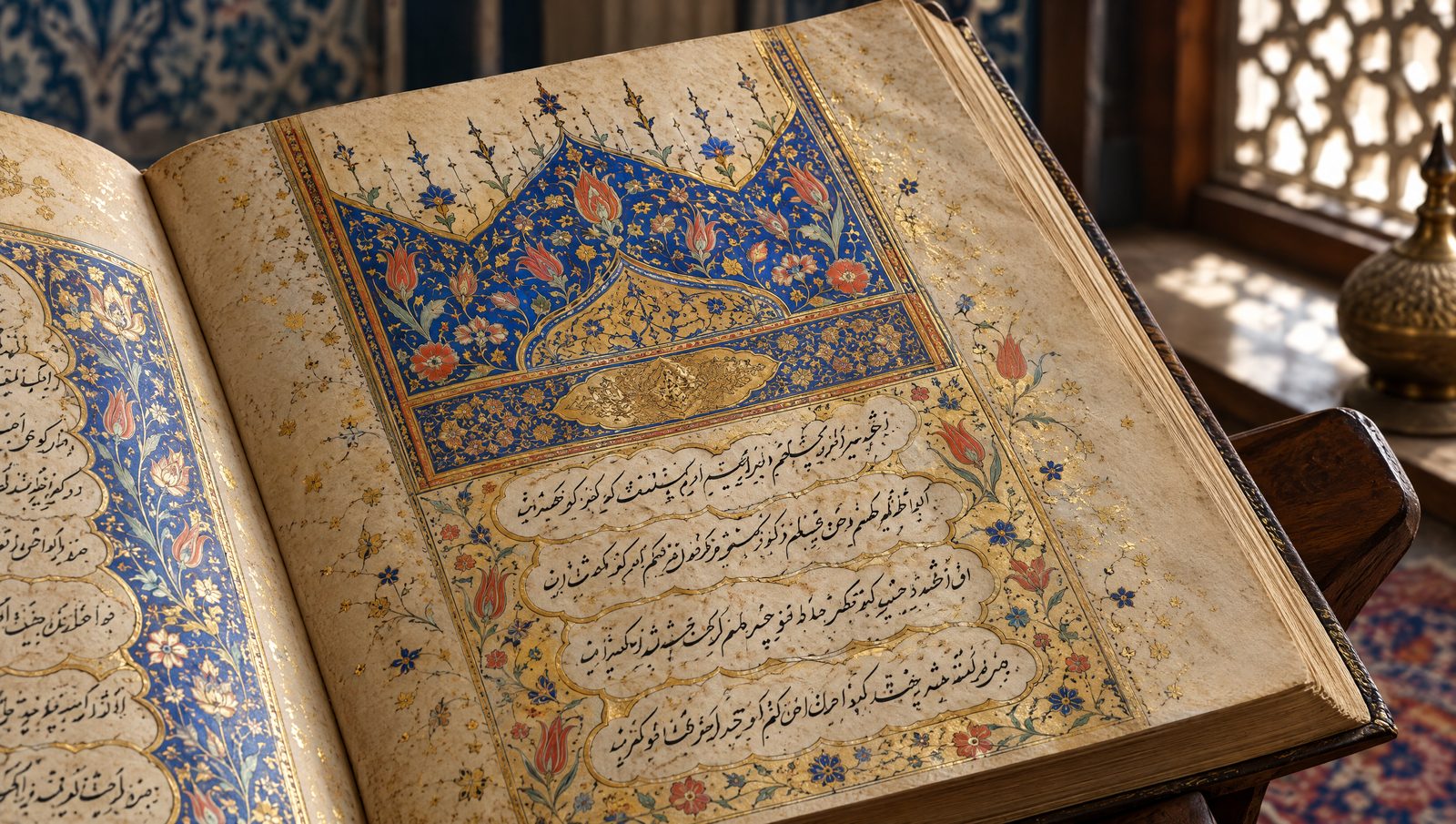
Ottoman Turkish was written in the Arabic script, extended with the Persian letters for p, ch, zh and g and with one of its own, a k with three dots that stood for a nasal n. It ran from right to left and, like Arabic and Persian, left most short vowels unwritten, which for a language with eight vowels and strict vowel harmony meant that a word on the page was often a prompt rather than a transcription. Readers knew what it said because they already knew the word. Chancery documents used divanî, a dense slanting hand designed to prevent forgery; books used nesih; the great inscriptions on mosques used sülüs, and every sultan’s decree was headed by his tuğra, a calligraphic monogram of his name and titles. Calligraphy was the empire’s highest art, and its masters were honoured as painters were in Italy.
- Vowel harmony. The vowels of a word agree with each other, front with front and back with back, so suffixes change shape to match: ev-ler, “houses”, but at-lar, “horses”. The Arabic script hid it.
- Three languages, one grammar. Nouns and verbs were Turkish and took Turkish endings, but a learned writer drew freely on Arabic and Persian words and used the Persian izâfet to link them: Devlet-i Aliyye-i Osmâniyye, “the Sublime Ottoman State”. The high style could be nine-tenths loanwords; the speech of the street was mostly Turkish.
- Long vowels in loanwords only. Turkish has no vowel length of its own, but Arabic and Persian words kept theirs: âlem, “world”, with a long first syllable, against alem, “flag”.
- The nasal n. Early Ottoman had a sound like the ng in sing in words such as deñiz, “sea”, and in the second-person suffixes, written with the three-dotted k. By the eighteenth century Istanbul speech had turned it into a plain n, though the spelling kept it until 1928.
- Arabic consonants, Turkish mouths. The script distinguished several Arabic sounds, the emphatic s, t and z and the throat consonants, that Turks did not pronounce differently. Sabah, sabır and ses all began with the same s, whatever letter they were written with.
- Stress fell on the last syllable of most words, lightly, and shifted with suffixes: İstanBUL, İstanbulLU, “a person from Istanbul”.
How do we know? Chiefly because the language did not die: modern Turkish is Ottoman Turkish with the loanwords thinned and the script changed, and the pronunciation of educated Istanbul in 1900 is within living memory of recordings. For earlier centuries there are the “transcription texts”, Turkish written down in Latin, Greek, Armenian or Hebrew letters by foreigners and by Ottoman Christians, which show the vowels the Arabic script hid; the Italian merchant Filippo Argenti’s phrasebook of 1533 and Franciszek Meniński’s great dictionary of 1680 are the most useful. Arabic and Persian poetic metres, which depend on long and short syllables, show how borrowed words were pronounced in verse. The uncertainties concern the earliest period, when the nasal n and some vowel distinctions were fading, and the gap between the written high style, which no one spoke, and the Turkish of the markets, which no one wrote down until Evliya.
| Original | Say it | Meaning |
|---|---|---|
| سلام عليكم — selâmün aleyküm | seh-LAH-mün ah-LAY-küm | Peace be upon you (the standard greeting) |
| خوش گلدڭز — hoş geldiniz | HOSH gel-di-NIZ | Welcome (literally “you came well”) |
| صباح شریفلرڭز خیر اولسون — sabâh-ı şerîfleriniz hayır olsun | sa-BAH-uh sheh-REEF-leh-ri-niz ha-YUHR ol-SUN | May your noble morning be auspicious (polite good morning) |
| نه وار نه یوق؟ — ne var ne yok? | neh VAR neh YOK | How are things? (literally “what is there, what is not”) |
| اوت / خیر — evet / hayır | eh-VET / HAH-yuhr | Yes / No |
| تشكر ايدرم — teşekkür ederim | teh-shek-KÜR eh-deh-RIM | Thank you |
| آڭلامدم — anlamadım | an-LAH-ma-duhm | I did not understand |
| اللّٰهه اصمارلادق — Allaha ısmarladık | al-LA-ha uhs-mar-la-DUHK | Goodbye (said by the one leaving; literally “we have entrusted you to God”) |
Every one of these is still said in Istanbul today; the Ottoman spellings are those of the nineteenth-century grammars, and the romanisation follows modern Turkish, in which c is the j of jam, ç is ch, ş is sh, ı is the vowel in roses and ü and ö are as in German.
بو شهر ستنبول كه بیمثل و بهادر
بر سنگنه یكپاره عجم ملكی فدادر
Bu şehr-i Sitanbul ki bî-misl ü bahâdır
Bir sengine yekpâre Acem mülkü fedâdırThis city of Istanbul, which is without equal and beyond price: for a single one of its stones the whole realm of Persia might be given.
Nedîm, from his kasîde in praise of Istanbul, early eighteenth century
Nedîm was the poet of the Tulip Era, and this is the opening couplet of the poem for which he is remembered, addressed to the grand vizier İbrahim Pasha. It is a good specimen of the high style. Only bu, ki, bir and the verb endings are Turkish; şehr, bî-misl, bahâ, seng, yekpâre, mülk and fedâ are Persian and Arabic, and şehr-i Sitanbul uses the Persian linking -i. The metre is a Persian one, and the long vowels marked with circumflexes are what make it scan. Yet a Turkish speaker today can read it aloud and catch its meaning with a little help, which is the Ottoman situation in miniature: a language whose grammar everyone shared and whose vocabulary belonged to the educated.
Maya reads these aloud in a reconstructed pronunciation, honestly labelled as a reconstruction, in a free Ottoman Turkish session of fifteen minutes by phone.
Where to stand today
Topkapı Palace
The sultans’ residence for nearly four hundred years sits at the tip of the peninsula in Istanbul, a sequence of courtyards, kiosks and gardens rather than a single building. The second court holds the council chamber and the kitchens; the third the audience hall, the treasury and the library of Ahmed III; the fourth is terraces and pavilions over the Bosporus. The Harem, with its tiled rooms and the quarters of the queen mother, needs a separate ticket and is the part to prioritise. Book a timed entry online, arrive at opening and go to the Harem first; it is closed on Tuesdays.
The Süleymaniye Mosque
Sinan’s journeyman work is the building to see if you see only one. The mosque itself is calm and enormous, its dome carried on four piers so that the interior reads as a single space washed with light from more than a hundred windows. Around it the complex held a hospital, a soup kitchen, a bath, a caravanserai and four madrasas. Behind the mosque are the tombs of Suleiman and of his wife Hürrem, and at the north corner, by the street, Sinan’s own. Entry is free outside the five prayer times; late afternoon brings the best light on the courtyard, and the terrace behind the complex looks down the Golden Horn to Galata.
Hagia Sophia
Justinian’s church of 537 became Mehmed’s mosque in 1453, a museum in 1934 and a mosque again in 2020. The Ottoman layers are what matter for this guide: the four minarets, two of them Sinan’s; the mihrab turned a few degrees towards Mecca; the eight great roundels with the names of God, the Prophet and the first caliphs painted in the nineteenth century by the calligrapher Kazasker Mustafa İzzet, the largest examples of Ottoman calligraphy anywhere; the sultan’s loge; and the library of Mahmud I. Visitors now enter through a separate gate and see the building from the upper gallery, with a ticket; go early or late to avoid queues, and dress as you would for any mosque.
The Grand Bazaar
Mehmed II’s covered market of the 1450s, the two stone bedestens at the heart of today’s bazaar, grew over four centuries into a roofed city of sixty streets and some four thousand shops. The Old Bedesten still holds the antique and silver dealers, and around it are streets named for the guilds that occupied them. The bazaar is closed on Sundays and religious holidays; go on a weekday morning when the shutters are rising, and leave by the Nuruosmaniye gate to see Istanbul’s first baroque mosque, finished in 1755.
The Museum of Turkish and Islamic Arts
Housed in the sixteenth-century palace of İbrahim Pasha, Suleiman’s grand vizier, on the Hippodrome, this is where Ottoman Turkish is most visible as script. The galleries hold Korans, imperial decrees headed by tuğras, calligraphic panels, the carved and gilded doors of mosques and one of the great carpet collections in the world. An hour here before Topkapı will teach you to recognise a tuğra, the sultan’s monogram, on every gate and fountain you pass for the rest of your stay.
Dolmabahçe Palace
On the European shore of the Bosporus, the palace that Abdülmecid built in 1856 to replace Topkapı is the Tanzimat in marble: a French and Italian confection with a ceremonial hall under a four-tonne crystal chandelier, Bohemian glass staircases and the bedroom where Atatürk died in 1938, its clocks stopped at five past nine. Visits are by timed ticket and the palace is closed on Mondays; the gardens along the water and the clock tower outside are free.
Edirne: the Selimiye
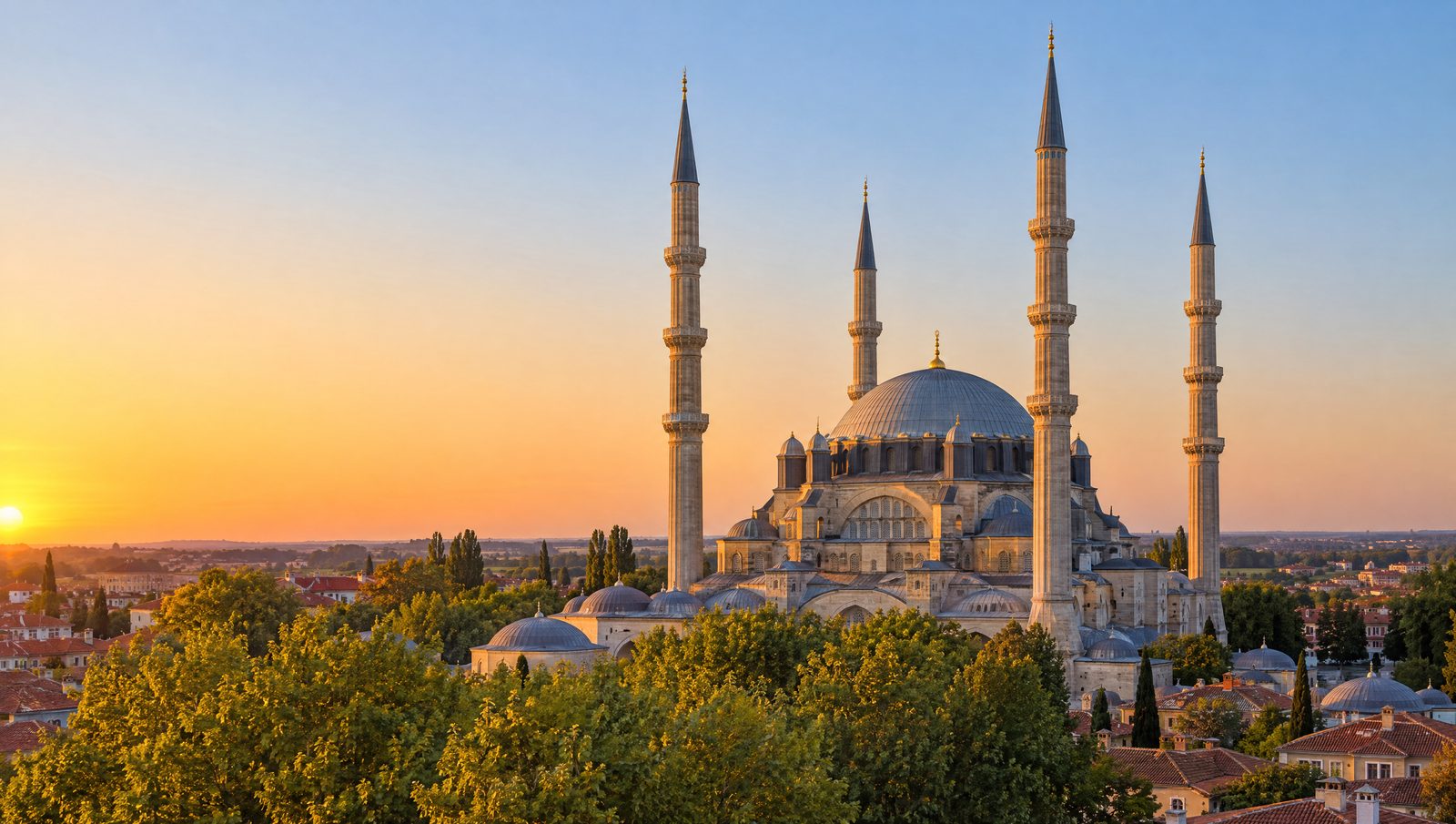
Two and a half hours west of Istanbul by road, near the Greek and Bulgarian borders, Edirne was the Ottoman capital before 1453 and kept a second court afterwards. Sinan’s Selimiye, finished in 1575 for Selim II, is the mosque he called his masterpiece: a dome that Sinan claimed outdid Hagia Sophia’s, carried on eight piers so that the whole interior is open, and four slender minarets more than seventy metres high. Edirne is a day trip or a quiet overnight from Istanbul, and the rest of Turkey‘s early Ottoman heritage, at Bursa and İznik, lies across the Marmara to the south.
Go deeper
- Caroline Finkel, Osman’s Dream: The Story of the Ottoman Empire, 1300–1923 (Basic Books) — the standard one-volume history in English, written by a historian who reads the Ottoman sources.
- Evliya Çelebi, An Ottoman Traveller: Selections from the Book of Travels, translated by Robert Dankoff and Sooyong Kim (Eland) — the best way into the Seyahatname, with the dream, the flight from Galata Tower and a hundred other things.
- Philip Mansel, Constantinople: City of the World’s Desire, 1453–1924 — a history of the city as the empire’s stage, strong on the mixed population and the court.
- Walter G. Andrews, Najaat Black and Mehmet Kalpaklı, Ottoman Lyric Poetry: An Anthology (University of Texas Press) — Bâkî, Fuzûlî, Nedîm and others in Ottoman text, transliteration and English verse, with notes on how the poems work.
- Geoffrey Lewis, The Turkish Language Reform: A Catastrophic Success (Oxford University Press) — the story of how Ottoman became modern Turkish after 1928, witty and exact.
Frequently asked questions
Is Ottoman Turkish hard to learn?
It is two tasks. The Turkish grammar is regular and agglutinative, building words by adding suffixes in a fixed order, and is learnable from any modern Turkish course. The difficulty is the script, which hides vowels, and the vocabulary, which draws on three languages. Students of modern Turkish usually need a year to read nineteenth-century newspapers comfortably.
How accurate is the reconstructed pronunciation?
For the nineteenth century, almost perfectly accurate: the language was recorded by grammarians, phoneticians and finally gramophones. For the sixteenth century, good: the transcription texts and the poetic metres fix the vowels and the long syllables, and the consonants have changed little. The remaining questions are about the earliest Ottoman, the fading nasal n and the gap between courtly recitation and street speech. Maya’s readings give the Istanbul pronunciation that the grammars describe, honestly labelled as a reconstruction for the older texts.
What modern languages descend from it?
Modern Turkish, directly: the Republic changed the script in 1928 and then spent decades replacing Arabic and Persian words with Turkish coinages, but the grammar and the core vocabulary are unchanged, and the 85 million speakers of Turkish are speaking Ottoman Turkish stripped of its court dress. Azerbaijani, Turkmen and Gagauz are close cousins. Balkan languages such as Bosnian, Albanian, Bulgarian and Greek keep thousands of Ottoman loanwords, and so does Istanbul’s Ladino, the Spanish of the Jews Bayezid II welcomed in 1492.
Can I read the original texts after a few months?
Printed texts from the nineteenth century, yes, with a dictionary, once the script is secure; the letterforms are regular and the prose was written to be understood. Manuscripts and chancery documents are a separate skill, since each hand has its own conventions and the divanî script was designed to be hard. Classical poetry takes longest, because its pleasure lies in Persian metre and in layers of allusion.
What is the best first trip for this era?
A week in Istanbul in April, when the tulips are out, or in October. Two days for Topkapı, Hagia Sophia and the Museum of Turkish and Islamic Arts; a day for the Süleymaniye, the bazaars and the Spice Market; a day for Dolmabahçe and a ferry up the Bosporus; a day for Eyüp, the Chora (Kariye) and the land walls; and a day trip to Edirne.