
The world at the time
The England of Chaucer is the England that comes after the plague. The Black Death reached the Dorset coast in the summer of 1348 and by the end of 1349 had killed something between a third and a half of the population. A country of perhaps five million people became one of under three, and did not recover its numbers for two centuries. Everything in this guide, from the price of a labourer to the triumph of the English language, follows from that catastrophe.
Edward III had been king since 1327 and would reign until 1377. In 1337 he had claimed the French crown and begun what we now call the Hundred Years’ War; the victories at Crécy in 1346 and Poitiers in 1356, where the Black Prince captured the French king himself, made the war popular and the ransoms made it profitable. Chaucer, born in London around 1343 to a wine merchant, was himself captured near Reims in 1360 and ransomed for sixteen pounds, the king contributing. He spent the rest of his life as a courtier, diplomat and customs official, and wrote poetry in the evenings.
The plague turned the labour market upside down. Survivors found their work in demand and asked for wages; Parliament answered with the Statute of Labourers in 1351, which tried to freeze pay at pre-plague levels. It did not work, and the resentment it bred fed the Peasants’ Revolt of 1381, when the men of Kent and Essex marched on London, burned the Savoy Palace of John of Gaunt, and beheaded the Archbishop of Canterbury on Tower Hill. The fourteen-year-old Richard II faced them down at Smithfield. He would be deposed in 1399 by his cousin Henry Bolingbroke, who became Henry IV, and would die in Pontefract Castle the following winter. Henry’s son Henry V won at Agincourt in 1415 and died in 1422, leaving a nine-month-old heir.
Most people lived in villages of a few hundred, in timber-framed houses with a hearth in the middle of the floor and smoke finding its way out through the thatch. The parish church was the one stone building. Wool was the national business: English fleeces went out through the staple port of Calais to the weavers of Flanders and Italy, and the Lord Chancellor still sits on a woolsack in the House of Lords because of it. London had perhaps 40,000 people and a skyline of church spires; the Thames was its main road.
Religion was everywhere and under argument. Pilgrimage to the shrine of Thomas Becket at Canterbury, murdered in his own cathedral in 1170, was the great English devotional journey. At the same time the Oxford theologian John Wyclif, who died in 1384, was questioning the wealth of the Church and the doctrine of the Mass, and his followers produced the first complete English Bible in the 1380s. The movement, nicknamed Lollardy, was declared heretical, and from 1401 those who refused to recant could be burned.
What made the period distinct was the return of English. Since the Norman Conquest of 1066 the language of the court, the law and most written literature had been French, with Latin for the Church and record-keeping. In 1362 Parliament ordered that pleas in the law courts be conducted in English, and that same year the Chancellor opened Parliament in English for the first time. Henry V wrote his letters home in English from 1417. Chaucer, William Langland, the anonymous author of Sir Gawain and the Green Knight, John Gower, Julian of Norwich and Margery Kempe all chose to write in it. By the time William Caxton set up England’s first printing press at Westminster in 1476 and printed the Canterbury Tales, the language was no longer a provincial tongue. It was the language of England.
The stories they told
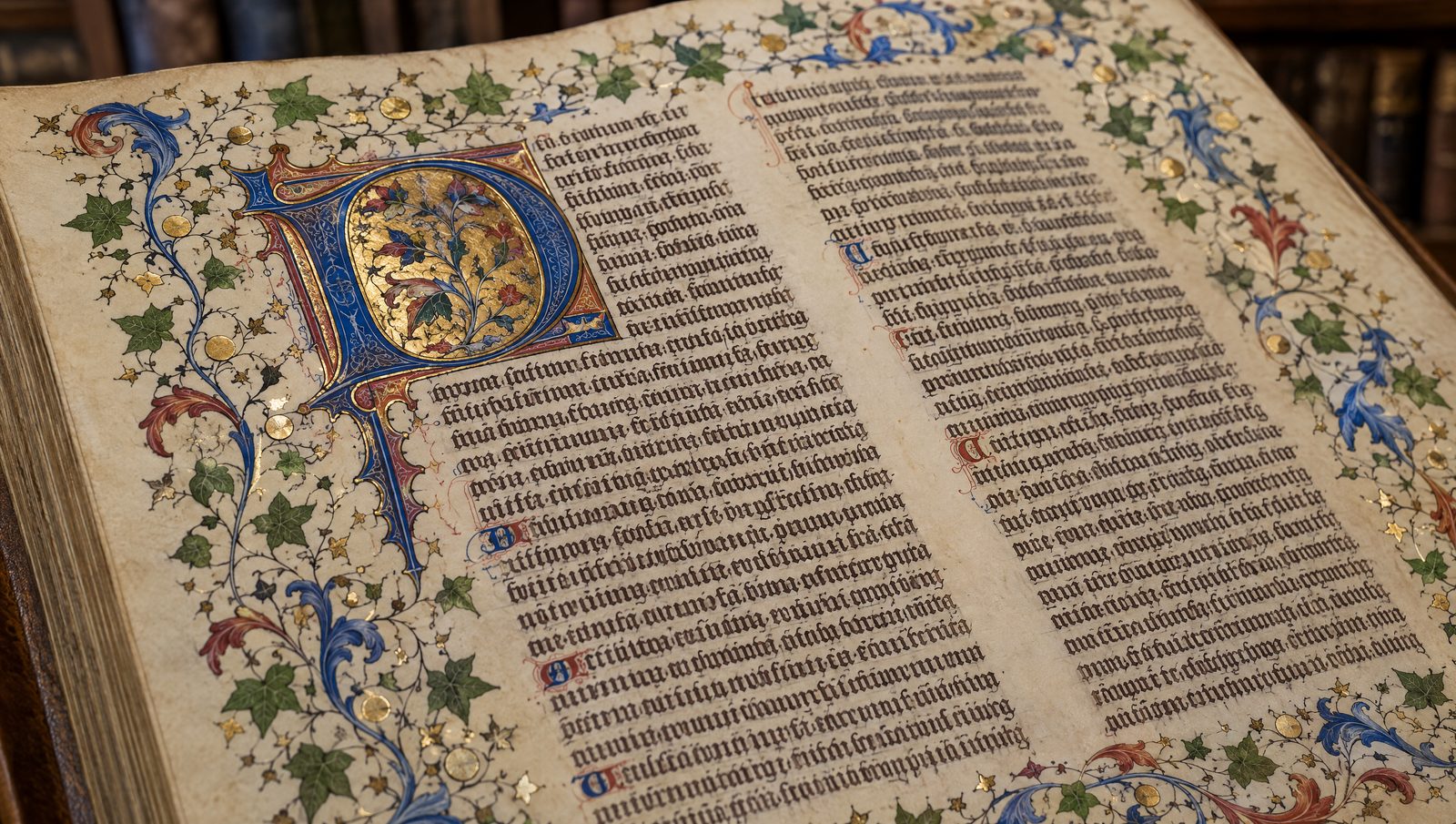
Three rioters go looking for Death
The Pardoner’s Tale is the sharpest short story in the Canterbury Tales, and it is told by a fraud. Chaucer’s Pardoner sells fake relics and admits it, then preaches against greed with a story he knows will loosen purses. In a Flemish town in plague time, three young drinkers hear a bell ring for a corpse and learn it was a friend of theirs, killed by a thief called Death. Drunk and furious, they swear brotherhood and set out to kill Death in turn. Under an oak they meet an old man who tells them Death is waiting up the path. What they find is eight bushels of gold florins. They agree to wait until dark to carry it home, and send the youngest to town for bread and wine. While he is gone the other two plan to stab him; while he is in town he buys rat poison for their bottles. He comes back, they kill him, they drink to celebrate, and the Pardoner lets the last line of the tale land on all three bodies. Then, without a pause, he asks the pilgrims for money, and the Host’s reply is unprintable here.
Gawain and the Green Knight
The poem survives in a single manuscript, British Library Cotton Nero A.x, written in the north-west Midlands dialect around 1400, by an author whose name we do not know. At Camelot on New Year’s Day a gigantic knight, green from skin to horse, rides into Arthur’s hall and proposes a game: any man may strike him with his axe, provided he accepts a return blow in a year and a day. Gawain takes the axe and beheads him. The Green Knight picks up his own head, which reminds Gawain of the appointment, and rides out. The following winter Gawain rides north through Wales and the Wirral to a castle where the lord proposes another game: each day’s winnings to be exchanged at night. The lord hunts; the lady of the castle tries to seduce Gawain; three times he gives back the kisses he receives, but on the third day he keeps a green girdle she swears will save his life. At the Green Chapel the axe falls twice without touching him and nicks his neck on the third stroke, once for the girdle he hid. The Green Knight was the lord all along. Gawain rides home in shame; the court laughs and adopts the green sash as a badge of honour.
Smithfield, June 1381
The Peasants’ Revolt is known from chronicles written by its enemies, chiefly the Anonimalle Chronicle of St Mary’s Abbey in York, Thomas Walsingham of St Albans and the Frenchman Jean Froissart, so every detail has to be read against the grain. The rising began in Essex at the end of May over a third poll tax in four years. By 13 June rebels from Kent under Wat Tyler were across London Bridge; they opened the prisons, burned the Savoy and on 14 June dragged Archbishop Sudbury and the Treasurer out of the Tower. The priest John Ball preached to them on the text that was already a proverb: when Adam dug and Eve spun, who was then the gentleman? On 15 June Richard II met Tyler at Smithfield, outside the walls. Tyler, by the chroniclers’ account, behaved with deliberate familiarity, rinsing his mouth and spitting in front of the king. The Mayor of London, William Walworth, struck him, a squire finished him, and the crowd drew bows. Richard rode forward alone and told them he would be their captain. He led them away to Clerkenwell while the militia gathered. The pardons he promised were revoked within weeks, and Ball was hanged at St Albans.
Margery Kempe writes her life
Margery Kempe was the daughter of a mayor of Lynn in Norfolk, born around 1373, married at twenty, the mother of fourteen children, a failed brewer and a failed miller. After a breakdown following her first birth she had visions of Christ, and in her forties she negotiated a vow of chastity with her husband and set off on pilgrimage: to Jerusalem by way of Venice, to Rome, to Santiago de Compostela, later to Danzig and Aachen. She wept, loudly and often, in churches, at meals and on the road, and her fellow pilgrims repeatedly tried to leave her behind. She was examined for heresy at Leicester and at York and talked her way out each time. In the late 1430s, unable to write, she dictated her life to a priest. The result, the Book of Margery Kempe, is the earliest surviving autobiography in English. It was known only from a few printed extracts until 1934, when the single manuscript turned up in the cupboard of a Lancashire country house during a search for ping-pong balls. It is now in the British Library.
How the language sounded
Middle English was written in the Latin alphabet, with two older letters hanging on: thorn, þ, for the sound of “th”, and yogh, ȝ, for a range of sounds including the one in “knight” and the “y” of “year”. Spelling was not standardised. The same scribe could write knight, knyght and knyȝt on one page, and a Kentish writer and a Yorkshire writer spelled very differently because they spoke very differently. Chaucer himself complained, at the end of Troilus and Criseyde, about the “gret diversite in Englissh and in writyng of oure tonge” and prayed that nobody would “myswrite” or “mysmetre” his poem. Books were copied by hand on parchment or paper.
The pronunciation of London English around 1400 differs from modern English in ways that are consistent and, once learned, easy to apply.
- The long vowels had their continental values. This is before the Great Vowel Shift, which began around 1400 and took two centuries. Name was “NAH-muh”, wif (wife) was “weef”, hous was “hoos”, fyve was “feev-uh”, goode was “GOH-duh”. The spelling of moon, house and wife still records the old sounds.
- Nothing was silent. The k in knight was pronounced, and the gh was a rasp in the throat, like German ich: roughly “k-nicht”. Wrong began with a w sound; folk kept its l.
- Final -e was usually a syllable. Soote (sweet) was “SOH-tuh”. In Chaucer’s verse the final -e is sounded when the metre needs it and dropped before a vowel, which is why his lines scan when read this way and limp when read as modern English.
- R was trilled or tapped wherever it was written, including at the ends of words.
- French loanwords kept French stress more often than now: natúre, licóur, coráge, with the last syllable sounded.
- Short vowels were close to modern northern English or Scots: that with an open “ah”, but with the vowel of “put”.
How do we know? Chaucer’s rhymes are the first witness: he rhymes soote with roote and licour with flour, and those pairs only work with the old vowels. His metre, a ten-syllable line with five beats, tells us which final -e’s were pronounced. The sixteenth-century spelling reformers who first described English sounds, John Hart among them, caught the Great Vowel Shift midway and let us run it backwards. Spellings in private letters, such as the Paston family’s from Norfolk, show how people heard words. Northern dialects and Scots preserve sounds London lost, and the French and Latin sources of thousands of borrowed words fix their original vowels.
The uncertainties are real but bounded. We cannot say exactly when the final -e stopped being heard in ordinary speech, only that it was dying in London by 1400 and that Chaucer’s immediate successors already mishandled it. The quality of the long open and close e and o is argued over. Dialects varied so much that a Londoner found the northern students of the Reeve’s Tale funny, and Chaucer gives them lines full of “I is” and “gang” and “sal” to prove it. Any single “Middle English pronunciation” is therefore a reconstruction of one educated London voice in one decade.
| Original | Say it | Meaning |
|---|---|---|
| Good morwe | gohd MOR-wuh | Good morning |
| How fare ye? | hoo FAH-ruh yay | How are you? |
| Gramercy | grah-MER-see | Thank you (from French grant merci) |
| What is youre name? | what is YOO-ruh NAH-muh | What is your name? |
| Ye / Nay | yay / nigh | Yes / No |
| I noot | ee NOHT | I don’t know (ne woot) |
| Wher is the chirche? | whair is thuh CHEER-chuh | Where is the church? |
| Fare wel | FAH-ruh wel | Goodbye |
Whan that Aprill with his shoures soote
The droghte of March hath perced to the roote,
And bathed every veyne in swich licour
Of which vertu engendred is the flour …When April with its sweet showers has pierced the drought of March to the root, and bathed every vein in such liquid by whose power the flower is engendered …
Geoffrey Chaucer, The Canterbury Tales, General Prologue, lines 1–4
Thousands of people can still recite these lines from school. Read aloud with the old vowels they turn into music: “Whan that AH-prill with his SHOO-res SOH-tuh”. The opening sentence runs for eighteen lines before it reaches its main verb, a piece of Latin-style architecture learned from Boccaccio and the French poets, and it ends not in Rome or Troy but in Canterbury, with ordinary English people wanting to travel after a long winter. That mixture of high craft and low company is the whole book in miniature. The Ellesmere and Hengwrt manuscripts, the two best witnesses, were both copied by the same London scribe, who has been identified, though not without argument, as Adam Pinkhurst, the man Chaucer teased in a short poem for his careless copying.
Maya reads these lines aloud in a reconstructed late-fourteenth-century London pronunciation, honestly labelled as a reconstruction, in a free Middle English session of fifteen minutes by phone.
Where to stand today
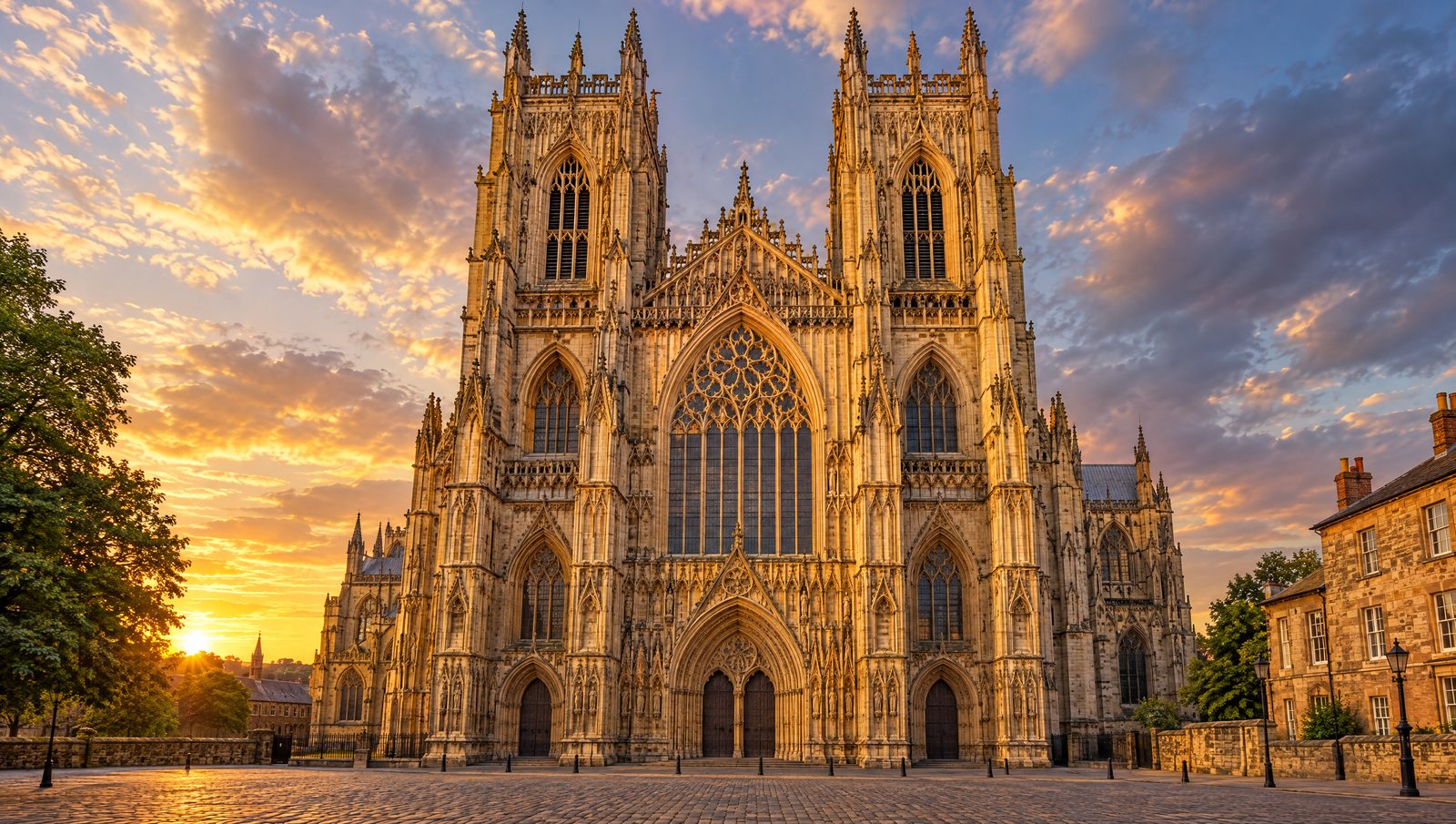
Canterbury Cathedral, Kent
The destination of Chaucer’s pilgrims is still the mother church of England. Becket’s shrine was destroyed on Henry VIII’s orders in 1538, but a single candle burns on the floor of the Trinity Chapel where it stood, and the steps up to it are worn into hollows by three centuries of knees. The Black Prince, hero of Poitiers, lies nearby under his bronze effigy, with copies of his helm and gauntlets above. The nave was rebuilt in Chaucer’s own lifetime, from 1377. The cathedral charges admission and closes to tourists during services; canterbury-cathedral.org has the day’s times. Evensong is free and is the best way to hear the building.
Southwark: the Tabard and Gower’s tomb
The pilgrims gathered at the Tabard Inn in Southwark, at the London end of the Canterbury road. The inn burned in 1676 and its replacement was demolished in 1873; a plaque in Talbot Yard, off Borough High Street, marks the spot, and the George Inn next door is the city’s last galleried coaching inn. A few minutes’ walk north, Southwark Cathedral was the priory church of St Mary Overie in Chaucer’s day, and holds the painted tomb of his friend John Gower, who died in 1408 with his head resting on his three books. Go on a weekday morning, when Borough Market between them is open and the church is quiet.
Westminster Abbey, Poets’ Corner
Chaucer was buried in Westminster Abbey in 1400 not as a poet but as a royal servant who had leased a house in the abbey garden. The grey marble tomb in the south transept was put up in 1556, and because Spenser was buried near him in 1599 the transept became Poets’ Corner. Richard II, who gave Chaucer his annuity of a tun of wine a year, lies in the chapel of Edward the Confessor with his first queen, Anne of Bohemia; Henry V is a few metres away. Tickets are timed and sell out in summer, so book online; Wednesday evening openings are cheaper and emptier.
The British Library, St Pancras
Two of the four texts in this guide exist in one copy each, and both are at the British Library. Cotton Nero A.x holds Sir Gawain and the Green Knight, Pearl, Patience and Cleanness, with crude but vivid paintings of the beheading. Additional MS 61823 is the Book of Margery Kempe. Neither is on permanent display, but the free Treasures gallery rotates its medieval manuscripts and usually shows something from the period. Check what is out before you go; the room is dim by design and rewards slow looking.
Norwich and King’s Lynn, Norfolk
Norwich was England’s second city in 1400, grown rich on worsted cloth, and the two great women writers of the age lived in Norfolk. Julian of Norwich received her sixteen visions in May 1373 and spent decades in a cell attached to St Julian’s Church, off King Street, writing them up as the Revelations of Divine Love; the church was bombed in 1942, and the rebuilt cell is a small, plain room anyone can sit in. Forty-five miles west, King’s Lynn keeps the chequered Trinity Guildhall of the 1420s, built just after her father’s years as mayor, the Minster she worshipped in, and the finest run of medieval merchant houses on the east coast. Both towns are quietest out of season, and the light off the Wash in winter is extraordinary.
York Minster and the Mystery Plays
The craft guilds of York were performing their cycle of biblical plays on wagons through the streets by 1376, and the full text of the York Mystery Plays, nearly fifty short dramas from Creation to Judgement, survives in a manuscript of the 1460s in Northern Middle English. The plays are still revived every few years, sometimes in the Minster itself. York Minster’s Great East Window, finished in 1408, is the largest expanse of medieval stained glass in Britain and was restored over a decade; the nave was being completed as Chaucer wrote. The Merchant Adventurers’ Hall of 1357 completes the picture. The Minster charges admission; morning light is best for the east window.
The Huntington Library, California
Not every Chaucer pilgrimage ends in England. The Ellesmere Chaucer, the most beautiful manuscript of the Canterbury Tales, was sold by the Earl of Ellesmere in 1917 to the railway magnate Henry Huntington and lives at his library in San Marino, outside Los Angeles. Its portraits of the pilgrims are the images reproduced in every textbook. The Huntington displays it in its exhibition hall on rotation with its Gutenberg Bible and Shakespeare folios, so check the current display before travelling. The ticket covers the gardens too.
Go deeper
- Geoffrey Chaucer, The Canterbury Tales, translated by Nevill Coghill (Penguin Classics) — the verse translation most people start with, still in print after seventy years; read it beside the original, not instead of it.
- The Riverside Chaucer, edited by Larry D. Benson (Oxford University Press) — the standard complete edition in the original Middle English, with glosses at the foot of each page and a pronunciation guide in the introduction.
- Sir Gawain and the Green Knight, translated by Simon Armitage (Faber and Faber / W. W. Norton) — a northern poet’s alliterative version, printed facing the Middle English text.
- Marion Turner, Chaucer: A European Life (Princeton University Press, 2019) — the best modern biography, organised by the places Chaucer lived and worked.
- The Geoffrey Chaucer Website (Harvard University) — free interlinear translations of the Tales with recordings of the Middle English.
Frequently asked questions
Is Middle English hard to learn?
For an English speaker it is the easiest historical language there is. Roughly four words in five on a page of Chaucer are recognisable once you know the spelling habits, the grammar is simpler than Old English and only slightly more inflected than modern English, and a glossed edition carries you through the rest. The real obstacles are false friends, words that look familiar and have moved: sely means blessed or innocent, not silly; nyce means foolish; lust is any pleasure. Most readers manage the General Prologue unaided within a few weeks.
How accurate is the reconstructed pronunciation?
For London English around 1400, good. Rhyme, metre, spelling and the later shift of the long vowels all agree, and the main features, continental vowels, sounded consonants and the final -e, are not disputed. Fine vowel quality and the exact point at which the final -e went silent are argued. Chaucer’s English was also one dialect of many: the Gawain poet in Cheshire and the York playwrights sounded markedly different, and we reconstruct their speech with less confidence.
What modern languages descend from Middle English?
Every variety of modern English descends from it: you are reading your own language before its vowels moved. Scots is the closest living relative of the northern Middle English of the York plays. Our spelling was largely fixed by Caxton and the Chancery clerks in the fifteenth century, just before the Great Vowel Shift changed how the words were said, which is why knight, though and through look the way they do.
Can I read the original texts after a few months?
Chaucer, yes, in a glossed edition. Langland’s Piers Plowman is harder, its vocabulary more native and its argument more tangled. Sir Gawain is the hardest of the great texts: its dialect is full of Norse-derived words that never entered standard English, and most readers keep a facing translation open. Kempe and Julian, in Norfolk prose, are surprisingly direct and make a good second step.
What is the best first trip for this era?
Do what the pilgrims did. Start in Southwark at the site of the Tabard, cross the river to Westminster Abbey, then take the train to Canterbury, under an hour from St Pancras; the sixty-mile road the pilgrims rode in three or four days can be walked in five along the North Downs Way. Add the British Library if a manuscript you care about is on display. A second trip, to York and Norfolk, shows you the England that did not speak like Chaucer.