
The world at the time
Old Church Slavonic is a language that was built on purpose. In 862 a prince in Moravia asked the Byzantine emperor for teachers who could explain Christianity to his people in their own speech, and the emperor sent two brothers from Thessaloniki who happened to speak the Slavic dialect of their home city. One of them designed an alphabet. Within a generation the language they wrote had become the liturgical and literary tongue of a Christian world stretching from the Adriatic to the upper Volga, and it remains, in later dress, the language of worship for most Orthodox Slavs today.
The Slavs themselves were newcomers to written history. They had spread across eastern and central Europe and deep into the Balkans in the sixth and seventh centuries, farming river valleys and living, as the Byzantine writers complained, without kings or cities. By the ninth century that was changing. In Moravia, roughly today’s Czech Republic and Slovakia, Prince Rastislav ruled a state strong enough to worry the Franks on his western border. In the Balkans the Bulgars, a Turkic warrior elite ruling a Slavic population, had built a khanate with its capital at Pliska whose ruler, Boris, accepted baptism from Constantinople around 864 and took the Christian name Michael. Far to the north-east, Scandinavian traders and warriors known as the Rus were establishing themselves on the river routes between the Baltic and the Black Sea, with Kyiv as their base from the 880s.
Byzantium in the 860s was recovering its confidence after the long quarrel over religious images, and the patriarch Photius was the most learned man of his age. Constantine, the younger of the two brothers, had studied under Photius, held the chair of philosophy at the imperial university and been sent on an embassy to the Khazars. His brother Methodius had governed a Slavic-speaking province before withdrawing to a monastery on Mount Olympus in Bithynia.
The Moravian mission of 863 lasted barely twenty years and ended in defeat. The brothers translated the Gospels, the Psalter and the liturgy, trained local clergy and travelled to Rome, where Pope Hadrian II approved the Slavic rite in 868. Constantine fell ill there, took monastic vows under the name Cyril and died on 14 February 869. Methodius was made archbishop of Pannonia, was imprisoned for more than two years by the Bavarian bishops who regarded Moravia as their territory, and died on 6 April 885. Within a year his disciples had been expelled and the Latin rite prevailed north of the Danube for good.
The refugees walked south to Bulgaria, and Boris welcomed them. The decades that followed are the reason the language survived. At Pliska and then at the new capital of Preslav, under Boris’s son Simeon, who ruled from 893 to 927 and called himself emperor of the Bulgarians and the Romans, a school of translators produced sermons, chronicles, a treatise on the six days of creation and a defence of the Slavic letters themselves. A second school grew up at Ohrid, on the lake in what is now North Macedonia, around Clement, who is said to have trained 3,500 pupils before his death in 916, and Naum, who died in 910. It was probably at Preslav that the simpler alphabet now called Cyrillic was devised, adapting Greek capitals and keeping the brothers’ original letters only for sounds Greek lacked.
Simeon’s Bulgaria fell to Byzantium in stages, finally in 1018, but by then the language had found its third home. Vladimir of Kyiv accepted baptism from Constantinople in 988 and ordered his people into the Dnieper to be christened, and Slavic books arrived in Rus ready-made from Bulgaria. The oldest dated East Slavic manuscript, the Ostromir Gospel, was copied in Novgorod in 1056–57. The great church of St Sophia in Kyiv, begun under Vladimir’s son Yaroslav in the 1030s, still carries on its walls the scratched prayers of eleventh-century worshippers. Serbian princes in the western Balkans adopted the same rite and letters, and for two centuries a monk in Kyiv, Preslav or Ohrid could read what a monk in any of the others had written.
Ordinary life in this world was agricultural and hard. People lived in sunken-floored houses of timber and clay, grew millet, wheat and rye, kept pigs and bees, and traded furs, wax, honey and slaves downriver for silk, wine and silver. Literacy was a monastic skill, and the earliest readers of Old Church Slavonic were priests and princes. Yet by the eleventh century merchants in Novgorod were scratching debts and love letters onto birch bark in the same alphabet, which tells you how fast a purpose-built language can escape its purpose.
The stories they told
The letters revealed
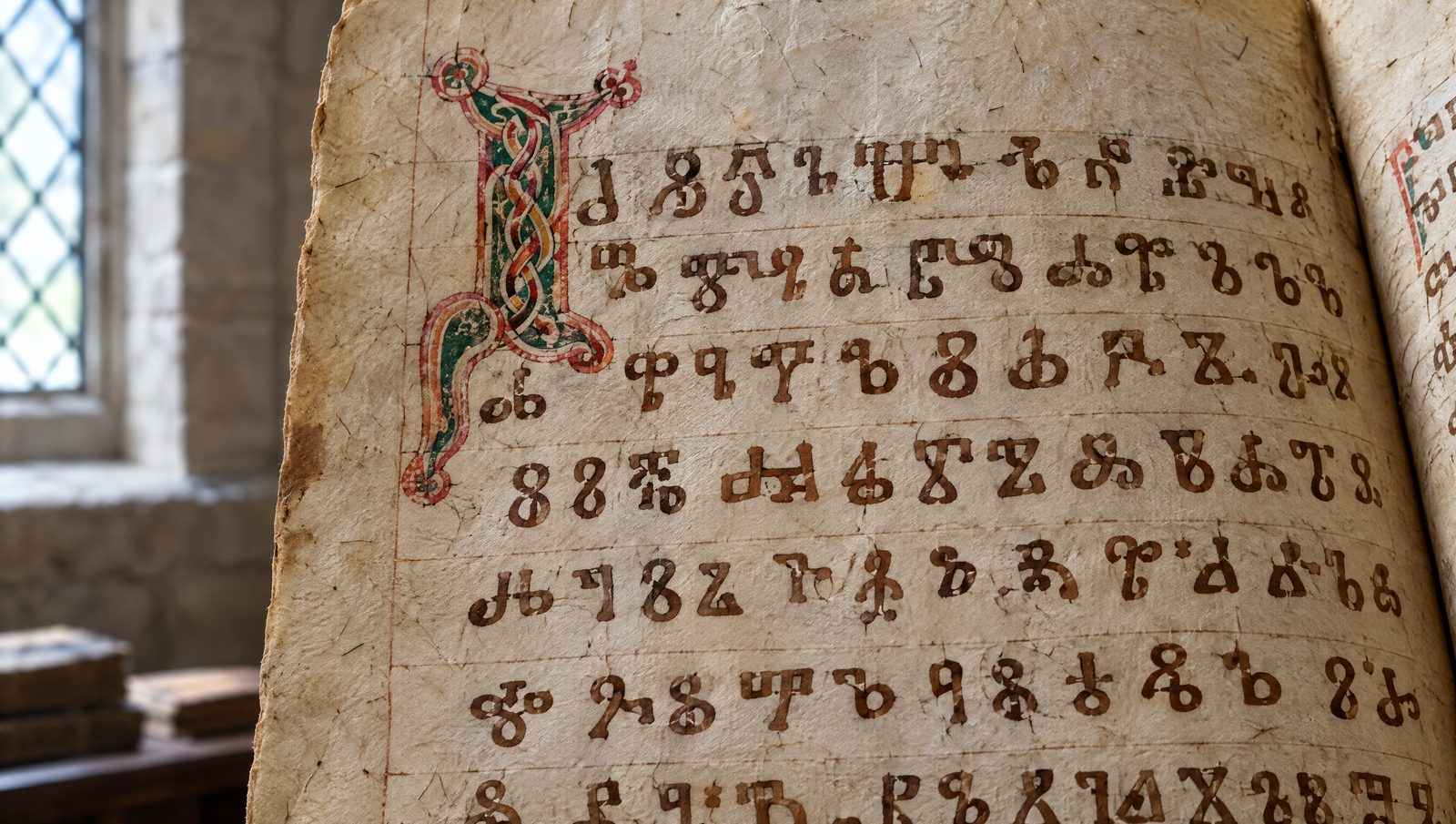
The Life of Constantine, written in Old Church Slavonic soon after his death, probably by someone who knew him, tells how the alphabet came to be. Rastislav’s envoys arrive in Constantinople and the emperor summons Constantine, who asks whether the Moravians have letters for their language. They do not, and he answers that writing a language without letters is like writing on water. The emperor presses him; Constantine goes away to pray with his companions, and God reveals the letters to him. He at once begins to write, and the first words he sets down are the opening of John’s Gospel: in the beginning was the Word. The story compresses years of work into a moment of grace, but the letters themselves support it. Glagolitic is not adapted from any existing alphabet; it is an invented system in which every sound of ninth-century Slavic has its own sign, built up from crosses, circles and triangles.
The dispute in Venice
On their way to Rome in 867 the brothers stopped in Venice, and the Life of Constantine records that the local clergy fell on him “like crows on a falcon”. Their argument was that God could properly be worshipped in only three languages, the Hebrew, Greek and Latin of the inscription on the cross. Constantine’s reply is the most quoted passage in the whole literature. Does God not send rain on all people equally, he asks, and does the sun not shine on all? Do we not all breathe the same air? How then can you be content that only three languages should praise God and all other peoples remain deaf and blind? He lists the nations who already have scripture in their own tongues, Armenians, Persians, Georgians, Goths and others, and quotes Paul to the Corinthians: I would rather speak five words with my understanding than ten thousand in a tongue. The Venetians, says the biographer, had no answer. The pope, when they reached him, laid the Slavic books on the altar of Santa Maria Maggiore and had the liturgy sung in Slavic in four Roman churches.
Hrabar defends the letters
Around 900 a Bulgarian monk who called himself Chernorizets Hrabar, “Hrabar the Monk”, wrote a short, combative essay, On the Letters. Before they were Christians, he says, the Slavs had no books and read and divined by “strokes and notches”. After baptism they tried to write with Greek and Latin letters “without order”, but how could you write the sounds in words like bogŭ or životŭ with Greek letters? Then God sent Constantine the Philosopher, who made thirty-eight letters, some after the Greek pattern and some after the Slavic speech. Hrabar’s best point is a comparison. The Greek alphabet, he says, was put together over centuries by many pagans whose names nobody is sure of; the Slavic letters were made by one holy man, whose name every Slav child knows, in the time of Michael emperor of the Greeks, Boris prince of Bulgaria, Rastislav of Moravia and Kocel of Pannonia. The essay won its argument, and survives in dozens of copies.
Vladimir chooses a faith
The Primary Chronicle, compiled in Kyiv around 1113, tells how the pagan prince Vladimir examined the religions on offer. Muslim Bulgars from the Volga explained their faith, but their ban on wine ended the conversation; Vladimir observed that drinking was the joy of the Rus and they could not live without it. Germans from the pope were sent away, and Khazar Jews were asked why, if their God loved them, they had lost their land. Then Vladimir sent envoys to see each religion in practice. Those who went to Constantinople were taken to the liturgy in Hagia Sophia and came home unable to describe it: they did not know whether they were in heaven or on earth, for on earth there was no such splendour, and they could not forget that beauty. Vladimir was baptised in 988, married the emperor’s sister and ordered the people of Kyiv to the river. The idol of the thunder god Perun was tied to a horse’s tail, beaten with sticks and thrown into the Dnieper. This is how the Rus chose to remember joining the world that wrote in Cyril’s letters.
How the language sounded
Old Church Slavonic was written in two alphabets. Glagolitic, the brothers’ own invention, is the script of most of the oldest manuscripts: the Codex Zographensis and Codex Marianus from Mount Athos, the Codex Assemanianus in the Vatican, the Kiev Folia, the Sinai Psalter. Cyrillic, devised in Bulgaria a generation later, takes the Greek uncial alphabet and adds signs for the Slavic sounds Greek lacks; it is the direct ancestor of the alphabets used today in Bulgaria, North Macedonia, Serbia, Ukraine and Russia. Both scripts were, for their time, almost perfectly phonetic, one letter for one sound, which is why linguists can describe the language with some confidence.
- Every syllable ended in a vowel. There were no closed syllables: mirŭ, “peace”, bogŭ, “god”, dĭnĭ, “day”.
- Two nasal vowels. The letters ѫ and ѧ stood for “on” and “en” said through the nose, as in French bon and fin. Rǫka, “hand”, was “RON-ka”; pętĭ, “five”, was “PEN-ti”. Polish still has these sounds.
- The yers. ъ and ь were very short vowels, something like the “u” in put and the “i” in pit cut off early. They were already falling silent in weak positions by the eleventh century, which is how dĭnĭ became den and dan and den’.
- Yat. The letter ѣ was a long, open “e” or “ya” sound, different from the plain e. Its later fate splits the Slavic world: “e” in Russian, “i” in Ukrainian, “ya” or “e” in Bulgarian.
- Soft consonants. Many consonants had palatal versions, pronounced with the tongue raised toward the roof of the mouth, and the two sounds spelt шт and жд, as in noštĭ, “night”, mark the language as the Slavic of the southern Balkans rather than of Moravia.
- Stress is unknown. The manuscripts do not mark it, and the modern languages disagree, so textbooks leave it out.
How do we know? The alphabets themselves are the main evidence; a script invented from scratch for a particular language is a snapshot of its sounds. Greek loanwords and Greek spellings of Slavic names give fixed points. The comparative method, working from the dozen modern Slavic languages back to their common ancestor, confirms the picture and fills gaps. And the language is not quite dead: Church Slavonic, its later form, has been sung continuously in Orthodox churches for eleven centuries, so the pronunciation of each national tradition, Russian, Bulgarian, Serbian, preserves clues even where it has drifted.
What is uncertain is almost everything above the level of the individual sound: stress, pitch, intonation, the exact quality of yat and the yers, and how far the written language matched anyone’s everyday speech. It was based on the Slavic dialect the brothers heard in Thessaloniki, but it was a book language from birth, and the copyists in Moravia, Bulgaria and Rus each let their own accent in.
| Original | Say it | Meaning |
|---|---|---|
| Радоуи сѧ — raduj sę | RAH-dooy sen | Rejoice, hail (the angel’s greeting to Mary) |
| Миръ вамъ — mirŭ vamŭ | MEE-ruh VAH-muh | Peace be with you |
| Азъ ѥсмь — azŭ jesmĭ | AH-zuh YES-mi | I am |
| Ѥи / Ни — jei / ni | YAY / nee | Yes / No |
| Чьто ѥстъ се? — čĭto jestŭ se? | CHI-to YES-tuh seh | What is this? |
| Къде ѥстъ? — kŭde jestŭ? | KUH-deh YES-tuh | Where is (he, it)? |
| Хвалѫ тебѣ въздаѭ — xvalǫ tebě vŭzdajǫ | HVAH-lon TEH-byeh vuhz-DAH-yon | I give you thanks |
| Иди въ миръ — idi vŭ mirŭ | ee-DEE vuh MEE-ruh | Go in peace |
All of these are Gospel phrases in the normalised spelling used by modern grammars; the manuscripts themselves vary from line to line. There is no attested everyday “hello” or “goodbye”, because nobody wrote down a conversation.
Ⰻⱄⰽⱁⱀⰻ ⰱⱑ ⱄⰾⱁⰲⱁ, ⰻ ⱄⰾⱁⰲⱁ ⰱⱑ ⱁⱅⱏ ⰱⱁⰳⰰ, ⰻ ⰱⱁⰳⱏ ⰱⱑ ⱄⰾⱁⰲⱁ.
Искони бѣ слово, и слово бѣ отъ бога, и богъ бѣ слово.
Iskoni bě slovo, i slovo bě otŭ boga, i bogŭ bě slovo.In the beginning was the Word, and the Word was with God, and the Word was God.
John 1:1, the opening of the Codex Assemanianus and of the Ostromir Gospel
According to his biographer these were the first words Constantine wrote in his new alphabet, and they open the Gospel lectionaries that were the first Slavic books, because the church year began at Easter with John. The sentence shows how close the language still is to its modern descendants. Slovo, “word”, is the same in Russian, Serbian and Bulgarian; bogŭ is bog everywhere; iskoni, “from the beginning”, lives on in Russian iskonno, “from time immemorial”. And Slověne, the Slavs’ own name for themselves, was heard by their medieval writers as “the people of the word”, the ones who could speak, as against the Němĭci, the dumb ones, which is still the Slavic word for Germans.
Maya reads these aloud in a reconstructed pronunciation, honestly labelled as a reconstruction, in a free Old Church Slavonic session of fifteen minutes by phone.
Where to stand today
Ohrid, North Macedonia
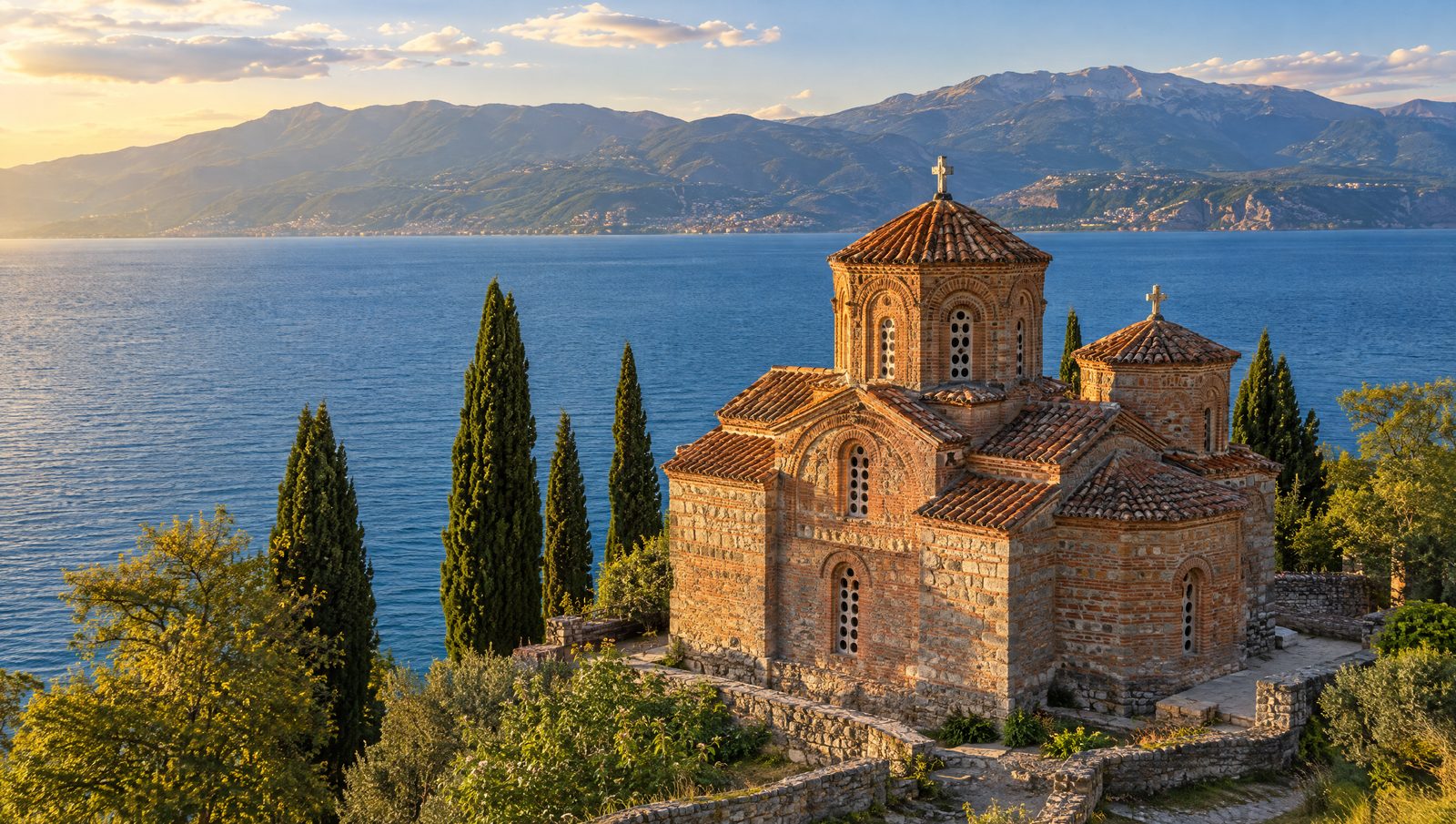
No place holds the era better than Ohrid. On the Plaošnik hill above the old town, the church of St Clement and St Panteleimon was rebuilt in 2002 on the foundations of the monastery Clement founded in 893, and his relics lie inside; the excavated outlines of his school and an earlier basilica with mosaic floors surround it. Below, the cathedral of St Sophia has eleventh-century frescoes from the years when Ohrid was an archbishopric of the Byzantine empire. Thirty kilometres south along the lake, the monastery of St Naum sits on a cliff above the springs that feed the lake, with Naum’s tomb in a side chapel where pilgrims press an ear to the stone to hear his heartbeat. Visit in May or September, when the crowds are thin, and climb Plaošnik in the morning light.
Pliska and Veliki Preslav, Bulgaria
The two capitals of the First Bulgarian Empire lie an hour apart in the rolling country of north-eastern Bulgaria, near Shumen. Pliska is vast and mostly foundations: the outer earthwork encloses twenty-three square kilometres, and the Great Basilica, nearly a hundred metres long, was the biggest church in Europe when Boris built it after his baptism. Preslav is more intimate and more rewarding. The Round Church, built under Simeon around 907, keeps its circular colonnade and its gold-leaf and painted-ceramic decoration in fragments; the site museum displays the Preslav gold treasure and the ceramic icon of St Theodore from the nearby Patleina monastery. Go with your own transport and allow a full day.
Sofia: the National Archaeological Museum
The former Ottoman mosque that houses the National Archaeological Museum in the centre of Sofia holds the single most important dated monument of early Cyrillic: the tombstone that Tsar Samuel raised in 993 for his parents and brother, found near Lake Prespa and carved in letters that any Bulgarian or Russian schoolchild can still read. The museum is closed on Mondays in winter and is quietest first thing; it pairs well with the Alexander Nevsky Cathedral’s crypt gallery of icons a few minutes’ walk away.
Thessaloniki, Greece
The brothers were born in Thessaloniki, then the second city of Byzantium with a Slavic-speaking countryside at its gates, and the churches they knew are still in use. The basilica of St Demetrios, the city’s patron, has been rebuilt after fires but keeps seventh-century mosaics and the crypt where the saint was believed to lie. The Rotunda, a Roman mausoleum turned church, has mosaics older still. The Museum of Byzantine Culture gives the context and is worth a long morning.
Rome: the Basilica of San Clemente
Cyril died in Rome and was buried in the church of San Clemente, near the Colosseum, three buildings stacked one on another: a twelfth-century basilica over a fourth-century one over a Roman house and a shrine of Mithras. His tomb is in a chapel of the lower church, surrounded by plaques of thanks in every Slavic language, and an eleventh-century fresco nearby shows the translation of St Clement’s relics, which Cyril himself had brought back from Crimea. The excavations charge a separate admission from the free upper church; book online for the morning, when the lower levels are empty and cool.
Kyiv: St Sophia
The cathedral of St Sophia in Kyiv, begun under Yaroslav the Wise in the 1030s, is the one great building of early Rus to survive largely intact, its baroque exterior wrapped around eleventh-century walls, mosaics and frescoes. The Virgin Orans in the apse looks down on more than seven thousand graffiti scratched by medieval visitors in the alphabet of this guide, among them prayers and the record of Yaroslav’s death in 1054. Yaroslav’s marble sarcophagus is in the north aisle. Ukraine is at war; check your government’s travel advice before planning any visit, and know that the cathedral has kept opening through it.
Go deeper
- Horace G. Lunt, Old Church Slavonic Grammar (Mouton de Gruyter, 7th edition) — the standard reference grammar in English, compact and exact, with a reading of the sound system that most textbooks follow.
- Marvin Kantor, Medieval Slavic Lives of Saints and Princes (Michigan Slavic Publications) — English translations of the Life of Constantine and Life of Methodius alongside the Slavonic text; the source for the stories above.
- The Russian Primary Chronicle, translated by Samuel Hazzard Cross and Olgerd P. Sherbowitz-Wetzor — the Laurentian text of the chronicle, with Vladimir’s choice of faith and the baptism of Rus.
- Francis Dvornik, Byzantine Missions among the Slavs (Rutgers University Press) — the classic account of the Moravian mission and its aftermath by the scholar who did most to establish the historical record.
- Alexander M. Schenker, The Dawn of Slavic (Yale University Press) — an introduction to Slavic philology for the general reader, covering the early Slavs, the alphabets and the oldest texts.
- TITUS, University of Frankfurt — a free online corpus of the canonical Old Church Slavonic manuscripts, including the Codex Marianus and Codex Zographensis, in searchable transcription.
Frequently asked questions
Is Old Church Slavonic hard to learn?
If you know any Slavic language, it is the easiest ancient language you will ever meet: the vocabulary is largely familiar and the grammar is a fuller version of what you already use. Starting from English alone it is harder, with seven cases, three numbers including a dual, and a verb system richer than Latin’s. The spelling is phonetic and the texts are Gospels and saints’ lives whose content you can follow in translation, so you are never reading blind.
How accurate is the reconstructed pronunciation?
For the consonants and the basic vowel inventory, good; the alphabets were designed for this language and the comparative evidence agrees with them. The nasal vowels and the yers are secure as categories, though their exact quality is debated. Stress and intonation are simply unknown. Anyone reading Old Church Slavonic aloud today, Maya included, is giving a scholarly reconstruction coloured by one or other modern Slavic accent, not a recording of ninth-century Thessaloniki.
What modern languages descend from it?
Strictly, none: Old Church Slavonic was a written language based on a South Slavic dialect, and the modern languages descend from the spoken dialects of their own regions. Its closest living relatives are Bulgarian and Macedonian. But its influence is everywhere. Church Slavonic, its direct continuation, is still the liturgical language of the Russian, Serbian, Bulgarian and other Orthodox churches. Russian took much of its learned vocabulary from it. And the Cyrillic alphabet, used by some 250 million people, is its most visible legacy.
Can I read the original texts after a few months?
Yes, with a Gospel in your own language open beside them. The Gospel manuscripts are the natural place to start because you know the story and the sentences are short. The Life of Constantine is harder but more rewarding, and Hrabar’s essay is short enough to read in an afternoon once you have the grammar. Reading the manuscripts themselves, in Glagolitic, is a separate skill that takes a few weeks of practice with the alphabet and then becomes a pleasure.
What is the best first trip for this era?
Ohrid, with Sofia and the two Bulgarian capitals. Fly to Sofia, spend a day at the Archaeological Museum, drive east to Pliska and Preslav, then south across the border to Ohrid for three days on the lake. Ten days covers it. Add Thessaloniki, four hours from Ohrid by road, if you want to begin where the brothers began.