
The world at the time
The Coptic Church still counts its years from AD 284, the accession of the emperor Diocletian. His persecution of Christians, which began in 303 and fell hardest on Egypt, is remembered there as the Era of the Martyrs, and the choice of starting point tells you how the Egyptians of this period understood themselves: as the people who had suffered for the faith and would not bend. Within a generation of Diocletian the empire was Christian. Within two, the deserts on either side of the Nile were filling with monks, and the language of the pharaohs, written now in Greek letters, was being used to translate the Bible.
Egypt in AD 300 was the richest province of the Roman east. Its grain fed Rome and then Constantinople; its papyrus supplied the empire’s paperwork, and because papyrus survives in the dry soil, we know more about ordinary life here than anywhere else in antiquity. The towns of the Nile valley ran on Greek, the language of administration and of the educated; the villages spoke Egyptian. Alexandria, the second city of the empire, held the most quarrelsome bishops in Christendom.
Christianity reached Egypt early and spread first in Greek. What made the Egyptian church different was the desert. Around 270 a young farmer named Antony gave away his land and went to live among the tombs, then in an abandoned fort, then on a mountain by the Red Sea; by his death in 356 he was the most famous man in the Christian world. Pachomius, a former soldier, organised the first communal monasteries at Tabennisi in Upper Egypt around 320, with rules, work rotas and thousands of monks. In the salt marshes of Wadi Natrun, west of the Delta, the settlements of Nitria, Kellia and Scetis became the model for monasticism everywhere; Benedict, Cassian and the Irish all looked here.
The monks wrote in Egyptian, and Egyptian had changed its clothes. From the third century, scribes abandoned the old scripts and wrote the language in the Greek alphabet, adding a handful of letters for sounds Greek lacked. We call this stage Coptic, from the Arabic word for Egyptian. In the southern dialect, Sahidic, the whole Bible was translated by the fourth century. In 1945 farmers near Nag Hammadi dug up a jar of thirteen leather-bound Coptic books from the same era, including the Gospel of Thomas and a library of Gnostic texts that the bishops had tried to suppress.
The great Coptic writer was Shenoute, abbot of the White Monastery near Sohag from about 385 until his death around 465, who ruled thousands of monks and nuns, wrote sermons and letters of ferocious eloquence, and smashed pagan temples in his spare time. His lifetime also saw the last hieroglyphic inscription, carved at Philae in 394, the murder of the philosopher Hypatia by a Christian mob in Alexandria in 415, and the Council of Chalcedon in 451, which deposed the patriarch Dioscorus over the definition of Christ’s nature. Egypt refused the council’s decision, and the Coptic Church has stood apart from Constantinople and Rome ever since.
Ordinary life went on beneath the theology. The papers of a sixth-century village lawyer and poet, Dioscorus of Aphrodito, show a world of tax disputes, leases and bad Greek verse. Weavers turned out the tapestry-woven tunics now in every major museum. Pilgrims went to the shrine of St Menas west of Alexandria and brought back clay flasks of holy water. Villagers built houses inside the temple of Ramesses III at Medinet Habu and called the town Jeme.
In 639 the Arab general Amr ibn al-As entered Egypt, and by 642 Alexandria had surrendered. Many Copts at first preferred Muslim rulers who taxed them to Byzantine ones who called them heretics. But Arabic became the language of government in 706, and over the following centuries it replaced Coptic in the towns and then the villages. By AD 1000, the end of this guide’s period, Coptic was already a language of the church and the countryside, and bishops were beginning to write theology in Arabic. It survived as a spoken tongue in pockets of Upper Egypt for several centuries more, and it is still sung every Sunday in Coptic churches from Cairo to Toronto.
The stories they told
Antony among the tombs
The Life of Antony, written in Greek by the patriarch Athanasius soon after the hermit’s death in 356 and translated into Coptic and Latin within decades, was the best-selling biography of the ancient world. Antony is a prosperous farmer’s son near Herakleopolis who hears the Gospel read in church, “sell what you have and give to the poor”, and does it. He takes up residence in a tomb outside the village, where demons in the form of lions, bears, snakes and scorpions beat him so badly that a friend carries him home for dead. He goes back. Later he walls himself into a deserted fort across the river for twenty years, living on bread thrown over the wall, while visitors outside hear what sound like crowds shouting inside. When they finally break down the door he walks out, Athanasius says, neither fat from idleness nor wasted from fasting, exactly as they had last seen him, and begins to heal the sick. Antony ends his days on the Inner Mountain near the Red Sea, where his monastery still stands, and asks that his grave be kept secret so that no one can make a relic of him.
The basket of sand
The Sayings of the Desert Fathers, collected in Greek and Coptic in the fifth century, are short stories about the monks of Scetis told by the people who knew them. Many concern Moses, a former slave and gang leader, Ethiopian by origin, who had been converted in the desert and become one of its most respected elders. In the best-known story a brother in Scetis commits a fault, and the elders call a council to judge him. They send for Moses, who refuses to come, and send again. He gets up, takes an old basket with a hole in it, fills it with sand, and walks to the meeting with the sand trickling out behind him. The others come out to meet him and ask what it means. “My sins run out behind me,” he says, “and I do not see them, and today I am coming to judge the errors of another.” They forgive the brother. Other stories show Moses telling a disciple who asks for a word to “go, sit in your cell, and your cell will teach you everything”, and dying with his companions when Berber raiders attacked Scetis in 407, having refused to flee because, he said, he had lived by the sword and would die by it.
Shenoute and the refugees
Shenoute’s own writings fill what were once nine volumes of sermons and letters, mostly surviving as torn pages scattered through European libraries, and his Life was written by his successor Besa. He is not a gentle figure: he beats monks who break the rule, breaks into a landowner’s house to smash his idols, and denounces magistrates and his own nuns with equal energy. But Besa also records that when the nomads called Blemmyes raided Upper Egypt, probably in the 440s, and the countryside fled before them, Shenoute opened the White Monastery to the refugees. By his account 20,000 people lived within the walls for three months, fed from the monastery’s stores; the monks baked bread day and night, doctors were brought in, and the dead were buried at the monastery’s expense. Shenoute’s sermons from these years rage against the wealthy who hoard grain while the poor starve. His Coptic, which later generations treated as the standard of the language, is at its most direct when describing what hunger does to a village. He died, Besa says, at the age of 118, which is probably a round number for a very long life.
The jar at Nag Hammadi
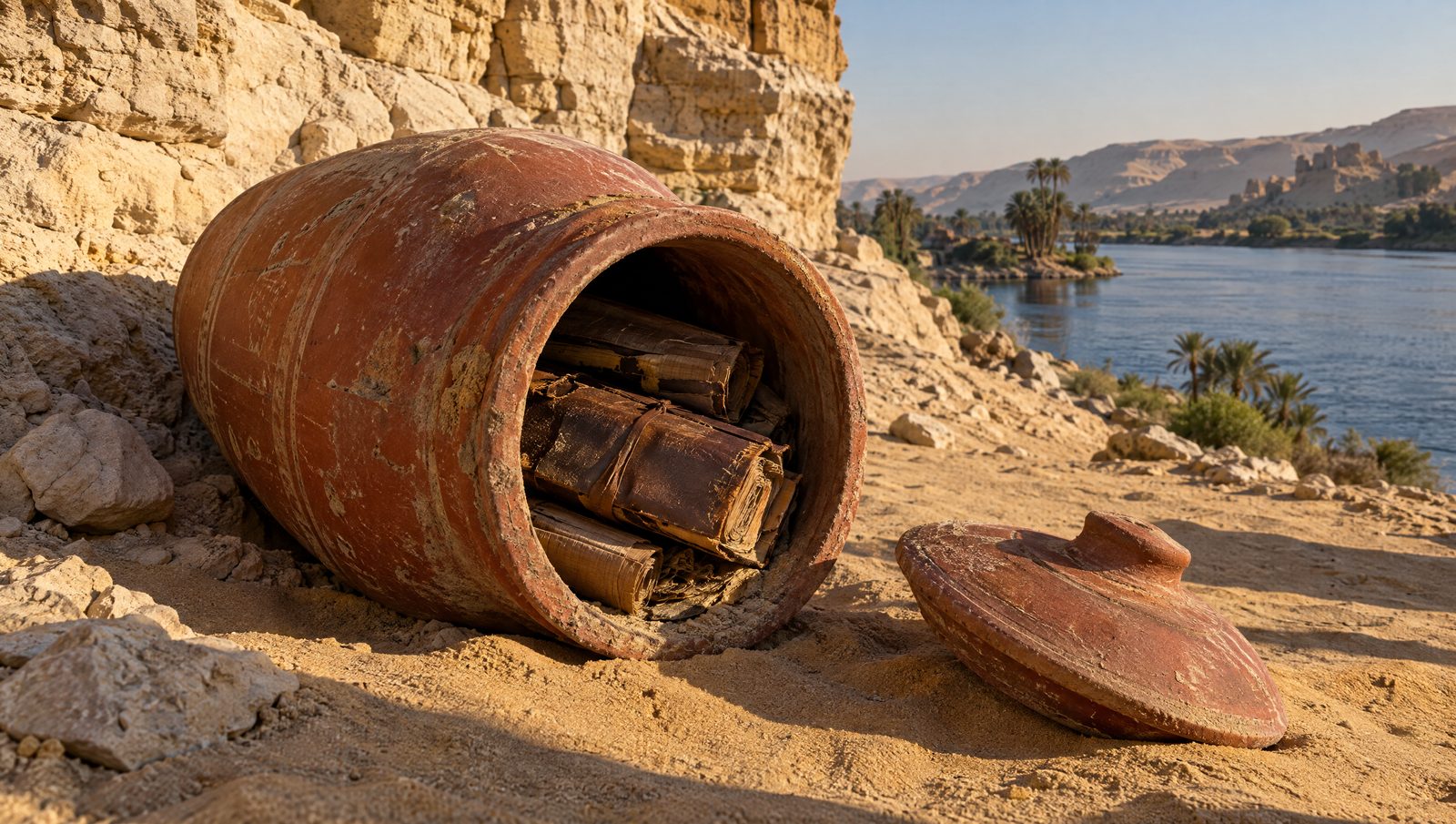
In December 1945, a farmer named Muhammad Ali al-Samman and his brothers were digging for fertiliser at the foot of the cliffs near Nag Hammadi when they struck a sealed red jar about a metre tall. Inside were thirteen papyrus codices bound in leather, written in Coptic, which had been buried around AD 400, perhaps by monks from the nearby Pachomian monastery after the patriarch ordered heretical books destroyed. The brothers took them home, and their mother burned some pages as kindling. The rest passed through dealers to the Coptic Museum in Cairo, where they remain. The find included the only complete copy of the Gospel of Thomas, 114 sayings attributed to Jesus, some familiar from the New Testament and some not, with no narrative, crucifixion or resurrection. Alongside it were the Gospel of Philip, the Secret Book of John and some forty other works of the kind the bishops called Gnostic, in which the material world is the botched work of a lesser god and salvation is knowledge of one’s own divine origin. All are Coptic translations of Greek originals, most of which are otherwise lost. Their discovery rewrote the history of early Christianity.
How the language sounded
Coptic is the only stage of Egyptian whose vowels we can read, because it was written in an alphabet that had them. The script is the twenty-four Greek letters plus six borrowed from Demotic, the cursive script of late pharaonic Egypt: ϣ for sh, ϥ for f, ϩ for h, ϫ for j, ϭ for a sound close to ky or ch, and ϯ for the syllable ti. The northern dialect, Bohairic, adds ϧ for a harsher kh. A stroke above a consonant, as in ⲙ̄ⲡⲏⲩⲉ, marks it as carrying a syllable on its own, with no vowel. Scribes wrote in a clear upright hand with no spaces between words; the Nag Hammadi books are among the earliest bound codices anywhere.
There are several dialects, and the one used here is Sahidic, the literary standard of Upper Egypt from the fourth to the tenth century and the dialect of Shenoute, the Nag Hammadi library and most of the early Bible. Bohairic, from the Delta, became the church’s standard after the eleventh century and is what you hear in a Coptic liturgy today.
- Vowels, at last. Short e and o were written ⲉ and ⲟ, long ē and ō were ⲏ and ⲱ; ⲁ was a, ⲓ was i, and ⲟⲩ was u.
- Strong stress. Every word had one stressed syllable, and unstressed vowels shrank or vanished. This is why Sahidic words are full of consonant clusters with a stroke over them, like ⲛ̄ and ⲙ̄, where a syllable is carried by n or m alone.
- No native b, g or d. The Greek letters ⲃ, ⲅ and ⲇ appear almost only in Greek loanwords; in Egyptian words ⲃ was probably a soft v-like sound. Native Coptic had p, t and k, and the “soft” sounds of Greek were foreign to it.
- Articles glued on the front. “The” is ⲡ- for masculine, ⲧ- for feminine and ⲛ- for plural, attached to the noun: ⲡⲣⲱⲙⲉ, “the man”; ⲧⲉⲥϩⲓⲙⲉ, “the woman”; ⲛⲣⲱⲙⲉ, “the men”.
- A fifth of the words are Greek. Centuries of bilingualism left Coptic with Greek vocabulary for religion, law and abstraction, so that “peace” is ⲉⲓⲣⲏⲛⲏ and “soul” is ⲯⲩⲭⲏ, Egyptianised in pronunciation.
- Two h-sounds and a kh. ϩ was an ordinary h; ϧ in Bohairic, and the combination ⲭ in some native words, were a rougher sound made in the throat, inherited from pharaonic Egyptian.
How we know is unusually straightforward: the alphabet itself. Greek letters had known values, Greek loanwords show how Egyptians heard Greek sounds, and medieval Arabic transcriptions of Coptic words add a second check. Comparing Coptic with hieroglyphic and Demotic spellings of the same words lets Egyptologists work backward to the vowels of the pharaohs, which is the main reason every Egyptologist learns Coptic.
The uncertainties are real but bounded. The exact quality of the short vowels, the pronunciation of ϭ and ϫ, which may have been closer to ky and ty or to ch and j, and the value of ⲃ are debated. There is also a modern complication: in 1858 the Coptic Church reformed its liturgical pronunciation to match modern Greek, so that ⲃ became v and ⲏ became ee, and the reconstruction of the older Bohairic sound, with its b and its long ē, had to be recovered from manuscripts and from the memory of a few villages. The table below follows the scholarly reconstruction of Sahidic, as taught in Layton’s grammar.
| Original | Say it | Meaning |
|---|---|---|
| ϯⲣⲏⲛⲏ ⲛⲏⲧⲛ̄ — tirēnē nētn | tee-RAY-nay NAY-tn | Peace be with you (John 20:19) |
| ⲡⲛⲟⲩⲧⲉ — pnoute | PNOO-teh | God |
| ⲡⲣⲱⲙⲉ — prōme | PROH-meh | The man, the person |
| ⲁⲛⲟⲕ — anok | a-NOK | I |
| ⲕⲏⲙⲉ — kēme | KAY-meh | Egypt (literally “the black land”) |
| ⲙⲟⲟⲩ — moou | MOH-oo | Water |
| ⲥⲉ / ⲙ̄ⲙⲟⲛ — se / mmon | seh / m-MON | Yes / No |
| ⲟⲩⲁ, ⲥⲛⲁⲩ, ϣⲟⲙⲛ̄ⲧ — oua, snau, šomnt | oo-AH, snow, SHOMNT | One, two, three |
ⲡⲉⲛⲉⲓⲱⲧ ⲉⲧϩⲛ̄ ⲙ̄ⲡⲏⲩⲉ ⲙⲁⲣⲉ ⲡⲉⲕⲣⲁⲛ ⲟⲩⲟⲡ
peneiōt ethn mpēue mare pekran ouopOur Father who is in the heavens, may your name be made holy.
Matthew 6:9, Sahidic New Testament
The opening of the Lord’s Prayer shows the machinery of the language in one line. Pen-eiōt is “our father”, the possessive glued to the front; et-hn-m-pēue is “who is in the heavens”, a relative particle, a preposition, a plural article and a noun run together; mare is an optative marker, “let”, “may”, that Coptic puts before a verb instead of changing its ending; pek-ran is “your name” with the masculine possessive pek-; and ouop is “be pure”. The word ran, name, is the word hieroglyphs wrote as rn three thousand years earlier, now at last with its vowel. The prayer is still sung in Bohairic in Coptic churches today, the same words in a slightly different accent.
Maya reads these aloud in a reconstructed Sahidic pronunciation, honestly labelled as a reconstruction, in a free Coptic session of fifteen minutes by phone.
Where to stand today
The Coptic Museum and Old Cairo
Inside the walls of the Roman fortress of Babylon in Old Cairo, the Coptic Museum holds the Nag Hammadi codices, the carved friezes and painted niches from the monasteries of Bawit and Saqqara, and the best collection of Coptic textiles anywhere. A few steps away are the Hanging Church, built over a Roman gate, and the church of St Sergius, with its crypt where tradition says the Holy Family sheltered. Take the Metro to Mar Girgis station, which opens directly onto the site; the museum is calm on weekday mornings and the churches are busiest on Sundays and Coptic feast days.
The monasteries of Wadi Natrun
Ninety kilometres northwest of Cairo on the Alexandria desert road, four monasteries still occupy the valley the monks called Scetis. The Monastery of the Syrians keeps wall paintings from the seventh to thirteenth centuries, uncovered under plaster since 1991, and a library that once held the oldest dated Syriac manuscripts in existence. St Bishoy and St Macarius are large working communities; the Monastery of the Romans is the quietest. All four admit visitors, with modest dress and no entry during Lent at some houses; a car and driver from Cairo for the day is the practical way to see Egypt‘s oldest living religious landscape.
The Monastery of St Antony, Red Sea
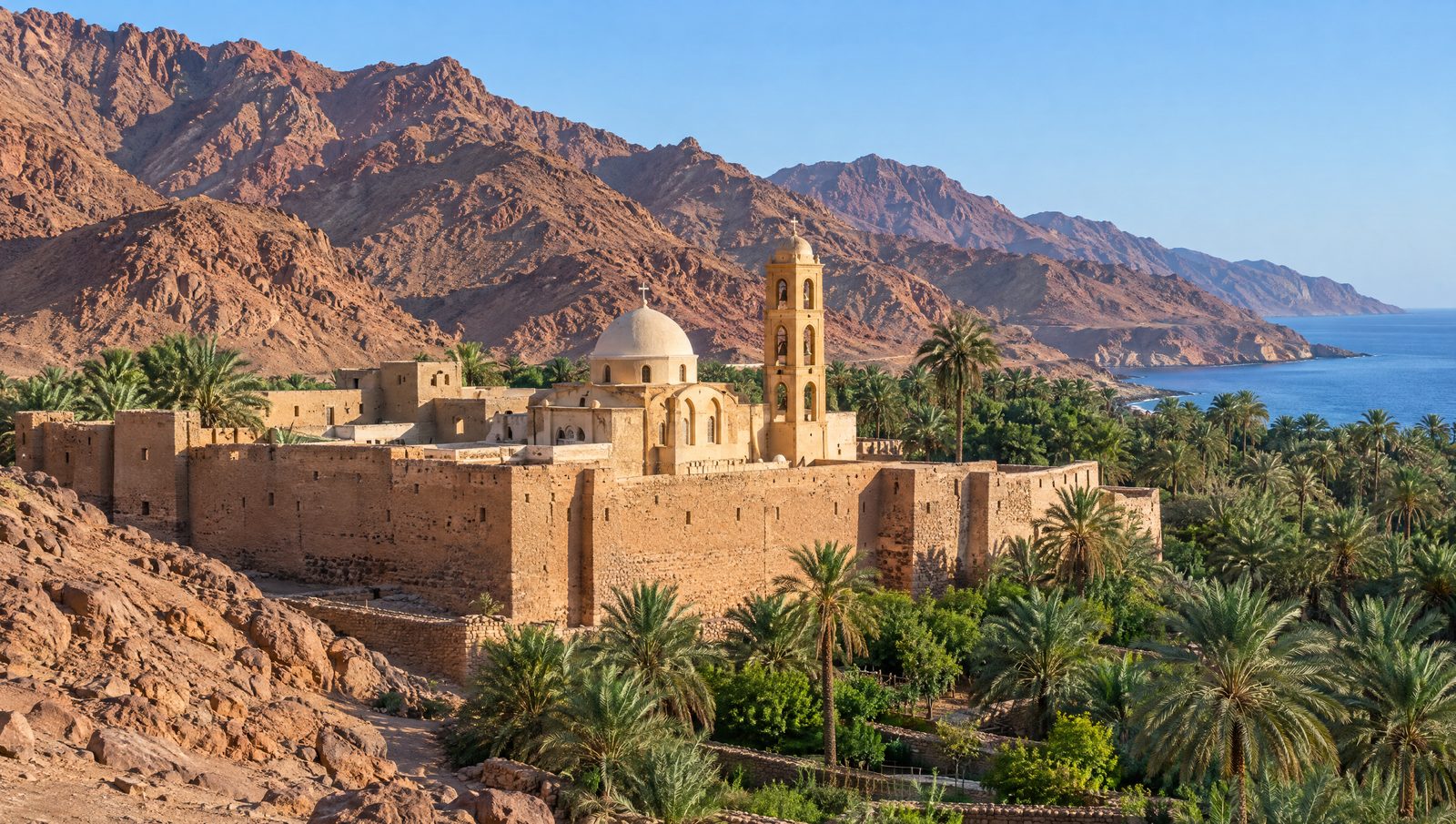
At the foot of the mountain where Antony spent his last decades, about 330 kilometres southeast of Cairo, the monastery is one of the oldest in the world and has been continuously inhabited, with interruptions for raids, since the fourth century. The old church holds the finest medieval wall paintings in Egypt, dated 1232–33 and cleaned by an international team between 1996 and 2002. A path behind the monastery climbs 270 metres to Antony’s cave in about forty-five minutes; go at first light, when the Red Sea is visible across the desert and before the heat makes the steps a trial.
The White and Red Monasteries, Sohag
Across the Nile from Sohag in Upper Egypt, the church of Shenoute’s White Monastery, built around 440, stands inside walls that slope inward like a pharaonic temple, built from the limestone of the pagan temples he demolished. Nearby, the smaller Red Monastery church has had its painted sanctuary cleaned since 2002 to reveal layers of fifth- and sixth-century colour that change how late antique Egyptian art is understood. Both are easy to reach from Sohag, on the Cairo to Luxor railway; a local driver can combine them with Akhmim in a morning.
The Monastery of St Simeon, Aswan
On the west bank of the Nile opposite Aswan, a short climb from the river through the sand, the fortress-like monastery known as St Simeon’s was built in the seventh century, rebuilt in the tenth, and abandoned in the thirteenth after raids. It is the most complete Coptic monastery ruin in Egypt: a two-storey keep with cells, a basilica with surviving painted apse, a bakery, oil presses and the latrines. Late afternoon gives the best light on the mud-brick upper storey and a view over the desert toward the tombs of the nobles.
The Louvre, Paris
French excavations at the monastery of Bawit in Middle Egypt between 1901 and 1913 gave the Louvre in Paris the carved capitals, painted niches and wooden doors with which it has reconstructed a Coptic church in its galleries of Roman and Coptic Egypt, alongside tapestry tunics and the painted icon of Christ with his arm around the abbot Mena, one of the oldest icons to survive anywhere. The Coptic rooms are on the lower ground floor of the Denon wing, rarely crowded, and a good first hour before the Egyptian galleries fill.
Go deeper
- Athanasius, The Life of Antony, translated by Tim Vivian and Apostolos Athanassakis (Cistercian Publications) — the Greek life with the Coptic version alongside; Robert Gregg’s translation in the Classics of Western Spirituality series is also good.
- Benedicta Ward, The Sayings of the Desert Fathers (Cistercian) and The Desert Fathers (Penguin Classics) — the alphabetical collection in full, and a shorter selection with an introduction.
- Marvin Meyer (ed.), The Nag Hammadi Scriptures (HarperOne) — the complete library in translation with introductions to each text.
- Bentley Layton, Coptic in 20 Lessons (Peeters) — the standard introduction to Sahidic, with exercises drawn from the Bible and the Sayings; his larger A Coptic Grammar is the reference.
- Gawdat Gabra, Coptic Monasteries: Egypt’s Monastic Art and Architecture (American University in Cairo Press) — a site-by-site guide with plans and photographs, by the former director of the Coptic Museum.
Frequently asked questions
Is Coptic hard to learn?
Easier than any other stage of Egyptian, because the alphabet is almost Greek and the vowels are written. The grammar is unlike anything European: verbs do not conjugate but sit inside chains of prefixes that mark tense, subject and negation, and word order is rigid. The vocabulary is small, with a large Greek component. Most students have a working reading knowledge of Sahidic after a year of part-time study, and the texts, the Bible and the monastic literature, are familiar enough in content to help.
How accurate is the reconstructed pronunciation?
Better than for any earlier Egyptian, since the script writes vowels and stress patterns are visible in the spelling. The consonants are secure, the vowel system is secure in outline, and the main debates concern a few letters: whether ϫ and ϭ were affricates or palatalised stops, and how ⲃ sounded. The liturgical pronunciation used in churches today was reformed in the nineteenth century on the model of modern Greek, so it is not a guide to the ancient sound; scholars reconstruct the older values from manuscripts and from Arabic transcriptions.
Is Coptic still spoken?
Not as a mother tongue. It faded in the Delta by the twelfth century and in Upper Egypt over the following centuries; reports of villages speaking it survive into the seventeenth century and possibly later. It lives as the liturgical language of the Coptic Orthodox Church, in which the Bohairic dialect is sung and read, and a small revival movement teaches it as a spoken language. Egyptian Arabic keeps many Coptic words, especially for farming and the calendar.
Can I read the original texts after a few months?
Yes, with a dictionary, if the text is the Bible, since you already know what it says. The Sayings of the Desert Fathers are short and repetitive and make a good second step. Shenoute is hard: long sentences, rare words, a rhetorical style that scholars are still editing. The Nag Hammadi texts are in a mix of dialects and are full of technical Gnostic vocabulary, but the Gospel of Thomas, being short sayings, is readable earlier than most.
What is the best first trip for this era?
Cairo and Wadi Natrun in two days, which gives you the museum, the oldest churches and the living monasteries, then a flight or overnight train to Aswan for St Simeon’s and the Nile. If you have another three days, St Antony’s on the Red Sea is the single most moving place in Coptic Egypt and combines with the Monastery of St Paul nearby. Go between October and April; the desert monasteries are punishing in summer.