
The world at the time
For most of the second and first millennia BC, if you wanted to send a letter from Egypt to Anatolia, from Cyprus to Iran, you wrote it in Akkadian. The Semitic language of Babylon and Assyria was the first to be used internationally, and the cuneiform tablets it was written on have survived by the hundreds of thousands: laws, letters, contracts, omens, recipes, school exercises, royal boasts and the oldest epic in the world. No other ancient culture tells us in such detail who owed whom a sheep.
The period in this guide opens with Babylon’s first great king. Hammurabi came to the throne of a modest city-state in 1792 BC and spent thirty years conquering his neighbours, Larsa, Eshnunna, Mari, until most of Mesopotamia answered to him. Near the end of his reign, around 1755 BC, he had his laws carved on a two-metre pillar of black diorite under an image of himself receiving authority from the sun god Shamash. Two hundred and eighty-two rulings cover wages, divorce, surgery, runaway slaves and the famous eye for an eye, graded by social class. The same decades produced the archive of Mari on the middle Euphrates, where King Zimri-Lim’s palace of three hundred rooms held 20,000 tablets: diplomatic correspondence, spies’ reports and prophets’ dreams.
A thousand kilometres to the northwest, Assyrian merchants from the city of Ashur had already set up a trading colony at Kanesh in central Anatolia around 1950 BC. Their letters home, more than 20,000 of them, record donkey caravans carrying tin and Babylonian textiles over the mountains for silver and gold, with wives in Ashur weaving the cloth and complaining about late payment.
Babylon’s first dynasty fell to a Hittite raid around 1595 BC, and a people called the Kassites ruled the city for four centuries, quietly and well. In this middle period Akkadian became the language of diplomacy. The archive found at Amarna in Egypt in 1887 contains some 380 letters from the mid-fourteenth century BC, nearly all in Akkadian, between the pharaohs and the kings of Babylon, Assyria, Mitanni, Hatti and Cyprus, as well as pleading dispatches from petty rulers in Canaan. Great kings addressed each other as “brother” and asked for gold.
From the ninth century BC Assyria became the dominant power, and then the first true empire. Ashurnasirpal II (883–859 BC) built a new capital at Nimrud and lined its palace with stone reliefs of his campaigns; Tiglath-Pileser III (745–727 BC) reorganised the army and deported conquered peoples by the tens of thousands; Sargon II built Dur-Sharrukin; Sennacherib (704–681 BC) made Nineveh the largest city on earth, with a palace he called “without rival”, and destroyed Babylon in 689 BC in a rage. His grandson Ashurbanipal (668–c. 631 BC) was literate, unusually for a king, and assembled at Nineveh a library of perhaps 30,000 tablets and fragments, copies of every learned text in the land, which is where most of the literature in this guide was found.
Daily life ran on barley, dates, beer and wool. Divination was a science: priests read the future in sheep’s livers, in the flight of birds and above all in the sky, and the Babylonian record of eclipses and planetary positions, kept nightly for centuries, is the longest run of scientific observation before modern times. Marduk of Babylon and Ashur of Assyria presided over hundreds of gods; demons caused illness, and incantations in Akkadian, recited over the patient, were medicine.
Assyria collapsed with shocking speed. Nineveh fell in 612 BC to an alliance of Babylonians and Medes, and the period closes with Nebuchadnezzar II rebuilding Babylon in glazed brick as the largest and most splendid city of its age. Akkadian would be spoken for a few centuries more, slowly losing ground to Aramaic, and written by astronomers in Babylon until the first century AD.
The stories they told
Gilgamesh and the flood
The Babylonian Epic of Gilgamesh in its standard form, attributed by ancient tradition to a scholar named Sîn-lēqi-unninni, runs to about 3,000 lines on twelve tablets. Gilgamesh, king of Uruk, two-thirds god and wholly a tyrant, is tamed by friendship with the wild man Enkidu; together they kill the forest guardian Humbaba and the Bull of Heaven. The gods decree that Enkidu must die for it, and Gilgamesh, watching a worm fall from his friend’s nostril, is seized by the terror of his own death. He walks to the end of the world to find Uta-napishti, the one man who survived the flood and was made immortal. Uta-napishti tells him how the god Ea warned him to build a boat, how he loaded it with his family, craftsmen and every kind of animal, how the storm raged for six days and the gods cowered like dogs, and how he released a dove, a swallow and a raven to find land. Gilgamesh fails a test of staying awake, loses a plant of rejuvenation to a snake, and returns to Uruk with nothing but the city wall and the story itself. In December 1872 George Smith, a self-taught assistant at the British Museum, read the flood tablet in the Nineveh collection and, by one account, became so excited that he began to undress. Its closeness to Genesis made headlines across the world.
Marduk and the sea
Enūma eliš, “When on high”, takes its title from its first two words, and it was recited every spring at Babylon’s New Year festival. In the beginning there are only two waters, Apsu the fresh and Tiamat the salt, mingled together. They produce gods, who are noisy, and Apsu plans to kill them so he can sleep. Ea, cleverest of the young gods, kills Apsu first. Tiamat, enraged, gives birth to an army of monsters, serpents, scorpion-men and a mad dog, and makes her consort Qingu their general. The older gods are terrified. Ea’s son Marduk offers to fight on one condition: that he be made king of the gods forever. They agree and send him out with a net, a bow and the seven winds. He drives a storm into Tiamat’s open mouth, shoots an arrow into her belly and splits her corpse like a dried fish, making the sky from one half and the earth from the other. From Qingu’s blood he makes humanity to do the gods’ work, and the grateful gods build him Babylon. The poem ends with fifty names of Marduk. It is theology as political argument, composed probably in the late second millennium BC, when Babylon needed the reassurance.
The poor man of Nippur
Not everything was epic. On a tablet copied in 701 BC at the Assyrian provincial town of Huzirina, in what is now southern Turkey, a scribe wrote out a comic tale. Gimil-Ninurta, a poor man of Nippur, buys a goat with his last coins, planning to present it to the mayor and share in the feast that must follow. The mayor takes the goat, hands him a bone, some gristle and a cup of third-rate beer, and has him thrown out. Gimil-Ninurta swears three revenges. First he borrows a chariot and fine clothes from the king for a day, arrives at the mayor’s house claiming to carry gold for the temple, and when the mayor tries to peek into the box, beats him from head to foot. Then he shaves his head, poses as a physician from Isin, offers to treat the mayor’s bruises in a dark room and beats him again. Finally he hires a man to run past the mayor’s house shouting “I am the man with the goat”, and while the servants chase the decoy, he steps out from under a bridge and beats him a third time. It is the oldest surviving comic revenge story, and its plot has parallels in tales from medieval Europe to the Arabian Nights.
The king’s stone
Hammurabi’s laws were not simply posted; they were framed as a story. The prologue, some three hundred lines, tells how the gods Anu and Enlil raised Marduk to supremacy and named Hammurabi “to make justice prevail in the land, to destroy the wicked and the evil, that the strong might not oppress the weak”. The epilogue imagines a wronged man coming to stand before the stele, having the words read to him, and going away with his heart at ease, blessing the king. It then curses, at length and with imagination, any future ruler who defaces the stone: may his reign be one of sighing, may his dynasty be forgotten, may his soldiers be heaped up in the field. About 1158 BC an Elamite king did exactly that, carting the stele off to Susa as a trophy and erasing a few columns to make room for an inscription he never added. French archaeologists found it there in the winter of 1901–02, in three pieces, and it has stood in the Louvre since. The curses did not take; Hammurabi is as well remembered as any Bronze Age king.
How the language sounded
Akkadian borrowed cuneiform from the Sumerians, who had invented it for a language with a completely different shape, and the fit was never comfortable. Scribes used the signs in three ways at once. Most signs spelled syllables, ba, ab, bab; many were kept as logograms, so that the Sumerian sign for “king”, LUGAL, was written but read aloud as the Akkadian word šarrum; and silent determinatives marked a word as a god, a city, a man or a woman. A trained Old Babylonian scribe knew a few hundred signs, and most signs had several syllabic values. Monuments were carved in stone in a deliberately archaic script, which is why Hammurabi’s stele is harder to read than a contemporary letter.
Because cuneiform writes syllables, we know the vowels of Akkadian far better than those of Egyptian or Hebrew, and because Akkadian is Semitic, we can check its sounds against Arabic, Hebrew and Aramaic. The outline is reliable.
- Four vowels, long and short. A, e, i and u, each of which could be long; length changed meaning and is marked in modern transcription with a macron or circumflex. There was no o.
- Words built on three consonants. Like every Semitic language, Akkadian makes families of words from a root: š-l-m gives šalāmu, to be well, šulmu, peace, and šalmu, healthy.
- Lost throat sounds. The pharyngeal consonants that Arabic and Hebrew keep had mostly vanished, leaving a trace: they turned a neighbouring a into e, which is why “lord” is bēlum in Akkadian but baʿal in Hebrew.
- Emphatic consonants. Written ṭ, ṣ and q, they were made further back in the mouth than t, s and k, as in Arabic today.
- Two dialects. Babylonian and Assyrian were as different as Spanish and Portuguese. Assyrian shifted a short a to match the vowel of the next syllable, so Babylonian šarratum, “queen”, was Assyrian šarrutum, and “of the queen”, šarratim, became šarritim.
- Stress by rule. Patterns of dropped vowels suggest stress fell on the last heavy syllable before the end of a word, or on the first syllable if there was none; it is a reconstruction, not something a Babylonian ever wrote down.
How do we know? From the Babylonians’ own bilingual dictionaries, which gloss Sumerian signs with Akkadian words spelled out syllable by syllable. From the comparative method across the Semitic family. From the way foreign scribes, Egyptian, Hittite and later Greek, transcribed Akkadian names into their own scripts; a handful of late tablets, the so-called Graeco-Babyloniaca, even write Akkadian in Greek letters. And from the scribes’ habit of writing long vowels with an extra vowel sign.
What is uncertain is the fine grain. The sibilants are the great puzzle: the sign series transliterated š may have been pronounced closer to a plain s in Babylonian, with the sign series written s sounding more like ts, and scholars still disagree. The quality of short vowels, the exact nature of the emphatics and the intonation of a sentence are beyond recovery. The pronunciation below is the standard one taught in grammars, built for Old Babylonian, the dialect of Hammurabi and of most literature.
| Original | Say it | Meaning |
|---|---|---|
| 𒇻 𒊩𒈠𒋫 — lū šalmāta | loo shal-MAH-ta | May you be well (the greeting in letters) |
| 𒁲 — šulmum | SHUL-moom | Peace, well-being, good health |
| 𒈗 — šarrum | SHAR-room | King (written with the Sumerian sign LUGAL) |
| 𒀭 — ilum | IH-loom | God |
| 𒂍 — bītum | BEE-toom | House |
| 𒀀𒈾𒆪 — anāku | a-NAH-koo | I |
| 𒆷 — lā | lah | No, not |
| 𒁹 𒈫 𒐈 — ištēn, šinā, šalāš | ish-TAYN, shi-NAH, sha-LAHSH | One, two, three |
𒁕𒉏 𒂗𒊭𒄠 𒀀𒈾 𒆷 𒄩𒁀𒅆
dannum enšam ana lā ḫabālimThat the strong might not oppress the weak.
Laws of Hammurabi, prologue, c. 1755 BC
The phrase occurs twice on the stele, in the prologue and again in the epilogue, and it became the standard formula of Mesopotamian kingship for a thousand years. The grammar is compact. Dannum is “the strong one”, with the -um ending that marks a subject in Old Babylonian; enšam is “the weak one” as an object; ana lā ḫabālim is literally “for the not-oppressing”, an infinitive doing the work of an English clause. The spelling on the stone, da-num en-ša-am a-na la ḫa-ba-lim, shows the syllabic system at work: each sign is a syllable, and the reader supplies the doubling of the n in dannum from knowledge of the word. The sign shapes above are the simplified forms used in modern fonts; on the stele itself they are taller, more elaborate and arranged in vertical columns.
Maya reads these aloud in a reconstructed Old Babylonian pronunciation, honestly labelled as a reconstruction, in a free Akkadian session of fifteen minutes by phone.
Where to stand today
The Louvre, Paris
Hammurabi’s stele stands in the Mesopotamian galleries of the Richelieu wing of the Louvre in Paris, where you can walk around it and see the erased columns on the lower front. The same wing holds the finds from Mari, including the alabaster statue of the steward Ebih-Il with his lapis eyes, and the Cour Khorsabad, a sunlit courtyard where the winged bulls from Sargon II’s palace gate stand at full height. Book a timed slot for opening and turn right into Richelieu; the Mesopotamian rooms are nearly empty for the first hour.
The British Museum, London
Nowhere else can you see Assyria like this. Rooms 6 to 10 of the British Museum in London are lined with the palace reliefs from Nimrud and Nineveh: Ashurnasirpal’s campaigns, Sennacherib’s siege of Lachish and, in Room 10a, Ashurbanipal’s lion hunt, the finest carving of the ancient Near East. Upstairs, Room 55 holds the Flood Tablet that George Smith read in 1872 and a selection from Ashurbanipal’s library. Entry is free; the Assyrian galleries are on the ground floor and busiest at midday.
The Ishtar Gate, Berlin
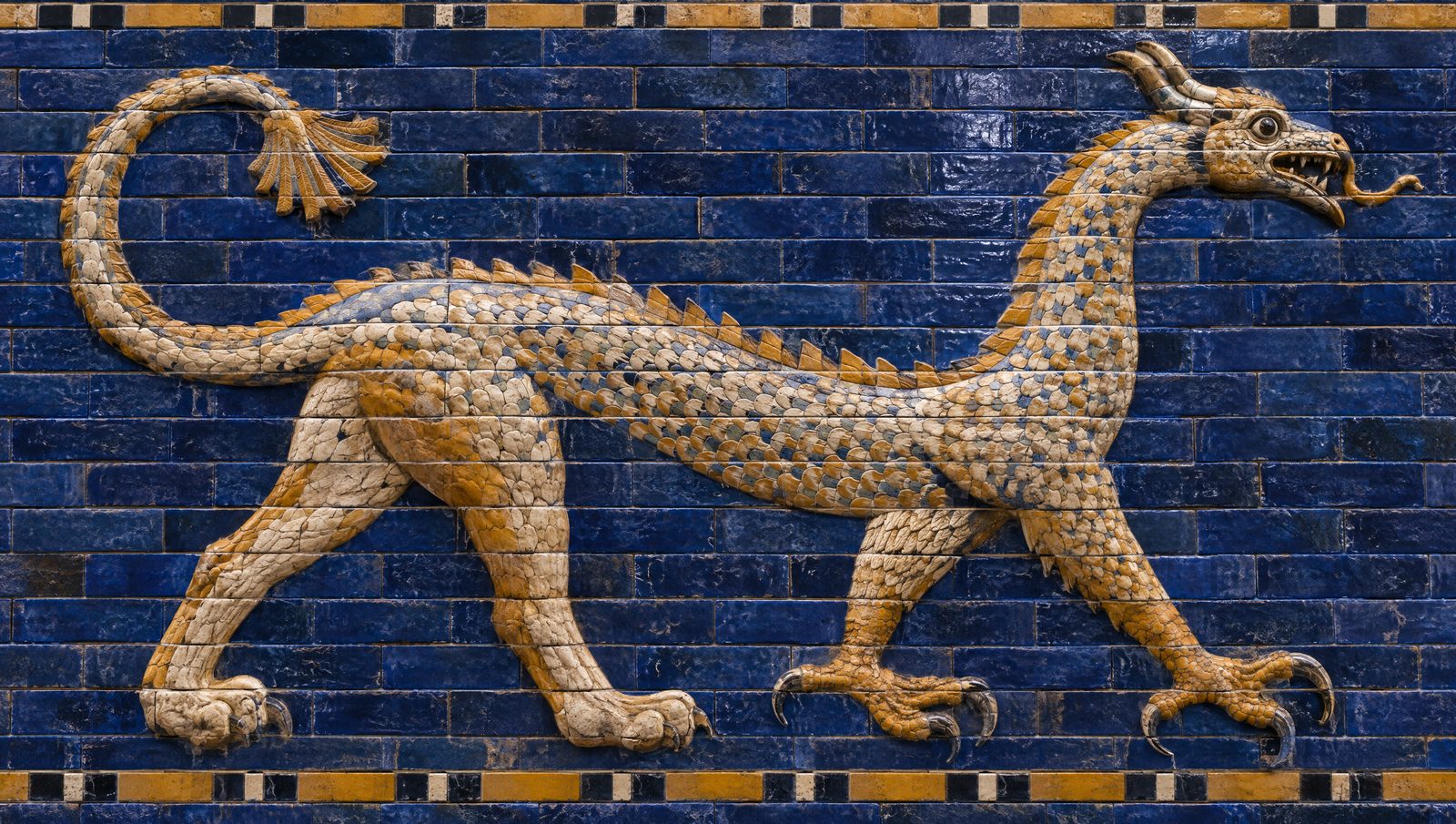
German excavators at Babylon between 1899 and 1917 shipped home the glazed bricks of Nebuchadnezzar’s Ishtar Gate and Processional Way, and the reconstructed gate, fourteen metres high and covered in blue-glazed bulls and dragons, is the centrepiece of the Pergamon Museum on Museum Island in Berlin. It belongs to the last decades of this guide’s period. The museum is undergoing a renovation that will keep parts of it closed for years, so check the Staatliche Museen site before you plan around it.
Babylon, Iraq
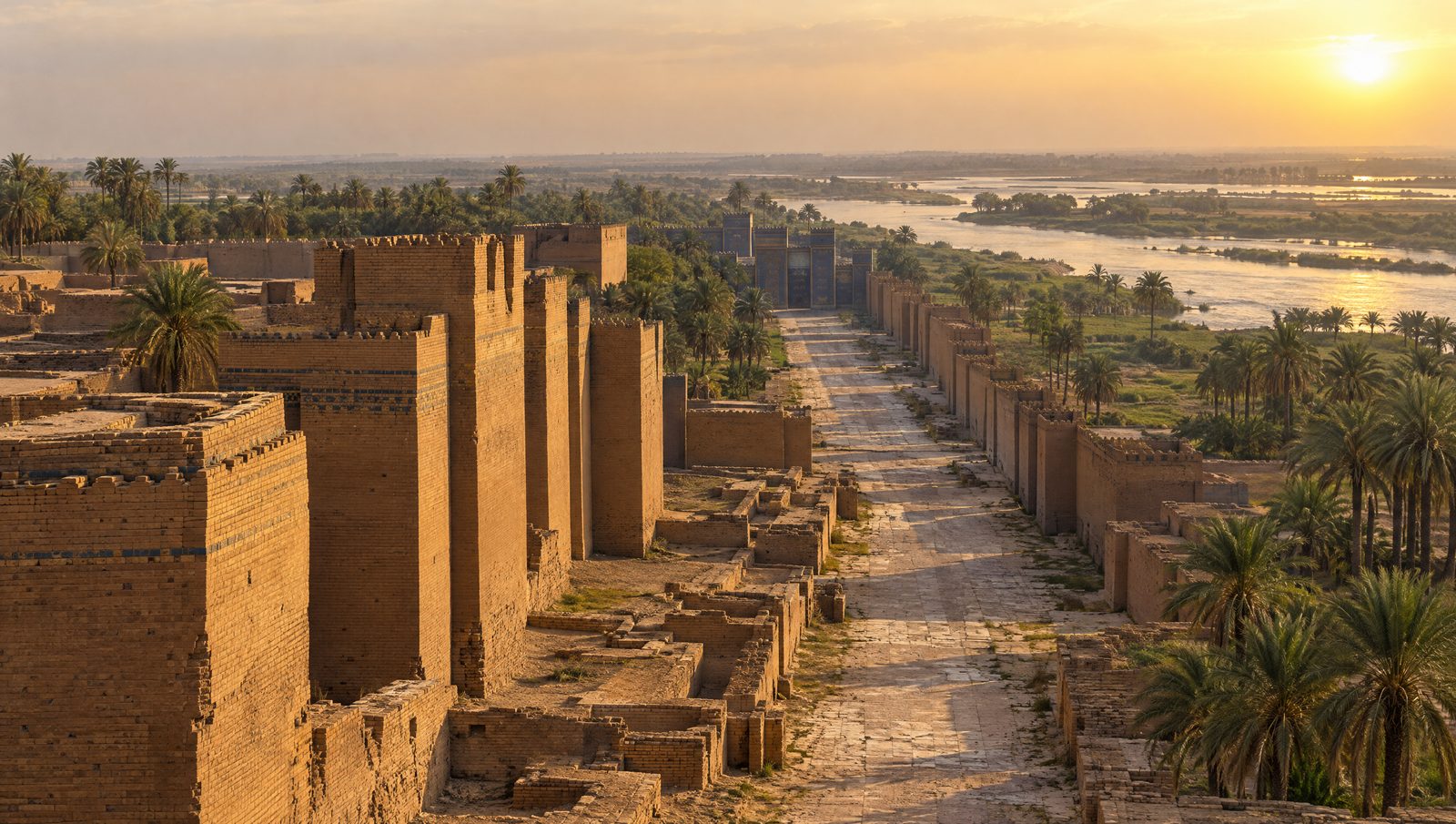
Babylon lies 85 kilometres south of Baghdad near Hillah, and since 2019 it has been a UNESCO World Heritage Site. What stands today is mostly Nebuchadnezzar’s city and, on top of it, Saddam Hussein’s reconstruction of the 1980s, which rebuilt the Southern Palace in new brick stamped with his name. Below the modern walls, the original foundations of the Processional Way, the lower courses of the Ishtar Gate with their unglazed animal reliefs still in place, and the basalt Lion of Babylon are genuine. Travel in Iraq is easiest with a licensed guide; go in the cooler months and early in the day.
Nineveh, Mosul
The mounds of Kuyunjik and Nebi Yunus on the east bank of the Tigris, inside modern Mosul, are Sennacherib’s and Ashurbanipal’s Nineveh, where the library and the lion hunt were found. The city walls still trace a circuit of twelve kilometres. The site suffered badly between 2014 and 2017, when the Nergal and Adad gates and the shrine of Nebi Yunus were destroyed, and restoration by Iraqi and international teams is ongoing. Visits are possible with a guide and depend on conditions; combine it with the restored heritage of Mosul’s old city, and treat any visit as a work in progress.
Mari, Syria
Tell Hariri, on the Euphrates near the Iraqi border in eastern Syria, is Zimri-Lim’s Mari. French teams excavated from 1933 until 2010, uncovering the palace with its painted investiture scene and the archive rooms. The site has been looted during the war and is not currently a realistic destination; it belongs on this list because the letters found there are the most intimate view we have of the age of Hammurabi, and because it will matter again when Syria reopens. For now, see the Mari finds in the Louvre.
Kültepe, Türkiye
Twenty kilometres from Kayseri, an easy day trip from Cappadocia, the mound of Kültepe is ancient Kanesh, where the Old Assyrian merchants lived in a quarter at the foot of the citadel from about 1950 BC. Excavations since 1948 have recovered more than 20,000 tablets, the oldest written documents from Anatolia, and the house foundations, hearths and tablet-storage rooms of the merchant colony are laid out for visitors. The best finds are in the Kayseri Archaeological Museum and the Museum of Anatolian Civilizations in Ankara. Spring and autumn are the seasons; the site has little shade and no café.
Go deeper
- Andrew George, The Epic of Gilgamesh (Penguin Classics) — the standard translation by the scholar who produced the critical edition, with the fragments laid out honestly and the Sumerian poems included.
- Stephanie Dalley, Myths from Mesopotamia (Oxford World’s Classics) — Enūma eliš, Atrahasis, the Descent of Ishtar and other Akkadian myths in one volume.
- Benjamin R. Foster, Before the Muses: An Anthology of Akkadian Literature (CDL Press) — nearly a thousand pages covering hymns, letters, humour and wisdom, including the Poor Man of Nippur.
- Martha T. Roth, Law Collections from Mesopotamia and Asia Minor (SBL) — Hammurabi’s laws with prologue and epilogue, alongside the earlier codes of Ur-Nammu and Lipit-Ishtar.
- John Huehnergard, A Grammar of Akkadian (Eisenbrauns) — the textbook most universities use, teaching Old Babylonian with real texts; the Open Richly Annotated Cuneiform Corpus (oracc.org) offers free editions of thousands of texts once you can read a little.
Frequently asked questions
Is Akkadian hard to learn?
The language is manageable; the script is the work. Akkadian grammar is a regular Semitic grammar, and anyone who knows Hebrew or Arabic will recognise the root system and much of the vocabulary. Cuneiform, with its hundreds of signs and multiple readings, takes about a year of steady practice before a tablet stops looking like scratches. Most university courses teach Old Babylonian first, in transliteration, and introduce the signs gradually. The reward is one of the largest bodies of text to survive from antiquity.
How accurate is the reconstructed pronunciation?
Good for an ancient language, because cuneiform writes vowels and because the Semitic relatives provide a check. The vowel system, the consonant inventory and the shape of words are secure. The uncertainties are the sibilants, where scholars disagree about what the letters transliterated s, š and ṣ actually sounded like, and prosody, where stress and intonation are inferred rather than attested. A Babylonian would recognise what a modern Assyriologist reads aloud; whether they would think it sounded foreign is another question.
What modern languages descend from Akkadian?
None directly. Akkadian was displaced by Aramaic over the first millennium BC and died as a spoken language around the time of Alexander, surviving only among temple astronomers until about AD 100. Its relatives are alive: Arabic, Hebrew, Aramaic and the Semitic languages of Ethiopia share its ancestry. Loanwords from Akkadian survive in Hebrew and Aramaic, among them the month names of the Jewish calendar, which were borrowed in Babylon during the exile.
Can I read the original texts after a few months?
Hammurabi’s laws, yes, in transliteration: they are formulaic, repetitive and the standard first reader in most courses. Old Babylonian letters come next, short and lively. Reading them from the clay or from a hand copy, rather than a transliteration, takes longer, and the literary dialect of Gilgamesh and Enūma eliš, with its rare words and poetic word order, is a second-year project.
What is the best first trip for this era?
Paris and London together, which can be done in four days by train. The Louvre has Hammurabi, Mari and Khorsabad; the British Museum has the Assyrian reliefs and the library of Nineveh. Add Berlin for the Ishtar Gate when the Pergamon Museum is fully open again. For the landscape itself, Babylon is the most accessible Mesopotamian site in Iraq and pairs well with the Iraq Museum in Baghdad on a guided trip of a few days.