
The world at the time
Old English is what was spoken and written in England from the arrival of the Angles, Saxons and Jutes in the fifth century until the generation after the Norman Conquest, and few people today could follow it for more than a word or two. The centuries from about 700 to 1066 are its documented heart: the age of Bede and Alfred, of Beowulf and the Lindisfarne Gospels, of Viking invasion and the making of a single English kingdom.
In 700 there was no England. The lowland part of Britain was divided among kingdoms whose names survive as counties and regions: Northumbria, Mercia, East Anglia, Essex, Kent, Sussex and Wessex. Their kings were recently Christian, converted by Roman missionaries from Kent and Irish monks from Iona, and the new monasteries were the powerhouses of learning. At Jarrow, in 731, the monk Bede finished his Ecclesiastical History of the English People, the first book to treat the English as one people. At Lindisfarne, around the same time, a bishop named Eadfrith painted the Gospels. In the eighth century Mercia under Offa (757–796) dominated the south, built the earthwork along the Welsh border that still bears his name, and struck silver pennies that set the pattern for English coinage for five hundred years.
Then the Vikings came. The raid on Lindisfarne in 793 was followed in 865 by the Great Heathen Army, which destroyed Northumbria, East Anglia and half of Mercia within a decade. Only Wessex survived. Its king Alfred, driven into the Somerset marshes in the winter of 878, came back to beat the Danes at Edington that spring, baptised their leader, and spent the rest of his reign building fortified towns, a navy and a programme of translation so that free-born boys could learn to read English. The Anglo-Saxon Chronicle, begun in his reign, was kept up year by year until 1154. His grandson Æthelstan took York in 927 and is usually counted the first king of all England; his victory at Brunanburh in 937 was celebrated in a poem the Chronicle preserves.
The tenth century saw a reform of the monasteries under Dunstan and Æthelwold and the greatest flowering of Old English prose, in the sermons of Ælfric and Wulfstan. It also saw the Vikings return. Æthelred, nicknamed Unræd, “ill-counselled”, paid them off with ever larger sums of silver, and in 1016 the Danish king Cnut took the whole kingdom. English kings returned with Edward the Confessor in 1042, who built Westminster Abbey and died in January 1066 leaving no heir. Harold Godwinson beat a Norwegian invasion at Stamford Bridge in September and lost to William of Normandy at Hastings on 14 October. Within a generation the ruling class, the bishops and the language of government were French or Latin, and English went underground for two hundred years.
Most people were ceorlas, free farmers, below a class of þegnas, landholding warriors who owed service to the king, and above a substantial population of slaves. Law was a matter of compensation: every person had a wergild, a price payable to their kin if they were killed, graded by rank. Disputes were heard at meetings of the hundred and the shire. People lived in timber houses with thatched roofs around a lord’s hall, where the feasting and poetry happened; stone was for churches. Towns were small, though Alfred’s burhs grew into Oxford, Wallingford and Wareham, and London, York and Winchester were real cities with mints and markets.
Religion was Christian throughout, but with the old world close beneath. The days of the week still carry the names of Woden, Thunor, Tiw and Frige. The Church brought Latin, which every educated person read, and the Anglo-Saxons were unusual in Europe in writing so much in their own language as well: laws, charters, sermons, medical recipes, riddles and some 30,000 lines of poetry survive, almost all of it in four manuscripts copied around the year 1000.
The stories they told
Beowulf and the monsters
The longest poem in Old English survives in a single manuscript, written around the year 1000 and scorched in a library fire in 1731, now in the British Library. When it was composed, and by whom, nobody knows. It is set not in England but in Scandinavia, among the Danes and the Geats of southern Sweden, in the sixth century. The Danish king Hrothgar builds a great hall, Heorot, and a monster from the fens, Grendel, comes at night for twelve years to kill and eat his men. Beowulf, a young Geat of enormous strength, sails to help, waits for Grendel in the dark hall and tears off his arm with his bare hands. The next night Grendel’s mother comes for revenge, and Beowulf follows her to the bottom of a haunted mere and kills her with a giant’s sword he finds there. Fifty years later, old and a king, he faces a dragon roused by a stolen cup, kills it with the help of one loyal young man while his other followers run, and dies of its venom. The poem ends with his funeral pyre and a barrow on a headland. It is a Christian poet’s elegy for a pagan heroic world, and its final word for its hero is lofgeornost, most eager for fame.
Cædmon’s hymn
Bede tells the story in Book 4 of his Ecclesiastical History. At the monastery of Whitby, under the abbess Hild, who died in 680, there was a cowherd named Cædmon who could not sing. When the harp went round at feasts he would leave before it reached him. One night, having gone out to the cattle sheds to avoid it, he dreamed that someone stood by him and told him to sing. “I cannot,” he said. “Nevertheless, you must sing to me.” “What shall I sing?” “Sing the beginning of created things.” And he sang verses he had never heard, in praise of God the maker of heaven and earth. In the morning he remembered them and added more, and Hild, hearing of it, had him taught scripture, which he turned into English verse by the next day each time. Bede gives the hymn in Latin paraphrase, but scribes added the nine-line Old English original in the margins of early copies, which makes it the oldest datable poem in the language. Cædmon is the first English poet whose name we know.
Alfred in the marshes
The Anglo-Saxon Chronicle for 878 is terse. After Twelfth Night the Danish army under Guthrum seized Chippenham by surprise, overran Wessex, and drove most of its people into submission or exile overseas, “and the king Alfred with a small force went with difficulty through woods and fen-fastnesses.” At Easter he built a fort at Athelney, an island in the Somerset Levels, and raided from it. In the seventh week after Easter he rode to a landmark called Egbert’s Stone and found the men of Somerset, Wiltshire and Hampshire waiting for him, “and they rejoiced to see him.” Two days later he beat the Danes at Edington, pursued them to their camp and besieged it for a fortnight until Guthrum surrendered, agreed to leave Wessex and to be baptised; Alfred stood godfather. Asser, the Welsh monk who wrote Alfred’s biography, adds that the king was ill all his life and learned to read Latin only in his late thirties. The story of the burned cakes, in which a swineherd’s wife scolds the disguised king for letting her loaves burn, is not in either source; it appears first in a Life of St Neot written more than a century later, which has not stopped anyone telling it.
The Battle of Maldon
In August 991 a Viking fleet landed on Northey Island in the Blackwater estuary in Essex, linked to the mainland by a causeway that floods at high tide. The ealdorman of Essex, Byrhtnoth, brought the local levy to face them. A poem, surviving only in an eighteenth-century transcript because the manuscript burned in the same fire that scorched Beowulf, tells what happened next. The Vikings demand tribute; Byrhtnoth answers that they will get spears and swords. The tide falls, three Englishmen hold the causeway, and the Vikings ask to be allowed across to fight on equal ground. Byrhtnoth, out of what the poet calls ofermōd, pride or over-confidence, lets them. He is killed. Some of his men flee, one of them on the ealdorman’s own horse so that others think their lord has run. The rest stay and die around his body, each making a short speech, and the old retainer Byrhtwold speaks the lines that have come to stand for the whole heroic code: “Courage must be the firmer, heart the bolder, spirit the greater, as our strength grows less.” The Chronicle records that after Maldon the English paid the Vikings 10,000 pounds of silver, the first of the great Danegelds.
How the language sounded
The earliest English was written in runes, the Anglo-Saxon futhorc of up to 33 characters, which survive on the whalebone Franks Casket, on the Ruthwell Cross, on swords and rings. With Christianity came the Latin alphabet in the rounded Insular script developed in Ireland, adapted with four extra letters: þ (thorn) and ð (eth) for the th sounds, ƿ (wynn) for w, and æ (ash) for the vowel in “cat”. Scribes wrote on prepared calfskin, in a West Saxon standard that by the year 1000 was used across the country regardless of how people spoke locally. Modern editions replace wynn with w and add macrons over long vowels.
Spelling was close to phonetic, so the rules are few and mostly about letters English has since gone quiet on.
- Every letter was pronounced. Cniht, “boy”, began with a k and ended with the sound in Scottish “loch”; wrītan, “to write”, had its w; hring had its h. The silent letters of modern English are fossils of this.
- C and g had two values each. Before back vowels they were k and hard g: cyning, gōd. Before front vowels c was “ch” and g was “y”: cild is “child”, ġēar is “year”. The pair sc was “sh”, so scip was already “ship”.
- Vowel length changed meaning. God with a short o is God, gōd with a long one is good. Æ was the a of “cat”; y was the German ü sound, which later unrounded to i, giving “king” from cyning.
- F, s and þ were voiced between vowels. Hūs, “house”, had an s; hūsian, “to house”, a z. This is why English still has “wolf” but “wolves”.
- Stress fell on the first syllable of the root, which is what makes the alliterative poetry work: the stressed syllables carry the matching sounds.
- The diphthongs ea and eo were spoken as two sounds in one syllable, roughly “ae-a” and “e-o”, and are the part of the system scholars argue about most.
The evidence comes from several directions. Spelling itself is the first, because the Anglo-Saxons adopted Latin letters with their Latin values and then adjusted them. Latin and Norse loanwords show how foreign sounds were heard. Poetic alliteration shows which initial sounds counted as the same: palatal and hard g alliterate with each other in early verse and stop doing so later, which dates the split. Middle English spellings and the modern language show where each sound ended up, and comparison with Old Saxon, Old Frisian and Old Norse fills the gaps.
What is uncertain is detail: the exact quality of the diphthongs, whether the long and short versions of ea differed only in length, how far the written standard concealed regional speech, and anything about intonation. Old English is the best-documented early Germanic language, but there are no native speakers to check against.
| Original | Say it | Meaning |
|---|---|---|
| Wes þū hāl | wess thoo HAHL | Hello, be well (the ancestor of “wassail”) |
| Far gesund | far yeh-SUND | Farewell, go in health |
| Ic þancie þē | itch THAN-kee-eh thay | I thank you |
| Ic hātte Ælfrēd | itch HAHT-teh ALF-rayd | I am called Alfred |
| Gēa / Nese | YAY-ah / NEH-zeh | Yes / No |
| Hwǣr is sēo cirice? | hwair iss SAY-oh CHIH-rih-cheh | Where is the church? |
| Ic ne understande | itch neh un-der-STAN-deh | I don’t understand |
| Hwæt! | hwat | Listen! So! The word that opens Beowulf |
Hwæt! Wē Gār-Dena in geārdagum,
þēodcyninga þrym gefrūnon,
hū ðā æþelingas ellen fremedon.Listen! We have heard of the glory of the kings of the Spear-Danes in days gone by, how those princes did deeds of courage.
Beowulf, lines 1–3, British Library, Cotton MS Vitellius A XV
Read aloud, the opening comes out roughly as “HWAT! way GAR-DEH-na in YAY-ar-DAH-gum, THAY-od-KÜ-nin-ga THRÜM yeh-FROO-non, hoo thah ATH-eh-lin-gas EL-len FREH-meh-don.” Each line has four stressed syllables and a pause in the middle, and the stressed words on either side of the pause begin with the same sound: Gār-Dena and geārdagum, þēodcyninga and þrym, æþelingas and ellen. That alliteration, not rhyme, is what made it poetry. The first word has been translated as “Lo,” “Listen,” “So” and, in one recent version, “Bro”; scholars still argue whether it is a separate exclamation or the start of the sentence. Gefrūnon, “we have learned by asking,” tells you the poet is passing on something heard, not invented.
Maya reads these aloud in a reconstructed West Saxon pronunciation, honestly labelled as a reconstruction, in a free Old English session of fifteen minutes by phone.
Where to stand today
Sutton Hoo, Suffolk
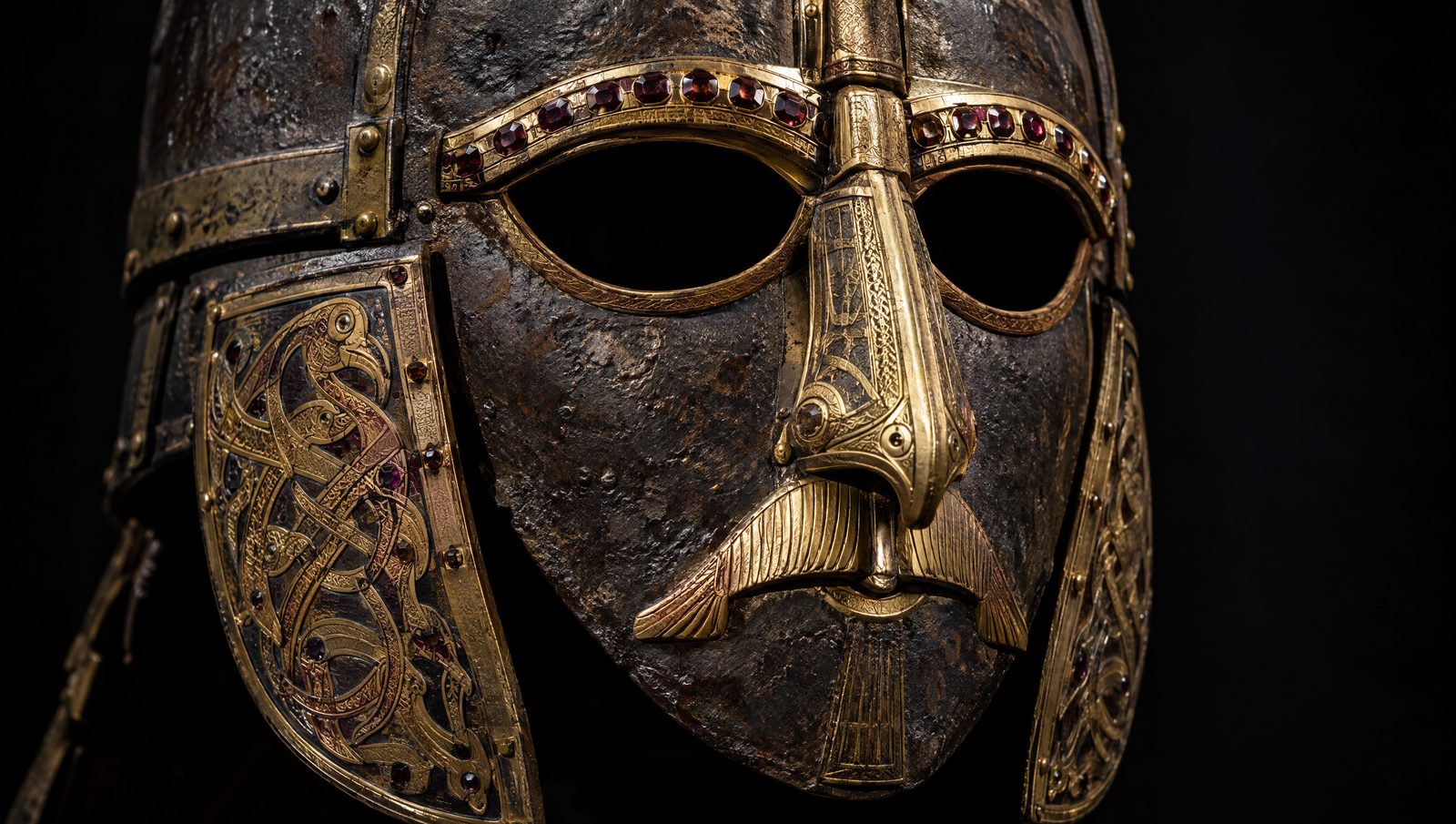
On a bluff above the River Deben in eastern England, a line of grassy mounds marks the burial ground of the East Anglian kings. Mound 1, opened in 1939, held a 27-metre ship and the richest grave ever found in Britain: the helmet, the gold buckle, the shoulder clasps and the Byzantine silver now in the British Museum. It dates to around 625, two generations before this guide begins, and it is the closest thing to the world of Beowulf that archaeology has produced. The National Trust runs the site with a viewing tower over the mounds, a full-size sculpture of the ship and replicas of the treasure; allow half a day and go on a weekday outside school holidays.
The British Library, London
The Treasures gallery of the British Library at St Pancras in London is where Old English literature physically is. The Beowulf manuscript, the Lindisfarne Gospels with their tenth-century Old English gloss squeezed between the Latin lines, and manuscripts of the Anglo-Saxon Chronicle are shown in rotation, so check what is on display before visiting; fragile items rest in the dark for long periods. Entry to the gallery is free. The British Museum, a short walk away, has the Sutton Hoo treasure and the Franks Casket in Room 41.
Winchester
Alfred’s capital keeps his street plan, laid out when he refortified the town in the 880s, under its Georgian and medieval buildings; High Street follows the Roman and Saxon line, and the side streets run off it in the grid he set. A bronze Alfred raised in 1901 stands at the bottom of it. The cathedral replaced the Old Minster, whose outline is marked in the grass beside it, and holds in painted chests the jumbled bones of the West Saxon kings, Cnut among them. Alfred himself was buried at Hyde Abbey, north of the centre, whose gatehouse survives. The City Museum, free to enter, has the Anglo-Saxon finds.
Jarrow and Lindisfarne
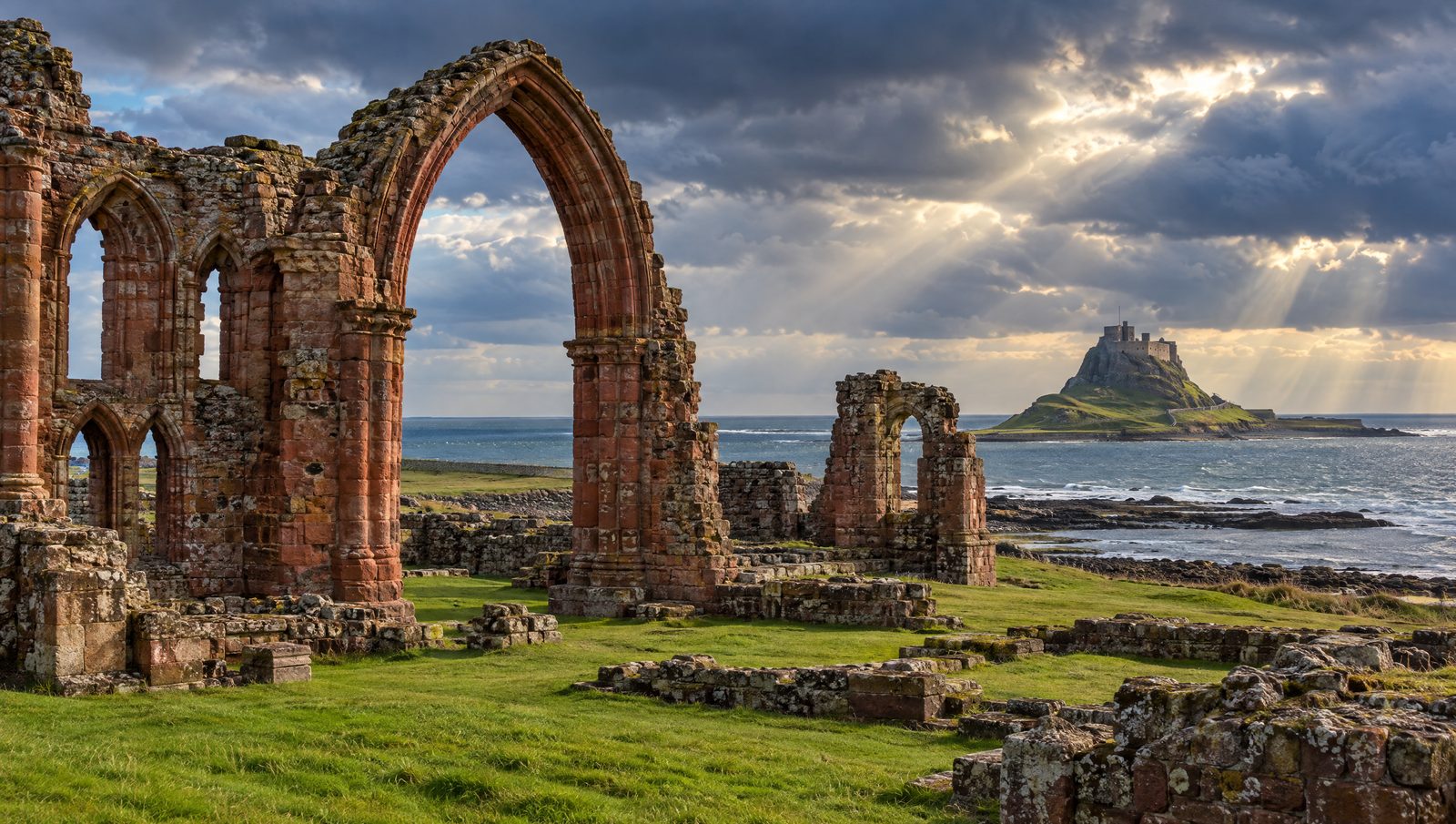
St Paul’s Church at Jarrow, on the south bank of the Tyne, still has the chancel of the monastery where Bede lived and died, with a dedication stone dated to 685 and some of the oldest stained glass in Europe; the museum beside it, Jarrow Hall, has a reconstructed Anglo-Saxon farm. Ninety minutes north, the island of Lindisfarne is reached by a tidal causeway, and the priory ruins, managed by English Heritage, stand on the site of the monastery the Vikings raided. Check the safe crossing times before driving over; people are rescued from the causeway every year. The museum displays the Lindisfarne name-stones and a facsimile of the Gospels.
York
Anglo-Saxon Eoforwic became Viking Jórvík in 866, and York is the best place to see the two cultures side by side. The Coppergate excavations of the 1970s, under what is now the Jorvik Viking Centre, found whole timber-framed houses, leather shoes and a silk cap in the waterlogged ground. The Yorkshire Museum holds the eighth-century Coppergate helmet, inscribed in Latin with the name of its owner, Oshere, and the Gilling sword. Of the Anglo-Saxon cathedral where Edwin was baptised in 627, nothing has yet been found. Book Jorvik ahead, especially in school holidays.
The Ruthwell Cross, Dumfriesshire
In a small parish church near the Solway coast of southern Scotland, in what was then Northumbria, stands a stone cross more than five metres high carved in the early eighth century with scenes from the Gospels and, around its edges in runes, lines from the poem The Dream of the Rood, in which the cross itself speaks of bearing Christ. It is the longest runic inscription in Old English and the only place the poetry can be read on stone. Broken by order of the Church of Scotland in 1642 and reassembled in 1887, it stands in a church that is normally open in daylight hours and free; Dumfries is twenty minutes away.
Offa’s Dyke
The bank and ditch that Offa of Mercia built along the frontier with Wales in the late eighth century still runs for long stretches through the border hills, up to eight metres from ditch bottom to bank top where it is best preserved. The national trail that follows it covers 177 miles from Chepstow to Prestatyn; the finest Anglo-Saxon sections are in the Clun Forest of Shropshire and around Knighton, where the Offa’s Dyke Centre explains the earthwork. A day’s walk from Knighton in either direction is enough; late spring, before the bracken is high, is the season.
Go deeper
- Beowulf, translated by Seamus Heaney (Faber & Faber; bilingual edition from W. W. Norton) — the translation that brought the poem to a wide readership; the Norton edition prints the Old English on facing pages.
- Bede, Ecclesiastical History of the English People, translated by Leo Sherley-Price (Penguin Classics) — the foundational narrative, with Cædmon’s story in Book 4.
- Kevin Crossley-Holland, The Anglo-Saxon World: An Anthology (Oxford World’s Classics) — translations of the Chronicle, Maldon, the elegies, riddles, laws and charms in one volume.
- Marc Morris, The Anglo-Saxons: A History of the Beginnings of England — a clear narrative history from the fifth century to 1066 for general readers.
- Peter S. Baker, Introduction to Old English (Wiley-Blackwell) — the standard university textbook, with a free companion website of exercises; the Bosworth-Toller dictionary is online for free at bosworthtoller.com.
Frequently asked questions
Is Old English hard to learn?
Easier than its reputation and harder than most English speakers expect. It is not an old spelling of modern English; it is a different language with four cases, grammatical gender and a verb system like German’s. But the core vocabulary is ours, the word order is often recognisable, and once the letters þ, ð and æ stop looking strange, a sentence like Sē cyning wæs gōd reads itself. Most learners are handling simple prose in three or four months and short poems within a year.
How accurate is the reconstructed pronunciation?
For the consonants and the basic vowels, very accurate: the spelling was phonetic, the Latin letter values were known, and the modern language confirms the outcomes. The uncertain areas are the diphthongs, the exact quality of long vowels, and everything about rhythm and intonation. What you hear in a classroom or a recording is a careful scholarly West Saxon of about the year 1000, not a Northumbrian ploughman of 750.
What modern languages descend from it?
English, in all its varieties, and Scots, which developed from the Northumbrian dialect. The hundred most common words in modern English are almost all Old English, and so are the grammatical bones: the pronouns, the irregular verbs, the plurals in -s and -en. What changed was everything else: the case endings wore away, French and Latin supplied half the dictionary, and the Great Vowel Shift of the fifteenth and sixteenth centuries moved every long vowel, which is why hūs became “house” and stān became “stone”.
Can I read Beowulf after a few months?
With a glossary and a facing translation, you can work through passages of it within a few months, and that is how most people first meet it. Reading it fluently is a different matter: the poetic vocabulary is large and much of it appears nowhere else, and the syntax is compressed. Start with prose, Bede’s account of Cædmon in Alfred’s translation or the Chronicle entries for 878, then the shorter elegies such as The Wanderer, then Maldon, and come to Beowulf when the metre already feels natural.
What is the best first trip for this era?
A week in England by train and hire car in May or September: a day in London for the British Library and British Museum, a day in Winchester, then north by train to York for a day, and a car for the Northumbrian coast, Jarrow, Lindisfarne at low tide, and Bamburgh, the Northumbrian royal seat. Sutton Hoo fits as a day from London. A second trip belongs to the Welsh border and Offa’s Dyke.