
The world at the time
Gothic is the oldest Germanic language anyone can read at length, and it survives for one reason: a bishop decided, around the middle of the fourth century, that a people living on the lower Danube should have the Bible in their own tongue. Everything else about the Goths comes to us through Roman and Greek eyes.
By AD 350 the Goths had been living north of the Danube and the Black Sea for a century and more, in the villages and cemeteries that archaeologists call the Chernyakhov culture, spread across what is now Ukraine, Moldova and Romania. They farmed, made fine wheel-thrown pottery and traded with the empire for wine, glass and silver coin. They had also raided it: the emperor Decius died fighting them in 251, and Gothic fleets once burned the temple of Artemis at Ephesus. By the fourth century the relationship was a wary partnership. Constantine made a treaty with them in 332; Gothic soldiers served in Roman armies; Roman goods and Roman ideas, including Christianity, moved across the river.
The man who carried the new faith was Wulfila, “little wolf”, born about 311 to a family descended from Christian captives taken from Cappadocia. He was consecrated bishop of the Christians among the Goths in 341, preached north of the Danube for seven years, and when a Gothic leader began persecuting converts he led his flock across the river into Roman Moesia, in the hills of what is now northern Bulgaria. There he invented an alphabet and translated the scriptures. His Christianity was Arian, a form that held the Son to be subordinate to the Father, and because the Goths received it from him, the Gothic kingdoms would be Arian for two centuries while their Roman subjects were Catholic. That split shaped everything that followed.
Then the Huns arrived. In 376 tens of thousands of Goths appeared on the north bank of the Danube asking for refuge, and the emperor Valens let them in. Roman officials cheated and starved them, the refugees rose, and on 9 August 378 at Adrianople, modern Edirne, they destroyed a Roman field army and killed the emperor. In 382 Theodosius settled the survivors inside the empire as allies under their own leaders. One of the boys who grew up in that settlement was Alaric.
Alaric’s Goths sacked Rome in August 410. They were then given land in Aquitaine in 418, and from Toulouse the Visigothic kings ruled most of Gaul and, in time, Spain. Theodoric I died fighting Attila on the Catalaunian Plains in 451; Euric issued a written law code around 475; Alaric II was killed by Clovis and the Franks at Vouillé in 507, after which the kingdom’s centre moved south to Toledo. A second Gothic people, the Ostrogoths, had meanwhile lived under Hunnic rule and then in the Balkans. Their king Theodoric, raised as a hostage in Constantinople, invaded Italy in 489 with the emperor’s blessing, killed his rival Odoacer at Ravenna in 493 and ruled a largely peaceful Italy for thirty-three years.
Daily life in these kingdoms was more Roman than the word “barbarian” suggests. The Goths were a military minority, perhaps a few per cent of the population, living among Roman landowners, bishops and tax collectors who kept on doing their jobs. Theodoric’s chancery, run by the senator Cassiodorus, wrote elegant Latin letters about aqueduct repairs, grain prices and the marble quarries. In Spain, Visigothic courts applied a code that drew heavily on Roman precedent. Gothic was spoken in the army, the royal household and the Arian churches; Latin was spoken everywhere else.
The end came in stages. Justinian’s armies invaded Italy in 535 and fought the Ostrogoths for nearly twenty years; the last Gothic king, Teia, died at the foot of Vesuvius in 552 or 553, and the Ostrogoths vanish from history. In Spain the Visigoths lasted longer. King Reccared abandoned Arianism at the Third Council of Toledo in 589, which removed the last barrier between Goths and Romans, and the Gothic language seems to have died out in Spain within a century. Only in Crimea, far from either kingdom, did a Gothic dialect survive, until a Flemish diplomat wrote down some eighty words of it in the 1560s.
The stories they told
Three ships from Scandza
The Goths’ own account of where they came from survives in the Getica, written in Latin in Constantinople in 551 by Jordanes, who says he condensed it from a lost twelve-volume history by Cassiodorus. The story begins on the island of Scandza, which is Scandinavia. Under a king named Berig the Goths set out in three ships, and because the third ship lagged behind, its people were called Gepids, from a Gothic word Jordanes glosses as “slow”. They landed on the Baltic shore and, five generations later under King Filimer, moved south toward the Black Sea into a rich land called Oium. On the way, half the army crossed a bridge over a great river and the bridge collapsed behind them, so that the people were divided and those left behind could never follow. No historian takes the three ships literally, but the broad movement the tale describes, from the Vistula to the Black Sea in the second and third centuries, matches the archaeology of the Wielbark and Chernyakhov cultures closely enough that the story is thought to preserve a genuine folk memory.
Wulfila leaves out the Book of Kings
Everything we know about Wulfila personally comes from a few pages: a letter by his pupil Auxentius of Durostorum, defending his teacher’s theology, and some paragraphs in the church historians Philostorgius and Socrates. Philostorgius records the detail everyone remembers: Wulfila translated the whole Bible except the Books of Kings, because the Goths were already too fond of war and did not need encouragement. Whether that is true or a good story told about a careful man, the surviving translation is strikingly faithful to its Greek original, following its word order so closely that scholars use it to reconstruct the Greek text Wulfila had in front of him. He coined words where Gothic had none and reused old ones where he could. He died in Constantinople in 383, in the middle of a church council, still arguing.
Alaric at the gates of Rome
Alaric did not want Rome. For a decade he had wanted a military title and land for his people, and the court at Ravenna kept promising and reneging. On 24 August 410 the Salarian Gate was opened, by treachery or exhaustion, and for three days the Goths plundered a city that had not seen a foreign enemy inside its walls for eight hundred years. The churches of Peter and Paul were respected and the killing was limited by the standards of the age; the gold and silver were not. Jerome, in Bethlehem, wrote that his voice failed him and sobs choked his words: the city which had taken the whole world was itself taken. Alaric marched south, meaning to cross to Africa, and died of fever at Cosenza before the year was out. Jordanes tells how his men diverted the river Busento from its bed, buried him with his treasure in the channel, let the water back, and killed the prisoners who had done the digging so that no one would ever know the place. No one ever has.
Theodoric, Boethius and the fish
Theodoric’s reign in Italy was long, prosperous and, by the measure of the time, tolerant. The last years went wrong. In 523 the senator Boethius, who had translated Aristotle and held the highest office in the kingdom, was accused of treasonable correspondence with Constantinople. He was imprisoned at Pavia and there, waiting for execution, wrote The Consolation of Philosophy. He was put to death in 524 or thereabouts, and his father-in-law Symmachus was executed the following year. Procopius, writing a generation later, says that a large fish was served at Theodoric’s table and the king saw in its head the face of Symmachus, teeth bared, and took to his bed shaking, and died within days. Theodoric died in August 526. In German legend he became Dietrich von Bern, Bern being Verona, a hero who outlived his own history by a thousand years.
How the language sounded
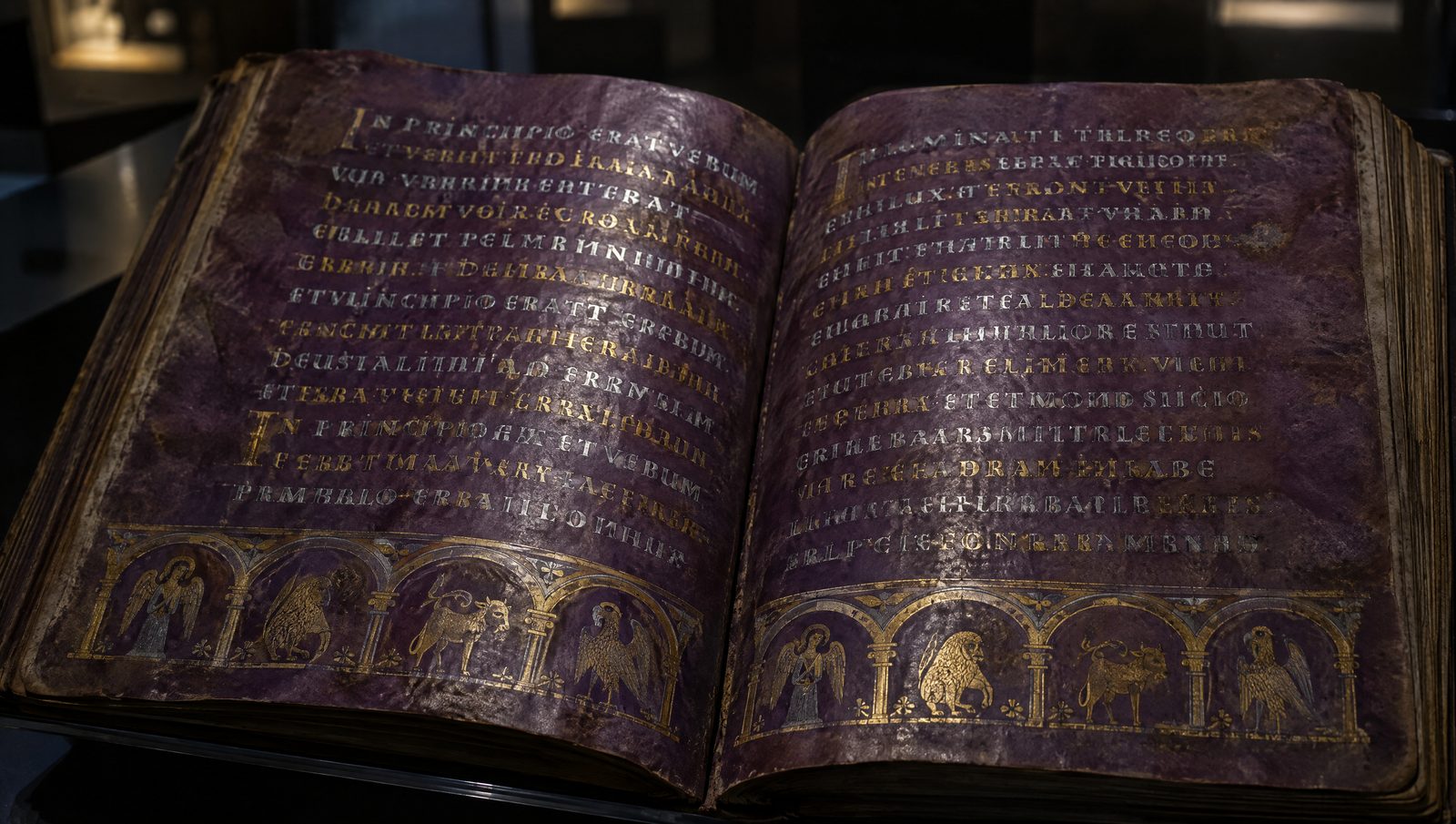
Wulfila built his alphabet mainly from Greek uncials, with a few letters borrowed from Latin and, probably, from the runes that Goths already used to scratch their names on spear heads and rings. There are twenty-seven signs, two of them used only as numerals. Modern editions transliterate them into Latin letters with two additions: þ for the “th” of thin, and ƕ for the “hw” sound that English once had in which. The alphabet survives in only a handful of manuscripts, all copied in Italy around 500, of which the Codex Argenteus in Uppsala, written in silver and gold ink on purple-dyed parchment, is by far the most complete.
Because Wulfila based his spelling on Greek, his choices tell us a good deal about the sounds, and the main points are not in dispute.
- þ and ƕ. Þiuda, “people”, began like English thin. Ƕa, “what”, began with a breathy “hw”, the sound still heard in some Scottish and Irish English.
- ei was a long “ee”. Wulfila took the Greek habit of writing a long i as ei, so mein, “my”, sounded like English mean, not mine.
- gg was “ng”. Another Greek habit: gaggan, “to go”, was pronounced roughly “GANG-an”, and drigkan, “to drink”, had the “nk” you would expect.
- ai and au before r and h. Written ai was a short open “e” as in bet and au a short open “o” as in hot in those positions, so wairþan, “to become”, was “WERTH-an”. Elsewhere textbooks usually read them as the diphthongs in eye and how, though some scholars argue they were long open vowels everywhere.
- b, d and g softened between vowels. Inside a word they were fricatives, and at the end of a word they hardened: giban, “to give”, but gaf, “gave”; hlaibis, “of bread”, but hlaifs, “bread”.
- Stress fell on the first syllable of the root. Verb prefixes such as ga- were unstressed.
How do we know? The Greek model of the alphabet is the first witness: when Wulfila needed a sign for a sound Greek lacked, he borrowed or invented one, and when he used a Greek letter we can assume it had something close to its Greek value. Greek and Latin spellings of Gothic names give a second check. The comparative method does the rest, setting Gothic beside Old Norse, Old English and Old High German, and beside the reconstructed Proto-Germanic parent of all of them. Gothic is the oldest of the family by several centuries and preserves features the others lost, including a dual number for “we two” and “you two”, and a set of reduplicating past tenses, so that “he called” is haihait, literally “he ca-called”.
The uncertainties are real. The sound of ai and au outside their safe positions is the oldest argument in Gothic studies. Vowel length is not marked except for ei, so it must be supplied from etymology. We have one dialect, Wulfila’s, frozen in a translation; the Gothic of a Visigothic farmer in Spain two centuries later certainly differed in ways we can only guess at.
| Original | Say it | Meaning |
|---|---|---|
| 𐌷𐌰𐌹𐌻𐍃 — hails | HILES (one syllable, rhyming with miles) | Hail, greetings (to one person) |
| 𐌹𐌺 𐌹𐌼 — ik im | ik im | I am |
| 𐌾𐌰 / 𐌽𐌴 — ja / ne | yah / nay | Yes / No |
| 𐍈𐌰 𐌹𐍃𐍄 𐌸𐌰𐍄𐌰? — ƕa ist þata? | HWAH ist THAH-tah | What is this? |
| 𐍈𐌰𐍂 𐌹𐍃𐍄? — ƕar ist? | HWAHR ist | Where is (it)? |
| 𐌰𐍅𐌹𐌻𐌹𐌿𐌳𐍉 𐌸𐌿𐍃 — awiliudo þus | AH-wi-liu-doh thoos | I thank you |
| 𐍆𐍂𐌹𐌾𐍉 𐌸𐌿𐌺 — frijo þuk | FREE-yoh thuk | I love you |
| 𐌲𐌰𐌲𐌲 𐌹𐌽 𐌲𐌰𐍅𐌰𐌹𐍂𐌸𐌹 — gagg in gawairþi | GANG in ga-WER-thi | Go in peace |
Every phrase above is taken from the Gothic Bible: hails is what the soldiers mock Jesus with, awiliudo þus is the Pharisee’s prayer in Luke, frijo þuk is Peter’s answer at the end of John, and gagg in gawairþi is what Jesus says to the woman healed in Mark and Luke. There are no attested Gothic words for “goodbye” or “please”, so none are offered.
𐌰𐍄𐍄𐌰 𐌿𐌽𐍃𐌰𐍂 𐌸𐌿 𐌹𐌽 𐌷𐌹𐌼𐌹𐌽𐌰𐌼, 𐍅𐌴𐌹𐌷𐌽𐌰𐌹 𐌽𐌰𐌼𐍉 𐌸𐌴𐌹𐌽. 𐌵𐌹𐌼𐌰𐌹 𐌸𐌹𐌿𐌳𐌹𐌽𐌰𐍃𐍃𐌿𐍃 𐌸𐌴𐌹𐌽𐍃.
Atta unsar þu in himinam, weihnai namo þein. Qimai þiudinassus þeins.Our Father, you in the heavens, may your name be hallowed. May your kingdom come.
Gothic Bible, Matthew 6:9–10, Codex Argenteus
This is the opening of the Lord’s Prayer, the best-known passage in the language and one that happens to survive in the Codex Argenteus. Atta is not the formal word for father but the nursery one, closer to “dad”, and it is the same word that gives the Hunnic king his Gothic name, Attila, “little father”. Weihnai belongs to the family of weihs, “holy”, which lives on in German Weihnachten, Christmas, the holy nights. Þiudinassus, “kingdom”, is built on þiuda, “people”, the same root that produced the word Deutsch, and so, by a long road, the English word Dutch.
Maya reads these aloud in a reconstructed pronunciation, honestly labelled as a reconstruction, in a free Gothic session of fifteen minutes by phone.
Where to stand today
Ravenna, Italy
Nowhere else in Italy can you walk through a Gothic capital. Theodoric’s mausoleum, a two-storey drum of Istrian limestone roofed with a single stone weighing over two hundred tonnes, stands north-east of the centre. Sant’Apollinare Nuovo was his palace church, built for Arian worship around 505; its nave mosaic shows the palace itself, with the figures of Theodoric’s court later removed and replaced by curtains when the building passed to the Catholics, though a few hands remain on the columns. The small Arian Baptistery nearby keeps its dome mosaic of the baptism of Christ. The mausoleum has its own ticket; a combined ticket covers the UNESCO churches, and Ravenna is a flat, walkable city best seen in the clear light of late autumn.
Uppsala, Sweden
The Codex Argenteus, the silver book, has been in Sweden since 1669, after passing through a monastery at Werden, the court of Rudolf II in Prague and a Swedish army’s baggage train. It is kept at Carolina Rediviva, the university library, where it is displayed in the exhibition hall under low light. The 187 surviving leaves out of an original 336 hold most of the four Gospels, and one more leaf, found in a reliquary at Speyer Cathedral in 1970, is kept there. The city is an easy day trip by train from Stockholm.
Toledo, Spain
The Visigothic capital lies under the medieval and Renaissance city of Toledo, and very little of it stands above ground. What survives is gathered in the Museo de los Concilios y de la Cultura Visigoda, housed in the thirteenth-century church of San Román on the hill in the old town: carved stone screens, pilasters and friezes from vanished Visigothic churches, bronze belt buckles from cemeteries, and replicas of the Guarrazar crowns. It is closed on Mondays; go in the morning, then walk down to the Alcántara bridge over the Tagus.
Madrid: the Guarrazar crowns
In 1858, after heavy rain, farmers near Guadamur outside Toledo found a hoard of gold votive crowns and crosses that Visigothic kings had hung over altars. The finest, the crown of King Recceswinth, who ruled from 653 to 672, hangs in the Museo Arqueológico Nacional in Madrid: a band of gold set with sapphires and pearls, with his name spelled out in letters dangling on chains beneath it. Several other crowns from the hoard are in the Musée de Cluny in Paris. The Madrid museum is free on Saturday afternoons and Sunday mornings, and the Visigothic gallery on the first floor is rarely crowded on a weekday.
Rome: the Aurelian Walls
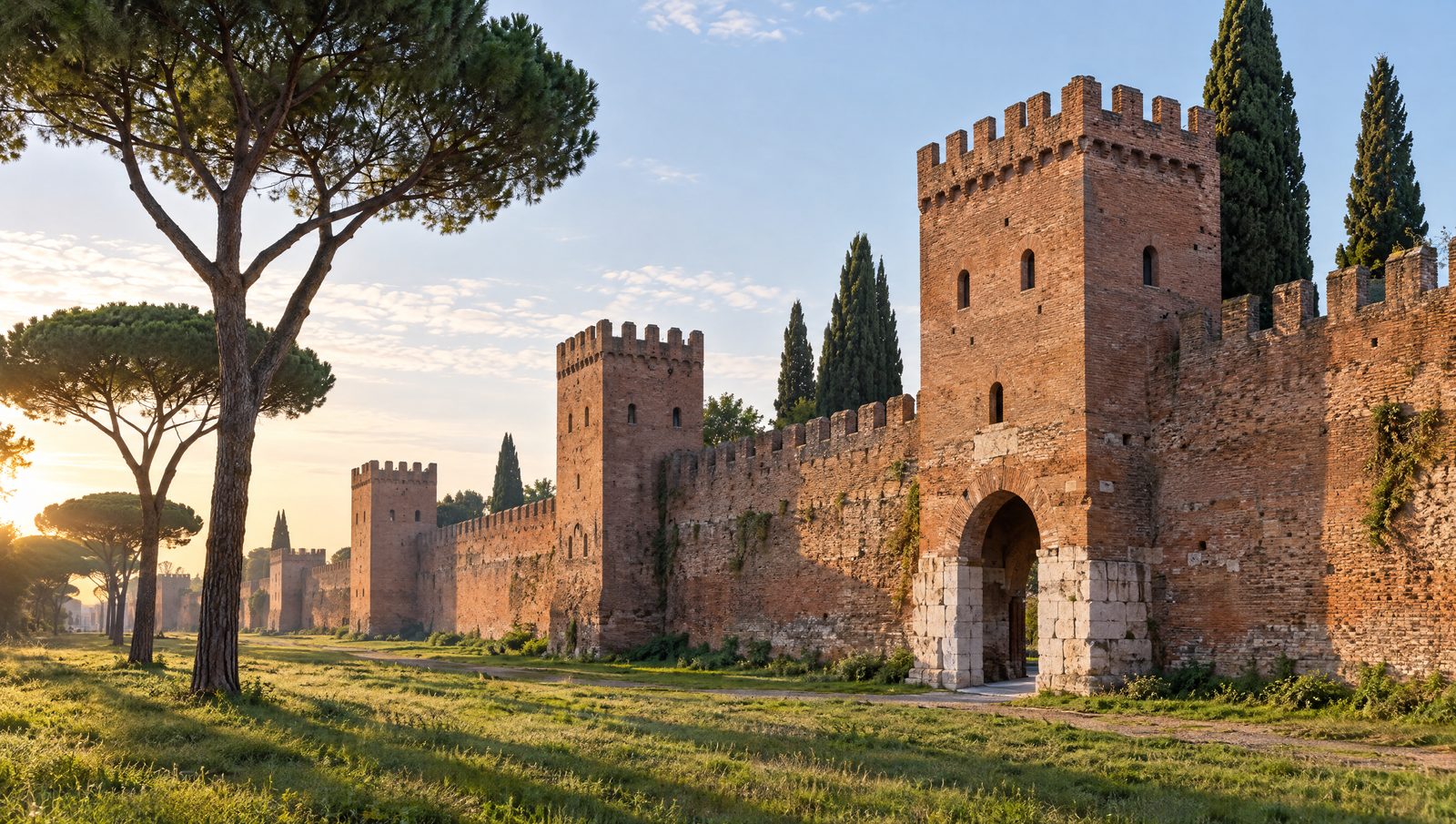
The gate through which Alaric’s Goths entered Rome, the Porta Salaria, was demolished in 1921 and is now a traffic junction at Piazza Fiume, but the walls it pierced are still there. The Aurelian Walls, begun in the 270s precisely because of Gothic raids, run for nineteen kilometres around the ancient city and are the best-preserved circuit of any ancient capital. At the Porta San Sebastiano, on the Appian Way, the Museo delle Mura lets you climb inside the gate towers and walk along the top of the wall for several hundred metres; entry is free and it is closed on Mondays.
Bucharest: the Pietroasele treasure
Two peasants digging for stone on a hillside at Pietroasele, in the wine country north-east of Bucharest, found a hoard of Gothic gold in 1837: a great eagle-headed fibula, a twelve-sided cup with figures in high relief, dishes and neck-rings, probably buried in the panic of the Hunnic invasion in the 370s. Twelve of the original twenty-two pieces survive and are shown in the Treasury of the National Museum of Romanian History on Calea Victoriei. One plain gold ring carries the only substantial Gothic runic inscription in existence, usually read as gutaniowihailag, “sacred to the Goths” or something close to it; it was cut in two by a thief in 1875 and the damage is still visible. The Treasury is a separate room from the main galleries, so check that your ticket covers it. The hoard is one of the few objects anywhere that speaks for the Goths of Romania and Ukraine, where the Chernyakhov villages lay.
Go deeper
- Peter Heather, The Goths (Blackwell, The Peoples of Europe series) — the standard one-volume history, from the Baltic origins to the fall of Toledo, written by the leading specialist and careful about what the archaeology can and cannot show.
- Herwig Wolfram, History of the Goths, translated by Thomas J. Dunlap (University of California Press) — denser and more argumentative than Heather, strong on the Gothic names and institutions preserved in Latin sources.
- Jordanes, The Gothic History, translated by Charles C. Mierow — the 1915 translation is out of copyright and free online; it is short, strange and the only history of the Goths that claims to come from the Goths.
- Joseph Wright, Grammar of the Gothic Language (Oxford) — first published in 1910 and still the textbook most learners start with; it includes the Gospel of Mark with notes and a full glossary.
- The Wulfila Project, University of Antwerp (wulfila.be) — the complete Gothic Bible online with a searchable word-by-word parse, the Greek alongside, and a library of older Gothic scholarship scanned in full.
Frequently asked questions
Is Gothic hard to learn?
The grammar is about as demanding as Latin or Old English, with four cases, three genders, strong and weak verbs and a dual number that no modern Germanic language keeps. Two things make it easier than it looks. The corpus is small, so the vocabulary you need is finite and you meet the same words constantly. And the texts are translations of the Gospels, which many people already know in outline, so you are never lost about what a sentence is trying to say.
How accurate is the reconstructed pronunciation?
For the consonants and for most of the vowels, very good, because Wulfila’s Greek-based spelling is close to a phonetic transcription and the comparative evidence from the other Germanic languages lines up with it. The real uncertainties are the values of ai and au in certain positions, the exact length of vowels the script does not mark, and anything to do with rhythm and melody. Any reading you hear today, including Maya’s, is a scholar’s best estimate of the Gothic of a fourth-century bishop, not a recording.
What modern languages descend from Gothic?
None. Gothic belongs to the East Germanic branch, along with the lost languages of the Vandals, Burgundians and Gepids, and every member of that branch is extinct. The last trace was Crimean Gothic, recorded in a letter by the diplomat Ogier Ghiselin de Busbecq in the 1560s and probably spoken until the eighteenth century. Gothic is a cousin of English, German and the Scandinavian languages rather than an ancestor of any of them, which is exactly why it matters: it shows what the family looked like centuries before the others were written down.
Can I read the original texts after a few months?
Yes, and this is one of the pleasures of Gothic. Because nearly everything that survives is a Gospel translation, you can sit with the Gothic on one side and the Greek or an English Bible on the other and work through Mark or Luke from the start. The Wulfila Project’s online text gives you a grammatical parse for every word. Within a few months of steady reading you will recognise most of the vocabulary; the remaining fragments, chiefly a commentary on John known as the Skeireins, are harder but short.
What is the best first trip for this era?
Ravenna, with two or three days to see the mausoleum, Sant’Apollinare Nuovo, the Arian Baptistery and the sixth-century mosaics of San Vitale that celebrate the Gothic kingdom’s destruction. Add Pavia, where Boethius was imprisoned, if you have a week in northern Italy. For the Visigoths, Toledo and the Madrid museum make a natural pair on a Spanish trip. Uppsala is a pilgrimage for anyone who wants to see the language itself, in silver on purple, open under glass.