
The world at the time
When the Spaniards came over the pass between the volcanoes in November 1519 and saw the Valley of Mexico spread out below them, the soldier Bernal Díaz wrote that some of them asked whether it was a dream. A city of perhaps 200,000 people stood on an island in a lake, joined to the shore by three straight causeways, with white temples rising above the water and canoes moving between gardens that floated. Tenochtitlan was larger than any city in Spain, and its language was Nahuatl.
The Mexica, the people we usually call Aztecs, were latecomers to the valley. Their own histories said they had wandered south from a place called Aztlan and founded their city in 1325 on a swampy island nobody else wanted, after seeing an eagle perched on a cactus. Then in 1428 the Mexica ruler Itzcoatl joined with Texcoco and Tlacopan to overthrow the city of Azcapotzalco, and this Triple Alliance began the conquests that, within ninety years, would collect tribute from the Gulf coast to the Pacific and from the deserts of the north almost to Guatemala. Moctezuma I, who ruled from 1440 to 1469, pushed the empire east and south; Axayacatl absorbed the twin city of Tlatelolco in 1473; Ahuitzotl rededicated the Great Temple in 1487 with sacrifices on a scale the chroniclers put in the tens of thousands, a figure historians dispute but do not dismiss; Moctezuma II took the throne in 1502.
The empire was not a state in the Roman sense. Conquered towns kept their own rulers and gods and sent tribute, which the Codex Mendoza, painted for the Spanish viceroy around 1541, itemises town by town: so many cloaks, so many bundles of feathers, so many jars of honey, so much cacao, warriors’ costumes, jade, gold dust and live eagles. The market at Tlatelolco, which Hernán Cortés estimated drew sixty thousand people a day, sold goods from every climate in Mesoamerica. Long-distance merchants called pochteca doubled as spies, and cacao beans served as small change.
Daily life ran on maize. Maize, beans, squash, chillies, tomatoes, amaranth and turkey made up the diet, with fish, waterfowl, insects and algae from the lake, and dog on feast days. Farming on chinampas, raised beds built up in the shallows and anchored by willows, produced several harvests a year and still does at Xochimilco. Every boy went to school, either the telpochcalli of his neighbourhood, which trained warriors, or the priestly calmecac, where the sons of nobles learned the songs, the calendar and the painted books.
Religion was everywhere and demanding. Two calendars ran side by side, a 260-day ritual count and a 365-day solar year, meshing every fifty-two years; at the end of each cycle all fires were put out and a new one kindled on a hilltop, the last time in 1507. The gods had given their blood to make the sun move, and humans owed it back, in bloodletting from ears and tongues and in the sacrifice of war captives on the temple platforms. Beside this stood a tradition of philosophy and poetry, cultivated especially at Texcoco under Nezahualcoyotl, who ruled from 1431 to 1472, built a dike across the lake to keep salt water from the city, and is remembered as the greatest poet of the language.
The end came fast. Cortés entered Tenochtitlan on 8 November 1519 and was received as a guest; within months Moctezuma was a prisoner and then dead. The Spaniards were driven out on the night of 30 June 1520, but smallpox arrived behind them and killed a large part of the city. Cortés returned in 1521 with brigantines built in pieces and carried over the mountains, and with tens of thousands of allies from Tlaxcala and other cities that hated the Mexica. The siege lasted from May to 13 August 1521, when the last ruler, Cuauhtemoc, was captured in a canoe. The city was razed and rebuilt as Mexico City on the same ground.
Then something unexpected happened. The Franciscan friars who arrived in 1524 learned Nahuatl, reduced it to the Latin alphabet and opened a college at Tlatelolco in 1536 where Nahua nobles’ sons studied Latin, rhetoric and their own traditions. Nahua scribes wrote wills, petitions, town histories and song collections in their own language for the next two hundred years. Bernardino de Sahagún spent decades interviewing elders for the twelve-book encyclopedia now called the Florentine Codex, finished around 1577. More Nahuatl survives from the century after the conquest than any other indigenous American language produced before 1800, and it is from these texts, not from the pictorial books of the empire, that Classical Nahuatl is known.
The stories they told
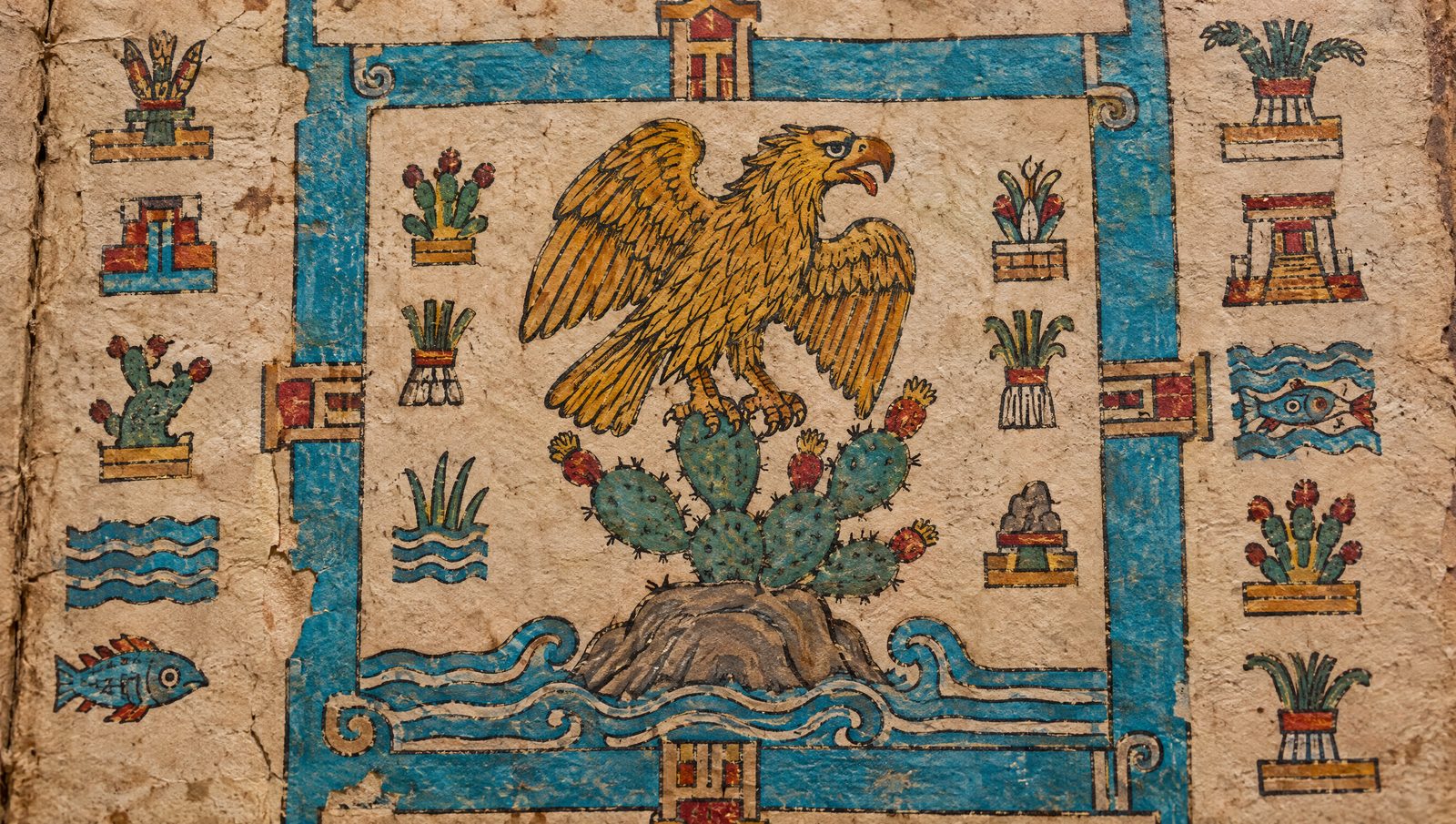
The eagle on the cactus
The Mexica told their own origin as a long migration under the guidance of their god Huitzilopochtli, Hummingbird of the South, who spoke to them through his priests and was carried in a bundle at the head of the march. The fullest version is in the Crónica Mexicáyotl, written in Nahuatl around 1609 by Fernando Alvarado Tezozómoc, a descendant of Moctezuma. The god had promised a sign: where they found an eagle perched on a prickly-pear cactus growing from a rock, they should build. The priests found it in the reeds of the lake, the eagle spreading its wings to the sun, and wept with joy. The name Tenochtitlan is usually read as “place of the stone cactus”, and the eagle on the cactus is on the frontispiece of the Codex Mendoza, painted twenty years after the conquest, and on the Mexican flag today. The date their chroniclers gave, 1325 in our calendar, is generally accepted.
The Fifth Sun
Book 7 of the Florentine Codex and the Legend of the Suns, a Nahuatl text of 1558, tell how the present world began. Four earlier suns had been destroyed, by jaguars, wind, fiery rain and flood. In the darkness the gods gathered at Teotihuacan and asked who would throw himself into the fire to become the new sun. A rich god, Tecciztecatl, volunteered, and so did a poor, pustule-covered god named Nanahuatzin. Then the fire was lit. Tecciztecatl ran at it four times and flinched each time. Nanahuatzin closed his eyes and jumped. Shamed, Tecciztecatl followed. Two suns rose in the east, equally bright, until one of the gods threw a rabbit in the face of the second to dim it, which is why the Nahua saw a rabbit in the moon. Then the sun hung in the sky and would not move until the gods offered their own hearts to feed it. That, in Mexica theology, was the debt humans inherited, and the reason the pyramids at Teotihuacan, already a thousand years old and empty, were called the place where gods were made.
The fall of Quetzalcoatl
Long before the Mexica, said the histories, the Toltecs of Tula had been ruled by a priest-king named Topiltzin Quetzalcoatl, Our Lord the Feathered Serpent. He refused human sacrifice, offering only snakes and butterflies. His enemy, the sorcerer god Tezcatlipoca, Smoking Mirror, came to him in disguise and showed him a mirror. Quetzalcoatl, who had never seen his own aged face, was horrified and hid himself away. Tezcatlipoca then persuaded him to drink pulque, the fermented sap of the agave, and the king got drunk, called for his sister and disgraced himself. In the morning he wept and set out for the eastern sea. In one version he immolated himself and his heart became the morning star; in another he sailed east on a raft of serpents, promising to return. The Annals of Cuauhtitlan and Book 3 of the Florentine Codex give the two versions. The idea that Moctezuma took Cortés for the returning Quetzalcoatl appears in post-conquest sources and many historians now think it was a story told afterwards to explain a catastrophe.
The omens and the meeting
Book 12 of the Florentine Codex is the conquest told in Nahuatl by Nahua survivors, written down in the 1550s. It begins with eight omens in the years before the Spaniards came: a tongue of fire in the night sky, a temple that burned without cause, a lake that boiled, a woman heard weeping in the streets for her children, a bird with a mirror in its head in which Moctezuma saw armed men riding on deer. Then come the reports from the coast of “deer as tall as the roof of a house” carrying men. The book describes the meeting on the causeway, Moctezuma’s formal speech of welcome and Cortés’s reply through his interpreter Malintzin, the massacre of the dancers at the festival of Toxcatl, the plague, and the siege street by street until the defenders were eating lizards, grass and adobe. Read against Cortés’s own letters and Díaz’s memoir, it is one of the few places in world history where the conquered describe their conquest in their own words.
How the language sounded
The Mexica wrote, but not in a way that records speech. Their painted books used pictures and a system of glyphs for place names, dates and numbers, with some rebus-style phonetic signs; they were memory aids for trained readers who knew the songs by heart. Nearly all were burned by the friars. Alphabetic Nahuatl begins in the 1530s, when Franciscans adapted Spanish spelling to the language, and it is in that spelling that the Florentine Codex, the Cantares Mexicanos and thousands of legal documents were written. The system is good but imperfect: Spanish had no way to write two sounds Nahuatl depends on, vowel length and the glottal stop, and most scribes left them out. Modern editions restore them with a macron and a letter h or an apostrophe.
- The sound tl. The language’s signature consonant is a single sound, made by saying t and releasing the air around the sides of the tongue, as in Welsh ll with a t in front. Nāhuatl is two syllables, “NAH-watl”, not three; Tenōchtitlan ends in that sound too.
- X was “sh”. In sixteenth-century Spanish x spelled the sound in ship, and the friars used it the same way. Mēxihco was “meh-SHEE-ko”; Xōchimilco, “shoh-chee-MEEL-ko”. Spanish later changed its own x, which is why Mexicans say “MEH-hee-ko” today.
- The saltillo. A catch in the throat, like the break in “uh-oh”, that Spanish could not write. It is the h in Mēxihco and in ahmō, “no”, and it changes meaning: tlachia, “he looks”, but tlachiah, “they look”.
- Long and short vowels. Four vowels, a, e, i and o, each long or short; the Jesuit Horacio Carochi’s grammar of 1645 is the main source for which is which. Tōtōtl, “bird”, has two long o’s; tlahtoāni, “ruler”, literally “speaker”, has one.
- No b, d, g, r or f. Spanish loanwords had to be remade: caballo, horse, became cahuayo. Hu before a vowel was w, cu was kw, and c before e or i was s, as in Spanish, so Cuauhtēmoc is “kwow-TEH-mok” and Cōātlīcue is “koh-ah-TLEE-kweh”.
- Stress fell on the second-last syllable almost without exception, so long words roll along evenly; the exception is the vocative ending -é, used when calling someone by name.
How do we know? The friars were careful observers who wrote grammars to teach the language to new priests, and Carochi in particular heard distinctions his predecessors missed and marked them with accents. Loanwords in both directions, among them chocolate, tomato, avocado, chilli and coyote, show how the sounds were mapped. Above all, Nahuatl is alive: about 1.6 million people speak modern varieties in Mexico, and although four and a half centuries have changed the language, the modern dialects preserve vowel length and the saltillo and let linguists check the colonial record against living speech.
What is uncertain is mostly rhythm and register. The songs in the Cantares were sung to drums whose beats are written into the manuscript as syllables like tocoto tiquiti, but no one is sure how the words fitted the music. The formal speech of the court, with its paired metaphors and long honorific forms, was a performance style whose intonation is lost.
| Original | Say it | Meaning |
|---|---|---|
| Niltze | NEEL-tseh | Hello |
| Quēn ticah? | kehn TEE-kah | How are you? |
| Cualli nicah | KWAHL-lee NEE-kah | I am well |
| Tlazohcāmati | tlah-soh-KAH-mah-tee | Thank you |
| Quēmah / Ahmō | KEH-mah / AH-moh | Yes / No |
| Tlein motōcā? | tlayn moh-TOH-kah | What is your name? |
| Cāmpa cah in tiyānquiztli? | KAHM-pah kah een tee-yahn-KEES-tlee | Where is the market? |
| Ahmō niccaqui | AH-moh neek-KAH-kee | I don’t understand (literally “I don’t hear it”) |
These are the forms given in colonial dictionaries and modern textbooks, spelled with the macrons and h that mark vowel length and the saltillo. Tiyānquiztli survives in Mexican Spanish as tianguis, a street market.
Cuix oc nelli nemohua in tlālticpac?
An nochīpa tlālticpac: zan achīca yē nicān.
Tel ca chālchihuitl nō xamāni, nō teōcuitlatl in tlapāni, nō quetzalli poztequi.
An nochīpa tlālticpac: zan achīca yē nicān.Is it true that one really lives on earth? Not forever on earth: only a little while here. Even jade shatters, even gold breaks, even quetzal plumes are torn. Not forever on earth: only a little while here.
Cantares Mexicanos, folio 17, Biblioteca Nacional de México
These are probably the best-known lines in Nahuatl. They come from a collection of ninety-one songs written down in Mexico City in the second half of the sixteenth century, and modern editors since Ángel María Garibay have attributed them to Nezahualcoyotl of Texcoco, though the manuscript itself names no author and the attribution is a scholarly guess. The theme, that life is a brief loan and even the most precious things break, runs through the whole collection. Jade, gold and quetzal feathers were the empire’s measures of value, and the verbs chosen for each are exact: jade shatters, gold snaps, feathers tear.
Maya reads these aloud in a reconstructed pronunciation, honestly labelled as a reconstruction, in a free Classical Nahuatl session of fifteen minutes by phone.
Where to stand today
The Templo Mayor, Mexico City
The Great Temple of Tenochtitlan lies a few steps from the cathedral in the centre of Mexico City, found in 1978 when electrical workers hit the great carved disc of the moon goddess Coyolxauhqui. Walkways take you past the temple’s seven building stages, the serpent heads, the painted shrine of the rain god and the wall of carved skulls. The site museum holds the Coyolxauhqui stone, the monolith of the earth goddess Tlaltecuhtli found in 2006, and offerings of coral, jaguars and knives that the Mexica buried in the temple’s fill. Closed on Mondays; go at opening, when the ruins are in shade and the museum is empty.
The National Museum of Anthropology
The Mexica hall of the Museo Nacional de Antropología in Chapultepec Park is built around the Sun Stone, the twenty-four-tonne calendar disc dug up in the main square in 1790, with the face of the sun at its centre and the signs of the twenty days around it. Nearby stand the statue of Coatlicue with her skirt of serpents, the Stone of Tizoc and a model of the sacred precinct as it stood in 1519. Allow a full day for the museum and half of it for this hall; it is closed on Mondays and crowded on Sundays.
Tlatelolco: the Plaza of the Three Cultures
North of the centre, the excavated platforms of Tlatelolco’s temples sit beside the church of Santiago, built from their stones in 1609, and a ring of 1960s apartment blocks: three cultures in one square. This was the site of the great market, of the last stand in 1521, and of the Franciscan college where Sahagún’s informants dictated the Florentine Codex. A plaque records that the fall of the city was “neither a triumph nor a defeat” but the painful birth of the mestizo nation. The archaeological zone is free and closed on Mondays.
Xochimilco
The canals and chinampas of Xochimilco, in the south of the city, are the last working remnant of the lake agriculture that fed Tenochtitlan. Flat-bottomed boats carry visitors along waterways lined with willows and nursery gardens, and on weekends the embarcaderos are a floating party with mariachis and food boats. For the farming rather than the fiesta, go early on a weekday from the Cuemanco embarcadero, which borders the ecological reserve, or book a tour that visits a working chinampa. Winter mornings are clear and cool.
Teotihuacan
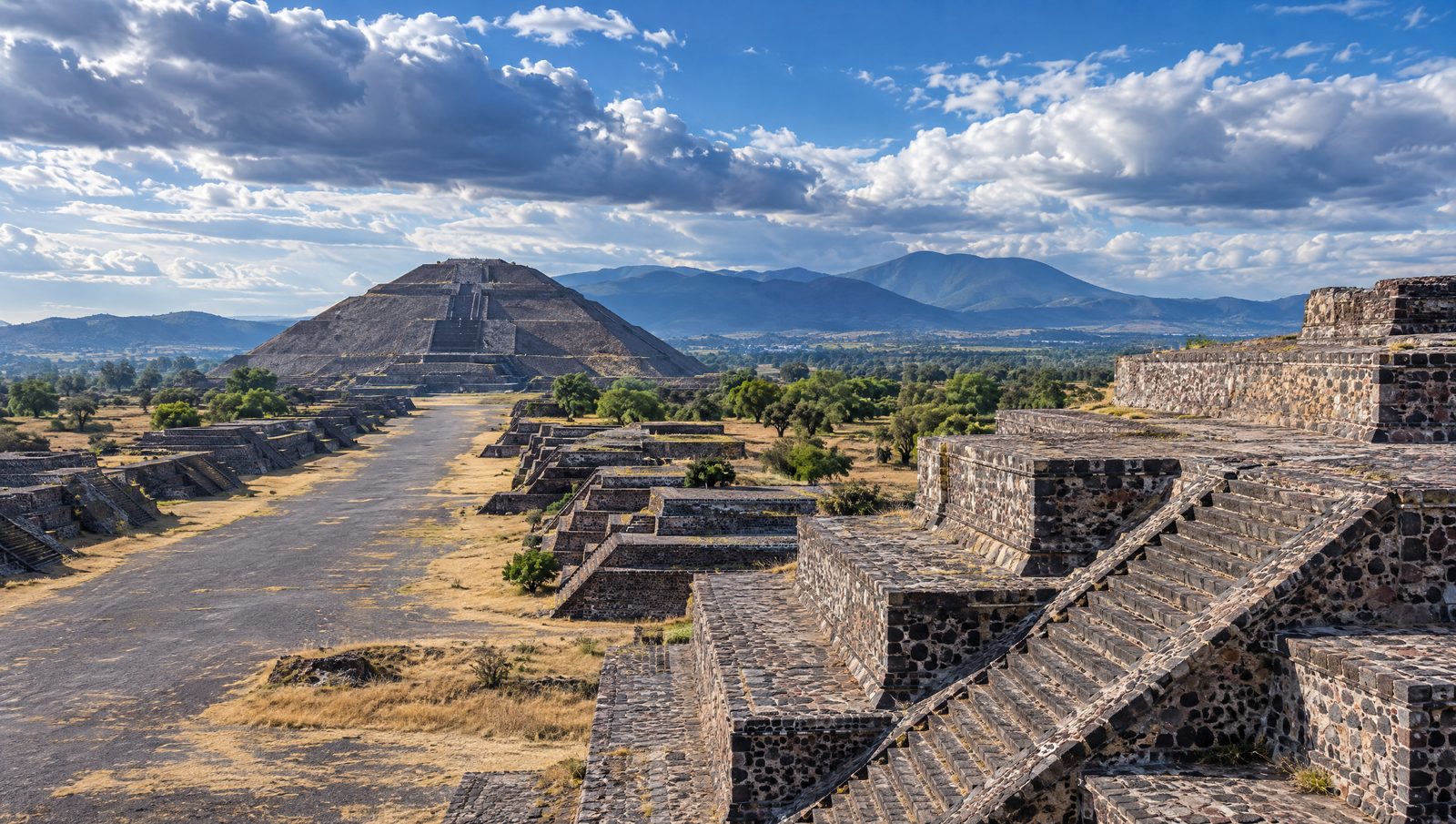
Fifty kilometres north-east of the capital, the pyramids of Teotihuacan were a ruin eight centuries old when the Mexica walked the Avenue of the Dead, gave the site its Nahuatl name and set their story of the Fifth Sun there. The Pyramid of the Sun, 65 metres high, and the Pyramid of the Moon at the avenue’s end dominate the largest ancient city in Mexico; climbing is now restricted, but the murals at Tetitla and Tepantitla, with their paradise of the rain god, are open. Arrive when the gates open at eight, before the heat and the tour buses, and bring a hat; there is almost no shade.
Tetzcotzinco, near Texcoco
On a hill east of the town of Texcoco, Nezahualcoyotl built a retreat of gardens, baths and shrines fed by an aqueduct that still runs along the ridge. Stairways and channels cut into the living rock lead to circular pools known as the baths of the king and the queen, with a view back across the dry lake bed to the volcanoes. Almost nothing is reconstructed and there are few visitors. Go with a local guide or your own car from Texcoco, wear proper shoes for the climb, and carry water.
Go deeper
- Miguel León-Portilla, The Broken Spears: The Aztec Account of the Conquest of Mexico (Beacon Press) — the Nahua sources on the conquest, including Book 12 of the Florentine Codex, in a short and affordable English edition.
- Camilla Townsend, Fifth Sun: A New History of the Aztecs (Oxford University Press) — a history of the Mexica written from the Nahuatl annals rather than the Spanish chronicles, and the best recent starting point.
- Inga Clendinnen, Aztecs: An Interpretation (Cambridge University Press) — an attempt to understand how Tenochtitlan’s people experienced their own city, its rituals and its violence.
- Bernardino de Sahagún, Florentine Codex, translated by Arthur J. O. Anderson and Charles E. Dibble (University of Utah Press) — the twelve books in Nahuatl and English; the Getty Research Institute’s Digital Florentine Codex puts the whole manuscript, with its images and both texts, free online.
- Michel Launey, An Introduction to Classical Nahuatl, translated and adapted by Christopher Mackay (Cambridge University Press) — the standard teaching grammar, with exercises drawn from the colonial texts.
Frequently asked questions
Is Classical Nahuatl hard to learn?
It is different rather than hard. There are no cases and no grammatical gender, the sounds are few and regular, and the spelling, once you know the conventions, is reliable. The challenge is that Nahuatl builds whole sentences into single words: nimitztlazohtla is “I love you”, with subject, object and verb fused together, and nouns take possessive and plural prefixes and suffixes in patterns that have to be learned.
How accurate is the reconstructed pronunciation?
Better than for most ancient languages, because the language never died. The consonants are secure. Vowel length and the saltillo are known for most words thanks to Carochi and to comparison with modern dialects, though for some words the evidence conflicts. What is lost is the sound of formal speech and song: the intonation of the court orators and how the Cantares fitted their drums. Any reading you hear, including Maya’s, gives sixteenth-century Nahuatl as scholars reconstruct it from the friars’ grammars, not a recording of Tenochtitlan.
What modern languages descend from it?
Nahuatl itself, in some thirty regional varieties spoken by about 1.6 million people, most of them in the Huasteca region of eastern Mexico, in Puebla, Veracruz and Guerrero, with smaller communities around Mexico City and as far away as El Salvador. They descend from the dialects of the empire’s provinces rather than from the courtly language of the texts. Nahuatl belongs to the Uto-Aztecan family, which makes it a distant cousin of Hopi, Shoshone and Comanche in the United States.
Can I read the original texts after a few months?
Simple ones, yes. Colonial wills and petitions are formulaic and short, and the Florentine Codex comes with a facing English translation, so you can work through passages of Book 12 with a grammar beside you after a few months of study. The Cantares are another matter: their language is dense, archaic and full of metaphor, and specialists still disagree about lines.
What is the best first trip for this era?
A week in Mexico City in the dry season, November to April. Two days for the Templo Mayor and the Anthropology Museum, a morning at Tlatelolco, a morning on the water at Xochimilco, a day at Teotihuacan and a day for Texcoco and Tetzcotzinco. The city’s altitude, 2,240 metres, takes a day or two to get used to, so put the museums first and the climbing later.