
The world at the time
Egypt was already ancient when the New Kingdom began; the pyramids of Giza were a thousand years old. But the four and a half centuries from about 1550 to 1070 BC were Egypt’s imperial age, the period of Hatshepsut and Thutmose III, Akhenaten and Tutankhamun, Ramesses the Great, and almost every temple and tomb a traveller sees at Luxor.
It opened with a war of liberation. Around 1550 BC Ahmose I, a prince from Thebes in the south, drove out the Hyksos, foreign rulers who had held the Delta for a century, and reunited the country as the first king of the 18th Dynasty. His successors did not stop at the border. Thutmose I reached the Euphrates. Hatshepsut, a king’s daughter who ruled as pharaoh in her own right from about 1479 to 1458 BC, sent a trading fleet to the land of Punt and built her terraced temple at Deir el-Bahari. Her stepson Thutmose III fought seventeen campaigns in Syria and Canaan, beginning with Megiddo around 1457 BC, the first battle in history for which a detailed account survives. Nubia to the south, with its gold mines, was governed directly as a colony.
The wealth poured into Thebes. Amenhotep III, around 1390–1352 BC, ruled a peaceful empire from palaces on the west bank and corresponded with the kings of Babylon and Mitanni in Akkadian cuneiform, the diplomatic language of the age; hundreds of these letters survive from the archive at Amarna. His son Akhenaten abandoned the old gods for the single sun-disc, the Aten, moved the capital to a new city in Middle Egypt, and died around 1336 BC. The boy-king Tutankhamun restored the old order and died at about nineteen; his small, hurriedly furnished tomb was the only royal burial in the Valley of the Kings to survive almost intact.
The 19th Dynasty brought Seti I and his son Ramesses II, who reigned for sixty-six years, from about 1279 to 1213 BC, fought the Hittites to a stalemate at Kadesh, signed the earliest surviving international peace treaty around 1259 BC, and covered Egypt with colossal statues of himself. Under Ramesses III, around 1177 BC, Egypt beat off the Sea Peoples who were destroying the other kingdoms of the eastern Mediterranean. But the state was weakening. In about 1157 BC the tomb-builders of Deir el-Medina downed tools because their grain rations were late, the first recorded strike in history. By 1070 BC the high priests of Amun at Thebes were effectively rulers of the south, and the New Kingdom was over.
Ordinary life followed the river. The Nile flooded each summer, depositing black silt; the year was divided into Inundation, Growing and Harvest, and the Egyptians called their country Kemet, the Black Land, after that soil. Most people were farmers who owed labour to the state in the flood season. Perhaps one person in a hundred could read, a few in a hundred at most; scribes ran the administration, and the surviving school texts tell boys to study hard because the scribe’s hand is soft while the farmer’s is cracked. At Deir el-Medina, the walled village of the men who cut the royal tombs, thousands of notes on limestone flakes preserve laundry lists, love poems, lawsuits and absences from work.
Religion was everywhere and mostly closed to the public. Temples were the gods’ houses, entered by priests; ordinary people met their gods when the statues were carried out in procession at festivals such as Opet, when Amun travelled from Karnak to Luxor Temple each year. The dead were equipped with spells, now called the Book of the Dead, to pass the judgement where the heart was weighed against the feather of Maat, the principle of truth and order the king was sworn to uphold. Trade brought cedar from Lebanon, copper from Cyprus, incense from Punt and lapis lazuli from Afghanistan; the Uluburun shipwreck off Turkey, from about 1320 BC, carried all of these and a gold scarab of Nefertiti.
The stories they told
Hatshepsut’s voyage to Punt
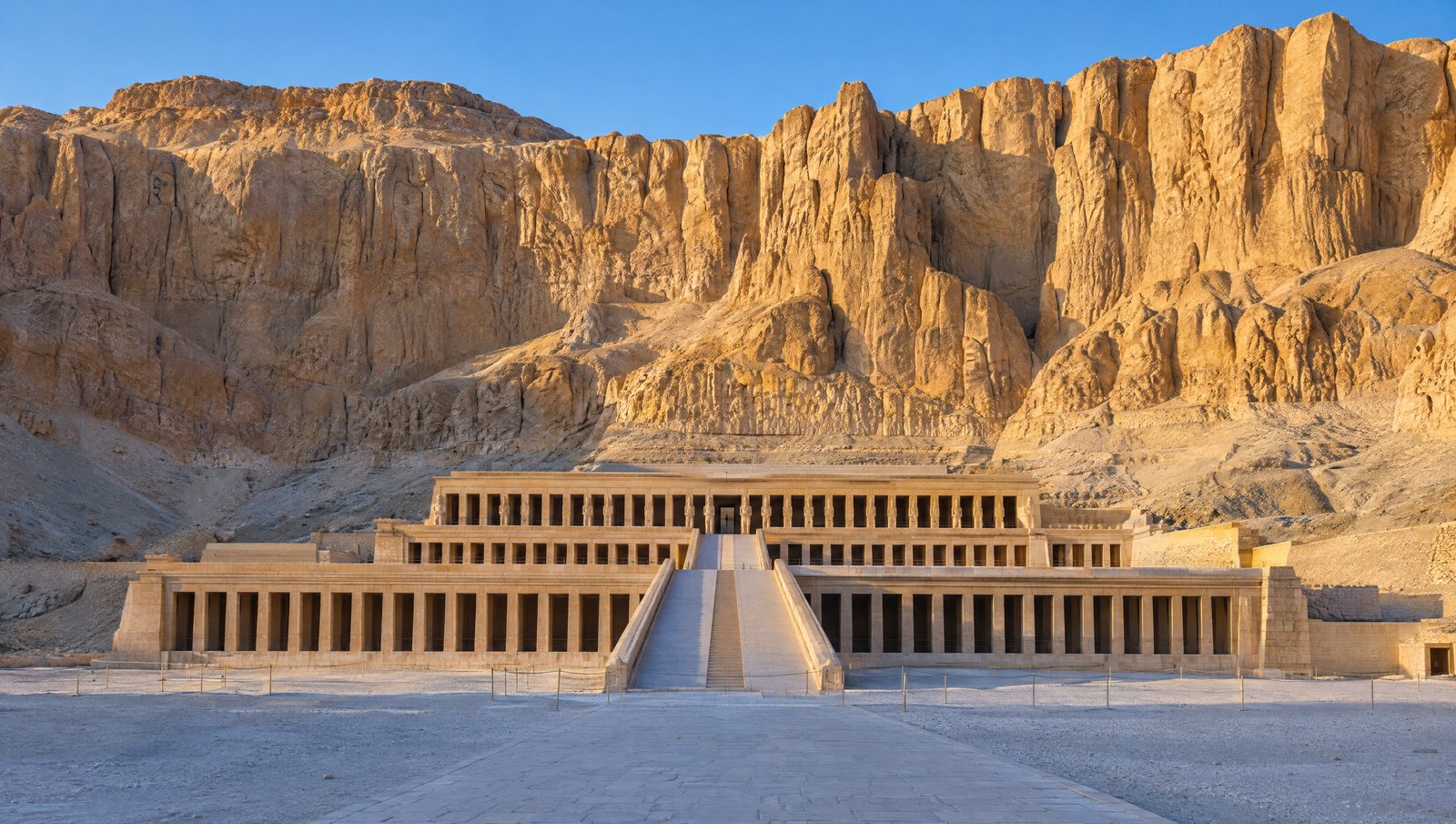
On the middle terrace of Hatshepsut’s temple at Deir el-Bahari, a long wall of carved relief records the expedition she sent, around 1470 BC, to Punt, a land on the southern Red Sea coast, probably in the region of modern Eritrea or Sudan. Five ships are shown sailing, then moored off a village of beehive huts on stilts, reached by ladders. The Egyptians are greeted by the chief of Punt and his wife, carved with unusual frankness. The cargo comes aboard: ebony, ivory, gold, panther skins, baboons, and thirty-one living incense trees with their roots balled in baskets, carried on poles by pairs of men. Back in Thebes the trees are planted in the temple garden, the incense is measured out in heaps while Hatshepsut dedicates it to her father Amun, and the inscription claims that no king before her had ever brought back such marvels. The reliefs are the fullest picture of an Egyptian trading expedition that exists, carved to prove that Amun himself had ordered her reign.
Ramesses at Kadesh
In the fifth year of his reign, around 1274 BC, Ramesses II marched four divisions north to take the city of Kadesh on the Orontes from the Hittite king Muwatalli. Two captured Bedouin told him the Hittites were far away. They were lying; the Hittite army was waiting behind the city. As Ramesses camped with his first division, the Hittite chariots smashed through the second division as it marched up and fell on the camp. The king’s own account, inscribed in two versions, a long poem and a shorter bulletin, on the walls of Karnak, Luxor, the Ramesseum and Abu Simbel, has him abandoned by his troops, calling on Amun, and charging the enemy alone in his chariot until the god answers and the Hittites break. What actually saved him was the arrival of a reserve force from the coast. The battle ended in a draw, and Kadesh stayed Hittite. Sixteen years later the two empires signed a treaty of peace and mutual defence, preserved both in hieroglyphs at Karnak and on a cuneiform tablet from the Hittite capital, now in Istanbul; a copy hangs in the United Nations headquarters in New York.
The Tale of the Two Brothers
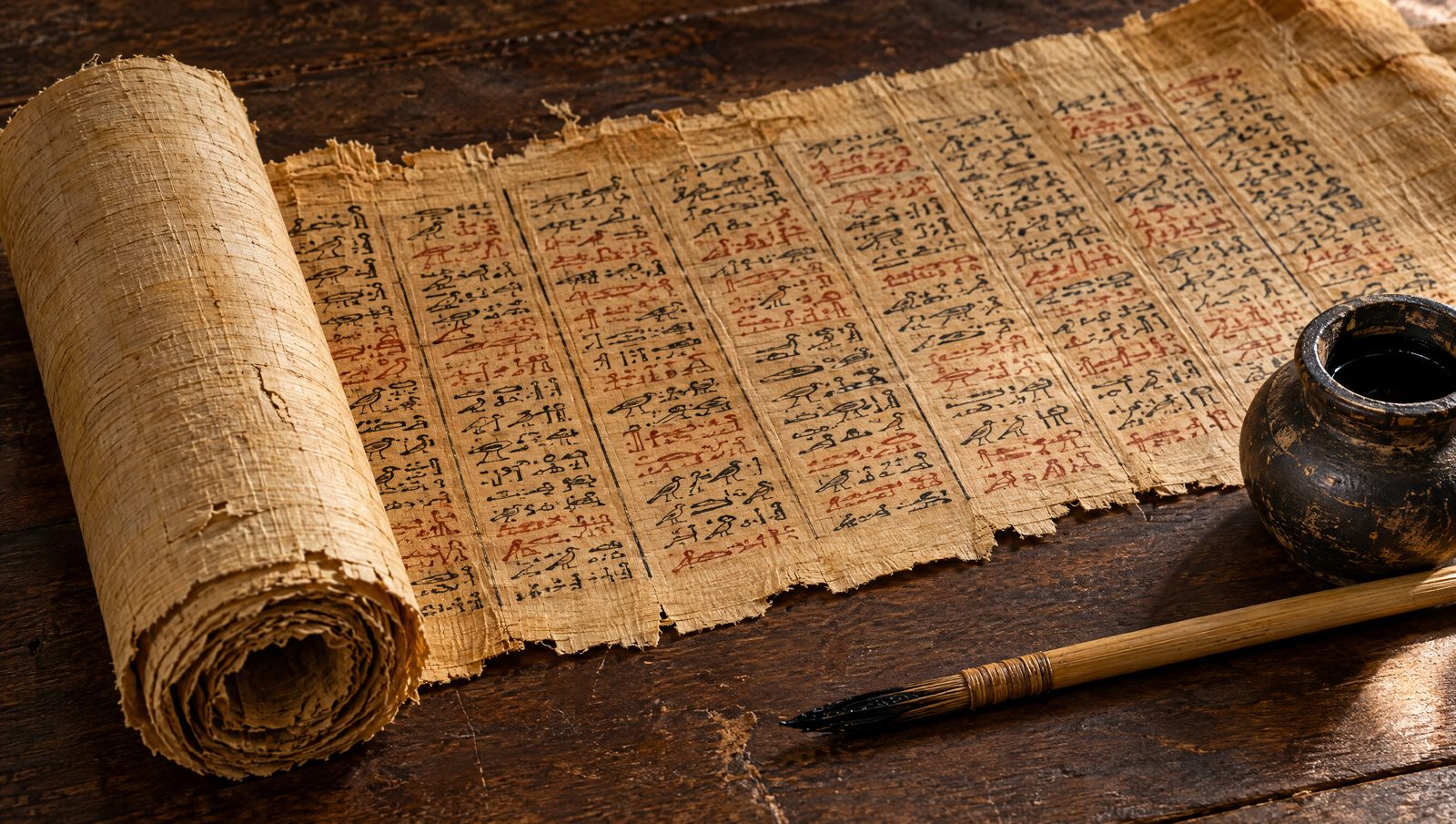
Papyrus D’Orbiney, written by a scribe named Inena in the late 19th Dynasty and now in the British Museum, holds the best-loved story of the period. Two brothers, Anubis and Bata, farm together; Bata, the younger, is strong and good and the cattle speak to him. One day the elder brother’s wife tries to seduce him. He refuses in horror, and she, afraid, tells her husband that Bata attacked her. Anubis waits behind the stable door with a spear. Bata’s cattle warn him as they come in, and he flees with his brother chasing, until the sun god Re puts a river full of crocodiles between them. Across the water Bata swears his innocence, cuts off his own genitals to prove it, and goes away to the Valley of the Cedar, placing his heart on the top of a pine tree for safekeeping. The gods make him a wife so beautiful that the pharaoh sends soldiers to take her. She betrays Bata and has the tree cut down. He dies, is revived by his brother, becomes a bull, then a pair of trees, then a splinter in the woman’s mouth, from which she conceives him again as the pharaoh’s heir. In the end Bata becomes king, and Anubis after him.
Akhenaten’s hymn to the sun
Around 1350 BC Akhenaten built a new city, Akhetaten, “Horizon of the Aten,” on virgin desert at the site now called Amarna, and had the walls of his courtiers’ rock tombs carved with hymns to his god. The longest, in the tomb of the official Ay, who later became king himself, is the Great Hymn to the Aten, and the king is named as its author. It praises the sun-disc as the sole creator who rises each morning to wake the world: birds lift their wings in worship, cattle skip, fish leap, ships sail up and down the river, and the chick in the egg chirps inside its shell because the Aten has given it breath. The god has made all lands and peoples, given them different skins and languages, and set a Nile in the sky to rain on the foreigners. Only Akhenaten knows him. Readers have long noticed the resemblance to Psalm 104. After Akhenaten’s death his city was abandoned and his name chiselled off the monuments; the hymn survived because no one bothered to erase a courtier’s tomb in the desert.
How the language sounded
Egyptian was written in three scripts at once. Hieroglyphs, the pictures carved on temples and painted in tombs, were a sacred and monumental script of several hundred signs in regular use. Hieratic, a flowing cursive version written with a reed brush on papyrus and limestone flakes, was what scribes actually used for letters, accounts and stories; the Tale of the Two Brothers is in hieratic. Centuries later, a third, even more abbreviated script, Demotic, appeared. The signs stand for consonants, one, two or three at a time, with silent picture-signs added to show a word’s category. Vowels were not written at all.
That last fact matters more than any other. The language itself is well understood: grammar, vocabulary and meaning are secure enough that scholars read a new inscription the way a Latinist reads a new tombstone. What we do not know is how most words were pronounced, because the vowels are missing. The language of the New Kingdom had two registers: Middle Egyptian, the classical form of five centuries earlier, still used for monuments and religious texts, and Late Egyptian, the spoken language of the day, which Akhenaten’s scribes were the first to write down freely.
- Egyptologists pronounce by convention. Since the vowels are unknown, the agreed habit is to put a short “e” between consonants and read the signs ꜣ and ꜥ as “a”, j and y as “i”, and w as “u”. That is how nfr became “nefer”. It is a filing system, not a reconstruction, and everyone in the field knows it.
- The real vowels are partly recoverable. Coptic, the last stage of Egyptian, was written in Greek letters from the third century AD and shows its vowels, so working backwards gives the ancient shape of many words. Egyptian names and words also appear in cuneiform, which writes vowels: Ramesses was something like Riamasesa, and the word for “great house”, pr-ꜥꜣ, from which “pharaoh” derives, was close to per-aa.
- There were sounds English lacks. ꜥ was the throaty consonant Arabic speakers know as ayin. There were two h-like fricatives, ḫ as in Scottish “loch” and ẖ as in German “ich”, besides a plain h and an emphatic ḥ.
- Some consonants shifted during the period. The sound written ṯ, originally “tch”, was merging with t, and ḏ (“dj”) with d, which is why Late Egyptian scribes spell the same word both ways.
- Stress fell on one of the last two syllables, and the vowel system was built around that stress, as Coptic shows.
So an honest answer to “how did it sound?” is: the consonants fairly well, the rhythm roughly, the vowels of common words approximately, and the exact voice of a Theban in 1300 BC not at all. The table below uses the standard transliteration with the Egyptological convention for saying it aloud, and gives the hieroglyphic spelling where one standard form exists; the same word could be written several ways.
| Original | Say it | Meaning |
|---|---|---|
| 𓇍𓅱 𓅓 𓊵𓏏𓊪 — jj.wj m ḥtp | ee-WEE em HO-tep | Welcome (literally “come in peace”) |
| 𓋹𓍑𓋴 — ꜥnḫ wḏꜣ snb | ankh WED-ja SEN-eb | Life, prosperity, health (added after a king’s name) |
| 𓄤𓆑𓂋 — nfr | NEH-fer | Good, beautiful |
| 𓇼𓄿𓊹 𓈖𓎡 — dwꜣ-nṯr n=k | DOO-a NET-jer en-ek | Thank you (literally “praise god for you”) |
| 𓇓𓏏𓊵𓏏𓊪𓂞 — ḥtp dj nsw | HO-tep dee NE-soo | “An offering which the king gives”: the opening of every funerary formula |
| 𓆎𓅓𓏏𓊖 — Kmt | KEH-met | Egypt, “the Black Land” |
| 𓇋𓏏𓆑 / 𓅐𓏏 — jt / mwt | yot / moot (vowels known from Coptic) | Father / mother |
| 𓂋𓈖 — rn | ren | Name: to speak a person’s name was to keep them alive |
ḫꜥ.k nfr m ꜣḫt nt pt, pꜣ jtn ꜥnḫ šꜣꜥ ꜥnḫ
You rise in beauty in the horizon of the sky, O living Aten, who began life.
Opening of the Great Hymn to the Aten, tomb of Ay, Amarna, c. 1350 BC
The line is given in transliteration rather than hieroglyphs because the tomb text runs in columns with spellings that do not transfer neatly to a screen. Read aloud by the Egyptological convention it comes out roughly as “kha-ek nefer em akhet net pet, pa iten ankh sha-a ankh”; the real vowels were different, and jtn, the sun-disc, has been reconstructed by some scholars as something like “yati”. The word ꜣḫt, horizon, is the same element in the name of his city, Akhetaten; ꜥnḫ, life, is the looped cross that every tourist recognises. In one short line the hymn names the god, the place he appears and his single function, and that economy is typical of the best Egyptian poetry.
Maya reads these aloud in the Egyptological pronunciation, honestly labelled as a scholarly convention rather than how the words truly sounded, in a free Ancient Egyptian session of fifteen minutes by phone.
Where to stand today
Karnak, Luxor
Every king in this guide built at Karnak, the house of Amun on the east bank at Luxor, the largest religious complex of the ancient world and the single most important site in Egypt for the New Kingdom. The Great Hypostyle Hall, 134 columns under a roof that once shut out the sun, was decorated by Seti I and Ramesses II; the Kadesh poem is carved on the outer walls, Hatshepsut’s obelisk still stands near the sanctuary, and Thutmose III’s annals of Megiddo line the walls behind it. Go when the gates open at six, before the heat and the coaches, and walk the whole axis to the sacred lake; two hours is a minimum.
Deir el-Bahari and the Valley of the Kings
Hatshepsut’s temple rises in three colonnaded terraces against the cliff on the west bank, and the Punt reliefs are on the south side of the middle terrace, left of the ramp; the carving is shallow, so see them in the morning when the light is angled. Over the ridge behind the temple is the Valley of the Kings, where the New Kingdom pharaohs were buried in painted corridors cut into the rock. The standard ticket admits you to three tombs; Tutankhamun’s, Seti I’s and Ramesses VI’s are extra, and Seti I’s is the finest painted tomb in Egypt. The valley is a furnace by late morning; start there at opening, then do the temple.
Deir el-Medina
A few minutes’ drive from the Valley, the workmen’s village is the one place on the west bank where you stand in the homes of named individuals: the stone footings of some seventy houses in a walled rectangle, and above them the small, brilliantly painted tombs the craftsmen made for themselves, including that of Sennedjem, where the painted couple reap wheat in the fields of the afterlife. The village produced the ostraca that tell us about the strike, the lawsuits and the love songs. It is rarely crowded and included on the general west-bank ticket; a torch is useful in the tombs.
Abu Simbel
Three hours by road south of Aswan, or a short flight, the two rock-cut temples of Ramesses II at Abu Simbel were cut from the cliff and moved uphill in the 1960s to save them from Lake Nasser. Four seated colossi of the king, twenty metres high, flank the entrance to the Great Temple; inside, the Kadesh battle covers a whole wall, and twice a year, around 22 February and 22 October, the rising sun reaches the statues in the sanctuary. The smaller temple is dedicated to his queen Nefertari and the goddess Hathor. Most visitors come on a dawn convoy from Aswan and leave by noon; staying overnight in the village gives you the temples nearly alone in the late afternoon.
The Grand Egyptian Museum, Giza
On the plateau beside the pyramids outside Cairo, the Grand Egyptian Museum now holds the complete contents of Tutankhamun’s tomb, more than 5,000 objects shown together for the first time since Howard Carter cleared the tomb in 1922, from the gold mask to the chariots and the child-sized gloves. The colossal statue of Ramesses II stands in the atrium. The older Egyptian Museum in Tahrir Square keeps much of the rest of the national collection and is worth a morning for its New Kingdom galleries, including the Amarna room with the unfinished heads of Akhenaten’s family. Book timed tickets for the Grand Egyptian Museum online and allow a full day.
Amarna
Akhenaten’s city lies on the east bank of the Nile in Middle Egypt, about 300 kilometres south of Cairo near the town of Mallawi, and sees few visitors. The city itself is mostly low mud-brick outlines on a plain of sand, but the rock tombs of the nobles in the cliffs, including Ay’s with the Great Hymn, keep their reliefs of the royal family under the rays of the Aten, each ray ending in a small hand. The site needs a car and driver from Minya and a full day; check current travel advice for the region before planning it, and go in winter.
Go deeper
- Miriam Lichtheim, Ancient Egyptian Literature, Volume II: The New Kingdom (University of California Press) — the standard scholarly translations of the Great Hymn, the Kadesh poem, the Two Brothers and the love songs, with brief introductions.
- Toby Wilkinson, The Rise and Fall of Ancient Egypt — a readable one-volume history that gives the New Kingdom its full weight and is honest about the brutality behind the monuments.
- Mark Collier and Bill Manley, How to Read Egyptian Hieroglyphs (British Museum Press) — the best starting point for reading real inscriptions, built around the offering formula found on stelae in every museum.
- James P. Allen, Middle Egyptian: An Introduction to the Language and Culture of Hieroglyphs (Cambridge University Press) — the full grammar for those who want to go further, with a clear chapter on what is and is not known about pronunciation.
- The History of Egypt Podcast by Dominic Perry — a long-running narrative podcast that walks reign by reign through the New Kingdom with the primary sources read aloud.
Frequently asked questions
Is Ancient Egyptian hard to learn?
The script is the hurdle, not the grammar. Learning a few hundred signs, the way they combine, and the habit of reading right to left or left to right depending on which way the birds face takes a few months of steady work. The grammar of Middle Egyptian is compact and regular once the verb system clicks, and because the vowels are not written there is no pronunciation to get wrong. Most learners can read the offering formula on museum stelae within weeks and simple tomb inscriptions within a year.
How accurate is the reconstructed pronunciation?
Be careful with the word “reconstructed”. The consonants are reasonably secure, and Coptic and cuneiform spellings give the approximate vowels of a few hundred common words and names. For everything else the “e” Egyptologists insert is a convention for saying words aloud in lectures, and no scholar claims it is how Egyptians spoke. Any spoken Egyptian you hear is a convention honestly used, not a recording of Thebes.
What modern languages descend from it?
Coptic, the final stage of the Egyptian language, written in a Greek-derived alphabet from the third century AD. It died out as a spoken language around the seventeenth century but survives as the liturgical language of the Coptic Orthodox Church, so you can still hear Egyptian sung in Cairo churches every Sunday. The Arabic now spoken in Egypt is unrelated, though it has absorbed Coptic words for farming and local things. Egyptian belongs to the Afroasiatic family, a distant cousin of Arabic, Hebrew and Berber.
Can I read the original texts after a few months?
Monumental inscriptions, yes, because they are formulaic: names, titles, offering formulas and standard epithets make up most of what is carved on a temple wall, and recognising a king’s cartouche at Karnak is a thrill available early. Literary texts in hieratic are another matter, requiring a second script and the different grammar of Late Egyptian, and are usually read in printed hieroglyphic transcription with a dictionary. Reading the Two Brothers unaided is a multi-year project.
What is the best first trip for this era?
Base yourself in Luxor for four or five nights between November and February, when daytime temperatures are pleasant. Split days between the east bank, Karnak and Luxor Temple, which is floodlit in the evening, and the west bank for the Valley of the Kings, Deir el-Bahari, Deir el-Medina and Medinet Habu, the temple of Ramesses III with the Sea Peoples reliefs. Then take the train or a Nile cruise to Aswan and fly or drive to Abu Simbel. Add two days in Cairo at the end for the Grand Egyptian Museum and Giza.