
The world at the time
Pick up almost any Latin textbook and the language it teaches belongs to a narrow window: roughly the century before Christ and the two centuries after. That is when Cicero argued in the Forum, Virgil polished the Aeneid, and Tacitus wrote his acid histories. It is also when a city-state that governed Italy became an empire stretching from the Tyne to the Euphrates.
The period opens in violence. The Social War of 91–88 BC forced Rome to grant citizenship to its Italian allies, which is why Latin, rather than Oscan or Etruscan, became the speech of the whole peninsula. Then the Republic consumed itself. Sulla marched on Rome; Cicero, as consul in 63 BC, exposed the conspiracy of Catiline; Julius Caesar crossed the Rubicon in January 49 BC and was stabbed at a Senate meeting on the Ides of March, 44 BC. His heir Octavian defeated Antony and Cleopatra at Actium in 31 BC and, in 27 BC, took the name Augustus. The Republic’s institutions survived on paper. In practice one man now controlled the armies, the treasury and the grain supply.
Augustus died in AD 14. The dynasty he founded ended with Nero in AD 68, and after a year of civil war the Flavians rebuilt confidence, literally: Vespasian began the Colosseum and his son Titus inaugurated it in AD 80, a year after Vesuvius buried Pompeii and Herculaneum. Under Trajan (AD 98–117) the empire reached its greatest extent, taking in Dacia and, briefly, Mesopotamia. Hadrian pulled back and built walls instead, including the one across northern Britain begun in AD 122. The era closes with Marcus Aurelius, the emperor who wrote his private Meditations in Greek while fighting on the Danube, dying in AD 180.
Rome itself held perhaps a million people, most of them in insulae, multi-storey apartment blocks that leaned over narrow streets and burned with depressing regularity. Roughly a fifth of the population may have been enslaved, and freed slaves and their descendants ran much of the city’s commerce. Around 200,000 male citizens drew free grain from the state. Water arrived by aqueduct in quantities no European city would match again until the nineteenth century, and the public baths were the social heart of every town from Britain to Syria.
Trade was Mediterranean in scale and beyond. The broken amphorae of Monte Testaccio in Rome, a hill some thirty-five metres high made of discarded olive-oil jars from Spain, give some idea of volume. Wine, grain, marble, slaves, fish sauce and textiles moved through Ostia and Puteoli. From Egypt, ships rode the monsoon to India; a Greek merchant’s handbook, the Periplus of the Erythraean Sea, describes the ports and what sold where.
Religion was public, contractual and plural. The state kept its calendar of festivals, its augurs and its Vestal Virgins; households kept their lares in a shrine by the hearth. Emperors were honoured with temples in the provinces and deified after death. Alongside all this, the cults of Isis and Mithras spread through the ports and the army, Jewish communities lived in every major city, and by the reign of Trajan a provincial governor named Pliny was writing to ask what exactly he should do about people called Christians.
What made the period distinct was its bilingualism. Educated Romans read and spoke Greek, and much of the eastern empire never spoke Latin at all. Yet Latin was the language of law, the army and the inscriptions that still cover the Mediterranean world. It is from this stretch of time, the so-called Golden and Silver Ages of Latin literature, that the classical standard comes.
The stories they told
Aeneas and the fall of Troy
Virgil worked on the Aeneid for the last decade of his life, from about 29 BC until his death in 19 BC, and asked on his deathbed that the unfinished poem be burned. Augustus overruled him. The poem gives Rome a Trojan pedigree: Aeneas, son of Venus, escapes the burning city carrying his father Anchises on his shoulders and leading his small son by the hand, his wife lost somewhere in the smoke behind them. Seven years of wandering follow. A storm throws his fleet onto the coast of North Africa, where Queen Dido is building Carthage. In Book 4 she falls in love with him; when the gods order him onward to Italy, she curses his descendants and kills herself on a pyre built from his belongings. Romans read in that curse the origin of the Punic Wars. In Book 6 Aeneas descends to the underworld and is shown the souls of Romans yet unborn, Augustus among them. Virgil’s hero is pius, dutiful, a man who does what fate demands and grieves for what it costs him. Generations of schoolchildren across the empire learned to read from this poem, and lines from its opening turn up scratched on the walls of Pompeii.
Lucretia and the end of the kings
Livy, writing under Augustus, tells the story in the first book of his Ab Urbe Condita. During a siege, young Roman noblemen argue over whose wife is the most virtuous and ride home unannounced to find out. The royal wives are at a banquet; Lucretia, wife of Collatinus, is at her loom with her maids, working late by lamplight. Sextus Tarquinius, son of the king, returns a few nights later and rapes her, threatening to kill her and a slave together and claim he caught them in adultery. Lucretia sends for her father and husband, tells them exactly what happened, demands vengeance, and stabs herself so that, in Livy’s phrasing, no unchaste woman could ever use her example to live. Lucius Junius Brutus pulls the knife from her body and swears to drive out the Tarquins. The traditional date for the expulsion of the kings and the first consuls is 509 BC. Whether any of it happened is doubtful; what matters is that Romans of Cicero’s day believed it, and that their word for the king’s tyranny and the republic’s birth was a woman’s refusal to be silenced.
Cicero against Catiline
On 8 November 63 BC the consul Cicero convened the Senate in the Temple of Jupiter Stator, at the foot of the Palatine, and found Lucius Sergius Catilina sitting among them. Catiline, a patrician who had twice lost the consular election, was organising an armed rising in Etruria and, Cicero claimed, had sent men to murder him at dawn the day before. Cicero rose and delivered the speech still read in its first line by every Latin student: Quo usque tandem abutere, Catilina, patientia nostra? How long, Catiline, will you go on abusing our patience? The senators around Catiline edged away, leaving him on an empty bench. He left the city that night for his army. Over the next month Cicero gave three more speeches, intercepted letters that proved the conspiracy, and had five of the ringleaders executed without trial in the Tullianum prison. Catiline died in battle near Pistoia in January 62 BC. Cicero called himself the saviour of the Republic for the rest of his life; the executions, strictly illegal, were used to drive him into exile five years later. Sallust’s short monograph Bellum Catilinae tells the same story with a far cooler eye.
Pliny watches Vesuvius
Some decades after the event, the historian Tacitus asked Pliny the Younger what he remembered of his uncle’s death. Two letters survive, Epistulae 6.16 and 6.20. In AD 79 the elder Pliny commanded the fleet at Misenum, across the bay from Vesuvius. On the afternoon the eruption began, his sister pointed out a cloud shaped like an umbrella pine rising from the mountain. He ordered a boat to investigate, then warships when a message arrived from a friend trapped beneath the volcano. Pumice fell on the decks. He dictated notes as he sailed. He landed at Stabiae, dined, bathed and slept, snoring audibly, while the courtyard filled with ash. In the morning, in darkness thicker than any night, the party made for the shore with pillows tied over their heads. The elder Pliny, a heavy man with a weak chest, collapsed and died on the beach. His nephew, seventeen years old, had stayed behind at Misenum reading Livy. His second letter describes the ground shaking, the sea pulled back from the shore, the crowd fleeing with a flood of ash at their heels, and people convinced that the gods were gone and this was the last night of the world. It is the only eyewitness account of a major eruption to survive from antiquity.
How the language sounded
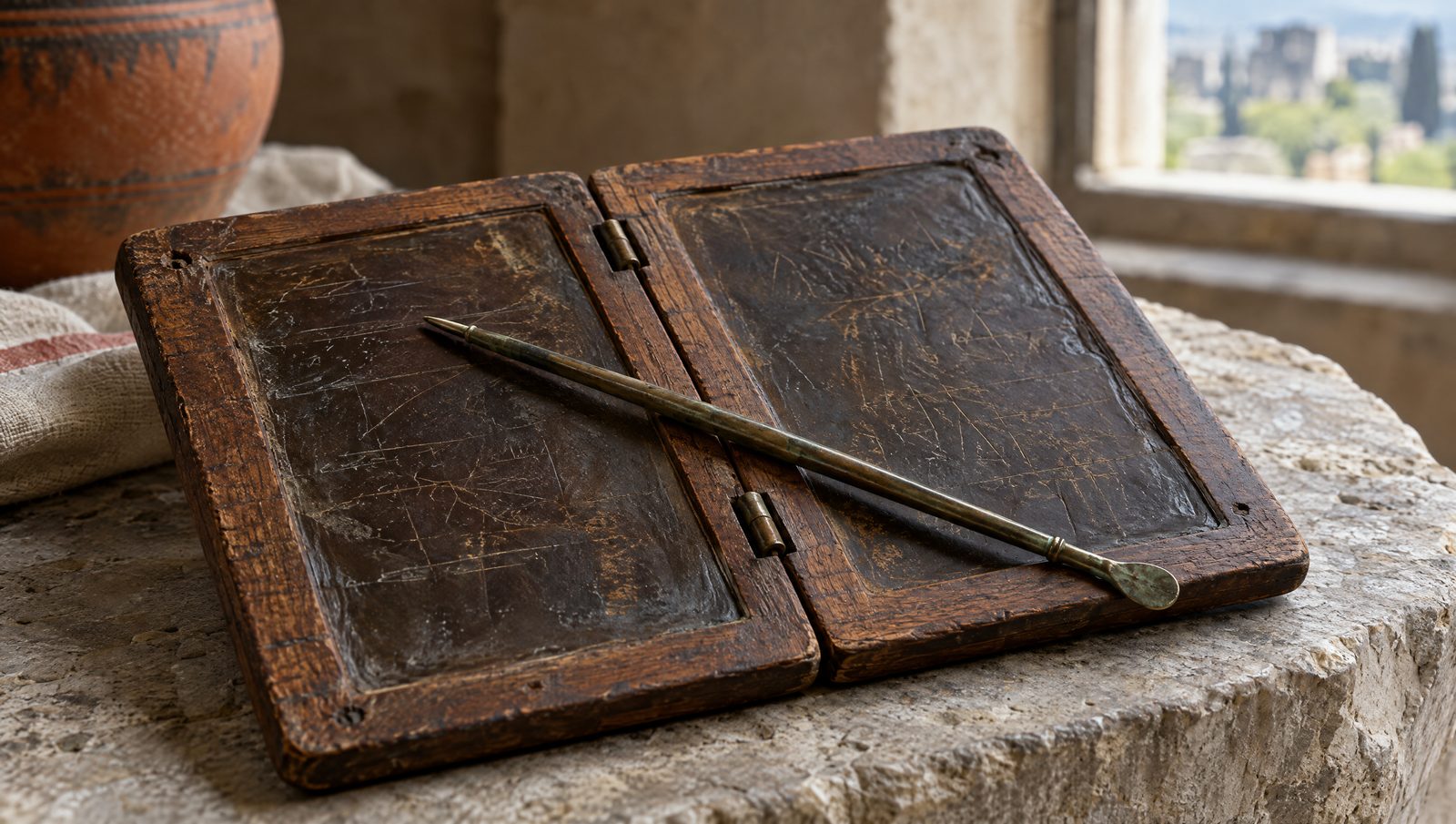
Latin was written in an alphabet of twenty-one letters inherited, through the Etruscans, from the Greeks; Y and Z were added for Greek loanwords. There was no J, U or W. The letter I covered both the vowel in vita and the consonant in Iulius; V covered the vowel in lupus and the consonant in vinum. Monumental inscriptions used the square capitals you still see carved on the Pantheon, often with a raised dot between words. Everyday writing used a cursive hand on wax tablets and papyrus, or scratched into plaster. The wooden writing tablets from Vindolanda, near Hadrian’s Wall, preserve birthday invitations and complaints about the roads in a script that takes specialists years to read.
The reconstructed Classical pronunciation differs from the Church Latin most people have heard in a handful of consistent ways.
- C was always hard. Cicero called himself something close to “KIH-keh-roh”. Greek writers spelled his name Kikerōn, and Germanic languages borrowed Caesar as Kaiser.
- V was a W sound. Veni, vidi, vici came out as “WAY-nee, WEE-dee, WEE-kee”. Greek wrote Valerius as Oualerios.
- AE sounded like the English word “eye”. Caesar was roughly “KYE-sar”. By the later empire it had become a simple “eh”, which is why the Romance languages have e here.
- Vowel length mattered. Every vowel was short or long, and the difference changed meaning: malum with a short a is evil, mālum with a long a is an apple. Modern editions mark long vowels with a macron; Romans occasionally did too, with a stroke called an apex.
- Nothing was silent. H was a light breath, every written consonant was pronounced, and doubled consonants were held longer, as in Italian.
- Stress fell by rule. On the second-last syllable if it was long, otherwise on the third-last. R was rolled.
How do we know? Roman grammarians such as Quintilian describe sounds directly. Greek transcriptions of Latin names show which letters matched which Greek sounds. Spelling mistakes in graffiti and private letters reveal what people actually heard: when a Pompeian wrote e for ae, the sound had shifted in his mouth. Poetry is built on patterns of long and short syllables, so a line of Virgil is also a record of vowel length. Finally, the Romance languages are Latin spoken continuously for two thousand years, and comparing them lets scholars work backwards.
Plenty remains uncertain. We know a final -m was weakly pronounced, probably as nasalisation of the preceding vowel, but not exactly how it sounded. Regional accents existed and are mostly lost. Above all, the Latin of the texts is an educated written standard; the speech of a Spanish legionary or a Roman fishmonger was already drifting toward what would become Spanish and Italian.
| Original | Say it | Meaning |
|---|---|---|
| Salvē / Salvēte | SAL-way / sal-WAY-teh | Hello (to one person / to several) |
| Valē | WAH-lay | Goodbye |
| Grātiās tibi agō | GRAH-tee-ahs TIH-bee AH-goh | Thank you |
| Quid agis? | kwid AH-giss | How are you? |
| Nōmen mihi est Marcus | NOH-men MIH-hee est MAR-kuss | My name is Marcus |
| Ubi est forum? | OO-bee est FOH-rum | Where is the forum? |
| Ita / Minimē | EE-tah / MIH-nih-may | Yes / No |
| Nōn intellegō | nohn in-TEL-leh-goh | I don’t understand |
Arma virumque canō, Trōiae quī prīmus ab ōrīs
Ītaliam fātō profugus Lāvīniaque vēnit
lītora.Arms and the man I sing, who first from the shores of Troy, a fugitive by fate, came to Italy and the Lavinian coast.
Virgil, Aeneid 1.1–3
These are the most quoted words in Latin, and they show how the language worked. The first word is a weapon and the second a man: Virgil is announcing that his poem will be both Iliad and Odyssey. Canō, “I sing”, comes third because Latin word order is free enough to put the verb wherever it carries most weight. The lines are dactylic hexameter, six feet of long and short syllables, which is why editors can tell you that the first a of arma is short and the ō of canō is long. Someone in Pompeii, before AD 79, scratched Arma virumque onto a wall, and someone else wrote a parody about a fuller instead of a hero. The poem was already a cliché within a century of its publication.
Maya reads these aloud in a reconstructed Classical pronunciation, honestly labelled as a reconstruction, in a free Latin session of fifteen minutes by phone.
Where to stand today
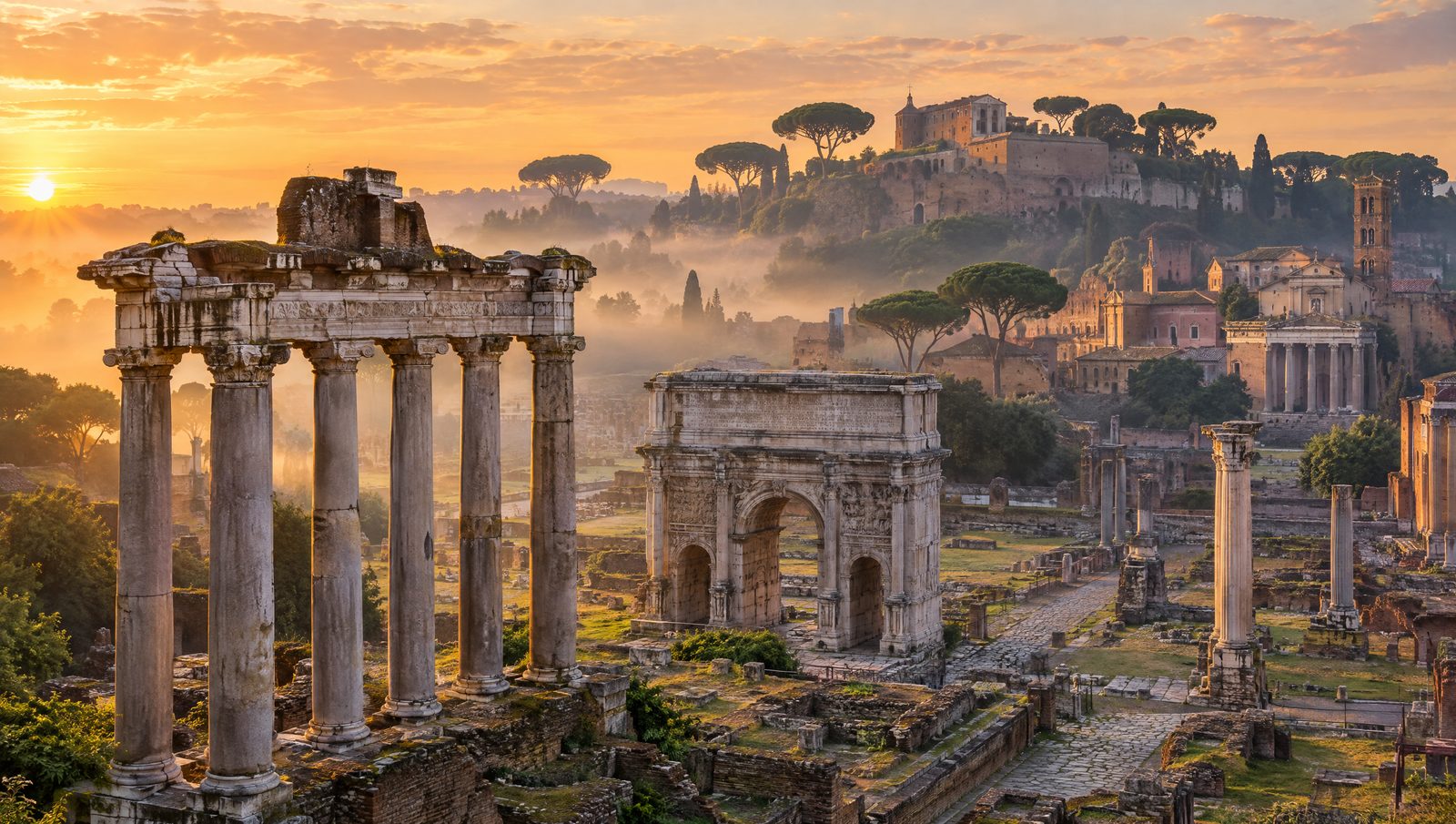
The Roman Forum and Palatine, Rome
Everything in this guide happened within a few hundred metres of the Roman Forum. The Temple of Jupiter Stator where Cicero attacked Catiline stood at the Palatine end; the Rostra from which he spoke to the people faces the Curia, the Senate house rebuilt by Diocletian and still standing because it became a church. Nearby is the spot where Caesar’s body was burned, still receiving flowers. Up on the Palatine, the modest House of Augustus keeps its painted rooms. The Forum, Palatine and Colosseum share one ticket; book a timed entry online and go at opening, when the light rakes across the columns and the tour groups are still at breakfast.
Pompeii and Herculaneum
Twenty minutes by train from Naples, Pompeii is where Latin stops being a textbook language. Election notices painted in red capitals, prices chalked on bar counters, lovers’ insults and lines of Virgil cover the walls. Herculaneum, smaller and buried deeper, preserves wooden doors, staircases and a carbonised library. Pliny’s letters describe both towns dying. The official site, pompeiisites.org, sells timed tickets; buy ahead in summer, carry water, and plan on Herculaneum in the afternoon when its shaded streets are a relief after Pompeii’s open ground.
The Vatican Museums and the Augustus of Prima Porta
Among the thousands of objects in the Vatican Museums, one statue defines the era: the Augustus found in 1863 at his wife Livia’s villa at Prima Porta. He stands barefoot like a god, in a breastplate carved with the return of the standards lost to Parthia. The Braccio Nuovo gallery that houses it is quieter than the Sistine route. Book the earliest slot available; the museums are a marathon, and the Latin inscriptions in the Lapidary Gallery are worth a slow walk if that corridor is open on your day.
Nîmes and the Pont du Gard, France
Southern France was Rome’s oldest province outside Italy, and Nîmes keeps the best-preserved Roman temple anywhere: the Maison Carrée, finished in the early first century AD and dedicated to Augustus’s grandsons. Its amphitheatre still hosts events. Twenty kilometres away, the Pont du Gard carries the city’s aqueduct fifty metres above the river Gardon on three tiers of arches cut without mortar. The site at pontdugard.fr has a museum and evening openings in summer; the late light on the honey-coloured stone is the reason to stay for them.
Mérida, Spain
Augusta Emerita was founded in 25 BC for veterans of the wars in northern Spain, and today’s Mérida in Extremadura has more standing Roman architecture than any other city in the country. The theatre, paid for by Augustus’s deputy Agrippa around 16–15 BC, still has its two-storey marble stage wall and hosts a classical theatre festival every July and August. The amphitheatre, aqueduct, bridge and temple of Diana are all within walking distance, and the National Museum of Roman Art holds the mosaics. A combined ticket covers the main monuments; spring and autumn are the seasons to walk between them.
Hadrian’s Wall and Vindolanda, England
The wall Hadrian began in AD 122 runs 73 miles across northern England. The central stretch between Housesteads and Steel Rigg is the walk to do, with the wall riding the crags above the lakes. Just south of it, Vindolanda is the fort where the writing tablets were found in waterlogged soil, and excavations continue every summer with volunteers; the site museum displays a changing selection of the tablets alongside leather shoes and a wooden toilet seat. The site closes over the deepest winter weeks, so check dates before travelling, and bring boots whatever the forecast.
The British Museum, London
Room 49 at the British Museum in London covers Roman Britain and holds most of the Vindolanda tablets, including the birthday invitation from Claudia Severa to Sulpicia Lepidina, among the earliest surviving writing by a woman in Latin. Rooms 69 and 70 cover Greek and Roman life and the empire, with the Portland Vase and a head of Augustus taken as a trophy to Meroë in Sudan. Entry is free; weekday afternoons are calmer than weekends, and the Roman rooms on the upper floor are rarely crowded.
Go deeper
- Virgil, The Aeneid, translated by Robert Fagles (Penguin Classics) — a modern verse translation with a long introduction by Bernard Knox; the older Penguin prose version by David West is also good for a first reading.
- Mary Beard, SPQR: A History of Ancient Rome — the best single-volume history of the period for a general reader, strong on how we know what we know.
- Pliny the Younger, The Letters of the Younger Pliny, translated by Betty Radice (Penguin Classics) — includes the two Vesuvius letters and the exchange with Trajan about the Christians.
- Frederic Wheelock, Wheelock’s Latin — the standard self-study grammar, now in its seventh edition, with readings from real authors from the first chapters.
- The Perseus Digital Library (Tufts University) — free online texts of Cicero, Caesar, Virgil, Livy and Tacitus with a click-through dictionary on every word; the Loeb Classical Library offers the same authors in print with Latin and English on facing pages.
Frequently asked questions
Is Latin hard to learn?
Harder than Spanish, easier than its reputation. The difficulty is the grammar: nouns change their endings for six cases, verbs for person, tense, mood and voice, and word order tells you emphasis rather than meaning. The compensation is that spelling and pronunciation are regular, there are no native speakers to embarrass yourself in front of, and roughly sixty percent of English vocabulary is Latin by descent or borrowing. Most adult learners can read adapted texts within a few months and simple real texts, such as Caesar’s Gallic War, within a year of steady work.
How accurate is the reconstructed pronunciation?
For the main consonants and vowels, very accurate; the evidence from grammarians, metre, Greek transcriptions and the Romance languages all points the same way, and the hard c and w-sounding v are not in serious doubt. Finer details are less certain: exactly how nasal the final -m was, the precise quality of short vowels, intonation and rhythm. No one knows what Cicero’s voice sounded like. Think of it as the way a careful historian would speak the language, not a recording of a Roman.
What modern languages descend from Latin?
Italian, Spanish, Portuguese, French, Romanian, Catalan, Occitan, Sardinian, Romansh and a cluster of smaller Romance languages are Latin as it continued to be spoken in each region after the empire fell. They descend not from Cicero’s written standard but from the everyday speech of soldiers and traders. English is Germanic, but it absorbed so much Latin through the Church, the Normans and the Renaissance that a Latin learner finds familiar words on every page.
Can I read the original texts after a few months?
With a dictionary and a commentary, yes, slowly. Caesar is the traditional starting point because his sentences are clear and his vocabulary is limited. Pompeian graffiti and inscriptions are short and often fun. Virgil and Cicero are harder: the poetry compresses, the oratory sprawls. Reading at speed for pleasure takes years, which is why so many people keep at it for life.
What is the best first trip for this era?
Rome and the Bay of Naples together, in a week or ten days, outside July and August. Three days in Rome for the Forum, Palatine, Pantheon and Ostia Antica, the city’s quiet excavated port; then the train south for Pompeii, Herculaneum and the National Archaeological Museum in Naples, where the best finds from both towns ended up. If you have a second trip in you, Hadrian’s Wall is the place to see what the empire looked like from its edge.