
The world at the time
Confucius died in 479 BC, in the small state of Lu in what is now Shandong, convinced he had failed. The Zhou kings he revered had been powerless for two centuries, their nominal vassals were at war with each other, and no ruler had hired him to put things right. His students wrote down what they remembered of him, and the result, the Analects, became the most influential book in East Asia. The seven hundred years covered by this guide, from his death to the fall of the Han dynasty, are the period in which the written language of those students became the written language of a civilisation.
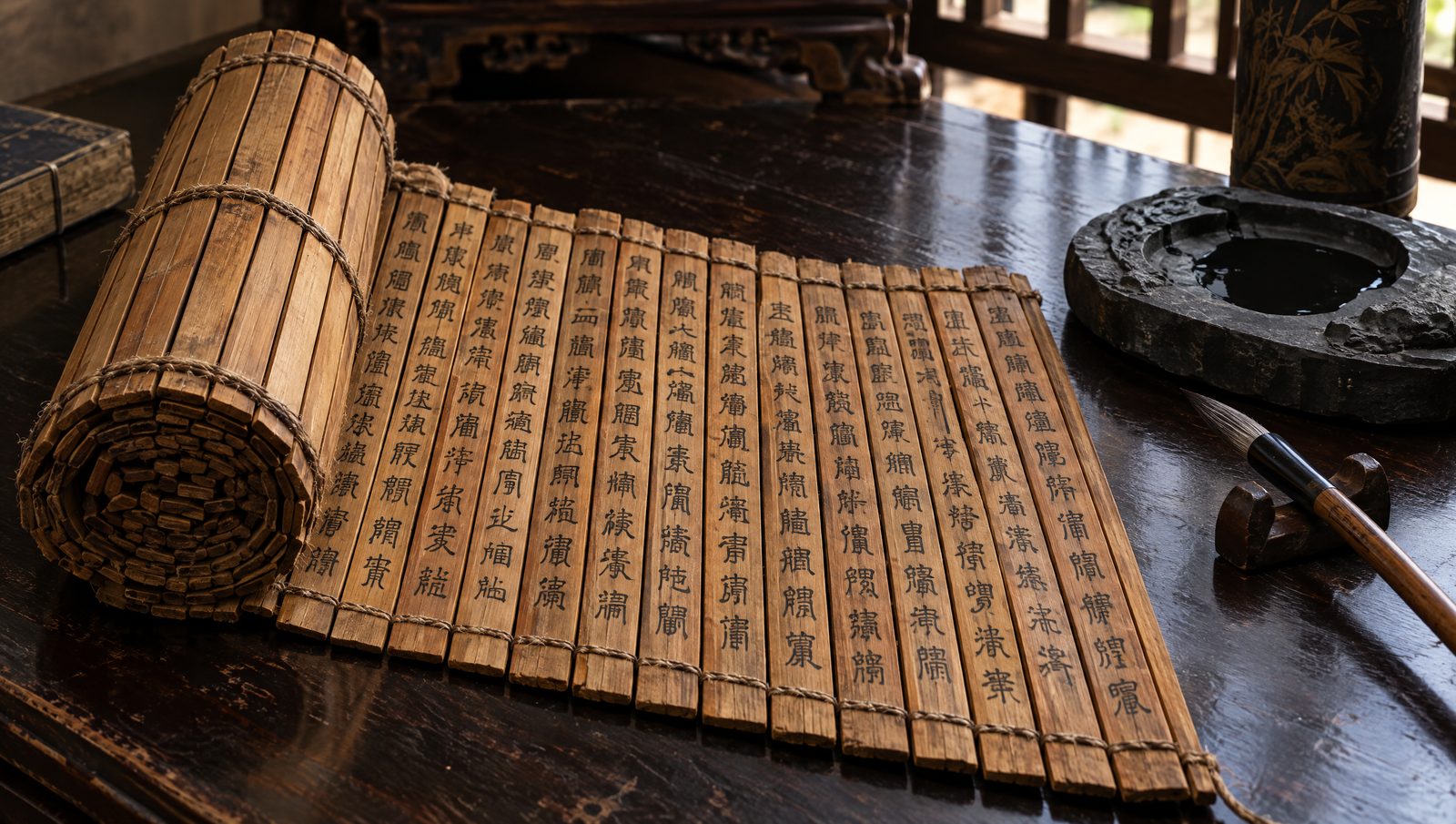
Historians call the first half the Warring States. Seven large kingdoms absorbed the smaller ones and fought with armies of conscripted peasants, crossbows and iron weapons. It was also, not by coincidence, the great age of Chinese thought. Mozi preached universal love and attacked ritual expense; Mencius argued that human nature is good and that a ruler who loses the people’s support may be removed; Zhuangzi laughed at everyone; the Legalists, above all Han Fei, who died in a Qin prison in 233 BC, told kings to trust law and punishment rather than virtue. The short, enigmatic Daodejing attributed to Laozi took shape in these centuries; a version was buried in a tomb at Guodian around 300 BC. Scholars moved between courts selling advice, and wrote on strips of bamboo bound with cord.
Qin, the western state that had taken Legalism most seriously since the reforms of Shang Yang in the 350s BC, won. In 221 BC its king conquered the last of his rivals and took the new title Shi Huangdi, First Emperor. In eleven years he standardised weights, measures, coinage, the width of cart axles and, most lastingly, the script, imposing Qin’s small seal forms across the empire. In 213 BC he ordered the burning of privately held histories and philosophical books, and he built himself a tomb near modern Xi’an guarded by an army of clay soldiers. The dynasty did not survive his son. By 206 BC the capital had fallen, and after four years of war a former village policeman named Liu Bang became emperor of the Han.
The Han lasted four centuries and gave the Chinese their name for themselves. Emperor Wu, who reigned from 141 to 87 BC, made Confucianism the official learning, founded an Imperial Academy in 124 BC where students studied the Five Classics for government posts, sent the envoy Zhang Qian into Central Asia and opened the routes we call the Silk Road. His court historian Sima Qian completed the Records of the Grand Historian around 94 BC, a history of the world as he knew it from the Yellow Emperor to his own day, and the model for every Chinese history after it. A census in AD 2 counted 57.7 million people.
After the usurper Wang Mang’s brief reign, the dynasty was restored in AD 25 with its capital at Luoyang. Cai Lun reported an improved method of making paper to the throne in AD 105, and Xu Shen finished the first dictionary to analyse characters by their components, the Shuowen Jiezi, at about the same time. In 175 the court had the Confucian classics carved on stone tablets at the Academy so that no copyist could corrupt them, and students came to take rubbings. Buddhism arrived from India along the trade routes; tradition says the first monastery, the White Horse Temple at Luoyang, was founded in AD 68.
What made the period distinct was the creation of a written standard that did not depend on speech. The spoken languages of the empire differed then as they do now, but the characters and the terse grammar of the classics could be read by anyone who had learned them, and the Han examination system made learning them the road to office. That language, which we call Classical or Literary Chinese, went on to serve Korea, Japan and Vietnam as Latin served Europe, for nearly two thousand years. The Han fell in 220, after the Yellow Turban rising of 184 and decades of warlordism, but its scholars had built something more durable than the state.
The stories they told
Confucius between Chen and Cai
The Analects is not a biography but a collection of sayings and short scenes, and the scene the tradition loved most is in Book 15. Confucius, about sixty, is travelling with his disciples between the states of Chen and Cai, looking for a ruler who will employ him. The provisions run out. The followers grow so weak that they cannot stand. Zilu, the bluntest of them, a former tough whom the Master had civilised, goes to him in anger and asks whether a gentleman, too, can be reduced to this. “A gentleman holds firm in hardship,” Confucius answers. “A small man in hardship goes to pieces.” Sima Qian, four centuries later, expanded the episode into a siege, with Confucius calmly playing his zither and testing each disciple in turn; it is Yan Hui, the gentle favourite who would die young, who gives the answer he wants, that a way can be worthy even if the world rejects it. The Analects also records Confucius’s cry at Yan Hui’s death, “Heaven has bereft me”, and the disciples’ surprise that a man so composed could weep so hard.
Zhuangzi’s butterfly, and his wife
The book that bears Zhuangzi’s name is the funniest and strangest text of the Warring States. Its second chapter ends with the author dreaming he was a butterfly, flitting about, happy, unaware of any Zhuangzi; then he wakes, and does not know whether he is Zhuangzi who dreamed he was a butterfly or a butterfly now dreaming it is Zhuangzi. In chapter 17 he walks with the logician Huizi on a bridge over the river Hao and remarks that the minnows are enjoying themselves. How, Huizi asks, can you know what fish enjoy, not being a fish? How, Zhuangzi replies, can you know that I don’t know, not being me? In chapter 18 Huizi comes to pay condolences on the death of Zhuangzi’s wife and finds him squatting on the ground, drumming on a basin and singing. Challenged, Zhuangzi says that he grieved at first, but then thought back to before she was born, before she had a body, before she had breath, and saw that her death was only one more change, like the turning of the seasons. To howl after her now, he says, would show he did not understand fate. The passage has consoled Chinese readers for two thousand years and troubled nearly as many.
Jing Ke and the king of Qin
In 227 BC the crown prince of Yan, a northern state about to be swallowed by Qin, sent an assassin to the future First Emperor. Sima Qian tells the story in his chapter on assassin-retainers. Jing Ke was a swordsman and drinker whom the prince housed in luxury for months. To get an audience he needed gifts the king of Qin would want: a map of Yan’s richest district, with a poisoned dagger rolled inside it, and the head of a Qin general who had defected, which the general, hearing the plan, cut off for him. At the river Yi the prince and his friends saw Jing Ke off in white mourning clothes, and his companion Gao Jianli played the lute while Jing Ke sang: the wind is bleak, the Yi water cold; the brave man goes and will not return. In the Qin audience hall his assistant lost his nerve, so Jing Ke carried the map up alone, unrolled it to the end, seized the dagger and the king’s sleeve. The sleeve tore. The king ran around a pillar with his long ceremonial sword stuck in its scabbard while his unarmed courtiers watched, until someone shouted to push the sword behind his back to draw it. Jing Ke, cut eight times, threw the dagger, missed, and died laughing at himself. Yan fell within the year.
Sima Qian’s choice
The historian whose book preserves most of the stories above paid for it with his body. In 99 BC the general Li Ling surrendered to the Xiongnu nomads after a hopeless battle, and at court Sima Qian, who barely knew him, spoke up in his defence. Emperor Wu took this as an attack on his favourite, the commander who had failed to support Li Ling, and sentenced Sima Qian to castration. A man of his rank was expected to buy his way out or kill himself; he had no money, and chose the mutilation so that he could finish the history his father had begun. His explanation survives in a long letter to a friend, Ren An, who was himself facing execution: he lists the men who wrote great works in disgrace, Confucius in distress, Qu Yuan in exile, Zuo Qiu blind, and says that if the book could be stored in a famous mountain and handed down to those who would understand it, he would have no regrets even if he were killed ten thousand times. The letter is preserved in the History of the Han; the hundred and thirty chapters of the Shiji are its vindication.
How the language sounded
Chinese is written with characters, each standing for a syllable and a meaning, and the system was already a thousand years old when Confucius was born: the oracle bones of the Shang kings, around 1200 BC, use its ancestor. Over this period the characters changed shape twice. The First Emperor’s reform fixed the elegant, rounded small seal script for official use; under the Han the brush produced the squarer, faster clerical script, from which all later forms descend, and which a modern reader can make out with effort. Books were bamboo or wooden strips tied into rolls, with silk for luxury copies; paper took over slowly from the first century AD.
What the characters sounded like is a different and much harder question. Classical Chinese texts are read today in whatever Chinese a reader speaks, so Confucius’s name is Kǒngzǐ in Mandarin, Húng-jí in Cantonese and Kōshi in Japanese. None of these is what his students called him. The reconstruction of Old Chinese, the speech of the Warring States and Han, is one of the great projects of modern linguistics, and the mainstream picture is this:
- There were no tones. The tones of every modern Chinese language developed later, from consonants at the ends of words: a final glottal stop became the rising tone, a final -s the departing tone. Confucius spoke a toneless language with more consonants than Mandarin.
- Syllables ended in consonants. Final -p, -t, -k, -m, -n and -ng were all common, as they still are in Cantonese; Mandarin has lost the first four.
- Syllables could begin with consonant clusters and carry prefixes, so that a word Mandarin now says as a single consonant and vowel might have been something like *s-tək. The asterisk is a linguist’s warning that the form is reconstructed.
- Voiced and voiceless consonants were distinct, b against p, d against t, in a way that most modern varieties have lost.
- Words were mostly one syllable, and the written language was terser than speech: the classics compress, and the commentaries exist to unpack them.
- Grammar came from word order and particles, not endings. A handful of small words, yě, yǐ, hū, zhī, do the work that inflection does in Latin, and learning to hear them is learning to read.
How do we know? Four kinds of evidence converge. The Book of Odes, the Zhou-era anthology of songs that Confucius quoted constantly, rhymes, and where its rhymes fail in modern pronunciation the old sounds can be inferred. Most characters contain a phonetic component that once indicated the sound, so characters sharing one must once have sounded alike. A rhyme dictionary of AD 601, the Qieyun, records the pronunciation of a later stage, Middle Chinese, in detail. And the readings of characters borrowed into Japanese, Korean and Vietnamese, together with the most conservative modern dialects, particularly Min, preserve features Mandarin has lost.
What remains uncertain is a great deal. The leading reconstructions, by Bernhard Karlgren in the 1950s, William Baxter and Laurent Sagart in 2014 and the Chinese scholar Zhengzhang Shangfang, agree on the broad shape and disagree on vowels, clusters and almost every detail. The sound of a Warring States court is not recoverable in the way that Cicero’s Latin is. The phrasebook below therefore gives the characters with their modern standard Mandarin readings, and notes one reconstructed form so you can see the distance.
| Original | Say it (modern Mandarin) | Meaning |
|---|---|---|
| 子曰 · zǐ yuē | dzuh YWEH | The Master said (the formula that opens most sayings of Confucius; Old Chinese roughly *tsəʔ ɢʷat) |
| 有朋自遠方來,不亦樂乎 · yǒu péng zì yuǎnfāng lái, bù yì lè hū | yoh pung dzuh ywen-fahng lie, boo yee luh hoo | To have friends come from afar, is that not a joy? (Analects 1.1) |
| 然 / 否 · rán / fǒu | rahn / foh | Yes, so it is / No |
| 不知也 · bù zhī yě | boo jir yeh | I do not know (Analects 3.11) |
| 何謂也 · hé wèi yě | huh way yeh | What does that mean? (Analects 3.8) |
| 何如 · hé rú | huh roo | What do you think? / How would that be? |
| 善哉 · shàn zāi | shahn dzye | Excellent! Well said! (a classical exclamation of approval) |
| 君子 · jūnzǐ | jwin-dzuh | Gentleman, person of cultivated character (the ideal of the Analects) |
子曰:學而時習之,不亦說乎?有朋自遠方來,不亦樂乎?人不知而不慍,不亦君子乎?
Zǐ yuē: xué ér shí xí zhī, bù yì yuè hū? Yǒu péng zì yuǎnfāng lái, bù yì lè hū? Rén bù zhī ér bù yùn, bù yì jūnzǐ hū?
The Master said: To learn, and at the proper time to practise what one has learned, is that not a pleasure? To have friends come from afar, is that not a joy? To go unrecognised and feel no resentment, is that not what makes a gentleman?
Confucius, Analects 1.1
Every Chinese schoolchild for two thousand years began here, and the three questions set out the whole programme: study, friendship and a self-respect that does not depend on office. Notice how the language works. There are no tenses, no plurals and no subject for “learn”; the particle hū at the end of each clause turns it into a question, and bù yì … hū, “is it not also…?”, is a rhetorical frame that expects agreement. The character 說 in the first line is read yuè, “pleased”, rather than its usual shuō, “speak”, a reminder that in the classical language one character can carry several words. The last line is widely taken as Confucius’s answer to his own disappointment.
Maya reads these aloud in standard Mandarin and, separately and honestly labelled as a scholarly reconstruction, in an approximation of Old Chinese, in a free Classical Chinese session of fifteen minutes by phone.
Where to stand today
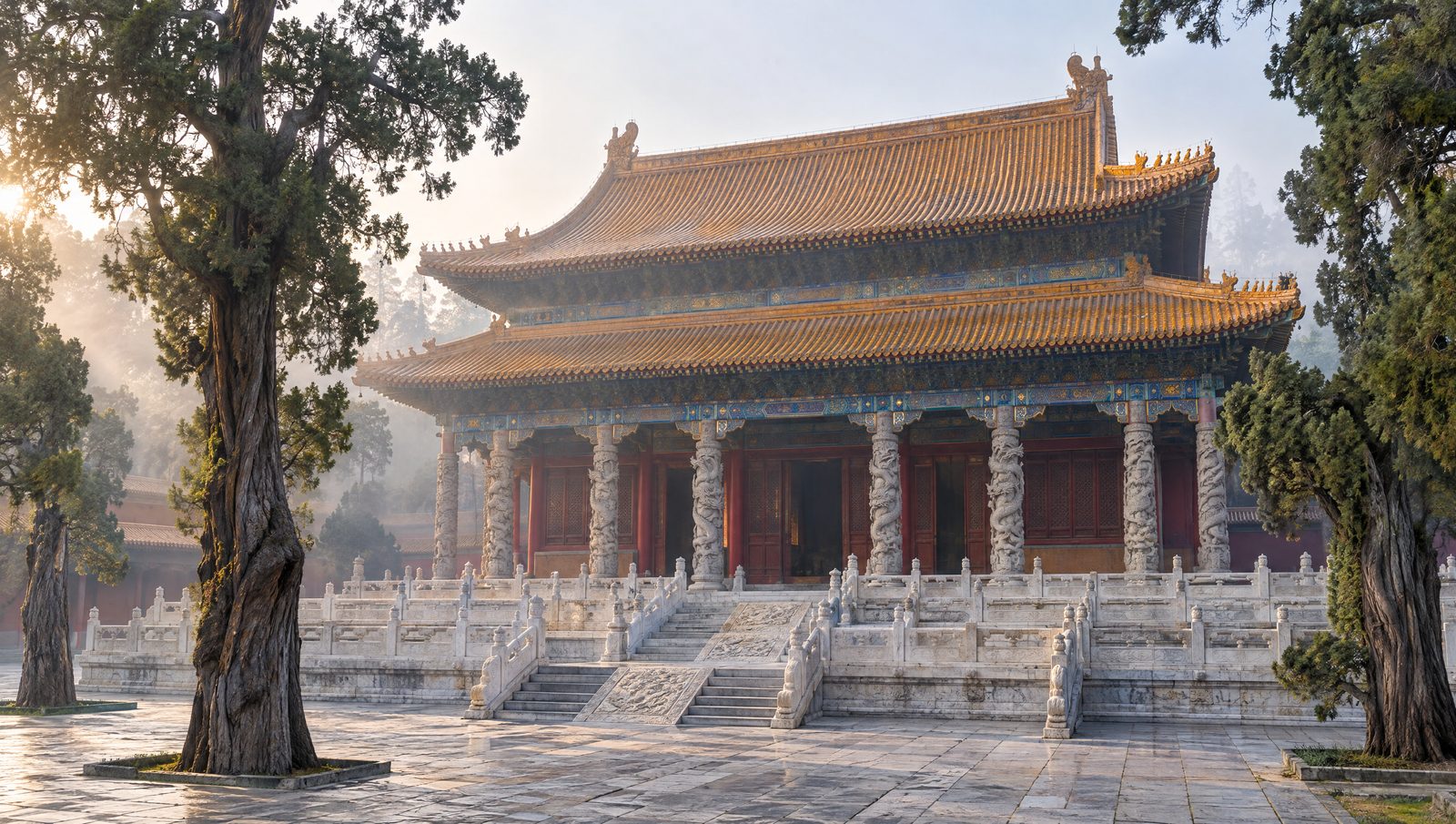
Qufu, Shandong
Confucius’s home town in eastern China holds the three sites known as the San Kong: the Temple of Confucius, a vast axis of courtyards and halls enlarged by every dynasty, with a forest of more than a thousand inscribed stone tablets; the Kong Family Mansion, where his descendants lived as hereditary dukes until 1937; and the Kong Forest cemetery, where the sage’s grave lies among those of some seventy generations of his line under ancient cypresses. The temple’s Hall of Great Perfection, with its carved dragon columns, was rebuilt in the 1720s after a lightning fire. A combined ticket covers all three; hire a bicycle or an electric cart for the cemetery, which is two square kilometres, and come on 28 September for the ceremony on his traditional birthday.
The Terracotta Army and Han Yangling, Xi’an
The pits at Lintong outside Xi’an, discovered by well-diggers in 1974, hold the First Emperor’s buried garrison: some eight thousand clay soldiers in battle formation, each face individual, with bronze weapons still sharp. Thirty kilometres away at Han Yangling, the tomb of the Han emperor Jing, who died in 141 BC, is the better place to understand the Han: a museum built over the burial pits, with glass floors above thousands of small nude clay figures that once had wooden arms and silk clothes, and herds of clay pigs, sheep and dogs. Book the Terracotta Army online, go at opening and see the Han tomb in the afternoon, when it is nearly empty.
Hunan Museum, Changsha
The three tombs of the Dai family at Mawangdui, excavated in 1972–74, are the richest Han burials ever opened and the finest view we have of how the classical texts were actually read. The Hunan Museum displays the painted silk banner that lay over the coffin of Lady Dai, her nested lacquer coffins, her astonishingly preserved body, and the library from her son’s tomb: silk manuscripts of the Daodejing, the Book of Changes, medical and astronomical texts and a map, all brushed in early clerical script in the 160s BC. Entry is free but requires booking with a passport number, and the museum closes on Mondays; allow a full afternoon.
National Palace Museum and Academia Sinica, Taipei
The imperial collection that left Beijing in the 1930s and ended up in Taipei includes the Mao Gong ding, a Western Zhou bronze whose inscription of nearly five hundred characters is the longest known, and bronze and jade from every period of this guide. Across the city at Academia Sinica, the Institute of History and Philology’s small museum displays part of the Juyan strips, more than ten thousand Han military documents on wood found on the Mongolian frontier in 1930, and oracle bones from its own excavations at Anyang; it opens to the public on limited days, so check first. The National Palace Museum is open daily and least crowded on weekday mornings.
Yushima Seidō, Tokyo
Classical Chinese was the language of learning in Japan for twelve centuries, and Tokyo‘s Confucian temple, founded by the shogunate in 1690 and later the seat of its official academy, is where that tradition is most visible. The black-lacquered hall, rebuilt in concrete after the 1923 earthquake, stands on a hill in Ochanomizu near the Kanda shrine and holds one of the largest bronze statues of Confucius anywhere. It is free, open daily and quiet; pair it with the bookshops of Jinbōchō, where Chinese classics in Japanese editions fill whole shops.
Sungkyunkwan and Jongmyo, Seoul
Korea took the Han model of a Confucian academy further than China itself. Sungkyunkwan in Seoul, founded in 1398 as the national academy of the Joseon dynasty, keeps its Confucian shrine, lecture hall and dormitories inside the modern university of the same name, and twice-yearly rites are still performed there in the old form, with music and dancers. Nearby, Jongmyo, the royal ancestral shrine, hosts the Jongmyo Jerye on the first Sunday of May, a ritual with Chinese-derived court music that UNESCO lists as intangible heritage. Both are near Changdeokgung palace; the shrine requires a guided tour except on Saturdays.
The Temple of Literature, Hanoi
Văn Miếu in Hanoi, founded in 1070 and dedicated to Confucius, housed Vietnam‘s first university and is the country’s most beautiful demonstration that the classical language outlived China’s borders. Five walled courtyards lead to the sanctuary; in the third stand 82 stone stelae on the backs of tortoises, recording in Classical Chinese the names of those who passed the royal examinations between 1442 and 1779. The inscriptions are legible to anyone who reads the classics. Go early on a weekday; graduation season fills the courtyards with students in gowns, which is charming but crowded.
Go deeper
- Confucius, The Analects, translated by D. C. Lau (Penguin Classics) — the standard English version for fifty years, with a long introduction on the text and its transmission.
- The Complete Works of Zhuangzi, translated by Burton Watson (Columbia University Press) — all thirty-three chapters in prose that catches the jokes.
- Sima Qian, Records of the Grand Historian, translated by Burton Watson (Columbia University Press) — the Qin and Han volumes include the First Emperor, Jing Ke and Sima Qian’s own letter.
- Mark Edward Lewis, The Early Chinese Empires: Qin and Han (Belknap Press) — the best one-volume history of the imperial half of this period, on cities, religion, kinship and writing.
- Bryan W. Van Norden, Classical Chinese for Everyone (Hackett) — a short, friendly introduction that has you reading real Analects passages in the first chapters; the free Chinese Text Project (ctext.org) hosts every classical text with a dictionary that pops up on each character.
Frequently asked questions
Is Classical Chinese hard to learn?
The grammar is the easiest of any language in this series: no conjugations, no declensions, no agreement, and a few dozen particles to learn. The difficulty is the characters and the compression. You need perhaps two thousand characters to read the Analects comfortably, each with several possible meanings and no word spacing to help, and the texts assume you already know the stories they allude to. Readers of modern Chinese or Japanese start with a large advantage; others usually need a year of steady work to read the Analects with a dictionary.
How accurate is the reconstructed pronunciation?
Less accurate than for Latin, Greek or Sanskrit, and honest teachers say so. The broad features, no tones, final consonants, consonant clusters, are secure; the specific sound of a given word is a scholarly best guess, and the main systems differ audibly from each other. A reading in reconstructed Old Chinese is an experiment, not a recording. Most people who learn the classical language read it aloud in modern Mandarin, Cantonese or the Sino-Japanese readings, which is what scholars in those countries do.
What modern languages descend from it?
All the Sinitic languages, Mandarin, Cantonese, Shanghainese, Hokkien, Hakka and the rest, descend from the spoken Chinese of this period, though not from the written classical style, which was never anyone’s mother tongue. Japanese, Korean and Vietnamese are unrelated languages that borrowed so heavily that over half their learned vocabulary is Chinese, pronounced in ways that preserve Middle Chinese sounds; Japanese still writes with Chinese characters, and Korean and Vietnamese did until the twentieth century. Reading the classics is therefore a doorway into four modern literatures at once.
Can I read the original texts after a few months?
Short passages of the Analects and Mencius, yes, with a textbook and a dictionary, because their sentences are brief and their vocabulary recurs. Zhuangzi and the Daodejing are harder because they are deliberately ambiguous. Sima Qian’s narrative prose is surprisingly readable once you have the basic grammar, and his stories pull you along. Readers of modern Chinese find the first months faster, though the classical particles and the changed meanings of familiar characters catch everyone out.
What is the best first trip for this era?
Xi’an and Qufu, by high-speed rail, in a week in October or April, with Luoyang, the Eastern Han capital, as a stop between them. Xi’an gives you the First Emperor and the Han court, Qufu the man who started it all; Beijing’s National Museum of China is a good bookend if you fly in or out of the capital. For the language’s later life, Seoul, Tokyo or Hanoi can each be done in a weekend, and each shows a different country making the classics its own.