
The world at the time
The oldest Sanskrit we have was never written down. The 1,028 hymns of the Rigveda were composed, most scholars think, between about 1500 and 1000 BC, by priestly families living in the Punjab, the land of seven rivers that the hymns call Sapta Sindhu. They were memorised, syllable by syllable, and passed from teacher to student for roughly two and a half thousand years before anyone committed them to palm leaf or birch bark. The recited text is treated as a more reliable witness than any manuscript.
The people who composed them called themselves ārya, and their language belongs to the same family as Greek, Latin and English. Their closest relatives were the Iranians, and the oldest hymns of Iran’s Avesta are so close to the Rigveda that scholars can sometimes convert one into the other by applying regular sound changes. A treaty between the Hittite and Mitanni kings, written in Syria around 1380 BC, invokes the gods Indra, Mitra, Varuṇa and the Nāsatyas, which is the earliest dated appearance of Vedic deities anywhere. The Indus cities had already declined by the time these herders moved through the Punjab; how the two populations overlapped is one of the most argued questions in South Asian history.
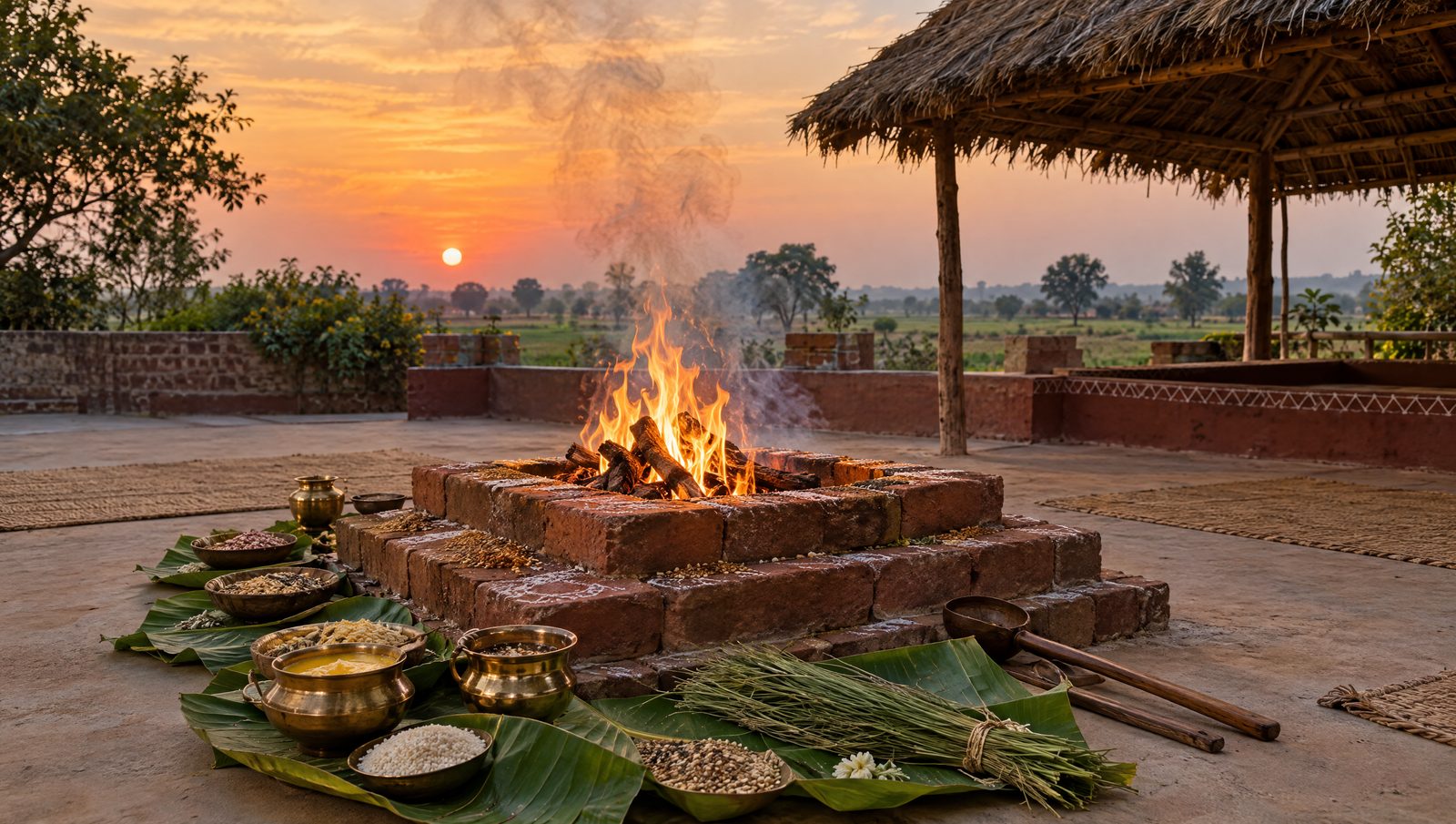
Early Vedic society was built on cattle. Wealth was counted in cows, the word for war meant literally “desire for cows”, and the chief gods were Indra, who drinks the pressed juice of the soma plant and fights, and Agni, the fire into which offerings were poured. There were no temples and no images. Worship meant a fire altar on open ground, a family of priests, and hymns chanted in metres whose names, gāyatrī, triṣṭubh, jagatī, are still used. Tribes were led by a rājan, a chief whose power depended on gifts and victories.
Around 1000 BC the centre of gravity moved east and south, into the land between the Ganges and the Yamuna. Iron appears in the archaeological record about then, along with the fine grey pottery painted with black lines that archaeologists call Painted Grey Ware and associate, cautiously, with the later Vedic texts. Rice joined barley. The tribes merged into larger kingdoms, above all the Kuru realm around modern Delhi and Haryana, where the Rigveda was collected into its present shape and the great royal rituals were elaborated: the rājasūya consecration and the year-long aśvamedha in which a horse wandered free, followed by an army, before being sacrificed.
The prose texts of this later period, the Brāhmaṇas, explain the rituals in staggering detail. The Śatapatha Brāhmaṇa, composed perhaps around 800–600 BC, runs to a hundred chapters, a large part of them on the building of a single fire altar. They also fix the four social orders that one late hymn of the Rigveda had described as the parts of a sacrificed cosmic man: priests from his mouth, warriors from his arms, farmers and traders from his thighs, servants from his feet. The system hardened over the following centuries into caste.
Then came the turn inward. In the forests at the edge of the kingdoms, teachers began to ask what the sacrifice was for and what the self was. Their conversations, recorded in the earliest Upaniṣads from about 700 BC, argue that a single reality, brahman, underlies the world and is identical with the ātman, the self within. By 500 BC sixteen great states competed across northern India, cities had returned, and two men from the eastern fringes, Mahāvīra and Siddhārtha Gautama, were preaching in the vernacular against the authority of the Vedas. A century or so later, the grammarian Pāṇini described the Sanskrit of his day in about 4,000 rules, and the language of the hymns became a classical tongue, to be learned rather than spoken.
The stories they told
Indra kills the dragon
The central myth of the Rigveda is told most fully in hymn 1.32. Vṛtra, whose name means “the obstacle”, is a serpent lying coiled on the mountains, holding back the waters of the world. Indra drinks three lakes of soma, takes up the thunderbolt that the craftsman god Tvaṣṭṛ forged for him, and strikes. Vṛtra falls like a tree trunk cut by an axe; his mother Danu lies over him like a cow over her calf, and the released rivers rush past the body “like lowing cattle”. The hymn then does something unexpected: it admits that Indra, having won, fled in terror across ninety-nine rivers “like a frightened eagle”, and asks what frightened him. The poets of the Rigveda rarely narrate; they allude, and this hymn is one of the few that tells its story straight through. The same combat appears in the Iranian Avesta and, in altered form, in the Greek story of Zeus and Typhon, which is how we know it is older than the Vedas themselves.
The battle of the ten kings
Hymn 7.18 is the closest thing the Rigveda has to a war report. Sudās, chief of the Bharatas, is caught on the banks of the Paruṣṇī by an alliance of ten tribes, among them the Pūrus, Anus, Druhyus, Yadus and Turvaśas. Vasiṣṭha, the Bharatas’ chief priest and the hymn’s composer, calls on Indra, and the god, as he puts it, makes the deep river fordable for Sudās and then turns it into a torrent against his enemies, who drown by the thousand or are scattered “like cows left without a herdsman”. The hymn ends with the poet counting his fee: two hundred cows and two chariots with mares. Behind the hymn lies a rivalry that the later tradition remembered for centuries: Vasiṣṭha had replaced Viśvāmitra, composer of book 3 of the Rigveda, as Sudās’s priest, and later legend made the two sages lifelong enemies. The tribal names are real, the river is real, and the Bharatas gave their name to the country: Bhārat.
Yājñavalkya and Maitreyī
The Bṛhadāraṇyaka Upaniṣad, one of the two oldest, is set largely at the court of King Janaka of Videha, where the sage Yājñavalkya outargues every priest in the kingdom and wins a thousand cows with gold tied to their horns. Its most personal passage is a conversation at home. Yājñavalkya tells his wife Maitreyī that he is leaving the household life and intends to divide his property between her and his other wife, Kātyāyanī. Maitreyī asks whether, if the whole earth and its wealth were hers, it would make her immortal. No, he says; her life would be the life of the wealthy. “Then what should I do with something that will not make me immortal?” she replies, and asks him to teach her what he knows instead. His answer is the heart of the early Upaniṣads: a husband is not dear for his own sake but for the sake of the self; the self is what must be seen, heard and understood; and where there seems to be another, one sees another, but where everything has become the self, “by what and whom would one see?”
The boy who questioned Death
The Kaṭha Upaniṣad, probably from the last centuries of the period, opens with a father performing a sacrifice at which he is supposed to give away everything he owns, and giving away only old, barren cows. His son Naciketas, embarrassed, asks three times, “Father, to whom will you give me?” until the father snaps: “To Death.” The boy takes him at his word and travels to the house of Yama, lord of the dead, who is away. Naciketas waits three nights without food. When Yama returns, ashamed to have left a Brahmin guest unfed, he offers three wishes. The first two are easy: a reconciled father, and knowledge of the fire ritual, which Yama names after the boy. The third is the question Yama does not want to answer: when a man dies, does he exist or not? Yama offers horses, gold, long life, anything else; Naciketas refuses them all, since they wear out, and Death, cornered, teaches him. The self is neither born nor dies, smaller than the small and greater than the great, and is to be found by the one who chooses the good over the pleasant. The image of the self as a rider in a chariot, with the body as chariot, the mind as reins and the senses as horses, comes from this text.
How the language sounded
Vedic Sanskrit had no script. Writing appears in India in the third century BC with the Brāhmī alphabet of the emperor Aśoka’s inscriptions, and Devanāgarī, the script in which Sanskrit is usually printed today, developed from it a thousand years later. When you see a Vedic hymn in Devanāgarī you are seeing a medieval convention applied to a Bronze Age text. The Vedas were preserved instead by a system of recitation that is itself an engineering feat: students learned each hymn as continuous text, then word by word, then in interlocking patterns such as krama (ab, bc, cd) and ghana (ab, ba, abc, cba, abc), so that any slip in one mode would be caught by another. UNESCO listed the tradition in 2008 as intangible heritage.
Because the tradition is so conservative, and because ancient Indian scholars wrote the world’s first phonetic treatises, we know more about how Sanskrit sounded than about any other ancient language.
- Aspiration is real and contrastive. k and kh, g and gh, d and dh are different consonants. Dharma has an audible puff of breath after the d; Buddha has a long d followed by a breathy one.
- Retroflex consonants, written with a dot beneath (ṭ, ḍ, ṇ, ṣ), are made with the tongue curled back to the roof of the mouth. They were in the language from the start.
- Vowel length matters. Short a was a neutral sound close to the u of “but”; long ā was the a of “father”. Rāma is RAH-muh, not “Rama” with two equal vowels.
- The vowel ṛ, as in ṛṣi and Kṛṣṇa, was a syllabic r, something like the “rr” of Scottish “burr” without the vowel. Modern north Indian pronunciation turns it into “ri”, which is why we write Krishna and rishi.
- Vedic had a pitch accent. One syllable in each word was spoken on a high tone (udātta), with a falling glide (svarita) on the next. The accents are marked in Vedic manuscripts and still chanted; Classical Sanskrit lost them, and modern reciters outside the Vedic schools ignore them.
- Words run together. The rules of sandhi change sounds at word boundaries, so that tat plus savitur is said and written tatsavitur, and a sentence is one unbroken stream.
How do we know? First, the recitation itself, which has preserved the pitch accents and a few archaic sounds, such as the ḷ of the Rigveda, for three millennia. Second, the Prātiśākhyas and Śikṣā texts, phonetic manuals composed in the middle of the first millennium BC that classify every sound by its place and manner of articulation with a precision European linguistics did not reach until the nineteenth century. Third, Pāṇini’s grammar. Fourth, the comparative method: Sanskrit pitṛ, Latin pater, Old English fæder let us triangulate. Fifth, the metres, which fix the length of every syllable.
What remains uncertain is the music rather than the notes. The exact melodic shape of the accents, and whether they were purely tonal or also involved stress, is debated. The metre sometimes requires reading a written long vowel as two syllables, which means the text was already slightly modernised when it was fixed. Regional accents existed and are mostly lost, and the short a may have been closer to a schwa than the grammarians’ idealised description allows.
| Original | Say it | Meaning |
|---|---|---|
| नमस्ते · namaste | nuh-muhs-TAY | Hello / greetings (literally “bow to you”) |
| स्वागतम् · svāgatam | SWAH-guh-tum | Welcome |
| कथम् अस्ति भवान्? · katham asti bhavān? | KUH-tum US-ti bhuh-VAHN | How are you? (to a man; bhavatī to a woman) |
| धन्यवादः · dhanyavādaḥ | DHUN-yuh-VAH-duh-huh | Thank you |
| मम नाम … अस्ति · mama nāma … asti | MUH-muh NAH-muh … US-ti | My name is … |
| आम् / न · ām / na | AHM / nuh | Yes / No |
| अहं न जानामि · ahaṃ na jānāmi | uh-HUNG nuh JAH-nah-mi | I don’t know |
| पुनर्मिलामः · punar milāmaḥ | PU-nur mi-LAH-muh-huh | See you again (literally “we meet again”) |
These are standard textbook and spoken-Sanskrit forms rather than Vedic ones; the hymns did not need to say hello.
तत्सवितुर्वरेण्यं भर्गो देवस्य धीमहि धियो यो नः प्रचोदयात्
tat savitur vareṇyaṃ bhargo devasya dhīmahi dhiyo yo naḥ pracodayāt
May we attain that excellent radiance of the god Savitṛ, who shall inspire our thoughts.
Rigveda 3.62.10, the Gāyatrī mantra
This is the most recited verse in the world, said at dawn by millions of Hindus every day, and it is three thousand years old. It is addressed to Savitṛ, the sun as the power that sets things in motion, and asks him to do the same for the mind. The verse is a gāyatrī, three lines of eight syllables each, and the metre gave the mantra its name. It comes from book 3 of the Rigveda, attributed to the family of Viśvāmitra, the sage who lost his place to Vasiṣṭha. In Vedic recitation the pitch accents are marked and sung; in daily practice the verse is usually prefaced with the syllable oṃ and the three words bhūr bhuvaḥ svaḥ, earth, air and heaven, which are not part of the original hymn. The translation above is deliberately plain; the compressed grammar allows several readings, and the tradition has produced thousands of pages of commentary on nine words.
Maya reads these aloud in a reconstructed Vedic pronunciation, pitch accents included and honestly labelled as a reconstruction, in a free Sanskrit session of fifteen minutes by phone.
Where to stand today
Kurukshetra, Haryana
The heartland of the later Vedic kingdoms is the flat, canal-fed farmland north of Delhi in India‘s Haryana state. Kurukshetra, the “field of the Kurus”, is named in the Brāhmaṇas as the place where the gods themselves performed sacrifice, and it later became the battlefield of the Mahābhārata. Today the town is a pilgrimage centre around the Brahma Sarovar, a vast rectangular tank where pilgrims bathe at solar eclipses, and the Sri Krishna Museum interprets the epic. Nothing standing is Vedic; the point is the landscape, the dry bed of the Sarasvatī that the hymns praise as mightiest of rivers, and the knowledge that this ground was sacred before the epics. Visit between November and February; the plain is punishing from April to September.
Hastinapur, Uttar Pradesh
The epic capital of the Kurus is a real mound on an old channel of the Ganges, about 40 kilometres north-east of Meerut. The archaeologist B. B. Lal excavated it in 1950–52 and found Painted Grey Ware levels dating to the early first millennium BC, with evidence of a flood that fits the Mahābhārata‘s story of the city being abandoned when the river washed it away. The excavated area is modest, and the site is better known today for its Jain temples, which draw their own pilgrims. Go with a driver from Delhi or Meerut as a half-day trip, carry water, and ask locally for the purana qila, the old fort, which is what villagers call the mound.
The National Museum, New Delhi
The National Museum on Janpath in Delhi holds the country’s finest Harappan gallery, with the bronze Dancing Girl and the steatite seals whose undeciphered script may or may not have anything to do with the Vedic people who followed. Its Painted Grey Ware sherds from Hastinapur and other sites are the closest thing to a Vedic artefact in any museum. The museum is closed on Mondays; arrive at opening to have the Harappan rooms to yourself, and allow a full morning. Check the current status of the building before you go, since the museum is scheduled to move to a new home in the redeveloped government district.
Varanasi, Uttar Pradesh
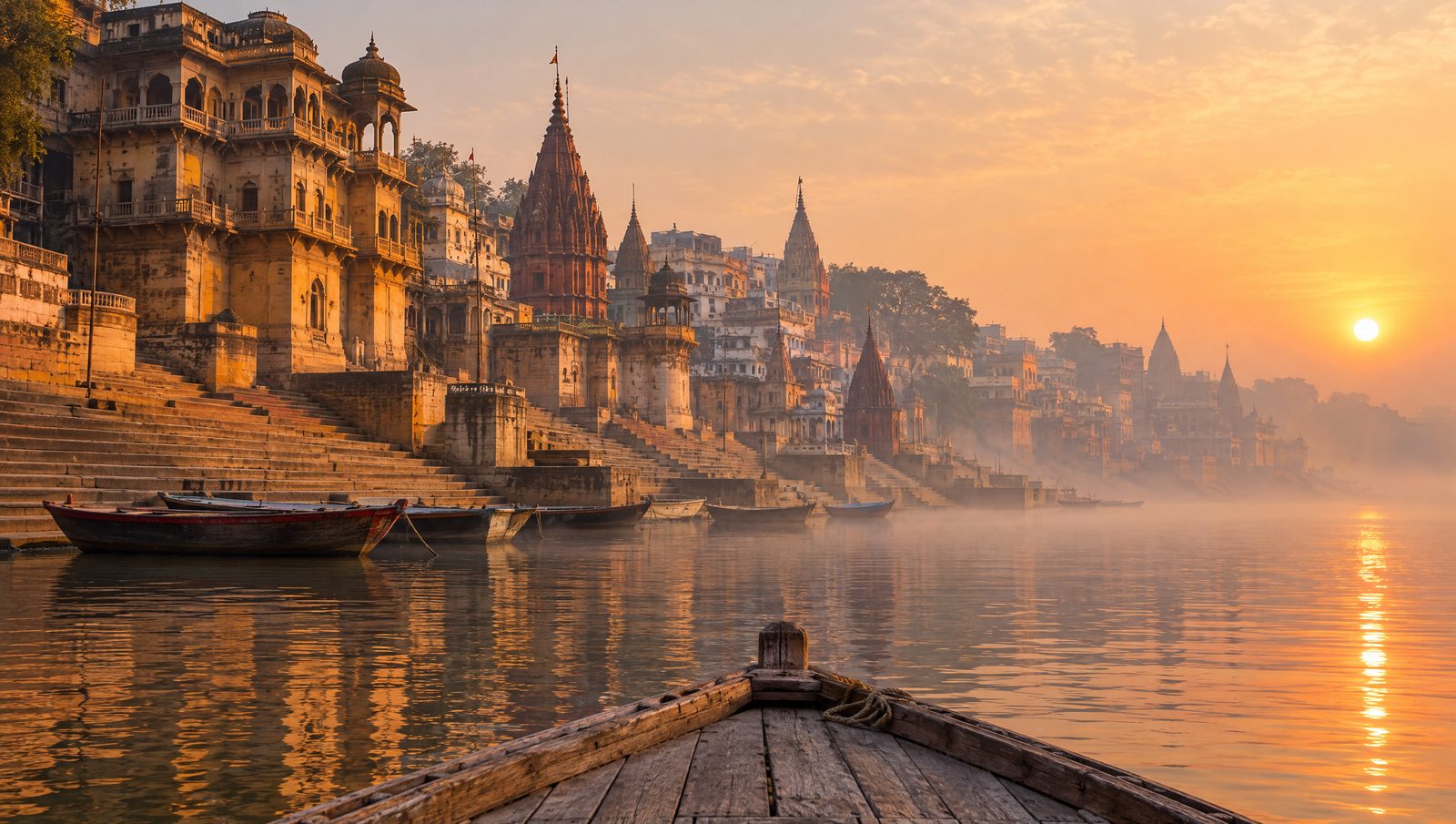
Kāśī appears in the later Vedic texts, and Varanasi has been a centre of Sanskrit learning for as long as anyone can trace. This is the city where Vedic chant is easiest to hear as a living thing: at the small pāṭhaśālās, traditional schools, where boys still learn the Rigveda by the methods described above, and at dawn on the ghats, where priests recite before the river. The Sampurnanand Sanskrit University keeps a manuscript library in a Victorian Gothic building. Go between October and March, take a boat at first light, and treat the recitation as worship rather than performance; ask before photographing anyone.
Janakpur, Nepal
The kingdom of Videha, where Yājñavalkya argued before King Janaka, lay in the eastern Gangetic plain, and tradition places its capital Mithilā at Janakpur in the Terai of southern Nepal. The identification is traditional rather than proven, but the region’s name, Mithila, is the ancient one. The town’s centrepiece is the Janaki Mandir, a white marble temple of 1910 to Janaka’s daughter Sītā, surrounded by sacred ponds. The Vivaha Panchami festival in late November or December, celebrating Sītā’s marriage to Rāma, fills the town. Janakpur has an airport with flights from Kathmandu, and the Indian border at Jaynagar is a few kilometres south.
Bhandarkar Oriental Research Institute, Pune
Three hours from Mumbai by road or rail, Pune is the scholarly capital of Sanskrit studies in India. The Bhandarkar Institute, founded in 1917, holds about 28,000 manuscripts, and its thirty manuscripts of the Rigveda, written on paper and birch bark between the fourteenth and nineteenth centuries, were added to UNESCO’s Memory of the World register in 2007. The institute also produced the critical edition of the Mahābhārata, a fifty-year project completed in 1966. Visitors can see the building and a small display; serious access to manuscripts needs an appointment and a reason.
The Nambudiri villages of Thrissur, Kerala
The most archaic Vedic recitation surviving anywhere belongs to the Nambudiri Brahmins of central Kerala, who preserve a style of chanting, with hand gestures and head movements marking the accents, that specialists believe is close to the Bronze Age original. In 1975 the village of Panjal, near Thrissur, performed the twelve-day Agnicayana, the building of a bird-shaped fire altar from more than a thousand bricks, before an audience of scholars led by Frits Staal; it was performed again at Panjal in 2011. These events are rare and announced locally. Between them, Thrissur offers the Vadakkunnathan temple complex, the Pooram festival in April or May, and a chance to hear Vedic chant at smaller rituals if you ask at the Sanskrit colleges.
Go deeper
- The Rigveda: The Earliest Religious Poetry of India, translated by Stephanie W. Jamison and Joel P. Brereton (Oxford University Press, 2014) — the first complete scholarly English translation in over a century, in three volumes, with an introduction to every hymn.
- Wendy Doniger, The Rig Veda: An Anthology (Penguin Classics) — 108 hymns including Indra and Vṛtra, the ten kings and the creation hymns, with notes; the best place to start.
- Upaniṣads, translated by Patrick Olivelle (Oxford World’s Classics) — the twelve principal Upaniṣads including the Bṛhadāraṇyaka and Kaṭha, in a translation that is both accurate and readable.
- Frits Staal, Discovering the Vedas: Origins, Mantras, Rituals, Insights (Penguin India, 2008) — by the scholar who documented the 1975 Agnicayana; strong on recitation and what the ritual was for.
- Thomas Egenes, Introduction to Sanskrit (two volumes) — the gentlest self-study grammar, teaching Devanāgarī and the basic language step by step; the free GRETIL archive at Göttingen University hosts searchable electronic texts of the Vedas and Upaniṣads.
Frequently asked questions
Is Sanskrit hard to learn?
The grammar is the most elaborate of any widely studied language: eight cases, three numbers, three genders for nouns, ten classes of verb, and sandhi rules that change the shape of every word depending on its neighbour. Against that, the script is perfectly phonetic, the pronunciation is well understood, and the vocabulary keeps turning up familiar roots. Most learners take a year to read simple Classical texts with a dictionary. Vedic is harder again, with extra forms, an accent system and a poetic vocabulary of its own, and is normally approached after the Classical language.
How accurate is the reconstructed pronunciation?
More accurate than for any other ancient language, because the recitation tradition never stopped and the ancient phoneticians described the sounds so carefully. The consonants and vowel lengths are not in doubt. The pitch accents are preserved in several recitation styles, though their exact melodic realisation varies between schools and the original may have differed from all of them. The main things a modern speaker gets wrong are the aspirates, the retroflexes and the short a, all of which a few weeks of attention fixes.
What modern languages descend from Sanskrit?
Hindi, Urdu, Bengali, Punjabi, Marathi, Gujarati, Nepali, Sinhala, Odia, Assamese and the other Indo-Aryan languages, spoken by about a billion people, descend from the everyday speech of the Vedic period through the Middle Indic languages called Prakrits. Strictly they are cousins of the hymns’ Sanskrit rather than children of it, since the priestly language was already distinct from what people spoke. Romani, the language of the Roma of Europe, is an Indo-Aryan language that left India about a thousand years ago.
Can I read the original texts after a few months?
The Upaniṣads, yes, in part: their prose is repetitive and their vocabulary small, and the Kaṭha and the dialogue of Yājñavalkya and Maitreyī are standard second-year readings. The Rigveda is another matter. Its grammar is older, its word order is poetic, and its meaning is often disputed even among specialists; read it with Jamison and Brereton’s translation at your side and expect to be puzzled. The Bhagavad Gītā, though later than this period, is the text most learners read first in the original.
What is the best first trip for this era?
Delhi and Varanasi in the cool season, with a day trip to Kurukshetra from the capital. The National Museum gives you the archaeology, Kurukshetra the landscape, and Varanasi the sound: find a pāṭhaśālā and sit at the back during the morning lesson. If you have another week, fly to Kerala for Thrissur, which rewards patience and a local contact. Nepal’s Terai is for a second journey, best combined with Lumbini, the Buddha’s birthplace.