
The world at the time
Aramaic never had an empire of its own. That is the odd thing about it. The Arameans were a cluster of small Iron Age kingdoms in what is now Syria, with capitals at Damascus, Hamath and Sam’al, and by the eighth century BC the Assyrians had swallowed every one of them. Yet within a century the conquerors were writing in the language of the conquered, and for the next six hundred years Aramaic was the working tongue of three successive empires, used by tax collectors in Egypt, garrison commanders on the Nile, satraps in Bactria and, eventually, a carpenter’s son in Galilee.
The reason was practical. Assyria deported Arameans by the tens of thousands into the heartland of Mesopotamia, and Aramaic was written in a simple alphabet of twenty-two letters on leather and papyrus, while Akkadian needed hundreds of cuneiform signs pressed into clay. Assyrian palace reliefs from the reign of Tiglath-Pileser III (745–727 BC) show scribes working in pairs: one with a stylus and tablet, one with a pen and scroll. The Bible records the moment the shift became visible. When Sennacherib’s army stood outside Jerusalem in 701 BC, the Judean officials on the wall begged the Assyrian envoy to negotiate in Aramaic, “for we understand it”, rather than in Hebrew where the people could hear.
Babylon inherited the habit. Nebuchadnezzar II (605–562 BC) destroyed Jerusalem in 587 or 586 BC and carried its elite to the Euphrates, where Judeans lived in Aramaic-speaking towns for two generations. Then in 539 BC Cyrus of Persia took Babylon, and the Persians made a decision that fixed the language’s future: their chancellery would run in Aramaic. Under Darius I (522–486 BC) the empire reached from the Aegean to the Indus, and a standardised form of the language, which scholars call Imperial or Official Aramaic, carried its orders from one end to the other.
The evidence for this world is unusually intimate, because Aramaic documents happen to survive in dry places. On the island of Elephantine at Aswan, a community of Judean soldiers in Persian service left a hoard of fifth-century papyri: marriage contracts, loans, a letter from 419 BC about how to keep Passover, and a petition from 407 BC about their burned-down temple. In the ruins of Persepolis, the Persian ceremonial capital, stone mortars and pestles from the treasury carry Aramaic notes. Leather letters from the satrap Arsames, now in Oxford, manage his Egyptian estates from somewhere in Babylonia. Far to the east, the Buddhist emperor Ashoka had an edict carved in Aramaic and Greek at Kandahar around 260 BC, for the descendants of Persian officials who still read it.
Religion in this period was diverse in a way that later empires would not tolerate. The Persians honoured Ahura Mazda but funded other peoples’ temples; the biblical book of Ezra preserves Aramaic copies of royal decrees authorising the rebuilding of the Jerusalem Temple. The Elephantine Judeans worshipped Yahu alongside goddesses their cousins in Jerusalem would have disowned.
Alexander’s conquest of Persia in 331 BC broke the chancellery, and Greek took over as the language of the new kingdoms. But Aramaic did not go away; it fragmented. Nabataean merchants at Petra, Palmyrene caravan lords in the Syrian desert and Jewish scribes in Judea all wrote local varieties descended from the imperial standard. Parts of the books of Daniel and Ezra were composed in it. The Dead Sea Scrolls include Aramaic retellings of Genesis and the earliest copies of the Book of Enoch. By the first century AD it was the everyday language of Galilee and Judea, which is why the Gospels, written in Greek, keep a handful of Aramaic words that someone remembered hearing. The era in this guide closes there, around AD 100, with the language about to split again into the Syriac of the Christian east and the Aramaic of the rabbis.
The stories they told
Ahiqar, the wise man betrayed
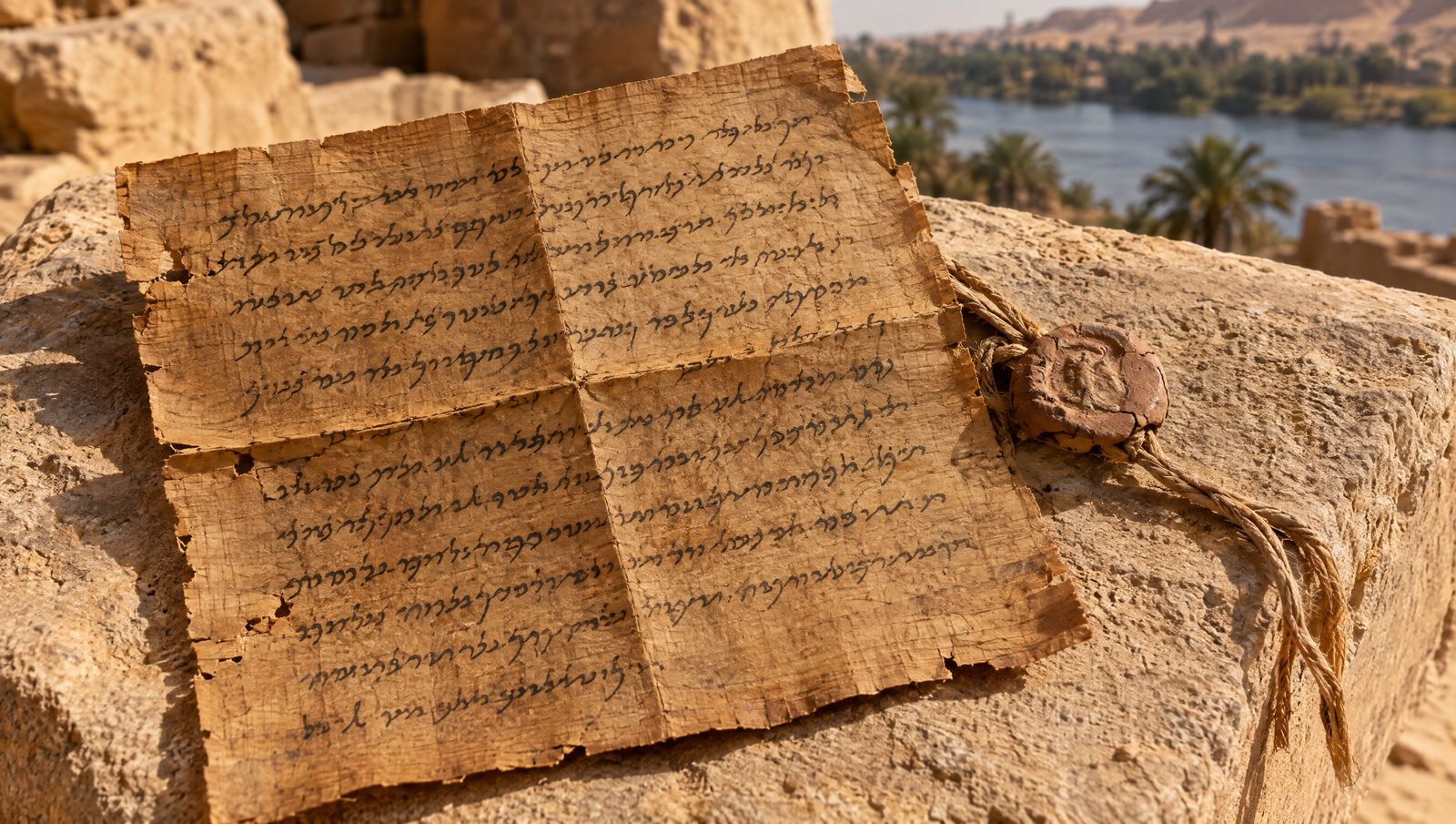
The oldest Aramaic story we can read in something like its original form was found at Elephantine on a reused papyrus roll from the fifth century BC. Ahiqar is chief counsellor and seal-bearer to Sennacherib of Assyria and then to his son Esarhaddon. Childless, he adopts his nephew Nadin, trains him in the sayings of the wise and presents him at court as his successor. Nadin repays him by forging letters that make Ahiqar look like a traitor. Esarhaddon orders his execution. The officer sent to carry it out is a man whose life Ahiqar once saved, and he hides the old man instead, killing a slave in his place. When the king later needs his counsellor’s wisdom, Ahiqar is produced alive and Nadin is punished. Attached to the tale is a collection of proverbs on holding your tongue, on kings and on debt. The story travelled further than almost any other from the ancient Near East. It is quoted in the Book of Tobit, survives in Syriac, Armenian, Arabic and Slavonic versions, and an Ahiqar figure turns up in the Greek Life of Aesop. A Babylonian tablet from Uruk does list a sage of Esarhaddon “whom the Arameans call Ahuqar”.
The writing on the wall
Chapter 5 of the Book of Daniel is written in Aramaic, and it is the source of a phrase that English has never let go. Belshazzar, ruling in Babylon, gives a feast for a thousand nobles and calls for the gold and silver vessels that Nebuchadnezzar looted from the Jerusalem Temple, so that his guests can drink from them in praise of gods of bronze and stone. A hand appears and writes on the plaster of the palace wall. His wise men cannot read the words. The queen remembers Daniel, the Judean exile who interpreted Nebuchadnezzar’s dreams. Daniel reads the inscription, mene, mene, tekel, upharsin, and explains it as a sequence of puns: God has numbered the days of the kingdom, weighed the king and found him light, and divided his realm between the Medes and the Persians. That night, the text says, Belshazzar was killed. History agrees in outline and differs in detail. Belshazzar was real, the son and co-regent of Nabonidus, the last Babylonian king, rather than Nebuchadnezzar’s son, and the city fell to Cyrus in October 539 BC. The story itself was probably written down in the second century BC, when Jews under the Seleucids needed to hear that empires end.
The temple on the Nile
In the summer of 410 BC, while the Persian governor of Egypt was away reporting to the king, the priests of the ram-god Khnum on Elephantine made a deal with the local commander, Vidranga. Soldiers entered the temple of Yahu that the Judean garrison had kept on the island since before the Persian conquest, broke its stone pillars, smashed its five gateways, burned the cedar roof and carried off the gold and silver bowls. Three years later the priest Yedaniah and his colleagues wrote to Bagohi, governor of Judah, describing all this and asking for a letter of support to rebuild. They mention, pointedly, that an earlier appeal to the high priest in Jerusalem had gone unanswered. They note with satisfaction that Vidranga has since been punished. The draft of their petition survives, with corrections, along with a brief memorandum of the reply: the governors of Judah and Samaria agree that the altar-house may be rebuilt and meal-offering and incense offered as before. Animal sacrifice is not mentioned, which looks like a diplomatic compromise with Jerusalem. The letters are the earliest detailed account of a Jewish community anywhere outside the land of Israel, written by the people themselves.
Talitha koum
The Gospel of Mark was written in Greek, probably within four decades of the crucifixion, and every so often its author stops translating. A synagogue leader named Jairus begs Jesus to come to his dying daughter; by the time they arrive the household is already wailing. Jesus takes the girl’s parents into the room, holds her hand and says, in Mark’s transcription, talitha koum, which the writer glosses as “little girl, I say to you, get up”. She stands and walks. Elsewhere Mark keeps ephphatha, “be opened”, spoken to a deaf man, Abba, the word for father used in the garden of Gethsemane, and the cry from the cross, Eloi, Eloi, lema sabachthani, which is Psalm 22 in Aramaic rather than Hebrew. These fragments are the clearest evidence that Jesus and his first followers spoke the Galilean dialect of the language, and they give the scenes an immediacy that the surrounding Greek cannot. Paul, writing to Corinth in the fifties AD, signs off with another untranslated Aramaic phrase, maranatha, “our Lord, come”, which suggests the earliest Christians were already praying in it.
How the language sounded
Aramaic was written in an alphabet borrowed from the Phoenicians: twenty-two letters, consonants only, running from right to left. Scribes early on began using a few of those letters to hint at long vowels, a system called matres lectionis, but a reader still had to supply most of the vowels from knowledge of the language. The script’s descendants are everywhere. The “Hebrew” letters in a modern Torah scroll are in fact the Aramaic hand that Jews adopted during the exile; the Nabataean variety used at Petra evolved into the Arabic alphabet; Syriac, Palmyrene and Mandaic are its children, and so, through the Sogdians of Central Asia, are the Uyghur and Mongolian scripts. Old Aramaic was cut in stone; the imperial bureaucracy wrote in ink on leather and papyrus.
A few features define the sound of the language against its neighbours.
- The article at the end of the word. Where Hebrew puts “the” in front (ha-melekh), Aramaic adds -ā at the back: melekh, a king; malkā, the king. The same suffix gives Golgotha, “the skull”, and Gabbatha, “the platform”.
- Throat sounds English lacks. There are two glottal and pharyngeal consonants, written ʾ and ʿ, a strong h (ḥ) as in Arabic, and “emphatic” ṭ, ṣ and q made further back in the mouth than English t, s and k.
- D and T where Hebrew has Z and SH. Gold is dəhav in Aramaic and zahav in Hebrew; three is təlāt against Hebrew shalosh; an ox is tōr against shōr. The oldest inscriptions still spell these with z and sh, which tells us the sounds were in the middle of shifting around the eighth century BC.
- Soft consonants after vowels. By the later part of this period the six letters b, g, d, k, p, t softened to v, gh, dh, kh, f and th when they followed a vowel, the same rule that governs Biblical Hebrew. It is why the Gospel writes sabachthani with a soft th.
- Long and short vowels. Vowel length was meaningful, and unstressed short vowels in open syllables tended to shrink to a murmur, written ə in transcriptions.
- Stress toward the end. Most words carried their stress on the final or second-last syllable, so malKĀ, ʾelāHĀ.
How do we know any of this when the texts have no vowels? Partly from transcriptions: Babylonian scribes wrote Aramaic names in syllabic cuneiform, which records vowels, and the Greek New Testament spells out Aramaic words letter by letter. Partly from the Masoretes, the Jewish scholars of Tiberias who, between about AD 700 and 1000, added vowel points to the Aramaic chapters of Daniel and Ezra, preserving a reading tradition far older than themselves. And partly from the living language: Aramaic is still spoken, in villages near Damascus and among Assyrian and Chaldean communities from northern Iraq to Chicago, and comparing those dialects with Syriac and the ancient texts lets linguists work backward.
The honest caveat is that the Masoretic vowels are a thousand years younger than the Persian clerks, and Imperial Aramaic was written by people with a dozen different mother tongues. We know the consonants well and the vowel system in outline. The exact colour of a fifth-century Egyptian scribe’s vowels, his intonation and his regional accent are lost. The table below uses the standard textbook pronunciation of Biblical Aramaic, which is the convention most courses and dictionaries follow.
| Original | Say it | Meaning |
|---|---|---|
| שְׁלָם — šəlām | sheh-LAHM | Peace; the standard greeting |
| שְׁלָמְכוֹן יִשְׂגֵּא — šəlāməḵōn yiśgē | sheh-lahm-KHOHN yis-GAY | May your peace abound (the letter-opening in Daniel 4 and 6) |
| מַלְכָּא — malkā | mal-KAH | The king |
| אֱלָהָא — ʾĕlāhā | eh-lah-HAH | God |
| אַבָּא — ʾabbā | ab-BAH | Father |
| בַּר — bar | bar | Son of (as in Bar Kokhba, Barabbas) |
| חַד, תְּרֵין, תְּלָתָה — ḥad, tərēn, təlāṯā | khad, teh-RAYN, teh-lah-THAH | One, two, three |
| לָא — lā | lah | No, not |
מְנֵא מְנֵא תְּקֵל וּפַרְסִין
mənē mənē təqēl ūp̄arsīnNumbered, numbered, weighed, and divided.
Daniel 5:25
Four words that an entire court could not read, and the point of the story is that they are ordinary. Mənē is a mina, təqēl a shekel, pərēs a half-mina: the wall lists weights, as if a merchant had chalked up an account. Daniel’s interpretation turns each weight into a verb, numbered, weighed, divided, and then squeezes a last pun from the final word, since pārās also sounds like Persia. The text as we have it carries the Masoretic vowels, so the pronunciation above is the Tiberian reading tradition rather than a recording from Babylon. The Aramaic of Daniel is a slightly later and more Jewish variety than the Persian chancellery standard, but it is close enough that a clerk of Darius would have understood every word.
Maya reads these aloud in a reconstructed pronunciation, honestly labelled as a reconstruction, in a free Aramaic session of fifteen minutes by phone.
Where to stand today
The British Museum, London
The Assyrian galleries of the British Museum in London are the place to see the empire that first adopted Aramaic. Room 10b holds the Lachish reliefs, Sennacherib’s own record of the 701 BC campaign whose next stop was the wall of Jerusalem where the officials asked for Aramaic. Look on the reliefs for pairs of scribes, one with a tablet and one with a scroll. The Cyrus Cylinder in Room 52 is the Persian conqueror’s account of taking Babylon in 539 BC. Entry is free; the Assyrian rooms are quietest in the last two hours of the day.
Vorderasiatisches Museum and the Elephantine papyri, Berlin
German excavations at Zincirli in the 1880s and 1890s recovered the monuments of Sam’al, one of the Aramean kingdoms, and the stele and reliefs of its king Bar-Rakib, with his Aramaic inscriptions, belong to the Near Eastern collection on Museum Island in Berlin, alongside the Ishtar Gate of Nebuchadnezzar’s Babylon. Berlin’s Egyptian collection also holds a large share of the Elephantine papyri. The Pergamon Museum building is in the middle of a long renovation and parts of it are closed for years at a time, so check the Staatliche Museen site for what is on display before you book.
Elephantine Island, Aswan
The island sits in the Nile opposite the corniche of Aswan, a few minutes by public ferry. The southern end is an archaeological zone: the temple of Khnum whose priests arranged the burning of the Judean temple, a Nilometer, and the mudbrick quarter where the garrison and its families lived and where the papyri were found. The small Aswan Museum at the landing displays finds from the site. Nothing of the temple of Yahu is marked, but among the house walls the world of Yedaniah’s letter is unexpectedly concrete. Go early; by late morning the stone is too hot to linger on.
The Israel Museum, Jerusalem
Two of the most important Aramaic objects in existence are a short walk apart in the Israel Museum in Jerusalem. The Tel Dan stele, a basalt fragment inscribed by an Aramean king around 840 BC, is the oldest reference to the “House of David” outside the Bible and one of the oldest Aramaic texts of any length. The Shrine of the Book next door holds the Dead Sea Scrolls, among them the Aramaic Genesis Apocryphon, a first-century BC retelling of the patriarchs’ lives. Allow a full morning and buy a timed ticket; the Shrine is dim and the scrolls are rotated, so what you see varies.
Petra, Jordan
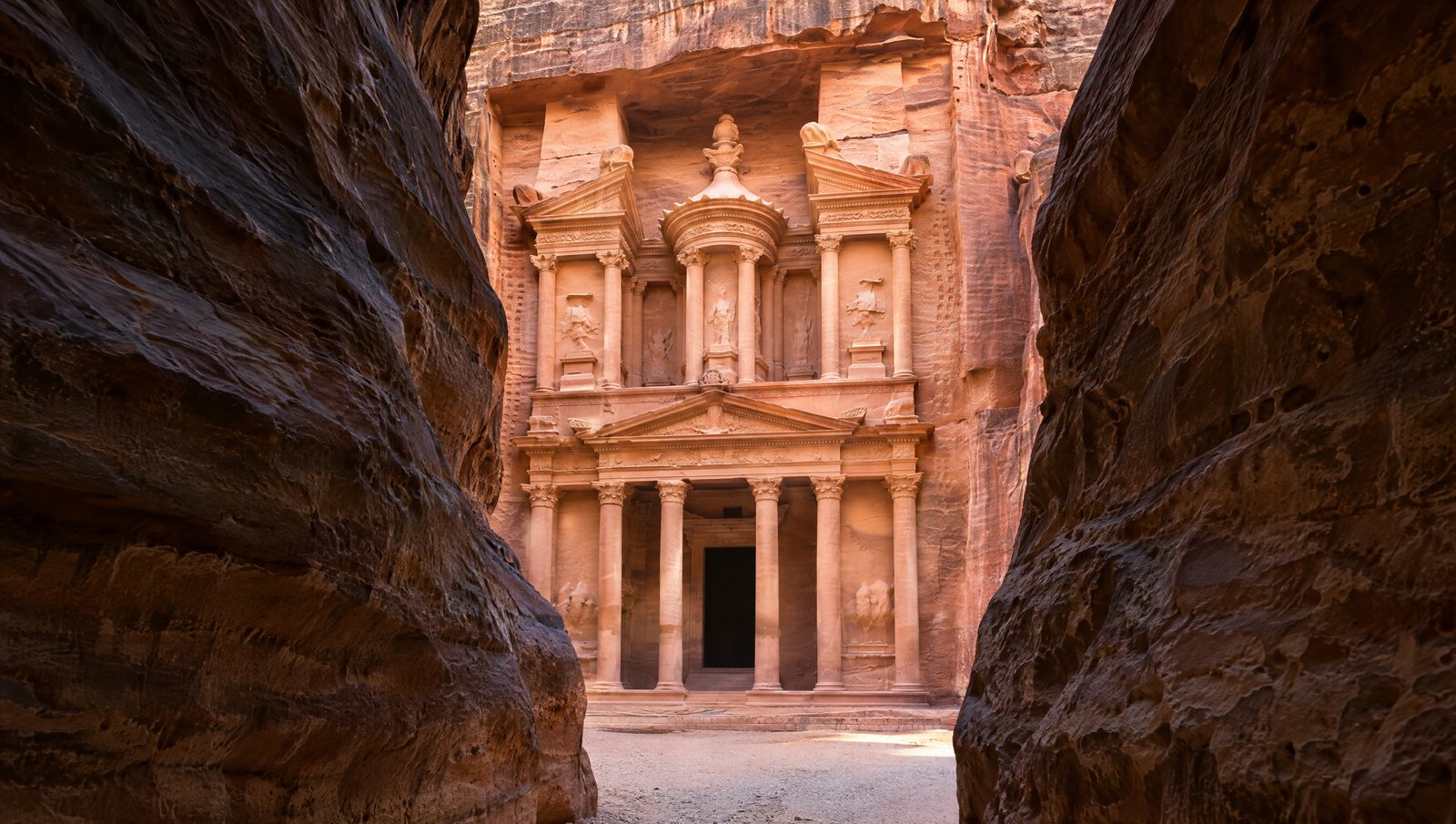
The Nabataeans who carved Petra spoke an Arabic dialect but wrote in Aramaic, and their script is the direct ancestor of the Arabic alphabet. Inscriptions in it are cut beside tombs along the Siq and in the Outer Siq, and the Petra Museum at the entrance explains the script. The Treasury catches direct sun for a short spell in mid-morning; the Monastery, a steep climb away, glows in the late afternoon. Buy a two-day pass, and if you can arrange it, arrive in Jordan in March or November, when the walk is bearable.
Persepolis, Iran
The ceremonial capital of Darius and Xerxes, an hour from Shiraz in Iran, is where the Aramaic chancellery worked. Thousands of clay tablets from the fortification wall and the treasury record rations, wages and travel permits, mostly in Elamite but with Aramaic dockets and hundreds of tablets written entirely in Aramaic. The stairways of the Apadana show delegations from every province bringing gifts, the empire the clerks administered. Spring brings wildflowers and tolerable heat; the site opens from early morning and the carved stairways face the best light before nine.
Go deeper
- Holger Gzella, Aramaic: A History of the First World Language (Eerdmans) — the one book to read on how a minor Syrian tongue became the administrative language of the Near East, written for non-specialists by a leading scholar.
- Bezalel Porten, The Elephantine Papyri in English (Brill) — full translations of the Aswan documents, with the Passover letter and the temple petition; his earlier Archives from Elephantine tells the community’s story.
- James M. Lindenberger, The Aramaic Proverbs of Ahiqar (Johns Hopkins) — the sayings in translation with commentary; the story and proverbs are also translated in volume 2 of Charlesworth’s Old Testament Pseudepigrapha.
- Franz Rosenthal, A Grammar of Biblical Aramaic (Harrassowitz) — the standard short grammar, compact enough to work through in a term with the Aramaic chapters of Daniel and Ezra beside it.
- The Comprehensive Aramaic Lexicon (Hebrew Union College) — a free online dictionary and text database covering every dialect from the Tel Dan stele to modern speech, at cal.huc.edu.
Frequently asked questions
Is Aramaic hard to learn?
If you already read Hebrew, Biblical Aramaic takes weeks rather than years: the script is the same, the grammar is a close cousin and roughly half the vocabulary is shared or predictable by sound-shift. Starting from scratch is harder, mainly because of the alphabet, the unfamiliar throat consonants and the need to supply vowels that the ancient texts do not write. The compensation is that the corpus for this period is small. The Aramaic of the Bible fills about two hundred verses, and with a grammar and a lexicon a patient learner can read all of it inside a year.
How accurate is the reconstructed pronunciation?
The consonants are secure; the alphabet records them and the living dialects confirm them. The vowels of Biblical Aramaic rest on the Masoretic pointing, a reading tradition written down a thousand years after the texts and influenced by Hebrew habits, so it is a faithful record of how medieval Jews read Daniel rather than of how a Persian clerk spoke. Greek and cuneiform transcriptions let scholars check it and it holds up well in outline. Think of the textbook pronunciation as a careful, consistent convention, not a recording.
What languages descend from it?
Aramaic is still spoken, which is remarkable for a language with a three-thousand-year written record. Western Neo-Aramaic survives in Maaloula and two neighbouring villages north of Damascus. Eastern dialects, usually called Assyrian, Chaldean or Sureth, are the home language of Christian communities from the plains of Nineveh and Urmia, now scattered across Europe, Australia and North America. Mandaic survives among a few thousand Mandaeans. Classical Syriac, the literary form of the Christian east, is still the liturgical language of several churches, and Jewish Aramaic lives on in the Talmud and the Kaddish.
Can I read the original texts after a few months?
The Aramaic of Daniel and Ezra is the usual entry point and the most forgiving, because it is vocalised and every word has been discussed for centuries. Three or four months of steady work with Rosenthal’s grammar will take you through Daniel 2 to 7, the stories of the furnace, the feast and the lions. The Elephantine papyri are harder: no vowels, scribal abbreviations, damaged lines. Reading the Genesis Apocryphon or the Targums comfortably is a longer project.
What is the best first trip for this era?
Jerusalem and Aswan, in that order, with a museum day in London or Berlin at one end of the journey. The Israel Museum gives you the oldest and the latest Aramaic of the period in one building, and the Old City of Jerusalem is where the officials on the wall asked Sennacherib’s envoy to switch languages. Aswan is a short flight from Cairo, and Elephantine Island is the only place where you can walk through the streets of an Aramaic-speaking community whose letters you have read.