
The world at the time
Around 3300 BC, in a city called Uruk on a branch of the Euphrates in what is now southern Iraq, somebody pressed a reed into a lump of wet clay to record a delivery of barley. That act, repeated by thousands of clerks over the next three thousand years, is the beginning of history in the strict sense: the point from which people speak to us in their own words. The people were Sumerians, their language is related to nothing else on earth, and their cities were the first anywhere.
Uruk itself was enormous for its time. By about 2900 BC its wall ran for some nine kilometres around several hundred hectares and tens of thousands of people, with the temple precinct of Eanna, the house of the goddess Inanna, at its heart. Excavators found there the earliest writing, the earliest cylinder seals, and the Warka Vase, a metre of carved alabaster showing a procession bringing produce to Inanna. The land that made this possible was flat, hot and nearly rainless, but it had two rivers, and canals turned the silt between them into the most productive farmland in the ancient world. Barley, dates, sheep and fish fed the cities; wool became the textiles that paid for everything the plain lacked, which was almost everything else: timber, stone, copper and the blue lapis lazuli that came a thousand miles from Afghanistan.
From about 2900 to 2350 BC, the period scholars call Early Dynastic, the plain was a quarrel of city-states: Ur, Uruk, Lagash, Umma, Kish, Shuruppak, and Nippur, which never ruled anyone but held the temple of Enlil, the god who conferred kingship. Each city belonged to a god; the ruler was his steward. Lagash and Umma fought for generations over a strip of irrigated border land, and the Stele of the Vultures, carved for Eannatum of Lagash around 2450 BC, shows the god Ningirsu holding the enemy in a net. In the Royal Cemetery of Ur, excavated by Leonard Woolley in the 1920s, a woman named Puabi was buried around 2500 BC under a gold-leaf headdress, with attendants, a sledge, lyres inlaid with bulls’ heads and the mosaic panel now called the Standard of Ur.
The city-states ended when Sargon of Akkad, a Semitic-speaking king from the north, conquered them all around 2334 BC. His daughter Enheduanna became high priestess of the moon god at Ur and the first author in the world whose name we know. Akkadian became the language of power, but Sumerian did not die; Sargon’s dynasty collapsed around 2150 BC, and under Gudea of Lagash, whose calm diorite statues fill a room in the Louvre, and then the kings of the Third Dynasty of Ur, it enjoyed a last century as the language of government.
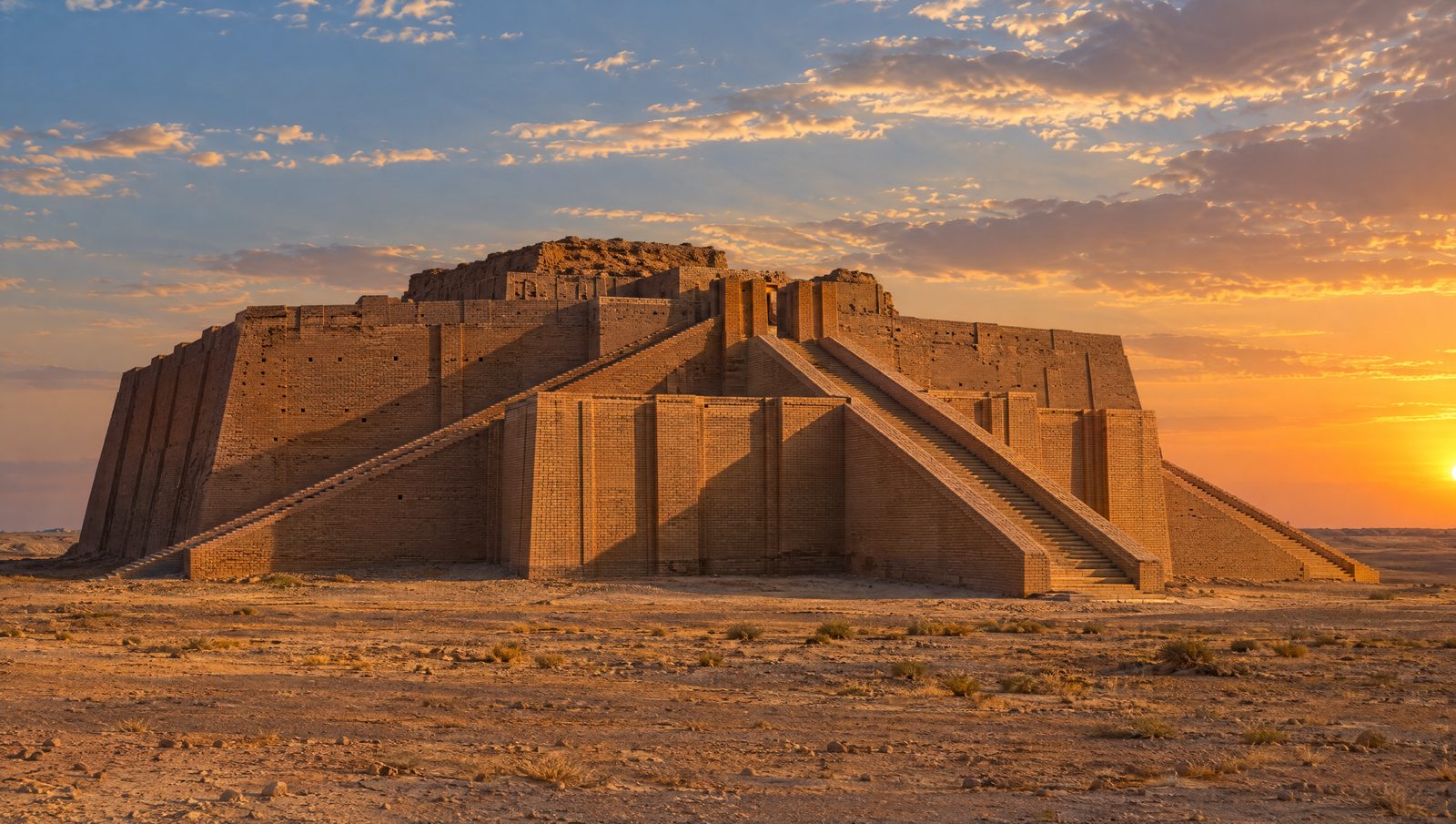
That century, c. 2112–2004 BC, is the best-documented in the ancient world before Rome. Ur-Nammu built the great ziggurat of Ur and issued the earliest surviving law code. His son Shulgi reigned forty-eight years, declared himself a god, reformed weights, calendar and taxation, and left a bureaucracy that produced something like 100,000 surviving tablets: receipts for sheep, rations for weavers, work-rosters for canal gangs. Numbers were written in base sixty, which is why an hour still has sixty minutes.
Religion was civic and anxious. Gods lived in their temples as statues, were fed twice a day and taken out for festivals; An ruled the sky, Enlil the air, Enki the fresh water under the earth, Nanna the moon at Ur, Utu the sun, and Inanna love and war at Uruk. Humans had been made to do the gods’ work, and a flood that nearly wiped them out was already an old story by 2000 BC.
The end came quickly. Famine, Amorite nomads pressing in from the west, and finally an Elamite army that sacked Ur around 2004 BC and carried off its last king, Ibbi-Sin. Within two centuries Sumerian was no longer spoken in the street. Yet it was taught in schools for another 1,800 years, the way Latin was taught in Europe, and most of the literature in this guide survives because Babylonian schoolboys around 1750 BC copied it out as homework.
The stories they told
Inanna’s descent to the netherworld
The goddess of Uruk decides, for reasons the poem never explains, to visit the Great Below, the kingdom of her sister Ereshkigal. She dresses in her full regalia and tells her minister Ninshubur that if she is not back in three days she is to beg the great gods for help. Ereshkigal orders the seven gates bolted, and at each one the gatekeeper strips a piece of her finery, until she enters the throne room naked and bowed. The judges of the dead fix her with the eye of death, and her corpse is hung on a hook. Ninshubur does as she was told; Enlil and Nanna refuse, and Enki, god of wisdom, scrapes the dirt from under his fingernails and makes two tiny creatures who slip in and revive Inanna with the plant and the water of life. But no one leaves the netherworld without a substitute, and demons escort her back to find one. She refuses to give up the servants who mourned for her, then finds her husband Dumuzi on his throne in fine clothes, not mourning at all. She looks at him with the eye of death. The text, about four hundred lines, ends with Dumuzi’s sister sharing his sentence: half the year below for each of them, which is why the shepherd god dies every summer.
Gilgamesh and the cedar mountain
Long before the Babylonian epic, there were separate Sumerian poems about Bilgames, as his name was then spelled, the king of Uruk who may have lived around 2700 BC. In “Gilgamesh and Huwawa”, the king watches corpses floating down the river and decides that since he cannot live forever he will at least make a name. With his servant Enkidu and fifty young men of Uruk he sets off for the Mountain of Cedar, guided by seven supernatural warriors lent by the sun god Utu. The forest belongs to Huwawa, a monster wrapped in seven terrifying auras. Gilgamesh fells a cedar and is knocked flat by the first aura; he recovers and begins to talk. He offers Huwawa his sisters in marriage and then a string of lesser gifts, and with each one the creature gives up an aura, until he stands defenceless and Gilgamesh strikes him. Huwawa pleads, and Gilgamesh, in the version most copies follow, is moved to pity, but Enkidu says a captured monster never stays captured and cuts off his head. They bring the head to Enlil, who is furious: Huwawa was his servant. The episode became the heart of the later Akkadian epic, where the monster is called Humbaba and the forest moves to Lebanon.
Enheduanna, priestess in exile
Sargon installed his daughter as en, high priestess, of the moon god Nanna at Ur, a post that bound the conquered south to the new dynasty. A limestone disc found at Ur in 1927 shows her in a flounced robe, watching a libation. The hymn known as “The Exaltation of Inanna” is written in her voice. It opens with long praise of Inanna as lady of all the divine powers and then turns personal. A rebel named Lugal-Ane has seized Ur and driven Enheduanna from her temple. She says that Nanna, her own god, has ignored her. She has been made to fly from her window “like a swallow” and driven out among the thorns. So she appeals over his head to Inanna, and the poem is the appeal: an account of composing it at night, “giving birth” to the song for the goddess, and a closing note that Inanna has accepted her prayer and she has been restored. Whether Enheduanna wrote the hymns herself or later scribes wrote them in her name is debated; the copies are five centuries younger than she is. Either way, the ancient world treated her as an author, and she remains the earliest person in history credited with one.
The lament for Ur
When Ur fell around 2004 BC, the poets of the next dynasty wrote its funeral. “The Lament for Ur” is a litany in which the great gods abandon their cities one by one, each verse ending with the same line about the sheepfold given over to the wind. Then Ningal, wife of the moon god and lady of Ur, speaks. She describes begging An and Enlil to spare the city and being refused. She describes the storm Enlil sent: the dead lying in the streets like potsherds, the mother who abandoned her child, the father who could not go to his son, gold and lapis scattered, the gates piled with bodies, the river reeds burned. The poem’s last section is a prayer that the storm be turned back and that Nanna return to his house. Lamentation priests performed it, with drums, whenever temples were rebuilt, as insurance against the gods’ anger. Variants survive for Nippur, Uruk and Eridu, and the genre was still being performed in Babylonian temples fifteen hundred years later, in Sumerian, to an audience that no longer understood a word.
How the language sounded
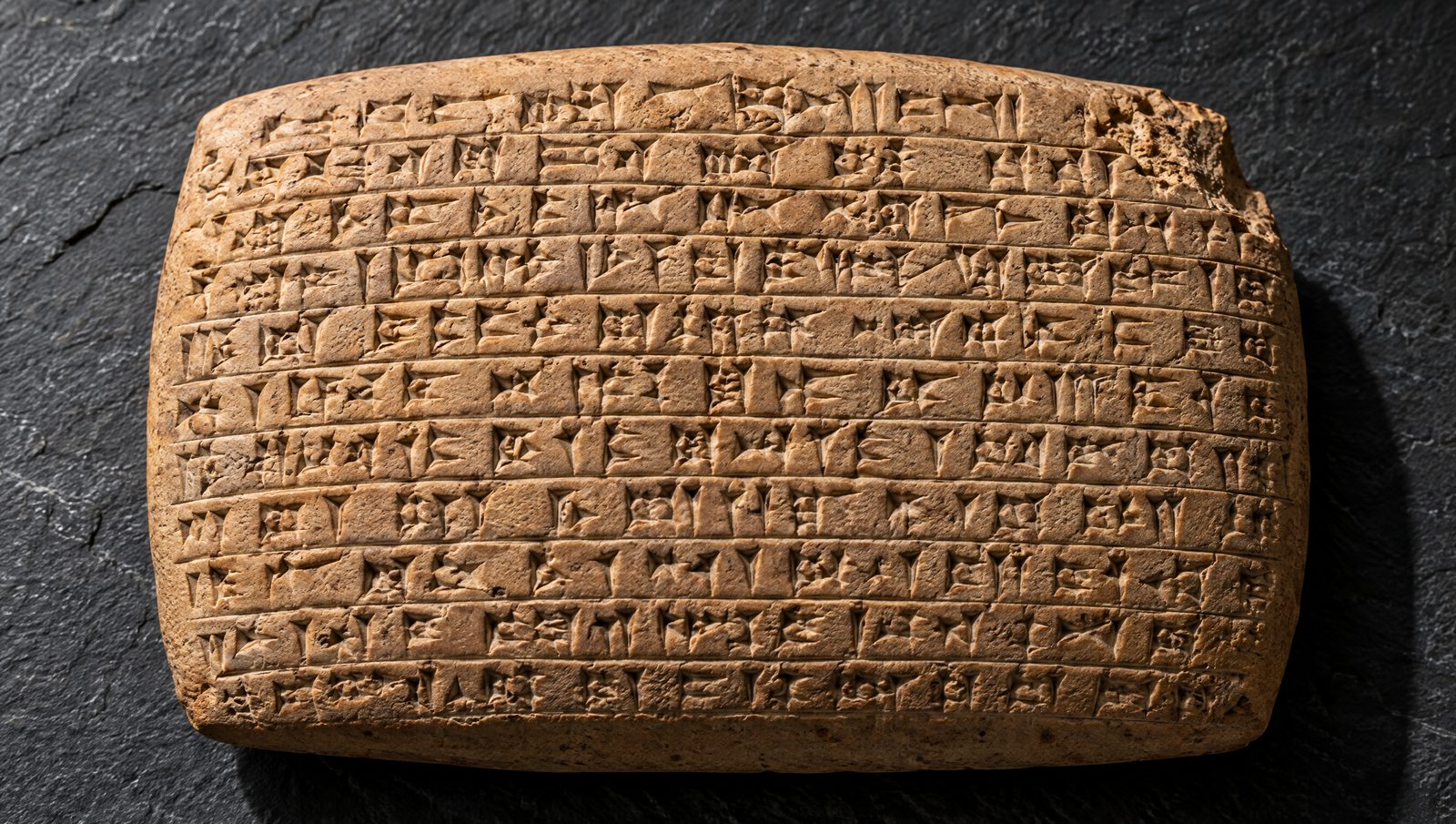
Sumerian was written in cuneiform, “wedge-shaped” writing, made by pressing the cut end of a reed stylus into damp clay. The first signs at Uruk around 3300 BC were pictures and tallies: a head with a bowl at the mouth meant “ration”, a triangle with stripes meant “barley”. Within a few centuries the pictures had become abstract bundles of wedges, and scribes had made the crucial leap of using a sign for its sound rather than its meaning, so that the sign for “arrow”, ti, could also write the word “life”, til. A fully developed text mixes three kinds of sign: logograms that stand for whole words, syllabic signs that spell out grammatical endings, and silent “determinatives” that tell the reader a word is a god’s name, a city or something made of wood. About six hundred signs were in regular use, and most had several possible readings, which is why modern transliterations attach numbers: du, du₃, du₈.
Here the honesty required by this series matters more than anywhere else. Nobody has heard Sumerian spoken since about 1800 BC, and it has no relatives to compare it with. What we know of its sounds comes almost entirely from the Babylonians, who learned it as a dead school language and wrote dictionaries giving each sign’s Sumerian reading spelled out in Akkadian syllables. Those syllables are our vowels: filtered through a different language a thousand years after the fact, a convention agreed among scholars rather than a recording. With that said, the broad outlines are reasonably secure.
- Four vowels, probably. The signs distinguish a, e, i and u. Some scholars think there was also an o, hidden because Akkadian had no way to write it.
- A nasal sound like the ng in “sing”. It is written ĝ in modern transliteration and begins the word for god, diĝir, and the word for wood, ĝeš. Akkadian lacked it, which is why it took a century of study to notice it was there.
- Dropped final consonants. Many words lost their last consonant at the end of a phrase: “life” was til before an ending but ti alone; “child” dumu hides a lost final consonant that reappears in dumu-ĝu₁₀, “my child”.
- Words built like trains. Sumerian is agglutinative: a verb is a chain of small prefixes and suffixes around a short root, so mu-na-an-du₃ is one word meaning “he built it for him”. Nouns take a single ending that applies to a whole phrase.
- Vowel harmony in the south. In early texts from Lagash, prefix vowels change to match the root, e- before e and i, i- before a and u, a feature that later scribes dropped.
- Stress unknown. No ancient source tells us which syllable was emphasised. Modern readers generally stress the first syllable of a root, as a convenience.
The consonant inventory is itself argued over. Sumerian seems not to have distinguished voiced and voiceless stops the way English does with b and p; the Akkadian spellings may instead be capturing a difference in aspiration. The phrasebook below follows the standard readings used in current grammars and in the Oxford Electronic Text Corpus of Sumerian Literature. The “say it” column is a reading convention that every Sumerologist uses and none would defend as what a citizen of Ur actually said.
| Original | Say it | Meaning |
|---|---|---|
| 𒁲𒈠𒃶𒈨𒂗 — silim-ma ḫe₂-me-en | SIH-lim-ma KHEH-meh-en | May you be well (the textbook greeting) |
| 𒈗 — lugal | LOO-gal | King (literally “big man”) |
| 𒀭 — diĝir | DING-ir | God; the same sign is the determinative before divine names |
| 𒂍 — e₂ | eh | House, temple |
| 𒌷 — iri | IH-ree | City |
| 𒀭𒆠 — an-ki | an-kee | Heaven and earth; the universe |
| 𒀀 — a | ah | Water |
| 𒁹 𒈫 𒐈 — diš, min, eš | dish, min, esh | One, two, three |
𒈗𒈨𒂗 𒊮𒋫 𒌨𒊕𒈨𒂗
lugal-me-en šag₄-ta ur-saĝ-me-enI am the king, a hero from the womb.
Opening line of the hymn Shulgi A, c. 2090 BC, in copies of c. 1800 BC
Shulgi of Ur commissioned dozens of hymns about himself, and this one, which Babylonian schoolboys copied as part of the standard curriculum, describes a day on which the king ran from Nippur to Ur, about 160 kilometres, celebrated a festival, and ran back through a hailstorm. The line shows the language in miniature. Lugal is “king”; -me-en is the verb “to be” in the first person, glued on as a suffix; šag₄-ta is “from the heart”, that is, from the womb; ur-saĝ, “hero”, is literally “dog of the head”, a compound whose logic is lost on us. Nothing here is certain in its vowels. Lugal is spelled with a single sign that the Babylonians glossed as lu-gal; whether Shulgi himself said something closer to “lugal” or “lukal” we cannot know.
Maya reads these aloud in the conventional scholarly pronunciation, honestly labelled as a reconstruction, in a free Sumerian session of fifteen minutes by phone.
Where to stand today
The Iraq Museum, Baghdad
The national museum of Iraq holds the objects that define Uruk: the Warka Vase, with its procession to Inanna, and the Mask of Warka, a life-size marble face of a woman from about 3100 BC, both looted in 2003 and both recovered. The Sumerian galleries also hold a share of the Royal Cemetery gold and the statues of Early Dynastic worshippers with their enormous inlaid eyes. The museum reopened fully in 2015 and has kept irregular hours since; confirm the current opening days through a local guide or hotel before you go, carry your passport, and allow a half day.
Ur, near Nasiriyah
The ziggurat Ur-Nammu began around 2100 BC still stands three storeys high on the flat plain south of Nasiriyah, its lower stage refaced with new brick by Iraq’s antiquities service in the twentieth century and its great central staircase open to climb. Behind it are the ruins of the Royal Cemetery, the temple of Ningal, and the house quarter where Woolley found the streets of around 1900 BC, including the building he insisted on calling Abraham’s house. Pope Francis held an interfaith meeting here in 2021. A licensed guide makes the checkpoints and permits far simpler; go between November and March, early in the day.
Uruk, Warka
The first city is about 80 kilometres northwest of Nasiriyah, a vast expanse of low mounds and brick stumps that takes imagination to read, which is the point. German teams have excavated here since 1912, and the remains of the Eanna precinct, the platform of the White Temple of An, and the brick of later Babylonian and Parthian rebuilding are all visible if you know what you are looking at. There are no facilities and very few visitors. Combine it with Ur in a single guided day, and carry water, a hat and a site plan.
The British Museum, London
Room 56 of the British Museum in London, “Mesopotamia 6000–1500 BC”, holds the British share of Woolley’s finds from Ur: the Standard of Ur, with its war side and its banquet side; the Queen’s Lyre with its gold bull’s head; one of the two “Ram in a Thicket” statues; and the Royal Game of Ur, whose rules were recovered from a Babylonian tablet. Entry is free. The room is upstairs and often half empty; go late in the afternoon.
The Penn Museum, Philadelphia
The University of Pennsylvania co-sponsored the Ur excavations and received the other half: Puabi’s headdress and cloak of beads, reconstructed on a mannequin, the Bull-Headed Lyre and the second Ram in a Thicket, plus the limestone Disc of Enheduanna. Beyond that, the Penn Museum holds the largest collection of Sumerian literary tablets anywhere, from the scribal quarter of Nippur, which is the reason Philadelphia rather than Baghdad became the centre of Sumerian studies in the twentieth century. The Middle East galleries were rebuilt in 2018. Philadelphia is an easy train ride from New York on a United States itinerary; the museum is closed on Mondays.
The Louvre, Paris
French excavations at Girsu, the sacred city of the state of Lagash, began in 1877 and gave the Louvre in Paris the finest group of Sumerian sculpture outside Iraq. The Mesopotamian rooms of the Richelieu wing hold a dozen diorite statues of Gudea, seated and standing, one with the plan of a temple on his lap; the Stele of the Vultures; and the two clay cylinders on which Gudea’s temple hymn, the longest Sumerian text from its own period, is written. Book a timed ticket online and head straight to Richelieu at opening, since most visitors turn the other way toward the paintings.
Go deeper
- Jeremy Black, Graham Cunningham, Eleanor Robson and Gábor Zólyomi, The Literature of Ancient Sumer (Oxford University Press) — the best anthology, with Inanna’s descent, the Gilgamesh poems, Enheduanna and the laments in clear translations and short introductions.
- The Electronic Text Corpus of Sumerian Literature (University of Oxford) — free online transliterations and translations of nearly four hundred compositions, the source for most of the texts quoted here.
- Harriet Crawford, Sumer and the Sumerians (Cambridge University Press) — a compact archaeological history of the cities, their economy and daily life.
- Andrew George, The Epic of Gilgamesh (Penguin Classics) — includes full translations of the Sumerian Gilgamesh poems alongside the Babylonian epic.
- Samuel Noah Kramer, History Begins at Sumer — the classic popular account of “firsts” by the scholar who pieced together much of the Nippur literature; dated in places, still a pleasure.
Frequently asked questions
Is Sumerian hard to learn?
Yes, and in an unusual way. The grammar is not the obstacle; it is agglutinative and quite regular once the pattern of verb chains clicks. The difficulty is the script, where each sign may have several readings and each reading several meanings, and the fact that no living speaker or closely related language can tell you when you have gone wrong. Most students learn it after Akkadian, because the Babylonian dictionaries are the key to the Sumerian sounds.
How accurate is the reconstructed pronunciation?
Less accurate than for any other language in this series. The readings rest on Babylonian scholars’ glosses written a millennium after Sumerian ceased to be spoken, in a script designed for a different language. The vowels a, e, i and u are reasonably secure; whether there were more, how consonants were really distinguished, and where words were stressed are open questions. What exists is a consistent scholarly convention for reading the texts aloud. Treat it as that.
What modern languages descend from Sumerian?
None. Sumerian is a language isolate, with no demonstrated relative living or dead, despite many attempts to link it to Hungarian, Turkish, Dravidian or Basque. It did leave traces: Akkadian borrowed hundreds of Sumerian words, and the base-sixty counting system survives in every clock. The script outlived the language by nearly two thousand years, used for Akkadian, Hittite, Elamite and Old Persian.
Can I read the original texts after a few months?
Royal inscriptions, yes. They are formulaic, “For the god X, his lord, king Y built his temple”, and a few months with a grammar and a sign list will let you pick out the bricks of Ur-Nammu in a museum case. Literature is another matter: the poems use rare words, archaic spellings and a terse style that even specialists argue about, and reading Inanna’s descent in Sumerian is a project of years rather than months.
What is the best first trip for this era?
If you are willing to travel in southern Iraq, a week with a licensed guide taking in Baghdad’s museum, Ur and Uruk puts you inside the landscape in a way nothing else can; the flatness, the heat and the brick mounds rising out of it are the whole story. If not, the finds from Ur are split between London and Philadelphia, and the two museums together, with the Louvre’s Gudea statues as a third stop, let you see nearly everything Woolley and the French dug up without a visa.