
The world at the time
Syriac began as the local Aramaic of one city. Edessa, now Şanlıurfa in southeastern Turkey, sat on the caravan road between the Roman and Persian empires, ruled by a dynasty of kings mostly named Abgar, and its scribes wrote their dialect in a distinctive rounded script from the first century AD. The earliest dated inscription is from AD 6. It became the third great language of ancient Christianity, after Greek and Latin, because Edessa became Christian early and its church carried the local tongue into the whole of the East.
By about 200 the Old Testament had been translated into Syriac, directly from Hebrew, in the version later called the Peshitta, “the simple”. The philosopher Bardaisan (154–222) was debating fate and free will at the court of Abgar VIII, and Tatian’s Diatessaron, a harmony of the four Gospels, was the form in which most Syriac speakers first read about Jesus. Rome annexed the kingdom around 214. Syriac Christians would live on both sides of the Roman-Persian frontier, trusted by neither.
The fourth century was the golden age. Ephrem, born around 306 in Nisibis, served as a deacon and teacher through three Persian sieges of the city, and when Rome surrendered Nisibis to Shapur II in 363 he moved with the Christian population to Edessa. There he wrote the hymns, madrashe, that made him the greatest poet of the Syriac tradition, composed for choirs of women to sing in church, dense with imagery of fire, pearls, mirrors and the sea. He died in 373, having spent his last months organising famine relief. Behind him stood a school at Edessa and then, after it was closed in 489 for heresy, the School of Nisibis across the border in Persia, which some historians have called the first university.
Then the church split, and Syriac split with it. The quarrels over how Christ’s divinity and humanity related, fought at the councils of Ephesus in 431 and Chalcedon in 451, left three Syriac-speaking churches. The Church of the East, inside the Persian Empire, followed the theology that Constantinople condemned as Nestorian and became the most far-flung church in the world. The Syriac Orthodox, in Roman territory, rejected Chalcedon and were organised into a separate hierarchy in the sixth century by Jacob Baradaeus. The Maronites of Lebanon kept their own line. Each developed its own script and pronunciation, and the division survives today.
Life in this world was monastic to a degree that startled visitors. In the limestone hills of northern Syria, villages of the fourth to sixth centuries, the so-called Dead Cities, still stand to their roofs, with churches and oil presses, and above them the church built around the pillar on which Simeon Stylites stood for thirty-seven years until his death in 459. In the Tur Abdin, the “mountain of the servants of God” east of Mardin, monasteries founded in the fourth and fifth centuries are still inhabited. Syriac monks translated Aristotle and Galen, wrote chronicles, and walked east along the Silk Road.
The Arab conquests of the 630s and 640s removed the frontier that had divided Syriac Christians for four centuries and put them all under one rule. Under the Umayyads and early Abbasids, Syriac scholars became the translators of the new empire, turning Greek science into Syriac and then Arabic. Isaac of Nineveh, a seventh-century bishop who resigned after five months to live as a hermit, wrote the ascetic treatises still read in Orthodox monasteries from Greece to Russia. By 800, when this guide closes, Arabic was beginning to replace Syriac as the language of daily life in the cities, but Syriac literature had another five centuries of productivity ahead, and in Kerala, Central Asia and China the Church of the East was still growing.
The stories they told
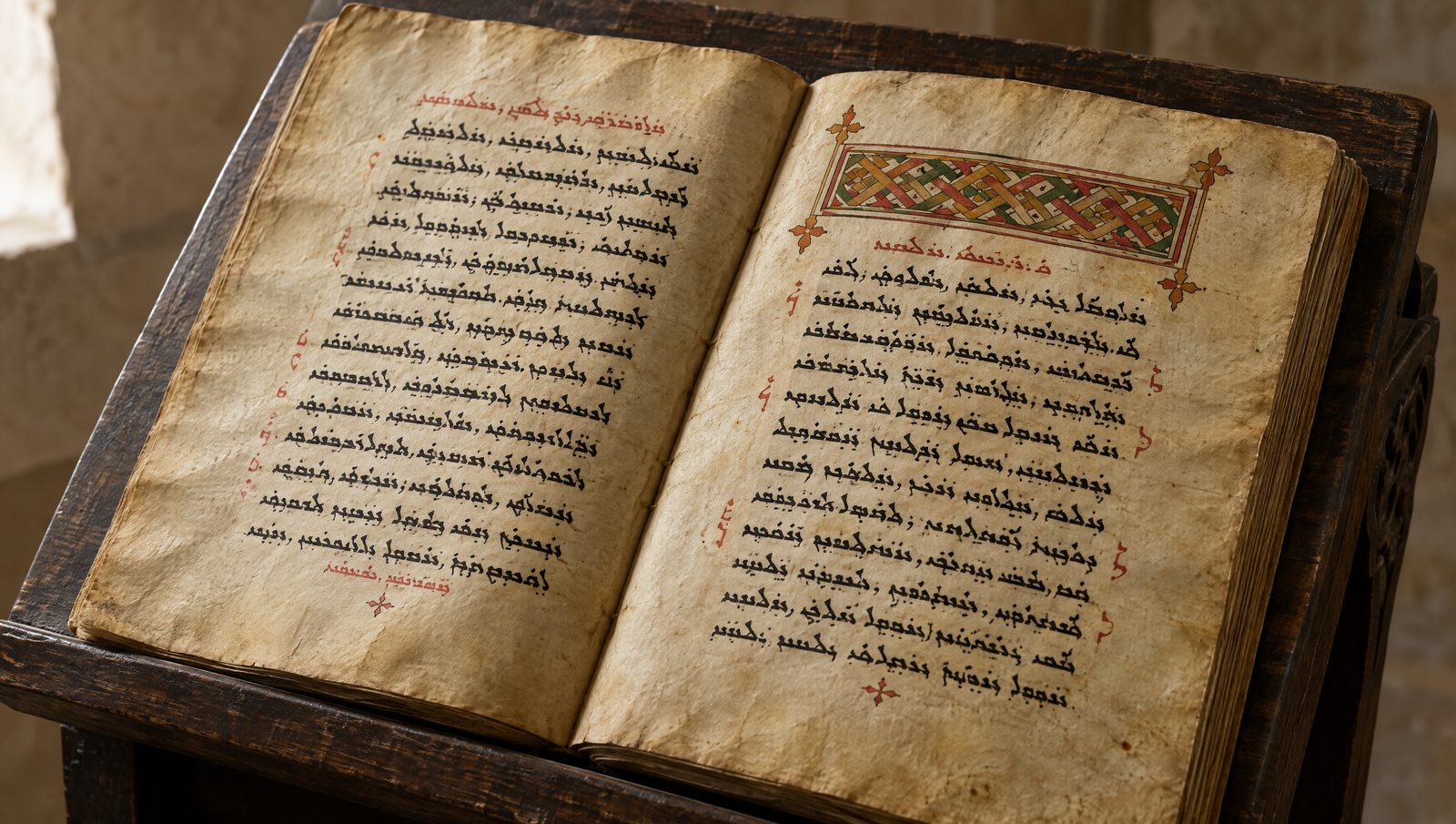
King Abgar’s letter to Jesus
Edessa’s founding legend, told in Syriac in the Doctrine of Addai and known already to Eusebius around 320, makes the city the first Christian kingdom. Abgar V, suffering from an incurable disease, hears of a healer in Palestine and writes to him: he has heard that Jesus cures without drugs or herbs, and invites him to Edessa, which is small but respectable and has room for both of them. Jesus replies, through a scribe, that he must finish his work and ascend, but that he will send one of his disciples afterward. In the Syriac version the king’s messenger also paints Jesus’s portrait, the origin of the image later venerated in Constantinople as the Mandylion. After the resurrection the apostle Thomas sends Addai, who heals Abgar, converts the city, and dies in his bed. The letter was copied onto doorposts and city gates across the Christian world as a charm, and Egeria, the pilgrim who visited Edessa in 384, was shown the originals and given a copy. Historians think the story was invented to give Edessa’s church apostolic credentials.
The Hymn of the Pearl
Embedded in the third-century Acts of Thomas, which tells how the apostle was sold as a carpenter to an Indian king, is a poem of about a hundred lines that is the finest thing in early Syriac literature. A prince in the East is sent by his parents to Egypt to fetch a pearl guarded by a serpent in the sea. They take away his robe of glory and promise it back when he returns. In Egypt he dresses as an Egyptian, eats their food, forgets who he is and falls asleep. His parents send a letter that rises up as an eagle, lands beside him and becomes speech, reminding him that he is a king’s son and a slave to no one. He wakes, charms the serpent with his father’s name, seizes the pearl and starts home, stripping off the filthy clothes as he goes. The robe comes to meet him on the road, and as he looks at it he sees himself in it, “as if in a mirror”, and it speaks. He puts it on and goes up to the gate of his father’s kingdom. Christians read it as the soul’s exile and return; Gnostics and Manichaeans claimed it; modern readers find in it something that reads like a dream told the next morning. It survives in a single Syriac manuscript and one Greek one.
Ephrem and the siege of Nisibis
In 350 Shapur II of Persia laid siege to Nisibis for the third time. The Roman frontier fortress stood on the Mygdonius river, and the Persians, after months of failure, dammed the river and released it against the walls, bringing down a stretch of them. Then, in a detail that Ephrem’s hymns and the later historians agree on, the breach was found to be a swamp of mud in which the Persian cavalry and elephants foundered, and by the time it dried the defenders had built a new wall behind it. Shapur withdrew. Ephrem, who was inside the city, wrote a cycle of hymns on the siege in which Nisibis speaks as a woman, Noah’s ark tossed on the flood, and the bishop Jacob and his successors are her pilots. These Nisibene Hymns are the earliest Syriac poetry we can date. Thirteen years later the emperor Jovian bought peace by handing Nisibis to Shapur without a fight, and the Christian population was given three days to leave. Ephrem walked west to Edessa with them and spent his last decade teaching there, training the women’s choirs himself.
A monk at the court of China
In 781 a stone stele nearly three metres high was set up at the Tang capital of Chang’an, modern Xi’an, with a long text in Chinese and, down its sides and base, the names of some seventy clergy in Syriac. It records that in 635 a monk named Alopen arrived from Persia carrying scriptures, that the emperor Taizong had them translated, judged them beneficial and ordered a monastery built, and that the “Luminous Religion” had spread to every prefecture under succeeding emperors with the help of a priest from Balkh named Yisi, who served as a general. The stele was buried, probably during the persecution of foreign religions in 845, and dug up in 1625, when Jesuit missionaries realised that Christianity had reached China eight hundred years before them. It is dated by the stele’s own words to the patriarchate of Hnanisho, head of the Church of the East in Baghdad; fragments of Syriac and Chinese Christian texts have since turned up at Dunhuang and Turfan. The stele stands today in the Beilin Museum in Xi’an.
How the language sounded
Syriac is written in a cursive alphabet of twenty-two letters descended, through Aramaic, from the Phoenician, running from right to left with most letters joined. There are three styles. Estrangela, the oldest, is the formal bookhand of the great fourth- to eighth-century manuscripts. After the churches divided, the Syriac Orthodox in the west developed the smaller, more flowing Serto, and the Church of the East its own “Eastern” script. Like Hebrew and Arabic, the alphabet writes consonants; vowels were originally left to the reader, and the two traditions later added them differently, the west with small Greek letters written above and below the line, the east with patterns of dots. Those two systems preserve two pronunciations.
Syriac is Aramaic, so its sounds are close to the Aramaic of the Persian chancellery and of Galilee, with the changes of a few centuries.
- Hard and soft pairs. The six letters b, g, d, k, p, t were pronounced hard after a consonant and soft after a vowel: v, gh, dh, kh, f, th. Scribes marked the difference with a dot above or below the letter.
- Throat consonants. ܚ (ḥ) is a strong h from the throat, ܥ (ʿ) a constriction of the pharynx, ܛ, ܨ and ܩ the emphatic t, s and k of Arabic. The glottal stop ܐ had weakened and in many positions was silent.
- East and West vowels. The single clearest difference between the two traditions is that where the East says ā, the West says ō: God is Alāhā in the East and Alōhō in the West. The East also keeps a distinction between long e and i that the West merged.
- The article is a suffix. As in all Aramaic, “the” is -ā at the end of a word, and in Syriac this form had become so common that it was simply the normal form of a noun: malkā is “the king” or just “king”.
- Stress on the last heavy syllable. Usually the final or second-last syllable, and final short vowels were dropped in speech long before they stopped being written, so that malkā was pronounced with two syllables but šmāḵ, “your name”, with one.
- Greek everywhere. Centuries of translation left hundreds of Greek words in Syriac, from nāmōsā, law, to pārṣōpā, person, pronounced to Syriac rules.
How we know is unusually well. Syriac grammarians from Jacob of Edessa in the seventh century onward described the sounds of the language; the two vowel systems record two reading traditions that diverged around that time and have been maintained continuously since; Greek loanwords and Greek transcriptions of Syriac names show how letters corresponded; and the language has never stopped being read aloud. Classical Syriac is sung every week in several churches, and its modern spoken descendants confirm the consonants.
The uncertainties are smaller than for any other language in this series except Latin and Greek. The pronunciation of Edessa in Ephrem’s own day, before the East-West split, is reconstructed rather than recorded, and the earliest manuscripts have no vowels at all. Which of the two living traditions is closer to it is argued; most scholars think the Eastern vowels are more conservative. The table uses a reconstructed early pronunciation with Eastern vowels, which is the convention of most grammars.
| Original | Say it | Meaning |
|---|---|---|
| ܫܠܡܐ — šlāmā | shlah-MAH | Peace; the everyday greeting |
| ܫܠܡܐ ܥܡܟܘܢ — šlāmā ʿamḵōn | shlah-MAH am-KHOHN | Peace be with you (John 20:19) |
| ܐܠܗܐ — alāhā | a-lah-HAH | God |
| ܡܪܝܐ — māryā | MAHR-yah | The Lord |
| ܒܝܬܐ — baytā | BAY-tah | House |
| ܡܠܟܐ — malkā | mal-KAH | King, the king |
| ܐܝܢ / ܠܐ — ēn / lā | ayn / lah | Yes / No |
| ܚܕ, ܬܪܝܢ, ܬܠܬܐ — ḥaḏ, trēn, tlāṯā | khadh, trayn, tlah-THAH | One, two, three |
ܐܒܘܢ ܕܒܫܡܝܐ ܢܬܩܕܫ ܫܡܟ
aḇūn d-ḇašmayyā neṯqaddaš šmāḵOur Father who is in heaven, may your name be made holy.
Matthew 6:9, Peshitta
The Lord’s Prayer in the Peshitta is the one Syriac text that millions of people know by heart, and it is a fair sample of the language. Aḇūn is “our father”, the possessive suffix on aḇā; d- is the all-purpose relative particle, “who, which, of”; b-ašmayyā is “in the heavens”, with the preposition fused to the noun; neṯqaddaš is a passive verb, “may it be sanctified”, formed with a prefix rather than an auxiliary; šmāḵ is “your name”. A Western Syriac speaker will say aḇūn d-ḇašmayō neṯqadaš šmōḵ, and the difference, that steady ā against ō, is the sound of the schism of 451 still audible in a prayer.
Maya reads these aloud in a reconstructed Classical Syriac pronunciation, honestly labelled as a reconstruction, in a free Syriac session of fifteen minutes by phone.
Where to stand today
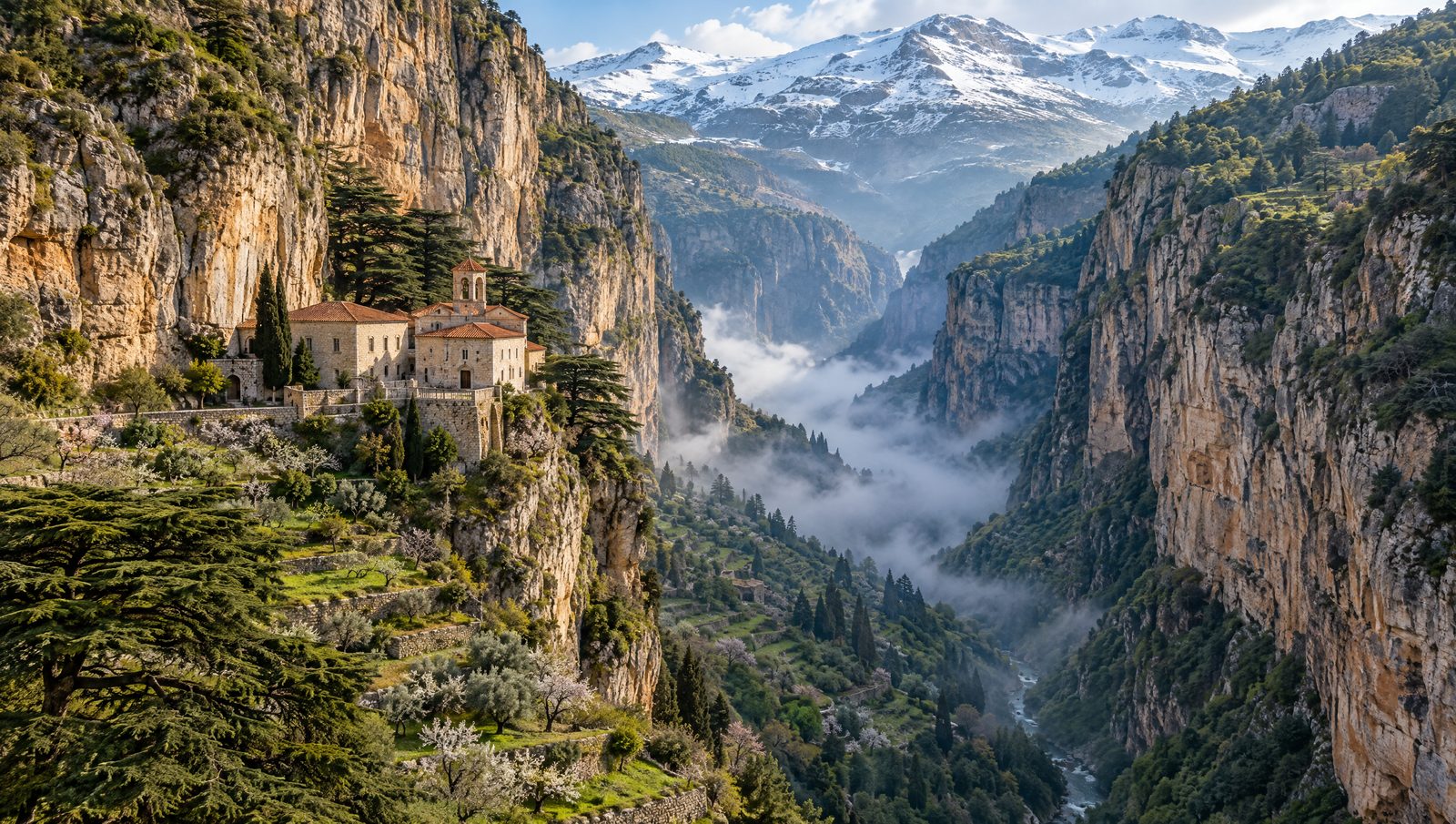
The Tur Abdin, Türkiye
The limestone plateau east of Mardin in southeastern Turkey is the heartland of Syriac Orthodox Christianity and the one place where the language of this guide is still spoken in the villages. Mor Gabriel, founded in 397, is the oldest functioning monastery in the world by some reckonings, with a fifth-century church, mosaics given by the emperor Anastasius and monks who will show you around between prayers. Deir al-Zafaran, outside Mardin, was the patriarchal seat for more than six centuries. Both admit visitors daily; dress modestly, go in spring or autumn, and stay a night in Mardin, whose old town is one of the finest in Anatolia.
Şanlıurfa, ancient Edessa
Nothing of Abgar’s palace survives above ground, but the two columns on the citadel that local tradition calls Nimrod’s throne are late Roman, and the pools of sacred carp below them, now tied to the story of Abraham, were already sacred in Ephrem’s day. The archaeology museum holds Syriac inscriptions and funerary mosaics of Edessan families from the second and third centuries, their names in the same script Ephrem wrote. Urfa is an hour’s flight from Istanbul; combine it with Göbekli Tepe, twenty minutes away, and stay in a restored stone house in the old bazaar quarter.
Qal’at Sim’an and the Dead Cities, Syria
Northwest of Aleppo in Syria, the vast church built around Simeon’s pillar around 480, four basilicas meeting at an octagon, was the largest church in the world when it was finished, and the base of the pillar still stands at its centre, worn down by centuries of pilgrims taking chips. Around it, the limestone villages of the fourth to sixth centuries, Serjilla, al-Bara and dozens more, keep their houses, churches and tombs. The site was damaged by an airstrike in 2016 and the region was a front line for years; access depends entirely on current conditions, and it is listed here because when it is possible again it will be the single most important landscape for this era.
Mar Mattai, Iraq
The monastery of St Matthew clings to the side of Mount Alfaf, thirty-five kilometres northeast of Mosul in Iraq, and has been a Syriac Orthodox house since the fourth century. In the Middle Ages its library was one of the greatest in the Syriac world, and the tomb of Bar Hebraeus, the thirteenth-century polymath, is inside. The view across the plain of Nineveh from the terrace is the reason to make the drive. The monastery was on the front line in 2014 and again receives visitors; go with a local driver from Erbil, which has the easier airport, and check conditions the week before.
The Qadisha Valley, Lebanon
The Maronites, the Syriac-rite church of Lebanon, took refuge in the gorge below the cedars of Bsharri, and the Qadisha, the “holy valley”, is lined with monasteries and hermitages cut into the cliffs, some occupied since the period of this guide. Qannubin, the patriarchal seat from the fifteenth century, and the Monastery of St Anthony of Qozhaya, which housed the first printing press in the Middle East, are the ones to walk to. The valley is a UNESCO World Heritage Site; a full day’s hike runs from Bsharri down and along the river, best in May or October when the path is dry and the orchards are in colour.
The Syrian Christians of Kerala, India
The St Thomas Christians of Kerala trace their faith to the apostle’s arrival in AD 52 and used Syriac as their liturgical language for well over a thousand years, in contact with the Church of the East across the Indian Ocean. St Mary’s Knanaya church in Kottayam, known as the Valiyapally, keeps two granite crosses carved with inscriptions in Pahlavi, the script of Sasanian Persia, probably from the eighth or ninth century, the oldest Christian monuments in India. Syriac is still chanted in some services. Kottayam is under two hours from Kochi; Sunday morning is the time to hear it.
The Beilin Museum, Xi’an
The stele of 781 stands in the Forest of Steles in Xi’an, the museum of inscribed stones inside the old Confucian temple by the south wall, among the Tang dynasty’s classics in stone. It is in the second hall, a dark limestone slab with a cross above a lotus at the top; the Syriac names run down the sides and are easy to miss unless you walk round it. The museum is a short walk from the South Gate of the city wall and quiet compared with the Terracotta Army.
Go deeper
- Sebastian Brock, The Luminous Eye: The Spiritual World Vision of Saint Ephrem (Cistercian Publications) — the best way into Ephrem’s thought, by the scholar who has done more than anyone to bring Syriac to English readers.
- Kathleen McVey (trans.), Ephrem the Syrian: Hymns (Classics of Western Spirituality, Paulist Press) — the Hymns on the Nativity, on Virginity and against Julian in full, with introduction and notes.
- Sebastian Brock and David Taylor (eds), The Hidden Pearl: The Syrian Orthodox Church and Its Ancient Aramaic Heritage (Trans World Film Italia) — three illustrated volumes covering the language, the church and the diaspora, with the Hymn of the Pearl among the texts.
- Philip Jenkins, The Lost History of Christianity (HarperOne) — a readable account of the Church of the East’s spread across Asia and its decline, the context for the Xi’an stele.
- Wheeler M. Thackston, Introduction to Syriac (Ibex) — the standard self-study grammar, with readings from the Peshitta and the fathers; John Healey’s Leshono Suryoyo is a shorter alternative, and the Peshitta can be read online with word-by-word analysis at dukhrana.com.
Frequently asked questions
Is Syriac hard to learn?
It is the easiest of the ancient Semitic languages. The alphabet has twenty-two letters and takes a few days; the grammar is simpler than Hebrew or Arabic, with fewer irregular verbs and a straightforward sentence structure; and the vocabulary is shared with Aramaic and, more distantly, with Hebrew and Arabic. Anyone who knows one of those has a head start. The main difficulty is learning to read the same word in Estrangela, Serto and Eastern scripts. Most students read the Gospels comfortably within a year.
How accurate is the reconstructed pronunciation?
Very, for a language of its age. Two living liturgical traditions, grammarians from the seventh century onward, Greek evidence and modern spoken descendants all agree on the consonants and on the main vowel contrasts. What is reconstructed is the pronunciation of Edessa before the two traditions diverged, around the sixth and seventh centuries, and in particular whether its long a sounded like the Eastern ā or had already begun the shift toward the Western ō. Any reading you hear today is Eastern, Western or a scholarly compromise.
Is Syriac still spoken?
Classical Syriac is a liturgical and literary language, like Latin, used by the Syriac Orthodox, the Church of the East, the Chaldean Catholic, the Maronite and the Syro-Malabar and Syro-Malankara churches of India. Its spoken descendants are very much alive: Turoyo in the Tur Abdin and its European diaspora, and the Eastern dialects called Sureth, Assyrian or Chaldean, spoken by communities from northern Iraq and Iran now scattered across the world.
Can I read the original texts after a few months?
The Peshitta Gospels, yes, since the grammar is simple and the content familiar, and most grammars start you on them. The Sayings of the Desert Fathers in Syriac and the Doctrine of Addai are not much harder. Ephrem is a different matter: compressed, allusive, written in syllabic metres, with a vocabulary of images that takes time to learn, which is why most people read him in translation first and in Syriac later.
What is the best first trip for this era?
Southeastern Turkey, in a week: fly to Şanlıurfa for Edessa and Göbekli Tepe, drive east to Mardin and the Tur Abdin for the monasteries, and if time allows continue to Diyarbakır and the Tigris. This is the one itinerary where the language, the churches and the landscape of the fourth century are all still present, and where you can hear Syriac at a service on Sunday. Kerala or Lebanon make a fine second trip.