
The world at the time
Two centuries, from roughly 500 to 300 BC, produced most of what the word “classical” means. Herodotus invented history and Thucydides made it rigorous. Aeschylus, Sophocles and Euripides wrote the tragedies still performed every summer in Greek theatres. Socrates asked questions in the marketplace, Plato wrote them down, and Aristotle catalogued everything from constitutions to cuttlefish. The Parthenon went up. None of this happened in a single country. The Greek world was a scatter of several hundred independent city-states around the Aegean, the Black Sea, Sicily, southern Italy, Cyprus and the coast of Asia Minor, sharing a language, gods and a habit of quarrelling.
Athens enters the period having just reinvented itself. In 508/7 BC the reforms of Cleisthenes gave every male citizen a vote in the assembly, a seat on the council by lot and a share in the courts. Within a generation this experiment faced the largest empire on earth. The Persians were turned back at Marathon in 490 BC; ten years later Xerxes came in person with a vast army and fleet, held briefly at Thermopylae, burned Athens, and lost his navy in the straits of Salamis. The land army was broken at Plataea in 479 BC. The alliance Athens then led against Persia, the Delian League of 478 BC, quietly became an Athenian empire whose tribute paid for the buildings on the Acropolis.
Pericles dominated the city from the 460s until his death in the plague of 429 BC. The Parthenon was built between 447 and 432 BC. Then Athens and Sparta fought the Peloponnesian War from 431 to 404 BC, a conflict Thucydides recorded as it happened; the disastrous Athenian expedition to Sicily in 415–413 BC was its turning point. Athens surrendered, its walls were pulled down to the music of flute-girls, and in 399 BC the restored democracy put Socrates to death. The fourth century belonged to orators and philosophers, to Plato’s Academy founded about 387 BC, and finally to Macedon: Philip II crushed the Greek cities at Chaeronea in 338 BC, and his son Alexander, dead at Babylon in 323 BC, carried Greek speech as far as the Indus.
Life in a polis was lived outdoors and in public. Perhaps 30,000 to 40,000 adult male citizens made up Athens at its height, within a total population of several hundred thousand. Citizen women had no political voice and respectable ones were rarely seen in the agora; the metics, free foreigners, ran much of the trade and craft; enslaved people worked the silver mines at Laurion that financed the fleet. Men drank together at the symposium, exercised at the gymnasium and argued in the agora.
Attica could not feed itself, so Athens lived by the sea. Grain came from the Black Sea through the Hellespont, timber from Macedon, papyrus from Egypt; Athenian pottery, olive oil and silver coins stamped with an owl went everywhere. Piraeus, laid out on a grid by Hippodamus of Miletus, was the busiest port in the eastern Mediterranean. Further west, Syracuse in Sicily rivalled Athens in size, and the Greek cities of southern Italy built Doric temples that still stand at Paestum and Agrigento.
Religion was woven into the calendar. The City Dionysia each spring was a religious festival at which the tragedies were competitions; the Panathenaea every four years brought a new robe to Athena’s ancient olive-wood statue in a procession carved on the Parthenon frieze. Delphi’s oracle advised cities on colonies and wars, the Olympic Games were held every four years in a truce, and thousands were initiated each autumn into the mysteries of Demeter at Eleusis, whose secret was never written down.
The Greek of this period was not one language but a family of dialects: Attic in Athens, Ionic along the Asian coast, Doric in Sparta, Sicily and Crete, Aeolic on Lesbos. Attic prose, the speech of Plato and Demosthenes, became the model, and after Alexander it flattened into the common Koine of the New Testament.
The stories they told
Thermopylae and Salamis
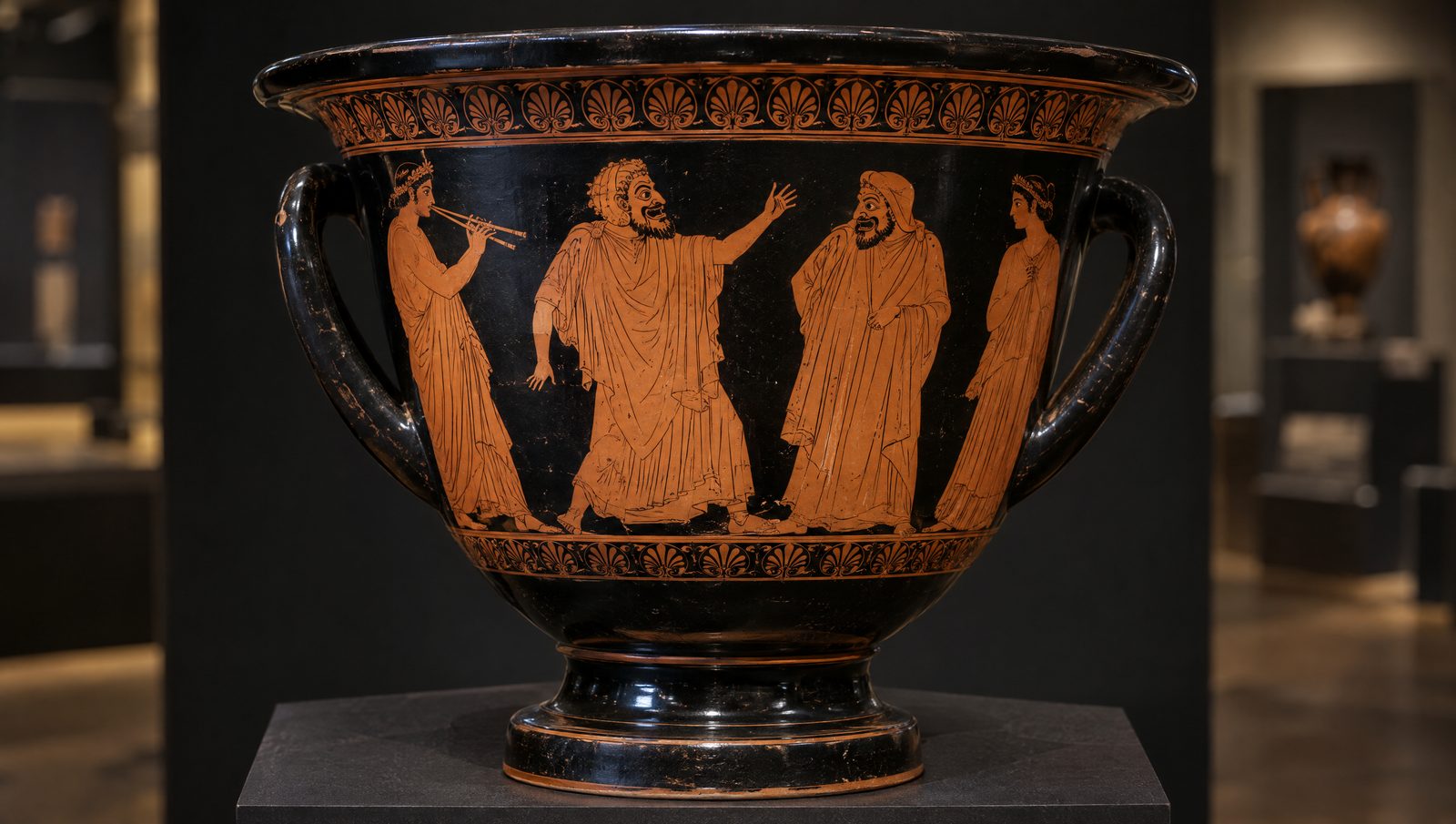
Herodotus tells it in Books 7 and 8 of his Histories, written some fifty years after the events from the memories of those who were there. In the late summer of 480 BC the Spartan king Leonidas held the pass of Thermopylae, a strip of shore between mountains and sea, with about 7,000 Greeks against Xerxes’ army. For two days the Persians broke on the Spartan shield wall. Then a local man, Ephialtes, showed them a mountain path around the pass. Leonidas sent most of the allies away and stayed with his 300 Spartans, the Thespians and some Thebans, to die. Herodotus records that when a Spartan was told the Persian arrows would hide the sun, he answered that they would fight in the shade. Weeks later, with Athens evacuated and burning, Themistocles tricked Xerxes into attacking the Greek fleet in the narrow water between Salamis and the mainland, where Persian numbers counted for nothing. Xerxes watched from a throne on the shore as his ships fouled one another and were rammed. Aeschylus, who fought in the battle, put it on stage eight years later in The Persians, the oldest surviving play in the world.
Pericles speaks for the dead
At the end of the first year of the Peloponnesian War, in the winter of 431–430 BC, Athens buried its war dead in a public tomb outside the walls, as it did each year, and chose one man to speak. Thucydides, in Book 2 of his History, gives Pericles’ speech, or his reconstruction of it; he admits elsewhere that he wrote what each speaker would most likely have said. The oration barely mentions the dead. Instead it describes what they died for: a city where office goes to merit rather than class, where people are free in private life and law-abiding in public, where citizens take an interest in politics and regard the man who does not as useless rather than harmless. “We love beauty without extravagance and wisdom without softness,” Pericles says, and calls Athens the school of Greece. Thucydides then follows it, without comment, with his clinical description of the plague that struck the overcrowded city the next summer and killed, among tens of thousands, Pericles himself. The juxtaposition is the point.
The death of Socrates
In 399 BC three citizens charged Socrates, then about seventy, with not believing in the city’s gods and corrupting the young. Plato’s Apology gives his speech to a jury of about 500 men, who had heard him question generals and poets in the agora for decades and found many of them exposed as ignorant. He refuses to beg, suggests that a fitting penalty would be free meals for life at public expense, and is condemned by a larger margin on the second vote than on the first. In the Crito his friends offer to bribe his way out of prison and he declines, arguing that a man who has lived under the laws of Athens may not break them when they go against him. The Phaedo describes the last day. He bathes so the women will not have to wash his corpse, sends his wife home, discusses the immortality of the soul until sunset, and drinks the hemlock the jailer brings. As the numbness climbs from his feet he says his last words: they owe a cock to Asclepius, the god of healing, and should not forget to pay it. Plato notes that he himself was not present; he was ill.
Oedipus in the theatre of Dionysus
Sophocles’ Oedipus Tyrannus was staged in Athens around 429 BC, probably in the shadow of the plague, and it opens with a plague. Thebes is dying, and its king Oedipus, who saved the city years before by answering the Sphinx’s riddle, sends to Delphi for a cure. The oracle says the murderer of the old king Laius must be found. Oedipus curses the killer and begins an investigation that the audience, who know the myth, watch with mounting dread. The blind prophet Tiresias tells him the truth and is not believed. A messenger from Corinth, bringing what he thinks is good news, removes the last doubt: the baby exposed on a mountainside with pinned ankles, the stranger killed at a crossroads, the queen Jocasta who is Oedipus’s wife and mother. Jocasta hangs herself; Oedipus blinds himself with the pins from her dress. Aristotle, in the Poetics a century later, treated it as the model tragedy. It did not win first prize that year.
How the language sounded
The Greeks took their alphabet from the Phoenicians around 800 BC and made one decisive change: they used spare letters for vowels, producing the first fully alphabetic script. Local versions competed until Athens formally adopted the 24-letter Ionic alphabet in 403/2 BC, the one still in use. Classical inscriptions are in capitals with no spaces between words, no accents and no breathing marks; the accents and breathings in modern editions were devised by scholars in Alexandria around 200 BC to help readers who no longer spoke Attic natively. Everyday writing went onto wax tablets, potsherds (the ostraka used to vote politicians into exile) and papyrus rolls.
The Attic Greek of Plato’s day sounded quite different from Modern Greek, and from the way most schools pronounce it.
- The accent was musical, not stressed. The acute mark showed a rise in pitch, the circumflex a rise and fall, on a long vowel. Dionysius of Halicarnassus says the interval was about a fifth. Stress accent replaced it only centuries later.
- Phi, theta and chi were aspirated stops. Φ was a p with a puff of air, as in English “pot”, not an f; θ was likewise a breathy t, χ a breathy k. Latin transcribed them as ph, th, ch, and that is why we write “Philip” rather than “Filip”.
- Beta, gamma and delta were b, g and d. The soft v, gh and th sounds of Modern Greek had not yet developed. Cratinus, a comic poet of the fifth century, wrote a sheep’s bleat as βῆ βῆ; it was pronounced “beh beh”, not “vee vee”.
- Vowel length mattered, and the long vowels were distinct: η was a long open “eh” as in “air”, ω a long open “aw”. The letter υ sounded like French u or German ü.
- The diphthongs were real diphthongs. αι rhymed with “eye”, οι with “boy”, ει was a long close “ay” shading toward “ee”, ου was “oo”.
- Rough breathing was an h sound, and ζ was pronounced “zd”, so Zeus was closer to “Zdeus”.
The evidence is unusually rich. Greek grammarians describe the sounds and classify the consonants. Latin and later Gothic and Armenian transcriptions show how Greek letters were heard by foreigners. The metre of all Greek poetry depends on syllable length, so every line of Sophocles is also a record of which vowels were long. Spelling mistakes in inscriptions reveal which sounds were starting to merge, and comparison with Modern Greek shows where the sound changes ended up.
What is uncertain is the melody. We know the pitch accent existed and roughly how large the interval was, but not how it interacted with sentence intonation, and no two scholars perform it quite alike. A handful of ancient musical scores survive, notably the two Delphic Hymns to Apollo carved on stone in 128 BC and the short Seikilos epitaph, and they show the melody generally following the word accents, which is the best confirmation we have.
| Original | Say it | Meaning |
|---|---|---|
| Χαῖρε / Χαίρετε (khaire / khairete) | KHY-reh / KHY-reh-teh | Hello or goodbye (to one person / to several) |
| Τί πράττεις; (ti pratteis?) | tee PRAT-tayss | How are you? |
| Καλῶς ἔχω (kalōs ekhō) | kah-LAWSS EH-khaw | I am well |
| Χάριν σοι οἶδα (kharin soi oida) | KHAH-rin soy OY-dah | Thank you (I am grateful to you) |
| Ναί / Οὔ (nai / ou) | nye / oo | Yes / No |
| Ὄνομά μοί ἐστι Σωκράτης (onoma moi esti Sōkratēs) | OH-no-mah moy ess-tee saw-KRAH-tayss | My name is Socrates |
| Ποῦ ἐστιν ἡ ἀγορά; (pou estin hē agora?) | poo ess-tin hay ah-go-RAH | Where is the agora? |
| Οὐ μανθάνω (ou manthanō) | oo man-THAH-naw | I don’t understand |
Ὦ ξεῖν’, ἀγγέλλειν Λακεδαιμονίοις ὅτι τῇδε
κείμεθα, τοῖς κείνων ῥήμασι πειθόμενοι.Ō xein’, angellein Lakedaimoniois hoti tēide / keimetha, tois keinōn rhēmasi peithomenoi.
Stranger, tell the Lacedaemonians that here we lie, obedient to their words.
Epitaph for the Spartans at Thermopylae, quoted by Herodotus, Histories 7.228
Herodotus says this couplet was carved on a stone at Thermopylae by the Amphictyonic League, and ancient tradition credited it to the poet Simonides. It is an elegiac couplet, a hexameter followed by a shorter pentameter, the standard form for epitaphs. Everything in it is restraint: the Spartans are not named as heroes, they simply lie where they were told to stand. The original stone is lost; a modern one with the same words stands at the site, and the couplet has been translated into English more often than almost any other two lines of Greek, usually beginning “Go, tell the Spartans.”
Maya reads these aloud in a reconstructed Attic pronunciation, honestly labelled as a reconstruction, in a free Ancient Greek session of fifteen minutes by phone.
Where to stand today
The Acropolis and its museum, Athens
The rock above Athens carries the Parthenon, the Erechtheion with its porch of maidens, the little temple of Athena Nike and the Propylaia gateway, all built in the half-century after the Persians burned what stood there before. Below it on the south slope is the Theatre of Dionysus, where Sophocles and Euripides competed; the stone seats are later, the place is the same. The Acropolis Museum at its foot displays the original caryatids and the surviving Parthenon sculptures in the exact arrangement of the temple, with glass views up to the building. Book a timed Acropolis ticket online, go at the 8 a.m. opening, and save the museum for the heat of the afternoon.
The Agora, Athens
The Agora northwest of the Acropolis is where Socrates talked and the assembly’s business was done. The Temple of Hephaestus on its edge is the best-preserved Greek temple anywhere, roof and all. The reconstructed Stoa of Attalos holds the site museum, whose cases include the kleroterion, a stone machine for choosing jurors by lot, and ostraka scratched with the names of Themistocles and Aristides by citizens voting to exile them. A combined ticket covers the Acropolis, Agora, Kerameikos cemetery and other sites over several days, and the Agora is at its best in the first hour after opening, when it is empty and the light is low.
Delphi
Two and a half hours northwest of Athens, on the flank of Mount Parnassus above a sea of olive trees, Delphi was the religious centre of Greece. The Sacred Way climbs past the treasuries that cities built to house their offerings, the Athenian one rebuilt, to the platform of the Temple of Apollo where the Pythia gave her answers. Above it are the theatre and, higher still, the stadium. The museum holds the bronze Charioteer of the 470s BC and the stone with the Delphic Hymns and their musical notation. Stay overnight in the modern village rather than day-tripping; the site opens early, and the morning light on the Phaedriades cliffs is the reason the ancients thought the place sacred.
Epidaurus
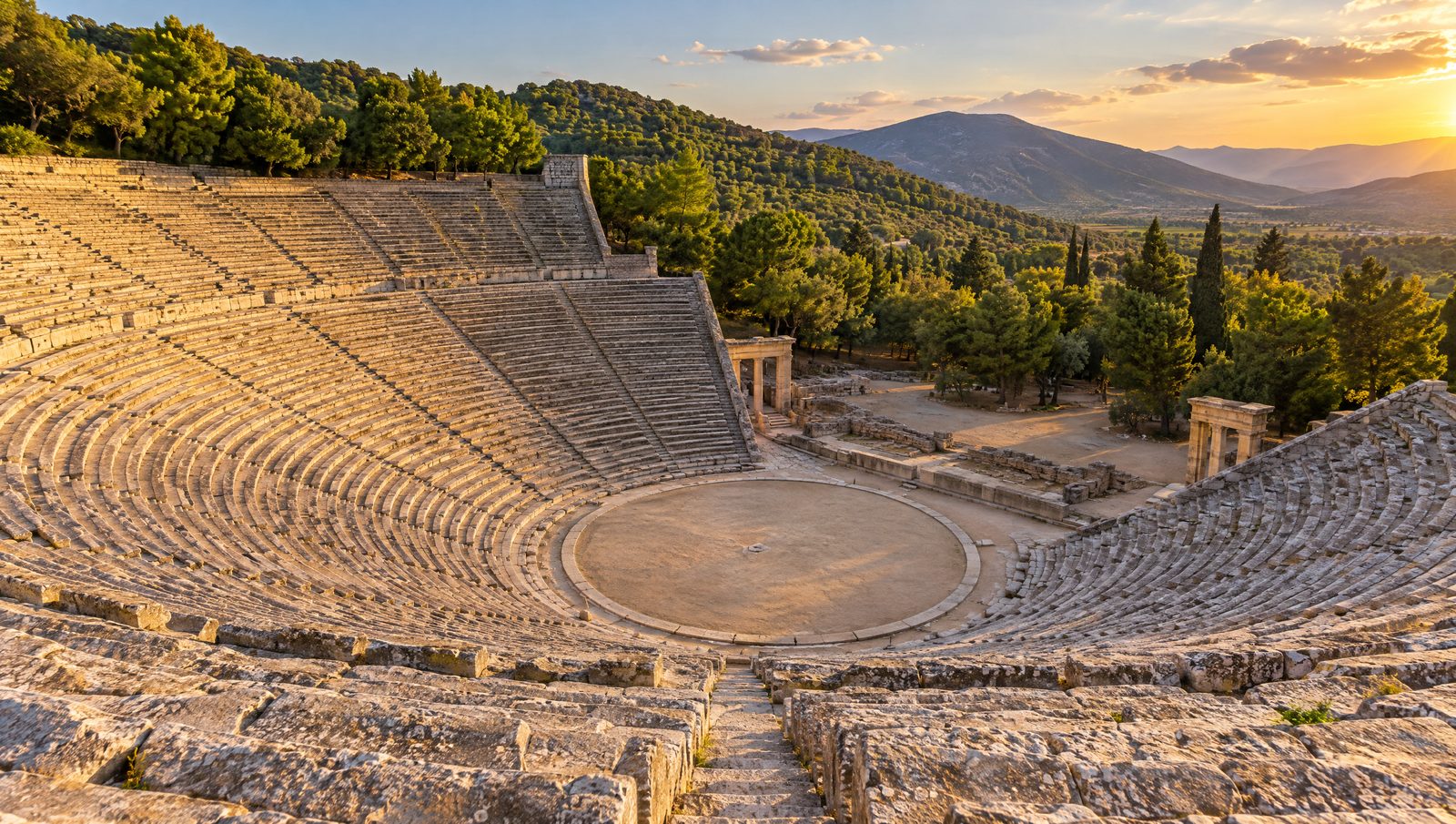
The theatre at Epidaurus in the Peloponnese, built in the fourth century BC within the sanctuary of Asclepius, is the finest in the Greek world: 55 rows of limestone seats in a perfect fan, with acoustics that carry a dropped coin from the circular orchestra to the top row. Ancient drama is still performed here on summer weekends during the Athens Epidaurus Festival, in Modern Greek with surtitles, and sitting on those stones at dusk while a chorus enters is as close as the era gets. Tickets sell out; book early, and combine it with Mycenae and Nafplio for a weekend.
Paestum, Italy
Greek Poseidonia, south of Salerno in Italy, keeps three Doric temples from the sixth and fifth centuries BC, standing nearly complete in a meadow by the sea. The so-called Temple of Neptune, from about 460 BC, is the best-preserved Doric temple on earth after the Hephaisteion in Athens. The site museum holds the Tomb of the Diver, painted about 470 BC, the only Greek wall painting of the classical period to survive with its figures intact: a symposium on the walls, and on the lid a young man diving into water. Spring, when the meadow is in flower, is the season; the site is quiet compared with Pompeii an hour north.
Priene, Türkiye
On the Aegean coast of Türkiye south of Ephesus, Priene is a fourth-century BC Greek city laid out on a Hippodamian grid on a terrace beneath a cliff. Alexander the Great paid for its Temple of Athena, and the dedication inscription naming him is now in the British Museum in London. The small theatre keeps its front-row stone armchairs and the council chamber its tiered seats. Because it was abandoned early and never built over, the plan of an ordinary classical city, houses and all, is clearer here than anywhere in Greece. Combine it with Miletus and Didyma in a day from Kuşadası or Selçuk, and go in spring or autumn, when the climb is pleasant.
The Cyprus Museum, Nicosia
Cyprus was Greek-speaking in this period but wrote its Greek in a syllabary of its own, a script inherited from the Bronze Age that lasted until the third century BC, and the island’s city-kingdoms paid tribute to Persia while sending kings like Evagoras of Salamis to fight for the Greek cause. The Cyprus Museum in Nicosia, the island’s archaeological museum, holds syllabic inscriptions, terracotta votive figures and the limestone sculpture that mixes Greek, Phoenician and Egyptian styles. The Phoenician temple precinct at Kition, in Larnaca, is twenty minutes from the airport. Allow a half day, and check seasonal hours.
Go deeper
- Herodotus, The Histories, translated by Tom Holland (Penguin Classics) — a lively modern version with notes by Paul Cartledge; Aubrey de Sélincourt’s older Penguin translation remains in print and is excellent.
- Thucydides, History of the Peloponnesian War, translated by Rex Warner (Penguin Classics) — includes the Funeral Oration, the plague and the Sicilian expedition.
- Plato, The Last Days of Socrates, translated by Hugh Tredennick and Harold Tarrant (Penguin Classics) — the Euthyphro, Apology, Crito and Phaedo in one volume.
- Reading Greek (Joint Association of Classical Teachers, Cambridge University Press) — the standard adult beginners’ course, teaching Attic through continuous adapted texts; Athenaze by Maurice Balme and Gilbert Lawall is the main alternative.
- The Perseus Digital Library (Tufts University) — free Greek texts of Herodotus, Thucydides, Plato and the dramatists with a dictionary a click away; the Loeb Classical Library has the same authors with facing English.
Frequently asked questions
Is Ancient Greek hard to learn?
Harder than Latin, mostly because of the verb, which has more tenses, moods and voices and a long list of irregular forms that simply have to be learned. The alphabet is the easy part; most people are reading it fluently within a week. The reward is that the rules are consistent, the vocabulary feeds directly into English scientific and medical words, and the texts waiting at the end are Homer, Plato and the tragedians. Most adult learners with a few hours a week can read adapted Attic within six months and real prose with a commentary in a year or two.
How accurate is the reconstructed pronunciation?
The consonants and the vowel system are secure; the evidence from grammarians, transcriptions, metre and comedy agrees. The pitch accent is the uncertain part. Scholars know it existed and roughly how large the rise was, but how it combined with phrase intonation, how fast people spoke, and how formal and casual speech differed are all lost. Any spoken reconstruction is a careful hypothesis, and anyone who tells you they know how Pericles sounded is overselling.
What modern languages descend from it?
Modern Greek, directly. It is the same language after 2,500 years of change, and a Greek speaker today can make out a good deal of a classical inscription, though the sounds have shifted a lot and the grammar has simplified. Nothing else descends from Greek, but it has lent words to every European language: democracy, theatre, philosophy, biology and thousands more. Learning Attic also unlocks the Koine of the New Testament and the Greek of Byzantium with relatively little extra effort.
Can I read the original texts after a few months?
Xenophon and the simpler Platonic dialogues, yes, with a dictionary and patience. Herodotus is readable early because his Ionic dialect is regular and his stories pull you along. Thucydides is famously difficult even for specialists, and the choral odes of tragedy are the hardest Greek there is. Inscriptions are short and formulaic, and reading one on an actual stone at Delphi is a pleasure available within the first year.
What is the best first trip for this era?
Athens plus the Peloponnese, in ten days, in May or late September. Three days for the Acropolis, Agora, Kerameikos and the National Archaeological Museum, then a hire car for Delphi, and south across the Corinth canal to Epidaurus, Mycenae and Olympia. If the Athens Epidaurus Festival is on, build the trip around a performance night. A second trip belongs to Sicily and southern Italy, or the Ionian coast of Türkiye.