
The world at the time
In June 793 ships from the north landed on the holy island of Lindisfarne off Northumbria, killed the monks who did not flee, and sailed away with the church silver. Historians have used the raid ever since as the opening of the Viking Age. The three centuries that follow are the period of Old Norse: the language of the raiders, but also of the farmers who settled Iceland, the merchants who traded on the Volga, the poets who composed for kings, and the men and women who carved runestones to their dead.
Scandinavia at the start of the period had no states, only chieftains, local kings and assemblies. Raiding paid for by the plunder of monasteries soon turned to conquest: the Great Heathen Army landed in England in 865 and took York, East Anglia and much of Mercia, and only Alfred of Wessex held out, agreeing a border with the Danish leader Guthrum in the 880s. In 911 the Frankish king granted the Seine estuary to a Norse chief named Rollo, and Normandy was born. Swedes travelled east along the rivers of what is now Russia and Ukraine to Constantinople and the Caliphate; the hundreds of thousands of Arabic silver coins dug up in Sweden show how well it paid.
Westward, the Norse crossed open ocean. Iceland was settled from about 870, the traditional first settler being Ingólfr Arnarson, and in 930 its chieftains established a national assembly, the Althing, at Þingvellir. Around 985 Erik the Red led colonists to Greenland, and around the year 1000 his son Leif sailed on to a land of grapes and timber he called Vinland. At home, kingdoms were forming. Harald Bluetooth, around 965, raised a stone at Jelling announcing that he had won all Denmark and Norway and made the Danes Christian. Olaf Tryggvason forced the new faith on Norway and died at sea at the Battle of Svolder in 1000; Olaf Haraldsson, killed at Stiklestad in 1030, became Norway’s patron saint within a year. Cnut of Denmark ruled England from 1016 and for a time Norway too.
The period ends where it began, in England. In September 1066 Harald Hardrada of Norway, a veteran of the Byzantine emperor’s guard, landed in Yorkshire and was killed at Stamford Bridge. Three weeks later the English king who beat him lost at Hastings to the Normans, Norsemen who had become French. Scandinavia by then had bishops, towns, coinage and dynasties, and the raiding age was over.
Most Norse people were farmers who never raided anything. They lived in longhouses of turf, timber or stone, a single hall with a central hearth shared with animals in winter, on farms that raised cattle, sheep and barley and fished and hunted to fill the gaps. Society had three broad layers: thralls, who were enslaved, free farmers who owned land and carried weapons, and jarls and kings. Free men settled disputes at the local assembly, the thing, by law and oath rather than by a judge, and a woman ran the household and carried its keys, could own property and divorce. Trade concentrated in a few towns: Hedeby in Denmark, Birka in Sweden, Kaupang in Norway, Ribe, where furs, walrus ivory, slaves and amber went out and silver, wine, glass and silk came in.
The old religion had no scriptures and no priesthood. Odin, Thor and Freyr were honoured at seasonal sacrifices called blót, in halls and at sacred places, and Adam of Bremen, writing in the 1070s, described a temple at Uppsala with gold images and bodies hanging in a sacred grove, though no one has found it. Thor’s hammer was worn as an amulet, increasingly in answer to the cross. Conversion came through kings, and in Iceland by vote at the Althing. What we know of the myths was written down in Iceland two centuries later, by Christians who still valued the poetry.
The stories they told
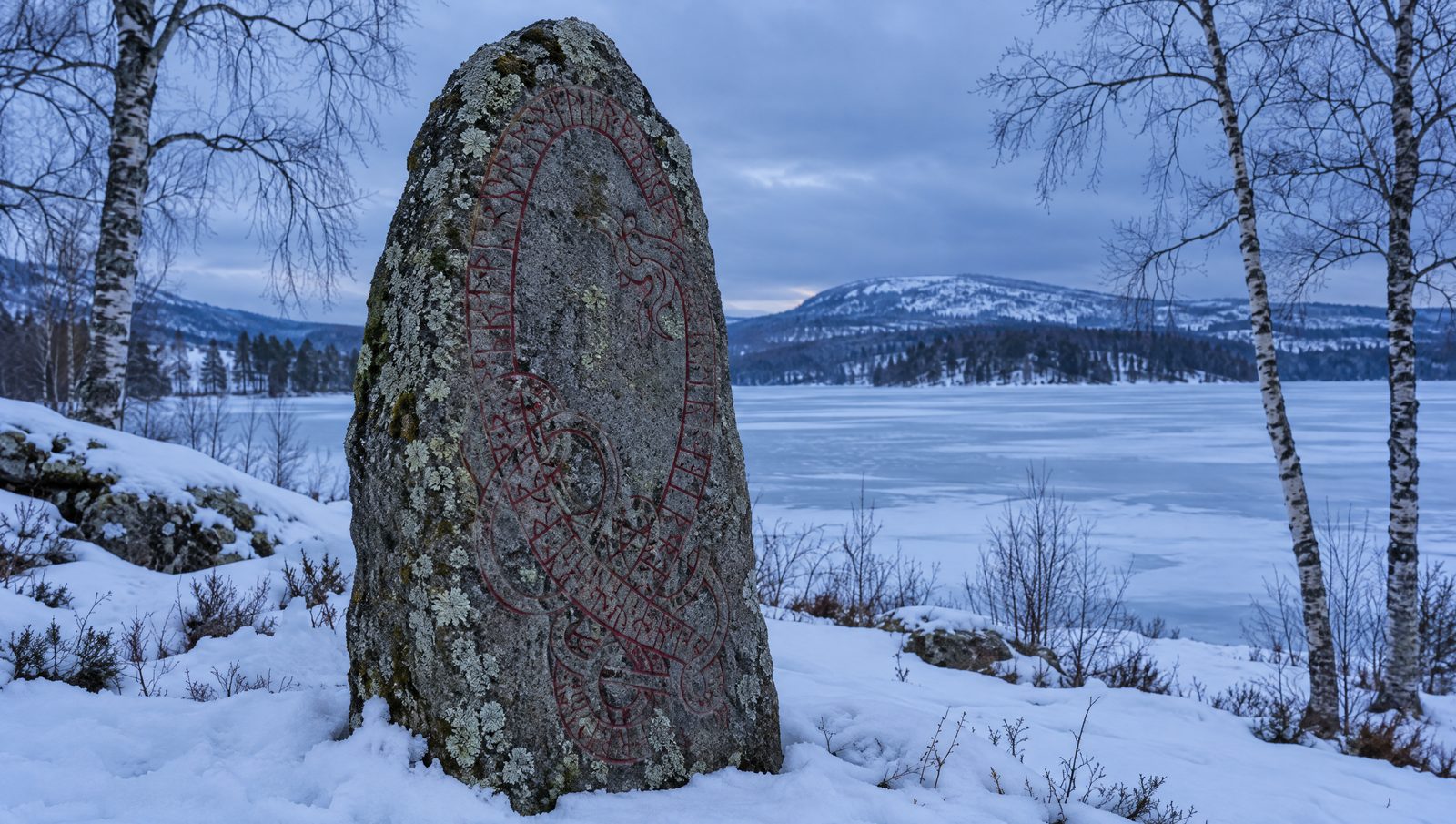
Ragnarök, the doom of the gods
The fullest account of the end of the world is the poem Völuspá, “The Prophecy of the Seeress,” preserved in the Codex Regius manuscript written in Iceland around 1270 but composed, most scholars think, around the year 1000, when the old faith was dying. A seeress raised by Odin tells him what she knows. First the beginning: the void, the giant Ymir, the world made from his body, the first humans carved from driftwood. Then the signs. Brothers will kill brothers; it will be an axe-age, a sword-age, a wind-age, a wolf-age. The wolf Fenrir breaks his chain, the Midgard serpent rises from the sea, the ship Naglfar sails free, and Heimdall blows his horn. On the plain of Vígríðr Odin is swallowed by the wolf and avenged by his son Vidar; Thor kills the serpent and staggers nine steps before its venom kills him; Freyr falls to the fire-giant Surt, whose flames consume the world. Then, in the poem’s last verses, the earth rises green from the sea, the surviving gods find the golden game-pieces in the grass, and a hall roofed with gold stands at Gimlé. Snorri Sturluson retold all this in prose in the Prose Edda around 1220, which is how most readers meet it.
Leif Eriksson sails to Vinland
Two Icelandic sagas, the Saga of the Greenlanders and the Saga of Erik the Red, written down in the thirteenth century from older tradition, describe voyages west from Greenland around 1000. They disagree in detail but agree in outline. A merchant blown off course sees a wooded coast; Leif, son of Erik the Red, buys his ship and goes to find it, naming three lands in turn: Helluland, a place of flat stones, Markland, a forest, and Vinland, where wild grapes grew and the rivers were full of salmon. His party builds houses and winters there. Later expeditions, under his brothers and then the trader Thorfinn Karlsefni with his wife Gudrid, try to settle, trade red cloth for furs with people the Norse called skrælingar, fight them, and give up. Gudrid’s son Snorri, born in Vinland, is the first European child known to have been born in the Americas. For centuries the sagas were treated as legend. Then in 1960 Helge and Anne Stine Ingstad found the turf-walled remains of a Norse camp at L’Anse aux Meadows on the northern tip of Newfoundland, with iron rivets, a bronze cloak-pin and a spindle whorl that proved women had been there.
Egill buys back his head
Egil’s Saga, probably written by Snorri Sturluson in the 1220s about his own ancestor, follows the most difficult man in Norse literature: Egill Skallagrímsson, a farmer’s son from western Iceland, ugly, violent, greedy and the finest poet of his age. He kills his first man at seven. He feuds for decades with the Norwegian king Eric Bloodaxe and his queen Gunnhild, killing their son and raising a pole with a horse’s head on it to curse them out of Norway. Then, around 948, he is shipwrecked on the Humber and finds that Eric is now king in York. He rides straight to the king’s hall, where his friend Arinbjörn advises him that his only chance is to spend the night composing a praise-poem. Egill does, twenty stanzas in a new metre with end-rhyme borrowed from English verse, and recites it before the king in the morning. Eric gives him his head, which is why the poem is called Höfuðlausn, “Head-Ransom.” Later in life, after two sons die, Egill lies down to starve until his daughter tricks him into composing instead, and Sonatorrek, his lament for his sons, is the most personal poem to survive from the Viking Age. He dies old and blind.
Iceland votes for Christ
Ari Þorgilsson’s Íslendingabók, “The Book of the Icelanders,” written in the 1120s from the testimony of men who had known the participants, records the strangest conversion in medieval Europe. By the year 1000 Iceland was split: a Christian party backed by the Norwegian king, and the heathen majority, each threatening to declare the other outside the law, which would have meant civil war. At the Althing the Christians asked the heathen law-speaker Þorgeir of Ljósavatn to decide for everyone. He went to his booth and lay down under his cloak for a day and a night, saying nothing. Then he rose and spoke from the Law Rock: if the law was torn in two, peace was torn too, and so there must be one law and one faith. All Icelanders would be baptised. Heathens could still sacrifice in private, expose unwanted infants and eat horsemeat, and these concessions were quietly abolished within a few years. Þorgeir went home and, later tradition says, threw his idols into a waterfall, now called Goðafoss, the falls of the gods.
How the language sounded
Old Norse was written in two scripts. During the Viking Age itself the only one in use was the runic alphabet, the Younger Futhark of sixteen characters, cut into stone, wood, bone and metal with a knife, which is why the letters are made of straight strokes. Sweden alone has well over two thousand runestones, most of them from the eleventh century, raised in memory of the dead and often recording where they died: in England, in Greece, in Serkland, the land of the Saracens. Sixteen runes for a language with more than thirty sounds meant one rune did several jobs, so runic spelling is a puzzle solved from context. The Latin alphabet arrived with Christianity, and the poems and sagas in this guide were written in it on vellum in Iceland from the twelfth century onward, in a standardised spelling that modern editions tidy further.
What reached the page is the language of Iceland and Norway, called West Norse; Danish and Swedish speakers used an East Norse that differed in small ways. The main features of the sound are not in doubt.
- Two th sounds. The letter þ (thorn) was the th of “thin” and ð (eth) the th of “this”. Both survive in Icelandic, which kept them when English let them go.
- Vowel length was meaningful. An accent marks a long vowel: á is “ah” held long, ó a long “oh”, ú “oo”. The letter ǫ was a rounded open o like the vowel in “law”, and y and ý sounded like German ü.
- Diphthongs were clear: ei as in “day”, au as in “house”, ey roughly “ay” with rounded lips. Leifr was “LAY-vr”, not “Leaf”.
- The ending -r was pronounced. Óðinn, Þórr, Leifr, Haraldr: the final r, often a syllable on its own, is a grammatical ending that the modern languages have lost or turned into -ur.
- Initial h was said before l, n, r and v. Hvat, “what”, began with a breathy “khw”; hringr, “ring”, with “hr”. Stress always fell on the first syllable.
- Between vowels, g and f softened: g to the fricative heard in Dutch, f to v, so Hávamál is “HOW-va-mowl”.
The evidence is good. Around 1150 an anonymous Icelander wrote the First Grammatical Treatise, an analysis of his own language’s sounds so precise that it distinguishes vowels by minimal pairs; linguists still cite it. Skaldic poetry depends on alliteration and internal rhyme, which fix which sounds matched. Runic spellings show what carvers heard. Old Norse words borrowed into Old English, Irish, Russian and Finnish preserve sounds as foreigners caught them. And Icelandic and Faroese are conservative descendants against which everything can be checked.
What is less certain is intonation. Norwegian and Swedish today have a pitch accent that distinguishes words, and whether Viking Age speech had it, or something like it, is debated. Regional accents are mostly lost, and the pronunciation given in textbooks is essentially that of thirteenth-century Iceland, two hundred years after the last raid, read back onto the earlier period.
| Original | Say it | Meaning |
|---|---|---|
| Heill ok sæll / Heil ok sæl | HAYL ok SEHL / HAYL ok SEHL | Hello, be well (to a man / to a woman) |
| Far vel | far VEL | Farewell |
| Þǫkk fyrir | THAWK FIR-ir | Thank you |
| Hvat heitir þú? | KHWAT HAY-tir thoo | What is your name? |
| Ek heiti Leifr | ek HAY-ti LAY-vr | My name is Leif |
| Hvar er skipit? | KHWAR er SKIP-it | Where is the ship? |
| Já / Nei | yow / nay | Yes / No |
| Ek skil eigi | ek skil AY-yi | I don’t understand |
In runes, the name of the thunder god was cut as ᚦᚢᚱ, þur, three strokes of the Younger Futhark standing for the five letters of Þórr; it appears on amulets and runestones asking the god to hallow the dead.
Deyr fé, deyja frændr,
deyr sjalfr it sama;
en orðstírr deyr aldregi
hveim er sér góðan getr.Cattle die, kinsmen die, you yourself will die the same; but the fame of the one who earns a good name never dies.
Hávamál, stanza 76, Codex Regius
Hávamál, “The Sayings of the High One,” is a collection of advice attributed to Odin and preserved in the same manuscript as Völuspá. This stanza and the near-identical one that follows it are the most quoted lines in Old Norse. Said aloud they come out roughly “dayr fyeh, DAY-ya FRAIN-dr, dayr SYALVR it SAH-ma; en ORTH-steer dayr AL-dreh-yi, khwaym er syer GOH-than GEH-tr.” The form is ljóðaháttr, a metre of paired short lines bound by alliteration: deyr, deyja; sjalfr, sama. The word orðstírr is literally “word-glory,” reputation as it lives in other people’s speech. For a culture without writing, this was the only immortality on offer, and the verse says so plainly.
Maya reads these aloud in a reconstructed Old Norse pronunciation, honestly labelled as a reconstruction, in a free Old Norse session of fifteen minutes by phone.
Where to stand today
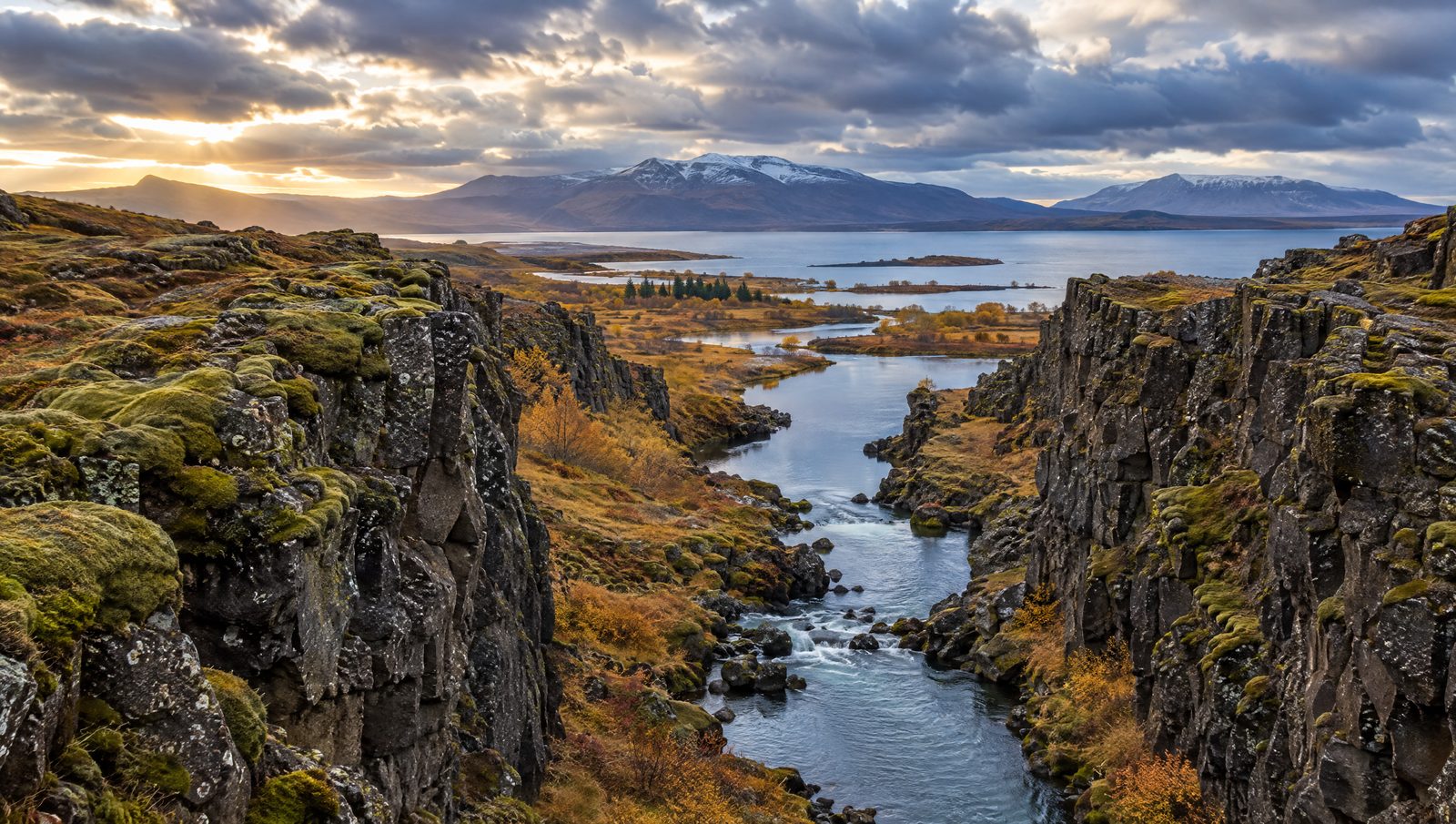
Þingvellir, Iceland
Forty-five minutes from Reykjavík, the rift valley where the Althing met from 930 is the single most evocative Norse site anywhere in Iceland: a plain of lava and birch between the walls of the Almannagjá fault, where the Law Rock stood and Þorgeir spoke in 1000. The assembly met here every summer until 1798. The site is a national park, free to enter apart from parking, and sits on the standard Golden Circle route, so it fills by mid-morning; come in the evening in summer, when the light stays until midnight and the coaches have gone, or on a clear winter day.
The Settlement Exhibition and National Museum, Reykjavík
Beneath a hotel on Aðalstræti in Reykjavík, the Settlement Exhibition preserves in place the walls of a longhouse built shortly after a datable layer of volcanic ash fell in 871, give or take two years, which is to say in the first generation of settlement; the hall around it explains how people lived in it. A short walk away, the National Museum of Iceland holds the Þór figurine from Eyrarland, a small bronze seated god gripping his hammer, and the medieval saga manuscripts are shown at the Edda building of the Árni Magnússon Institute. Both museums are included on the Reykjavík City Card.
Jelling, Denmark
In the small Jutland town of Jelling, in Denmark, two huge burial mounds flank a white church, and between them stand the two Jelling runestones. The smaller was raised by King Gorm to his wife Thyra; the larger, around 965, by their son Harald Bluetooth, who declares that he won Denmark and Norway and made the Danes Christian, beneath the oldest image of Christ in Scandinavia. It is often called Denmark’s birth certificate. The stones are now under glass cases to protect them from frost. The visitor centre, Kongernes Jelling, is part of the National Museum of Denmark at natmus.dk, free to enter, and the site is an easy stop between Aarhus and Legoland at Billund.
The Viking Ship Museum, Roskilde
Half an hour by train from Copenhagen, Roskilde’s Viking Ship Museum displays five ships deliberately sunk around 1070 to block the fjord, raised in 1962 and conserved: two warships, two cargo vessels and a fishing boat, their surviving timbers mounted on steel frames so you can read each hull. The longest, Skuldelev 2, was built of Irish oak near Dublin and carried about sixty warriors. In the boatyard outside, shipwrights build replicas with period tools, and from May to September visitors can row and sail one on the fjord. Check the museum’s site at vikingeskibsmuseet.dk for sailing times, which depend on weather.
Birka and Gamla Uppsala, Sweden
Birka, on the island of Björkö in Lake Mälaren, was Sweden‘s first town, a trading settlement from the 750s to the 970s ringed by some three thousand burial mounds; a museum and guided walks explain a site that is otherwise grass and stones. Boats run from central Stockholm in summer only, and the Swedish History Museum in the city holds the finds, including the grave goods of the warrior in grave Bj 581, shown by DNA in 2017 to have been a woman. North of Stockholm, the three royal mounds at Gamla Uppsala, raised in the sixth century beside the spot Adam of Bremen described as a pagan temple, are open all year with a good museum.
Oslo and the Viking ships
The Oseberg and Gokstad ships, buried around 834 and 900 with the finest Viking Age woodcarving in existence, belong to the University of Oslo, which closed the old Viking Ship Museum at Bygdøy in 2021 to build a much larger Museum of the Viking Age around them. Check whether it has opened before you plan around it; meanwhile the university’s Historical Museum in the city centre shows Viking Age weapons, jewellery and runestones.
L’Anse aux Meadows, Canada
At the tip of Newfoundland’s Great Northern Peninsula, a long drive from any airport, the grassed-over outlines of the Norse buildings sit by a bay where icebergs drift past in June. Parks Canada runs a visitor centre with the original finds and has built reconstructed turf halls with costumed interpreters. Recent tree-ring work on wood from the site, published in 2021, dated Norse activity precisely to the year 1021. The site opens only from June to early October; combine it with Gros Morne National Park on the way up.
Go deeper
- The Poetic Edda, translated by Carolyne Larrington (Oxford World’s Classics) — the complete mythological and heroic poems, including Völuspá and Hávamál, with clear notes.
- Snorri Sturluson, The Prose Edda, translated by Jesse Byock (Penguin Classics) — the medieval handbook of the myths, the source for most retellings of Ragnarök.
- The Sagas of Icelanders (Penguin Classics) — a one-volume selection from the complete Leifur Eiríksson edition, including Egil’s Saga and both Vinland sagas.
- Neil Price, Children of Ash and Elm: A History of the Vikings — the best recent single-volume history, by an archaeologist, strong on belief, daily life and what the graves actually show.
- Jesse Byock, Viking Language 1: Learn Old Norse, Runes, and Icelandic Sagas — the standard self-study course, with readings from the sagas from the first lessons and a chapter on the runes.
Frequently asked questions
Is Old Norse hard to learn?
For an English speaker it is one of the more approachable old languages. It is Germanic, so the basic vocabulary feels familiar and the hundreds of Norse words in English, from “egg” and “sky” to “they” and “window,” help. The grammar has four cases and strong and weak verbs, like German, which takes a few months to settle. Saga prose is plain and direct, so the reward comes early. Anyone who knows Icelandic has a head start that amounts to most of the journey.
How accurate is the reconstructed pronunciation?
The consonants and the vowel system are well established thanks to the First Grammatical Treatise, runic spellings, poetic metre and the modern descendants. The honest caveat is that this is the Icelandic of around 1200, the period of the manuscripts, projected back onto the Viking Age; speech in ninth-century Denmark would have differed in ways we can only partly reconstruct. Intonation and rhythm are educated guesses.
What modern languages descend from it?
Icelandic and Faroese are its most conservative descendants; an Icelander can read a saga in the original with little more difficulty than an English speaker reads Shakespeare. Norwegian, Danish and Swedish descend from it too, but have changed far more. Norn, spoken in Orkney and Shetland until the eighteenth century, is extinct. English is not a descendant but absorbed a great deal of Norse in the Danelaw, including the pronoun “they” and the verb “are”.
Can I read the original texts after a few months?
Saga prose, yes, with a glossary; the sentences are short and the vocabulary repeats. Eddic poetry is harder but manageable with a facing translation. Skaldic verse, the court poetry with its interlocking rhymes and riddling compounds called kennings, is among the most difficult poetry in any language and is read with a commentary even by specialists. Runestones are formulaic and, once you know the sixteen runes and the standard phrases, oddly readable.
What is the best first trip for this era?
Iceland in June, when the days do not end: three nights in Reykjavík for the Settlement Exhibition and National Museum, Þingvellir in the evening light, then the west and north, Borgarfjörður for Egill’s country, Snæfellsnes, and Goðafoss on the ring road if time allows. For a second trip, Denmark fits into a long weekend from Copenhagen: Roskilde by train, then a hire car to Jelling and the reconstructed Viking centre at Ribe.