
The world at the time
Around 500 BC the Ganges plain was filling with cities again for the first time since the Indus civilisation. Sixteen states, the mahājanapadas, competed for the river trade: among them Kosala with its capital at Sāvatthī, Magadha ruled from the hill-ringed fortress of Rājagaha, the Vajji confederacy governed by assembly at Vesālī, and the small Sakya republic in the Himalayan foothills whose chief’s son, Siddhattha Gotama, left home to become a wandering ascetic. Punch-marked silver coins, baked brick and iron ploughs mark the period; so does a new kind of person, the samaṇa, who gave up house and caste to seek liberation and lived on what householders put in his bowl.
The Buddha was one of many such teachers. Mahāvīra, the founder of Jainism as we know it, was a near contemporary; so were the fatalist Makkhali Gosāla and the materialist Ajita Kesakambalī, whom the Pali texts argue against by name. Bimbisāra of Magadha and his son Ajātasattu, who had him killed and then came to the Buddha to confess, and Pasenadi of Kosala, appear in the suttas as real, flawed men worried about war, succession and digestion. The Buddha’s death, which the tradition dates to 543 or 483 BC, is now placed by most historians around 400 BC. The texts say his followers met at Rājagaha the following rainy season to recite what they remembered, and again at Vesālī about a century later to settle disputes about monastic discipline.
The community they built, the saṅgha, was unusual. Monks and, after some resistance, nuns, lived under a detailed code, moved from place to place for eight months of the year and settled for the rains, which is why monasteries began as donated parks: the Bamboo Grove at Rājagaha, given by Bimbisāra, and Jeta’s Grove at Sāvatthī, bought by the banker Anāthapiṇḍika, where the Buddha is said to have spent more rains retreats than anywhere else. Lay people earned merit by feeding them, and the arrangement carried monks and merchants together along the trade roads to Takkasilā and the Deccan.
In 326 BC Alexander of Macedon reached the Punjab and turned back. Within a few years a young adventurer named Candragupta had seized Magadha and founded the Maurya dynasty, ruling from Pāṭaliputta on the Ganges; the Greek ambassador Megasthenes described its wooden walls and 570 towers around 300 BC. Candragupta’s grandson Asoka came to the throne about 268 BC, conquered Kaliṅga on the east coast around 261 in a war he later said killed a hundred thousand people, and turned to Buddhism. He is the first Indian ruler whose own words survive: edicts cut into rocks and polished pillars across the subcontinent, in local Prakrit dialects close to Pali, in Greek and Aramaic at Kandahar, telling his subjects to obey parents, spare animals, respect all sects and plant shade trees along the roads.
Asoka also sent missions. The Sri Lankan chronicles say his son, the monk Mahinda, arrived on the island around 250 BC, converted King Devānampiya Tissa on a hill at Mihintale, and founded the Mahāvihāra monastery at Anurādhapura; his daughter Saṅghamittā followed with a cutting of the tree under which the Buddha had awakened. The Theravāda school that grew there preserved the Pali canon and, in the first century BC, wrote it down for the first time on palm leaves at a cave monastery at Aluvihāra. The same tradition later spread to Burma, Thailand, Laos and Cambodia, which is why Pali is chanted today from Kandy to Phnom Penh.
What made the period distinct was the argument at its heart. The Vedic sacrifice assumed a permanent self and a cosmos kept in order by priests. The new teachers denied the first, ignored the second and taught in the languages people spoke rather than in Sanskrit. The Buddha’s own instruction, recorded in the Vinaya, was that monks should learn his teaching in their own dialect. Pali, the language of this guide, is the result: a Middle Indo-Aryan tongue, simpler in sound than Sanskrit, in which the earliest complete account of Buddhism survives.
The stories they told
The going forth
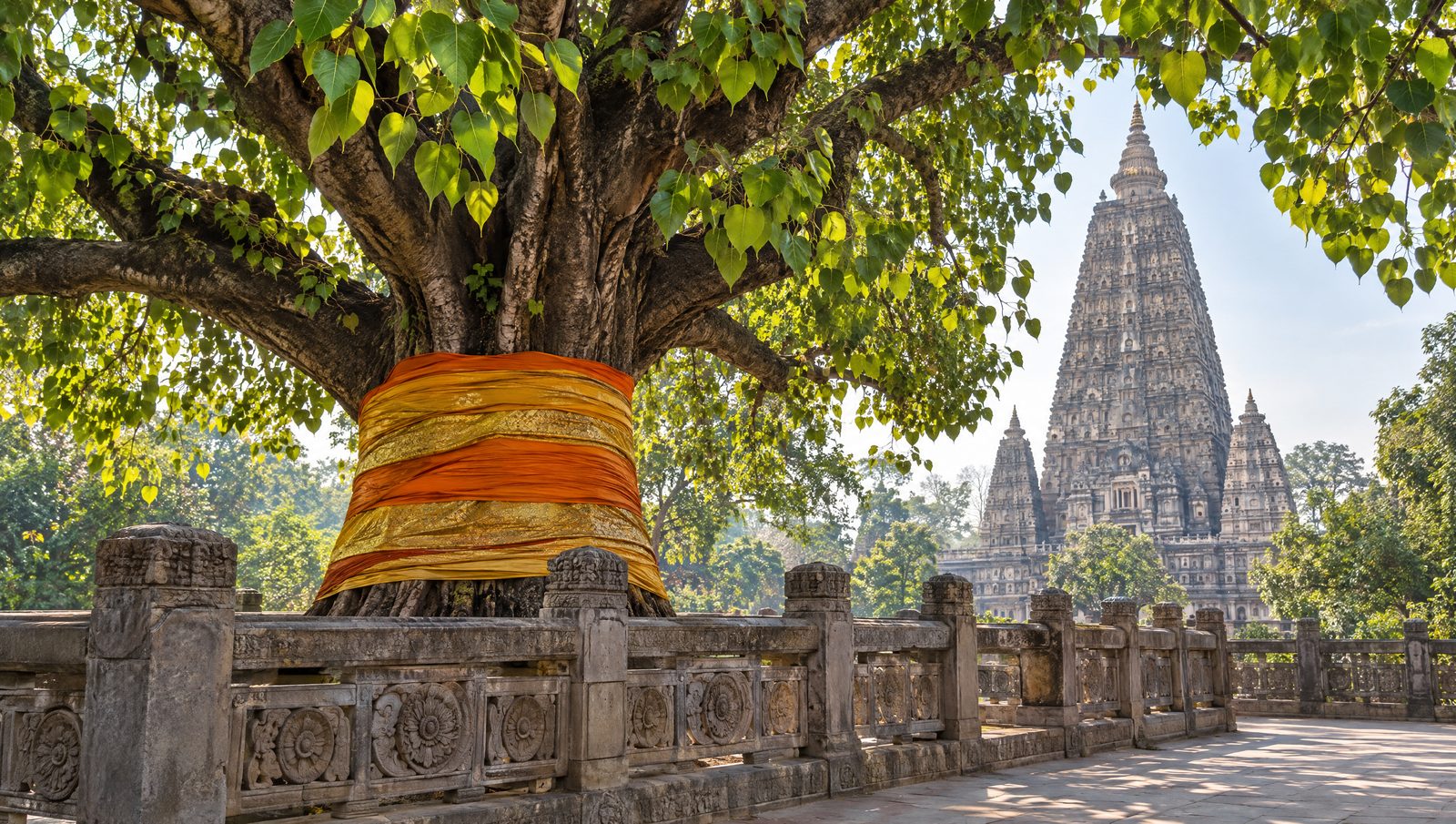
Everyone knows the version with the four sights: a prince sheltered from suffering sees an old man, a sick man, a corpse and a wandering ascetic on four chariot rides, and leaves his palace, wife and newborn son at night. That telling belongs to the later biographies, above all Aśvaghoṣa’s Sanskrit Buddhacarita of the second century AD and the Pali Nidānakathā. The Buddha’s own account in the Ariyapariyesanā Sutta (Majjhima Nikāya 26) is plainer and, in its way, more affecting. He was young, he says, black-haired, in the prime of life; his parents wept as he shaved his head and put on the yellow robe. He had asked himself why, being subject to ageing and death, he kept seeking things that were themselves subject to ageing and death. He studied under two meditation teachers, Āḷāra Kālāma and Uddaka Rāmaputta, mastered what they taught, found it did not lead to the end of suffering, and left. He tried near-fatal austerities for years, abandoned them, ate a proper meal, and sat down under a tree at Uruvelā, by the river Nerañjarā, in what he calls “a delightful stretch of ground”. The sutta spends one sentence on what happened there.
Kisāgotamī and the mustard seed
The story comes from the commentaries on the Dhammapada and the Therīgāthā, the collection of verses by early nuns, where Kisāgotamī’s own poem survives. She was a poor woman of Sāvatthī, thin, hence her nickname, married into a family that despised her until she bore a son. The boy died as soon as he could walk. Out of her mind with grief, she carried the body from house to house asking for medicine, and people said she was mad, until one kind man sent her to the Buddha. He told her he could help if she brought him a mustard seed from a house where no one had died. She went door to door. Everyone had mustard seed; everyone had lost someone, a child, a parent, a husband. By evening she understood, laid her son’s body in the charnel ground, and came back to be ordained. Her verses in the Therīgāthā speak of a woman who has seen her children eaten by jackals and her husband dead on the road, and end by saying that she has done what the Buddha taught.
Aṅgulimāla
The Aṅgulimāla Sutta (Majjhima Nikāya 86) tells of a bandit in the forests of Kosala who killed travellers and wore their fingers on a string around his neck, which is what his name means. The Buddha walked alone into his territory despite the warnings of cowherds and farmers. Aṅgulimāla ran after him with sword and shield and found that however fast he ran, the Buddha, walking at an ordinary pace, stayed out of reach. “Stop, ascetic!” he shouted. “I have stopped, Aṅgulimāla,” the Buddha answered. “You stop too.” The bandit threw his weapons into a pit and asked to be ordained. Soon afterwards King Pasenadi rode out with five hundred horsemen to deal with the murderer and found him sitting among the monks, shaven and robed; the king, astonished, offered to supply him with requisites instead. On almsround Aṅgulimāla was stoned by people who remembered, and the Buddha told him he was experiencing now what would otherwise have been lifetimes of hell. The verses of protection he spoke for a woman in difficult labour are still chanted in Theravāda countries for pregnant mothers.
The last journey
The Mahāparinibbāna Sutta (Dīgha Nikāya 16) is the longest text in the canon, and follows the Buddha, aged about eighty, on a final walk north from Rājagaha. At Vesālī he falls ill during the rains, recovers by will, and tells Ānanda that he will die in three months. At the house of Cunda the smith he eats a dish called sūkaramaddava, “pig’s delight”, whose meaning was already disputed in antiquity, becomes violently sick, and insists that Cunda be told his meal brought great merit. Between the twin sāl trees outside the small town of Kusinārā, which Ānanda thinks an unworthy place to die, he lies on his right side. The trees bloom out of season. He asks the monks three times whether anyone has a doubt or a question, and no one speaks. His last words are that all conditioned things decay and that they should strive on with diligence. Then he enters the meditative absorptions in sequence and dies. The Mallas of Kusinārā cremate him, and eight claimants divide the relics; the stūpas built over them are the beginning of Buddhist architecture.
How the language sounded
Pali has never had a script of its own. For the first three or four centuries the canon was carried entirely by memory, organised for recitation into groups by length and number, with refrains and formulas that make a sutta easy to hold in the head. When it was written down in Sri Lanka it was in the local script, and ever since each Theravāda country has written the same words in its own alphabet: Sinhala, Burmese, Khmer, Thai, Lao, and in India and the West the Roman alphabet with diacritics, standardised by the Pali Text Society after its foundation in 1881. A Thai monk and a Sri Lankan monk read different letters and chant the same text; the transliteration here is the Roman standard.
Pali is a Middle Indo-Aryan language, a daughter of the kind of speech that stood behind Vedic Sanskrit, and its sound system is Sanskrit’s made easier.
- Consonant clusters were smoothed out. Sanskrit dharma became dhamma, nirvāṇa became nibbāna, sūtra became sutta. The doubled consonants are held long, as in Italian mamma.
- Aspiration is a separate sound. Buddha has a long d and a breathy dh; Bhikkhu, monk, begins with a breathy bh and has a held, breathy kkh in the middle. The h after a consonant is never silent.
- Retroflex consonants (ṭ, ḍ, ṇ, ḷ) are made with the tongue curled back, as in Sanskrit and modern Indian languages.
- Vowel length is meaningful and is the only guide to stress. a is the u of “but”, ā the a of “father”; e and o are always long except before a doubled consonant.
- The sibilants merged. Sanskrit’s three s-sounds became one plain s, so śramaṇa is samaṇa.
- ṃ, the niggahīta, is a nasal hum at the end of a syllable, roughly the ng of “sing” without releasing the g: saraṇaṃ, evaṃ.
How do we know? Pali sits between two well-described stages. Behind it is Sanskrit, whose sounds Indian phoneticians catalogued in the first millennium BC; in front of it are the modern Indo-Aryan languages and the Prakrit inscriptions of Asoka, which show the same cluster simplifications in writing within a century or two of the Buddha. Pali’s own grammarians, beginning with Kaccāyana in roughly the sixth or seventh century AD, describe the language in Pāṇini’s terms. The metres of the verse texts fix syllable lengths. And the chanting traditions, though they have drifted in different directions, preserve the system in outline.
The uncertainties are of two kinds. First, Pali is not exactly the Buddha’s own dialect: it is a literary language with features from western India mixed with the eastern Māgadhī he probably spoke, and the chronicles’ claim that it was the language of Magadha is not accepted by linguists. Second, the living pronunciations differ. Thai monks chant v as w and give final syllables a tonal lift; Burmese softens the consonants; Sri Lankan recitation is closest to the written standard. No one knows what a Vesālī monk of 400 BC sounded like. What follows is the reconstructed standard that scholars teach.
| Original | Say it | Meaning |
|---|---|---|
| Namo Buddhāya | NUH-moh bood-DHAH-yuh | Homage to the Buddha (a greeting between Buddhists) |
| Sādhu | SAH-dhoo | Well said / good (the response to a teaching, said three times) |
| Sukhī hotu | soo-KHEE HOH-too | May you be happy (a blessing) |
| Bhante | BHUN-tay | Venerable sir (addressing a monk) |
| Āma, bhante / Na | AH-muh BHUN-tay / nuh | Yes, sir / No |
| Buddhaṃ saraṇaṃ gacchāmi | BOOD-dhung SUH-ruh-nung guhch-CHAH-mi | I go to the Buddha for refuge |
| Evaṃ me sutaṃ | AY-vung may SOO-tung | Thus have I heard (the opening of every sutta) |
| Anumodāmi | uh-noo-moh-DAH-mi | I rejoice in your merit (the monastic “thank you”) |
Handa dāni, bhikkhave, āmantayāmi vo: vayadhammā saṅkhārā, appamādena sampādethā ti.
Now, monks, I declare to you: all conditioned things are subject to decay. Strive on with diligence.
Mahāparinibbāna Sutta, Dīgha Nikāya 16, the Buddha’s last words
Eleven words, and the whole teaching is in them. Saṅkhārā, “conditioned things” or “constructions”, is everything that comes into being through causes, which for the Buddha meant everything, the listener included. Vayadhammā says that their nature is to pass away. Appamādena, “with diligence” or “without heedlessness”, is the quality the Dhammapada calls the path to the deathless, and it is the last thing he asked of anyone. The sentence is prose, and its rhythm is that of speech: short clauses, a direct address, a verb at the end. Read aloud, remember that every consonant is sounded, that bhikkhave has two aspirates and a held kk, and that the final -ti is simply a closing quotation mark, pronounced.
Maya reads these aloud in a reconstructed scholarly Pali pronunciation, honestly labelled as a reconstruction and distinguished from the Thai, Burmese and Sinhala chanting styles, in a free Pali session of fifteen minutes by phone.
Where to stand today
Lumbini, Nepal
The Buddha’s birthplace in the Terai of southern Nepal is one of the few sites in this guide with a dated ancient witness: a sandstone pillar that Asoka set up in 249 BC, whose inscription says he came here in person because “the Buddha Sakyamuni was born here” and reduced the village’s taxes. The pillar still stands beside the Maya Devi temple, which shelters excavated brick shrines going back to the third century BC and possibly earlier, and a sacred pool. Visit at dawn, before the tour buses from India arrive, and between October and March; Bhairahawa airport is a thirty-minute drive.
Bodh Gaya and Rajgir, Bihar
Uruvelā is now Bodh Gaya in India‘s Bihar state, and the Mahabodhi temple, a brick tower of the fifth or sixth century AD standing on Asokan foundations, marks the spot under the tree. The present pipal is a descendant, planted in the nineteenth century from the Anuradhapura line, which was itself grown from a cutting of the original. Pilgrims from a dozen countries circumambulate from before dawn, each chanting in their own style. Rajgir, two hours north, is the Buddha’s Rājagaha: the hills are the same, Vulture Peak where he taught is a short climb or a chairlift, and the hot springs still run. Carry small notes for offerings, remove shoes at the temple, and avoid the Indian summer.
Sarnath, Uttar Pradesh
Ten kilometres from Varanasi, the deer park at Isipatana is where the Buddha gave his first discourse to five former companions and “set the wheel of the Dhamma in motion”. The Dhamek stūpa, a cylinder of stone and brick 43 metres high, was enlarged in the sixth century AD over an older core; around it lie the brick footings of monasteries that functioned for 1,500 years. The stump of Asoka’s pillar is here, and its capital, four lions back to back on a drum carved with a wheel, is in the Sarnath museum next door. It is the emblem of the Indian republic, and seeing it at its real size, a little over two metres, is a shock. The museum closes on Fridays; the site is best in the late afternoon.
Sanchi, Madhya Pradesh
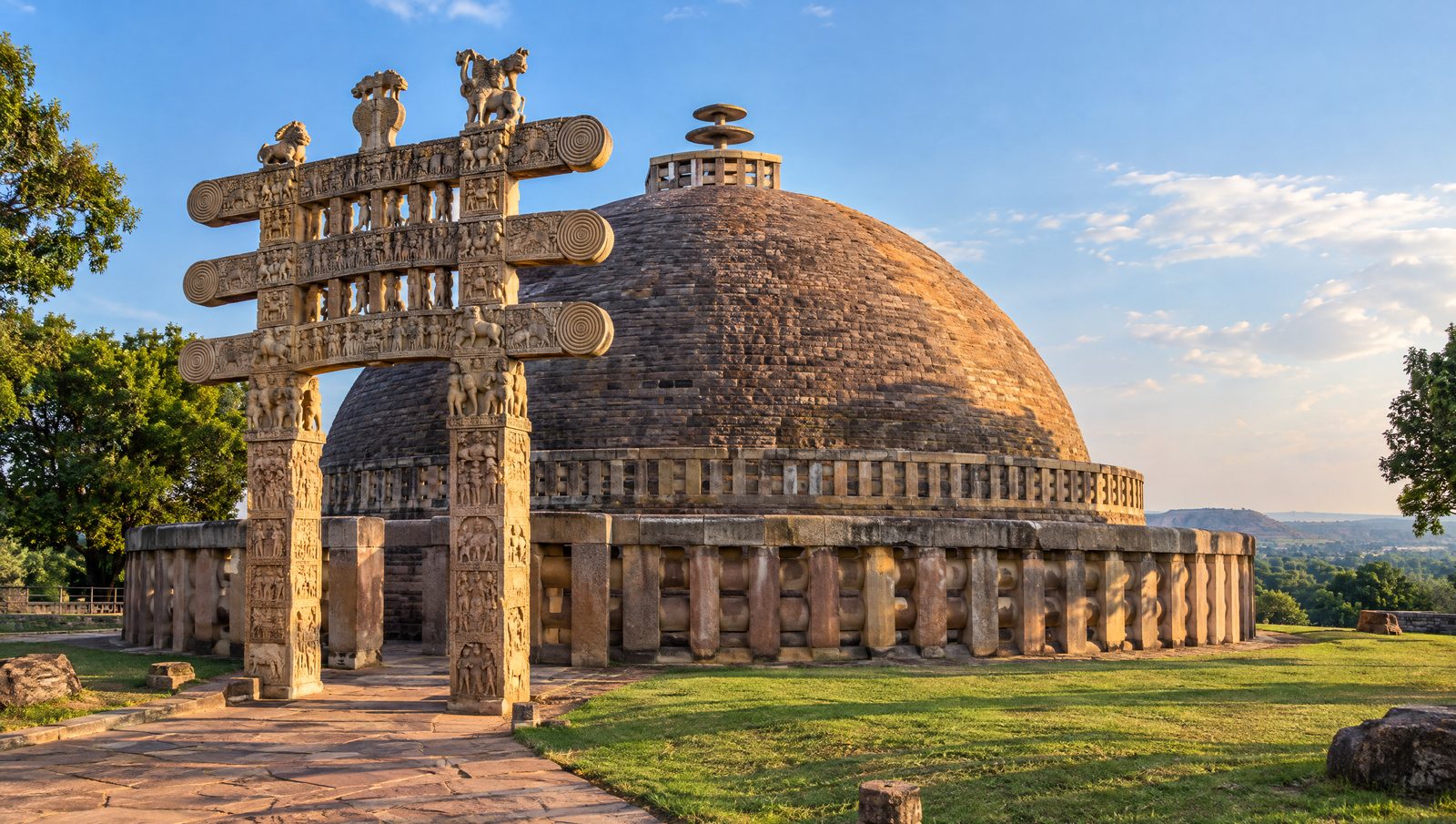
On a hilltop above the plain an hour from Bhopal, the Great Stūpa at Sanchi is the most complete early Buddhist monument in India. Asoka built the first brick mound here around 250 BC; it was encased in stone and doubled in size a century later, and the four carved gateways, with their crowded scenes from the Buddha’s lives in which he is shown only by a footprint, a tree or an empty seat, were added in the first century BC. The Buddha never came here; Sanchi mattered because the merchants of nearby Vidisā paid for it and had their names cut into the railings. The site opens at sunrise, which is when to walk the processional path, and the small museum holds Asoka’s lion capital from the site.
Anuradhapura and Mihintale, Sri Lanka
The capital where Pali was preserved lies in the dry north of Sri Lanka, four hours from Colombo. The Jaya Sri Maha Bodhi, the tree grown from Saṅghamittā’s cutting, has been tended continuously since the third century BC, which makes it the oldest tree in the world with a documented planting date. Around it stand the great brick stūpas, Thūpārāma, said to be the first on the island, Ruwanweliseya and the enormous Jetavana, and the ruins of the Mahāvihāra. Mihintale, twelve kilometres east, is the hill where Mahinda met the king; 1,840 steps lead to the summit. On the full moon of June, Poson, both sites fill with white-clad pilgrims. Go at first light, dress for a temple, and hire a bicycle for the ruins.
Aluvihara, Matale
Half an hour north of Kandy, a cluster of granite boulders above the road shelters the cave monastery where, according to the chronicles, five hundred monks wrote the Pali canon onto palm leaves in the first century BC, during a famine and war that threatened to kill off the reciters. The present cave shrines are later and brightly painted, and a small museum shows how ola leaves are prepared, incised with a stylus and rubbed with soot to bring up the letters; the monks will demonstrate for a donation. The library of manuscripts was burned by British troops in 1848. It is a short, steep stop on the Kandy to Dambulla road.
Bangkok and Nakhon Pathom, Thailand
Pali is a living liturgical language in Thailand, and Bangkok is the easiest place to hear it chanted daily. Evening chanting at Wat Pho, the temple of the reclining Buddha, or at Wat Bowonniwet, where Thai kings have been ordained, is open to anyone who sits quietly at the back; the words are the same suttas and protective verses in the Thai pronunciation described above. An hour west, Nakhon Pathom’s Phra Pathom Chedi, at 120 metres the tallest stūpa in the world, stands on the site Thai tradition identifies with the Asokan mission to Suvaṇṇabhūmi, the “land of gold”; the historical connection is unproven, but the earliest layers are genuinely ancient. Cover shoulders and knees, and go on a Buddhist holy day.
Shwedagon, Yangon
Burmese tradition holds that two merchant brothers brought eight hairs of the living Buddha to this hill, which would make the Shwedagon in Myanmar‘s largest city the oldest stūpa anywhere. Archaeology cannot confirm that, and the gilded structure you see dates mostly from the fifteenth century onward, but Burma has been the most scholarly of the Pali countries since the Pagan period, and its monks are the acknowledged masters of the Abhidhamma, the canon’s philosophical section. The platform at dusk, with families lighting candles and Pali recitation from every shrine, is as close as a traveller can come to the living texture of this guide. Check current travel advice before planning a visit.
Go deeper
- Bhikkhu Bodhi, In the Buddha’s Words: An Anthology of Discourses from the Pali Canon (Wisdom Publications) — the best single-volume selection, arranged by theme, by the leading modern translator of the Nikāyas.
- Sayings of the Buddha, translated by Rupert Gethin (Oxford World’s Classics) — new translations of key suttas including the Aṅgulimāla and Mahāparinibbāna; his The Foundations of Buddhism is the standard introduction.
- The Dhammapada, translated by Valerie Roebuck (Penguin Classics) — the 423 verses with notes and the stories from the commentary, including Kisāgotamī’s.
- Richard Gombrich, Theravada Buddhism: A Social History from Ancient Benares to Modern Colombo (Routledge) — how the religion of the suttas became the religion of Sri Lanka.
- SuttaCentral (suttacentral.net) — the entire canon online, free, in Pali with parallel translations and a click-through dictionary; the Pali Text Society’s editions and A. K. Warder’s Introduction to Pali are the standard print grammar and texts.
Frequently asked questions
Is Pali hard to learn?
Easier than Sanskrit, which it resembles, and easier than most ancient languages. The sound system is simpler, the grammar has shed many Sanskrit irregularities, and the texts are built from repeated formulas, so that vocabulary learned in one sutta carries into the next. The chief difficulties are the long compound words and the sheer number of near-synonyms for mental states. Readers with Sanskrit pick it up in weeks; others usually need six months to a year to read straightforward suttas with a dictionary.
How accurate is the reconstructed pronunciation?
The consonants and vowel lengths are secure, because they sit between Sanskrit, which is well described, and the modern languages. What is less certain is everything above the level of the individual sound: intonation, rhythm and regional colouring. The national chanting styles have each drifted, and the scholarly standard is a reasoned middle course rather than a recording of anyone. It is also worth remembering that the Buddha did not speak Pali exactly as we have it; the canon is a slightly later literary form of his kind of speech.
What modern languages descend from Pali?
None directly, in the way Italian descends from Latin: Pali was a literary and liturgical language rather than a mother tongue for most of its history. Its cousins, the Prakrits of ancient India, developed into Hindi, Bengali, Marathi, Sinhala and the other Indo-Aryan languages, and Sinhala in particular has borrowed heavily from Pali. Thai, Burmese, Khmer and Lao belong to unrelated families but have thousands of Pali loanwords, especially for religion, law and learning, much as English has Latin ones; the Thai word for “teacher”, ajahn, is Pali ācariya.
Can I read the original texts after a few months?
Yes, more easily than with most ancient languages, because the suttas repeat themselves. Once you know the formula for how a discourse opens, how the Buddha addresses the monks and how a teaching is summarised at the end, a surprising amount of each text is already familiar. The Dhammapada and the shorter suttas of the Majjhima Nikāya are the usual first readings; the Abhidhamma and the commentaries are for later.
What is the best first trip for this era?
The Buddhist circuit of north India and Nepal in the cool months: Bodh Gaya, Rajgir, Sarnath and Kushinagar, with Lumbini across the border, is a ten-day loop that most pilgrims do by hired car from Varanasi or Patna. It is the landscape of the suttas, flat, green and crowded with pilgrims. For the language itself, Sri Lanka is the better trip: Anuradhapura, Mihintale and Aluvihara in a week from Colombo, with Pali chanted every evening in the temples around Kandy.